Politics
Israel destroys vital fruit and veg market in West Bank

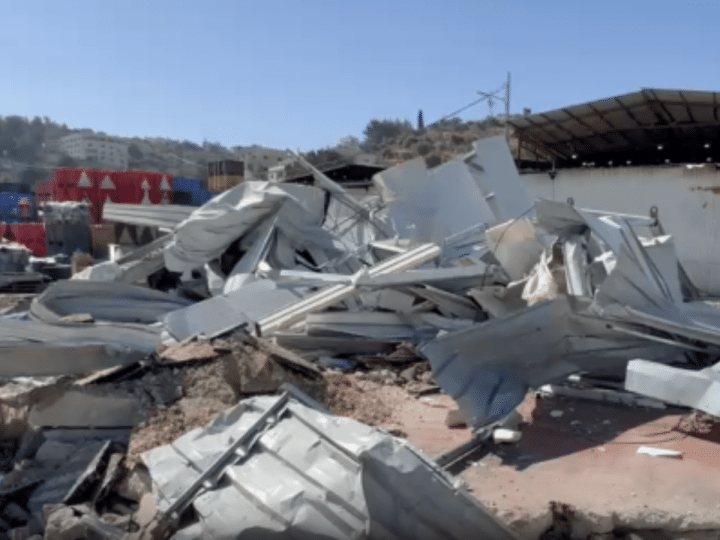

Israeli occupation forces (IOF) have destroyed part of the central fruit and vegetable market in the West Bank town of Beita, South of Nablus. The market holds significant economical importance, with Palestinians from all over the West Bank coming to Beita to buy and sell produce.
West Bank – Israel carries out destruction
The demolition, carried out by a military bulldozer, took place on 1 June at around 2am.
Bassem Al Jaghoub is a member of Beita Village Council. He told the Canary:
Maybe 35 percent of the market has been destroyed this time. Six big shops were demolished, and they warn they will demolish another 15 percent in the next days. This is just a vicious action against the Palestinians and our economy. They do everything to make our lives miserable.
Al Hisba, as the market is known, is the main market for Palestinians in the West Bank. It provides employment for hundreds of Palestinians. And it also plays a key role in supporting the agricultural sector and enhancing food security of the West Bank.
Al Jaghoub says more than 50 families have now lost their livelihoods. It was not only the six commercial structures which were destroyed. Also demolished were the municipality’s office within the market, an office belonging to the Palestinian Ministry of Agriculture, sanitary facilities, and a cafe. Significant portions of the market’s infrastructure and public services have also been destroyed.
A bridge has been built on the road West of Beita market. Its purpose is to allow settlers to travel freely, without entering Palestinian villages. According to al Jaghoub this is the reason the Israeli occupation demolished the market.
He said:
The bridge was built two years ago, while the market has been here for more than 20 years. They say the market is near the bridge, and threatens the settlers, but this is not true. The market is more than 50 metres away, and is lower than the bridge. Cars using the bridge belong to both Arabs and settlers, the bridge is for everyone. It’s like a big punishment for Beita. The Israelis are masters of collective punishment.
Constant destruction
This is not the first time the Israeli occupation has demolished the market. The same thing happened in September 2025, less than a year ago. The Israeli occupation ordered shop owners to remove their produce and leave the market. Clashes resulted, and the IOF then used tear gas and stun grenades against Palestinians. They then proceeded to block ambulance access to the injured. The municipality of Beita again rebuilt the market.
The market is rented to the farmers and traders by Beita municipality, and the money it earns is then used for the people of Beita. But, according to al Jaghoub, the municipality has now lost five or six million shekels due to the most recent demolitions. On top of this figure, there is then the cost to loss of earnings and livelihoods.
The timing of the demolition could not have come at a worse time. The economic crisis is affecting everyone in the West Bank and, says al Jaghoub, “all people are suffering.”
Beita not only has to cope with violent IOF raids. It is also constantly targeted by what al Jaghoub describes as “some of the most vicious settlers in the West Bank”. They are “armed to the teeth” and totally protected by the army.
He says:
All the West is talking about Hamas attacking Israel but no one talks about the daily attacks here on farmers and homes. Everyday these settlers attack, but go unpunished and feel they are totally protected. We have lost 25 guys in the last five years to violence, and the attacks continue.
Freelance journalist and cameraman Abed Khabeisa lives in Beita. He tells us things have become much worse since the genocide in Gaza. He agrees that the occupation is inflicting collective punishment on the population.
Settlers have gained confidence and protection since October 2023
Residents of Beita are renowned for their persistent, organised civil resistance against illegal colonial settlers. But Khabeisa says since October 2023, these armed settlers have become extremely violent. Now dozens of settlers are living at Evyatar outpost, on Mount Sabih, in North Beita.
Khabeisa explains:
During the first intifada, for a few years, Evyatar used to be an Israeli security point. When it was evacuated, they didn’t allow the Palestinians to access their land. Every time someone went there, the military told them it’s a military area. So in 2018, settlers started trying to control the area.
But when they put up some tents, people in Beita held demonstrations. Two days later the IOF arrived and evacuated the settlers. They returned again in 2019 and were again evacuated.
When the Gaza genocide started, settlers again turned up on the land. This time there were 10 mobile homes and tents. Beita residents and people from all over the West Bank demonstrated there day and night. Eventually the settlers from the mobile homes were again evacuated.
It is now for the high court to decide if the land belongs to Palestinians, or the “state of Israel”, although the decision is continually being postponed. The settlers have returned anyway, and are expanding the settlement by erecting tents on the mountains behind Evyatar.
Homes in this area are constantly attacked, property is damaged and cars burnt. Every night the settlers cause problems, with the full protection of the Israeli occupation army. The violence also affected the olive harvest last year. Most people didn’t manage to harvest anything, because they were repeatedly attacked. I know a 72 year old woman who had her legs broken by these settlers. She was one of 20 people who got wounded from the settlers during the last harvest.
76 seriously injured Palestinians in Beita in 2025
76 people in Beita were attacked and had broken bones last year, according to al Jaghoub. And during the month of May, 12 were viciously attacked and hospitalised. Two are still in hospital with bullets in their legs.
People in the West Bank have no idea what awaits them each day, as the army and settlers are free to terrorise whenever and wherever they please. Khabeisa says people in Beita often cannot sleep at night, as one of the family stays awake incase settlers attack the area. And he is not alone when he tells us he worries constantly about the safety of his grown-up children, whenever they leave the house.
But despite immense hardship and violence, most Palestinians feel the same way. They refuse to leave the land their ancestors have been on for thousands of years.
Khabeisa says:
The people of Palestine have decided not to leave their homes, even if they are killed. The Israelis want us to leave our homes and land, and go to Jordan. But now we are aware of what happened in 1948 and 1967 and they will not do the same thing again.
And even though the rubble is piled high at al Hisba, part of the market is still there. So people will return to their work.
Al Jaghoub sums up:
We are optimists. We hope always for peace. Always we seek freedom, peace and good times for our generations to come. However long this takes, we will stay on this land. We will raise our kids to stay here, and will never let them forget.
Featured image via the Canary
By Charlie Jaay
You must be logged in to post a comment Login