Politics
Joseph Gwinn: Why it’s not impossible for the Tories to poll higher than Reform as early as April
Joey Gwinn is a parliamentary assistant, researcher, and a former county and city council candidate.
Cast your mind back to September and the narrative was clear to see – The Conservatives were a lifeless corpse all but buried clinging onto just over half of the vote share Reform was courting in the polls.
By the 12th September, just three days before Danny Kruger’s defection, Reform’s meteoric summer had created a 13.5 per cent gap between themselves and the Conservatives, and yet it felt like it was the Tories who were defying gravity mere points above abyss. In reality, neither party would surpass greater superlatively in the polls again. Not only would the polling gap never be greater than on that blustery September day, but, as if cosmically aligned, it would also mark the inflection points for both parties’ polling fortunes.
Today, columnists and politicians have been commenting anecdotally on a Reform stagnation and Conservative bounce for weeks, often pointing to individual polls, but analyse all voting intention polls, and the full empirical picture begins to emerge – one that will make grim reading for Reform HQ.
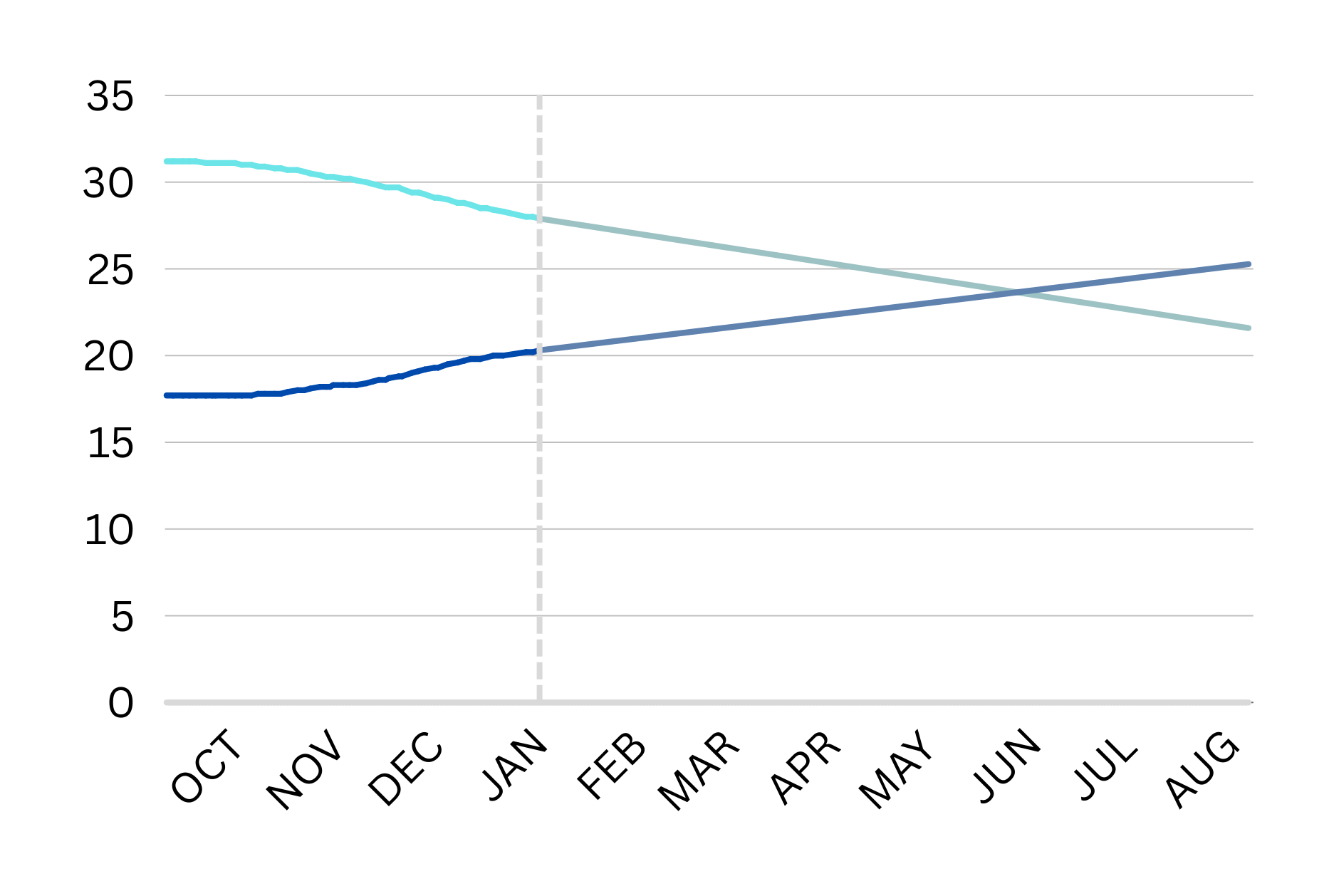
Project forward the estimated voting intentions compiled by ElectionMap’s poll of polls tracker from the 12th September to the most recently available compiled rolling poll average estimates on the 4th January last week, and it’s clear that the Conservatives have been gaining on reform at a rate of 0.36 per cent per week since then. Assuming Conservative growth and Reform decline continues at the same rate – with the Conservatives currently gaining on Reform by a percent every 19 days, then the Tories should expect to surpass Farage at the 23.6 per cent mark on the 30th May this year.

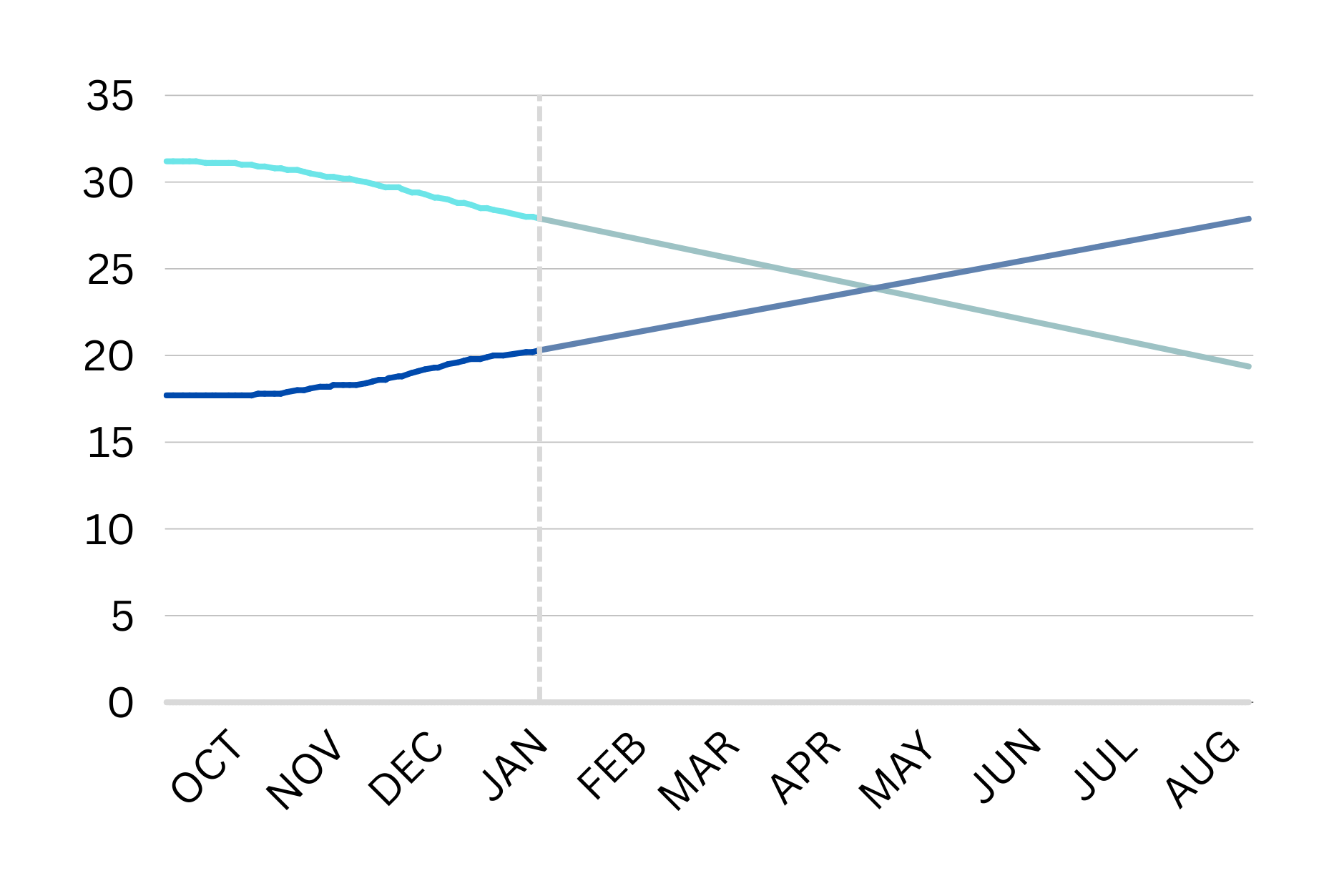
But, consider the seismic Budget Week media narrative shift between the two parties as the true political inflection point – as much of the general public do, and push the model further taking just data from Budget activities onwards, and the results are even more dramatic. Running them numbers from the 19th November, just a week before Kemi’s barnstorming evisceration of perhaps the most chaotic budget week in memory, and her Tories have been gaining a whole percent on Reform every 13 days since. At a continued haemorrhaging of 0.53 per cent a week from Reform, the Conservatives are on course to overtake Farage at 23.9 per cent on 16th April – a whole three weeks before millions are set to cast their ballots in May’s pivotal local elections.

Of course it must be stressed that these are simply reflections of polling current to the mood of the public historically up to now, and rates of change will undoubtably fluctuate to the rhythm of current affairs. Still, such hypothetical projections make starkly clear the magnitude of Reform’s faltering momentum. Neither have they been the only harbinger in recent months.
It is more than fair to say that, since party conference season, Reform have struggled to land any real narrative within the media – a significant departure from the unbridled dominance they had wielded over the national conversation over the spring and summer months.
On one front, Reform’s weekly Monday press conferences – the bulwark of their media strategy since the springtime, have now all but lost their sensationalist potency. In August and September, such events could be relied upon to capture the narrative outputs of all the major legacy broadcast and print outlets, as well as social media. However, you could be forgiven for believing that these weekly press conferences had now ceased, as coverage of them in the last two months has drifted away almost as quickly as Farage’s positive demeanour has whilst hosting them. And this isn’t because Reform have stopped talking about significant issues – fiscal policy, local democracy and entrepreneurship chiefly among them. Clearly, the media are no longer prepared to listen to or relay what Reform have to say outside of immigration – a paradigm shift away from the exponential poll surge-fuelling exposure they’d enjoyed just months before.
Then is the matter of the Reform mid-Tory-party-conference televised defection that never was. Early on the conference’s final morning the rumour of an impending defection of a second sitting Tory MP – potentially a shadow cabinet member, broadcast live on stage alongside a brimming Farage from a hotel function room mere furlongs away from the stage from which Kemi would give her keynote speech spread through attendees like wildfire. In the minutes afterwards, Kemi would go on give a speech barnstorming enough to unify the parliamentary party, and conference and digital chatter would be extinguished. Had delegates and journalists simply been seeing ghosts in the night in the halls of the Midland Hotel? No Reform press conference has ever been trailed or reported on so anywhere near such an extent since, sliding into comparative near-total obscurity in many publications and public service broadcasters. One has to wonder if it’s because the media had been given a reason to stop seeing the magic of Farage’s weekly faux spectacles.
The Conservatives, on the other hand, have adopted the same frequent single-issue press conference messaging strategy (akin to post-summer PMQs) with significant effect. Just in the last two months, broadcasted pressers including on the budget, welfare and grooming gangs, often held within the same news cycle timeframe as Reform’s own, have successfully landed across the media landscape.
On another front, Reform is failing to run rampant at the ballot box. Beyond their most high-profile failure in Caerphilly – one that they’d asserted victory over just hours before polls closed, lay a litany of by-elections that serve as canaries for what may well become a spring of failures that the Reform establishment simply won’t see coming.
In November, the Conservatives won Trafford Hale, gaining 9.7 per cent of the total vote share we’d won in 2024 – our gains greater than Reform’s total vote share at just 8.1 per cent. In December, Reform only held on to Long Eaton North by 0.9 per cent having lost 7.7 per cent since May 2025 – The conservative candidate had gained 4.2 per cent. In Market Harborough’s Logan two weeks later, Conservatives won gaining 3.3 per cent on May results – Reform gaining just 0.1 per cent during the same period. In Cornwall’s St Columb Minor and Colan, Reform lost 4.2 per cent over the same time span.
Where Reform are the incumbents, it’s becoming clear that their party’s campaigning is no longer delivering the same exponential growth afforded to them when they were cutting their teeth. Much of May’s gains were won with virtually no ground campaign in comparison to legacy parties – what makes these by-election results more significant is that they are now becoming unstuck in spite of a wider push to ensure local branches are now deploying their real like-for-like best-effort ground campaigns alongside the national messaging.
Returning back to budget day offers one final glimpse into Reform’s faltering campaign machine. Perhaps most notable in the coverage of the budget in the days and weeks after its announcement was neither Kemi’s linguistic lancing, Reeves’ deceitful misdirection or the OBR’s catastrophic premature publications, but the Farage shaped hole in any media reaction.
Farage certainly wasn’t silent on it, so whilst it’s open for to debate as to whether this was down to Conservative messaging being such a break away success, or Reform being simply unable to be convincing enough for their own messaging to break through – the fact is they just could not land a message in the press. The day after the budget, Reform spent £1 million on pushing out their budget response through paid for advertising, including £700,000 on purchasing a two page spread in the Telegraph, Times, Sun, Mail, Metro and iNews – for which Kemi Badenoch, through sheer gumption and oratory talent, had already secured near universal coverage on the front and following pages of the same publications and more for free. Farage has said that he’s betting the whole house on this May’s local elections – a figure he says is £5 million. If we are to take what he’s said at face value, then Reform can only afford to fail to land five more messages before the taps run dry. This is hardly a position you’d wish for when surging in the polls, let alone when you’re in such notable decline with your rivals now turbocharged in every which way snapping at your heels.
Though this is all certainly something for Conservatives to draw optimism from, it can’t be emphasised enough it should not be cause for relief or complacency – quite the opposite. We’ve had a taste of a comeback – in the Commons, in the media, in by-elections, and now, very clearly, in the polls; now we must work hard to achieve it at all opportunities at the ballot box.jo
You must be logged in to post a comment Login