
Politics
Labour Minister Faces Probe Over Campaign Smear Claims

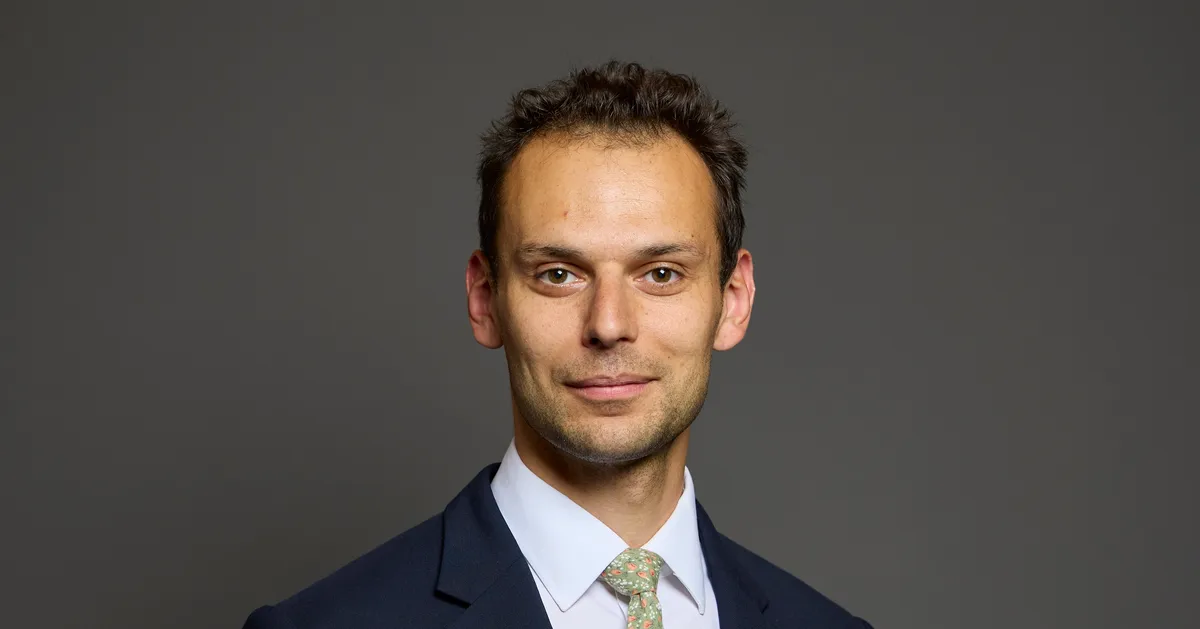
A Cabinet Office minister is under investigation after his former think tank allegedly ordered a smear campaign against journalists.
Josh Simons was the director of Labour Together in 2023 when the pro-Keir Starmer think tank ordered an investigation into the “backgrounds and motivations” of reporters.
The journalists were trying to look into the source of the think tank’s funding at the time.
Simons was elected as a Labour MP in 2024 and is now a member of the government, meaning the issue is set to cause another headache for Labour.
He has said he is “surprised and shocked to read the report extended beyond the contract” at the time.
Here’s what you need to know about this new saga.
Why Is Labour Together Being Investigated?
Labour Together is a think tank closely linked to Starmer and his rise to power.
It used to be headed up by Morgan McSweeney, who left his position as the prime minister’s chief of staff earlier this month.
The organisation allegedly commissioned PR consultancy Apco Worldwide to write a report which made false claims about journalists who were investigating the think tank, according to The Sunday Times.
That investigation examined “sourcing, funding and origins” of a November 2023 Sunday Times report into Labour Together’s funding, after the group failed to declare £730,000 of donations between 2017 and 2020.
Its findings – which included allegations about Sunday Times’ journalists Gabriel Pogrund and Harry Yorke – were then shared informally with Labour figures.
Apco’s senior director and a former Sunday Times employee, Tom Harper, reportedly claimed to use “discreet human source inquiries” and documents as part of his report.
He allegedly claimed some of the emails backing up the Sunday Times reporting came from a “suspected Kremlin hack of the Electoral Commission”.
The Apco probe allegedly referred to Pogrund’s Jewish heritage and made baseless claims about his faith, too.
The research was paid for and then reviewed by Simons, according to The Guardian.
This move has sparked outrage across the political spectrum in recent days.
What Has The Government Said?
Speaking to reporters on Monday, Starmer confirmed there would be a Cabinet Office investigation, adding: “And quite right too.
“And so that is already in place. I didn’t know anything about this investigation, and it absolutely needs to be looked into. So the Cabinet Office will be establishing the facts.”
But the science and technology secretary Liz Kendall has suggested the Cabinet Office’s probe will not be a formal inquiry.
The trade body for the PR industry, the Public Relations and Communications Association, is allegedly launching the official probe.
“It’s absolutely right that the relevant regulatory body that covers public affairs is already investigating this. The Cabinet Office will be establishing the facts,” she told BBC Radio 4′s Today programme. “Establishing the facts is the first thing that you’ve got to do on anything, isn’t it? If you want to look into something properly, you have to be able to establish the facts.”
She added: “The freedom of the press, difficult though it is, is an essential part of the proper functioning of a parliamentary democracy, and that’s extremely important.”
No.10 has refused to offer further details on what the government’s process might look like but it is thought to be led by the Cabinet Office’s propriety and ethics team.
The Downing Street spokesperson told reporters: “This relates to a Labour think tank and the dates precede this government and our minister’s appointment as a minister.”
“I’m somewhat limited in what I can say,” the representative added. “The Cabinet Office is looking into this to make sure the facts are established.”
But he added No.10 does have confidence in Simons as it stands.
What Has Josh Simons Said?
He told The Sunday Times: “I was surprised and shocked to read the report extended beyond the contract by including unnecessary information on Gabriel Pogrund.
“I asked for this information to be removed before passing the report to GCHQ. No other British journalists were investigated in any document I or Labour Together ever received.”
How Have Other MPs Responded?
Multiple Labour MPs have criticised the government’s response.
Left-wing Labour MP, Richard Burgon, said: “I’m afraid this simply does not wash. The Cabinet Office is going to look into allegations involving a Cabinet Office minister?
“The Labour Party needs to start taking these allegations very seriously. That means an independent investigation.”
The Conservatives also called for an immediate investigation into Simons’ role in the probe.
Conservative Party chair Kevin Hollinrake said: “Josh Simons must now recuse himself from his role as the minister with responsibility for inquiries policy while he is being investigated by the Cabinet Office.
“We must also see the terms of reference for the inquiry and know who is leading it.
“The Labour Party must also investigate and review its ongoing relationship with Labour Together in light of these very serious accusations.”
Liberal Democrat Cabinet Office spokesperson Lisa Smart said: “I’m appalled by reports of smear tactics by a party that promised to make politics cleaner than clean. It looks like the group that credits itself with getting Labour into government has carried out an outrageous attack on our independent free press.
“Josh Simons should temporarily step down as Cabinet Office minister while the investigation takes place to avoid any conflict of interest.”
Green Party leader Zack Polanski said: ‘Once again, our caretaker PM ‘didn’t know.’.
“We need to get to the bottom of this disturbing pattern of shady authoritarianism and the world of secret political funding.
“These disturbing stories are indicative of the kind of culture that continues to define this Labour government – and the rot goes right to the top.
“Labour Together’s antics have been known for ages. As with Mandelson and Doyle, Starmer must have known. Come clean. Stop investigating and start acting.”
“The surveillance and smearing of journalists is another sign of our slide into briefcase authoritarianism: where protesters are thrown in jail without a jury trial, where digital ID is mandatory, and where our most personal health data is sold off to US tech giants.”

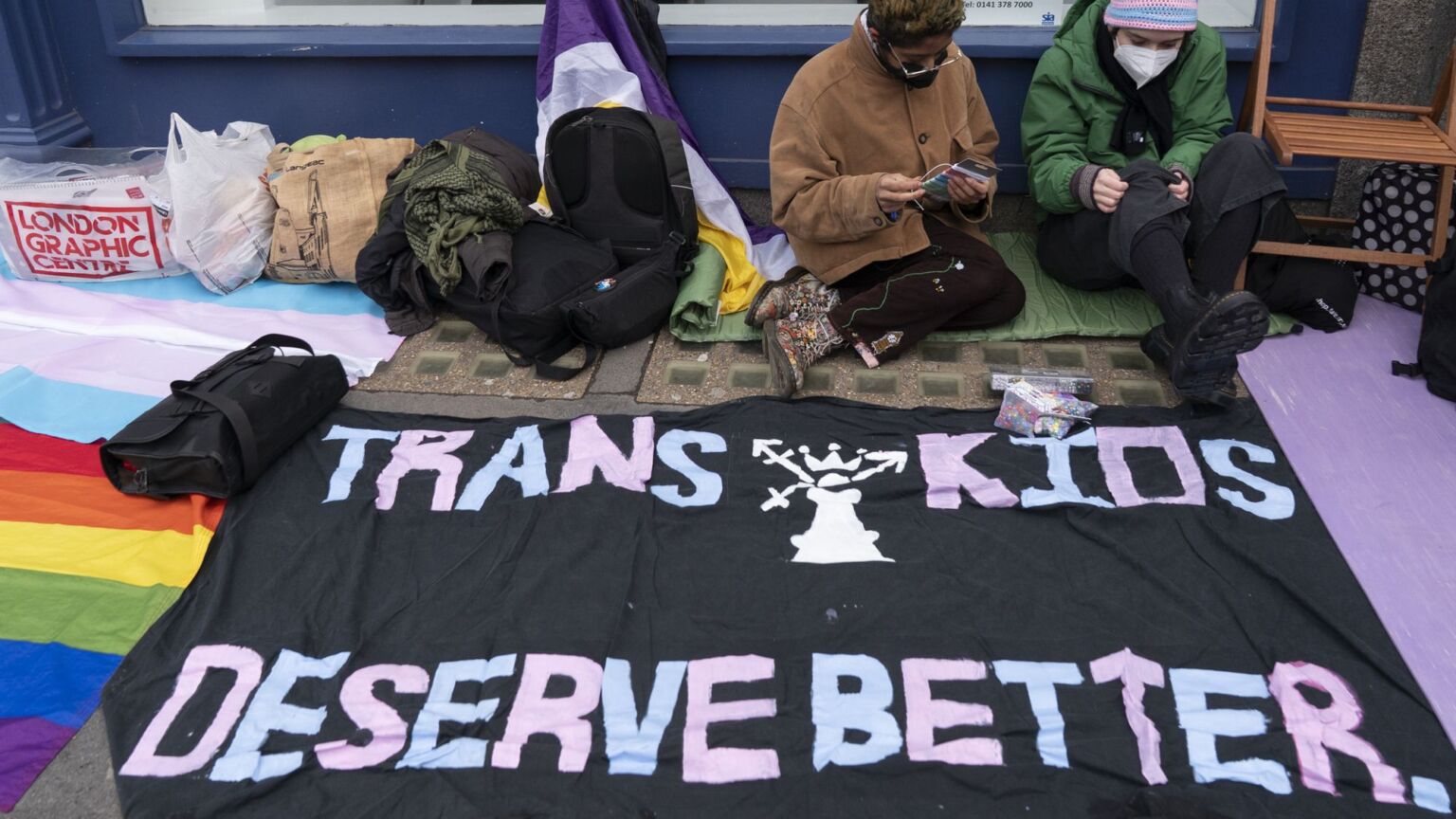
What would you think if you were told that a six-year-old boy had tried to cut off his penis because he could no longer join Girlguiding? Would you blame the new admissions policy – which no longer allows boys to join, even if they identify as girls – or would you think this was a child in serious distress?
This is not a hypothetical question. It was, in effect, the framing of a recent Observer article, which presented this deeply troubling account as evidence of the harms caused by the girls-only admissions policy. It also used the phrase ‘her penis’ and she / her pronouns throughout to describe a six-year-old boy.
I was already aware of this case through my Sunday Telegraph reporting on the troubles within Girlguiding, and made a conscious decision not to include it, because it involved a very young child and raised serious ethical questions about how such situations should be reported. Four days ago, I raised concerns about the piece – both publicly and with the Observer directly – but it remains online, unchanged.
Of course, this isn’t an isolated case. Inaccurate reporting on sex and gender is a persistent problem in journalism, with fresh examples appearing weekly. In recent weeks, the Manchester Evening News reported a violent murder committed by a male as having been carried out by a woman. STV reported a 23-year-old man found guilty of possessing indecent images as a woman. Shortly after the Observer article, Metro published a feature about a ‘devastated’ 10-year-old boy who can no longer be in Girlguiding – built almost entirely around this single emotive account.
Part of the problem, I think, is that the line between reporting and opinion has become blurred. Journalists can – and should – write opinion. I’m doing it here. But when reporting on a contested issue, the basic rules still apply.
This isn’t just about individual journalists or articles, however. It raises serious questions about what is being taught on journalism courses – and what standards are being upheld in newsrooms.
I trained in journalism in the early 2000s at the London College of Printing (now the London College of Communication). My tutors – both experienced hacks – didn’t pull any punches, and they didn’t worry about hurting your feelings either. If your copy wasn’t good enough, or something was missing, you were told to fix it.
I wrote mainly for the Guardian for many years, and my regular editor was uncompromising. While it drove me mad at times, it made me a much better journalist. If I had filed a piece like the Observer or Metro articles, I would have been told to go back and find at least one more person to interview – to establish whether this was part of a wider pattern – and to include at least one counterview to ensure the piece was fair and balanced.
When I later became an editor, those were the same standards I expected of others. Because good journalism is not about reinforcing a narrative. It is about testing it – with accuracy, balance and a willingness to ask difficult questions.
Balance doesn’t mean giving both sides equal space. But it does mean acknowledging that another side exists. Otherwise, readers aren’t being informed – they’re being led.
And that’s activism, not journalism. Nowhere is this clearer than in the language increasingly used in reporting on sex and gender. As Brendan O’Neill put it in a 2024 spiked article, the phrase ‘her penis’ is ‘the most Orwellian phrase of our age’. It asks both journalists and readers to accept something that is plainly untrue – not for the sake of clarity, but in the service of a particular ideology.
And once you start noticing it, you see it everywhere. Recent Metro headlines are a case in point: ‘I’m a trans non-binary Pakistani Muslim woman – all my identities co-exist’ and ‘I want to see more hairy, brown, gender non-conforming bodies like mine’. These may be opinion pieces, but the language – and the assumptions that underpin it – are increasingly treated as ‘neutral’ across journalism more broadly, when they clearly are not.
I don’t place all the blame on individual reporters. They should be able to rely on their university lecturers to teach them journalism, not activism – God knows they’re paying enough – and on more experienced journalists to model what good practice looks like.
If I sound invested in what education can do, that’s because I am. Education was my beat for many years, and I’ve also taught journalism at a number of UK universities. I loved it – and I’d love to do so again. With 25 years’ experience and a formal teaching qualification, I should be in demand. But I’m not naive enough to think I’d be hired now. As a woman with openly gender-critical views, why would a university take that risk – knowing students might find my views ‘problematic’, or even try to bully me out?
This is not hyperbole. I used to teach at Goldsmiths, which has a notoriously political student body and ran a #ThisGirlCan campaign in 2024 celebrating women’s sport – featuring a man who identified as a woman. One look at my X feed and I suspect I’d have a target on my back for the ‘Kathleen Stock’ treatment.
For the uninitiated, Stock was forced to quit her role at Sussex University in 2021 after sustained pressure from students over her gender-critical views. That alone should give us pause. Because if people with certain views are effectively excluded from journalism education, it raises a very obvious question: what exactly are students being taught – and what are they not being encouraged to question? Particularly in universities, which have traditionally championed free speech.
Journalism does not just reflect reality – it helps shape how we understand it. If basic facts are blurred, or language is used in a way that obscures rather than clarifies, the consequences go far beyond a single article. They affect how we understand issues such as crime, safeguarding and public policy – and whether people trust what they are being told.
None of this is complicated. Journalists are not required to take a particular view on contested issues. But they are required to report them clearly, accurately and with enough balance, so that audiences can make up their own minds.
If journalism is to retain public trust, it needs to get back to basics: accuracy, clarity and a willingness to test claims rather than reinforce them.
Janet Murray is a journalist writing on women, culture and public policy. Follow her on X: @jan_murray.
5 min read
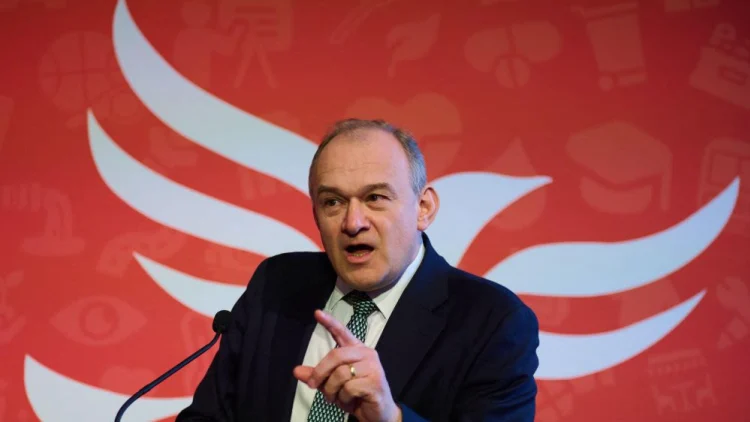
The issue of student loans has recently exploded into life, with the government’s decision to freeze the repayment threshold prompting outrage and a debate about major reform. Now that more than 15 years have passed since their highly-damaging tuition fees U-turn, are the Lib Dems ready to talk about student loans again?
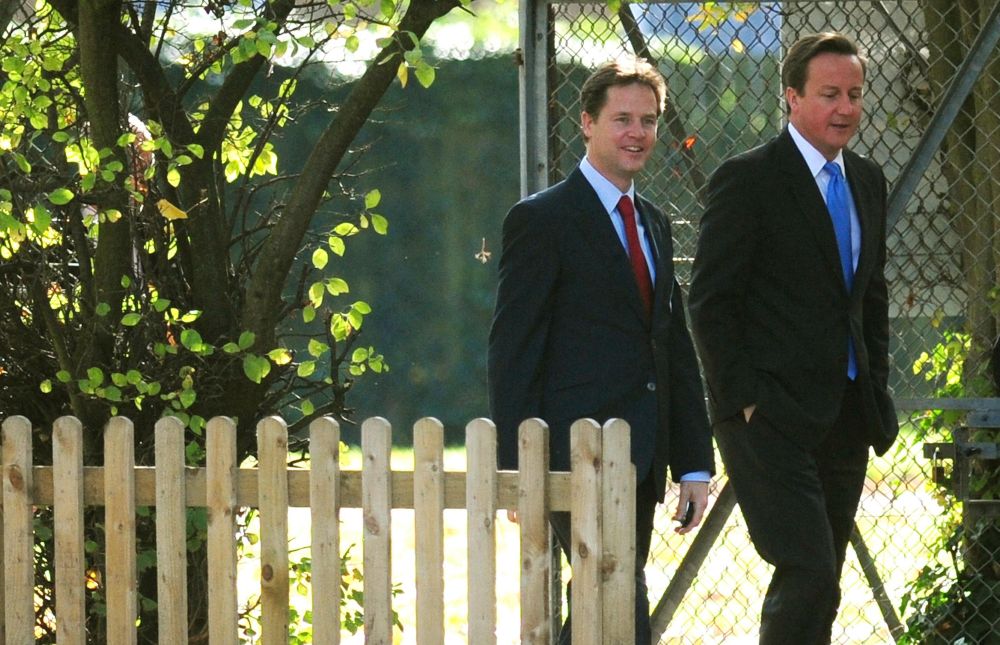
Ahead of the 2010 general election, the Liberal Democrats, under then-leader Nick Clegg, made a bold and memorable promise: a Lib Dem government would scrap university tuition fees.
But just seven months after Clegg’s party entered government as part of a coalition with David Cameron’s Conservatives, a motion to increase tuition fees in England to £9,000 was narrowly passed in the Commons.
The move split the parliamentary party, with more than half of Clegg’s MPs voting against the policy or choosing to abstain. Clegg, then the deputy prime minister, was moved to film an apology video in 2012, telling the camera through a downcast expression: “We made a pledge, we didn’t stick to it, and for that I am sorry.”
The U-turn was later seen as a key, if not the main, reason for the party’s subsequent collapse. At the 2015 general election, the Liberal Democrats won 8 per cent of the national vote share, down from the 23 per cent it won five years before.
The pain didn’t end there, though. The broken promise haunted the party long after it left office. Tim Farron, the Lib Dem MP for Westmorland and Lonsdale since 2005, admitted to PoliticsHome that he was “nervous” about the issue when he became party leader in 2015.
Fast forward to 2026, and the Lib Dems have seemingly taken a major step forward in exorcising the ghost of the tuition fees U-turn by announcing their boldest universities policy since falling out of office.
The party has announced that it would reverse the decision by the Labour government to freeze the threshold at which graduates repay their student loans, as well as write off student debt for public service workers, and reverse the National Insurance increase and international student levy to help improve university finances.
PoliticsHome reported at the time of the announcement that there was some nervousness among party figures about making the topic a major policy focus, even 15 years on from the U-turn.
The Lib Dem MP for St Neots and Mid Cambridgeshire, Ian Sollom, who is leading on the policy for leader Ed Davey, acknowledged that student finance is an area “where we are still building trust”.
“We know that there will be a trust issue for many graduates around this particular issue,” he told PoliticsHome.
However, Sollom said that part of the way to build that trust is to “not go out and oversell what we have got”. He described the plans announced earlier this year as “pragmatic” and wants the policy to speak for itself.
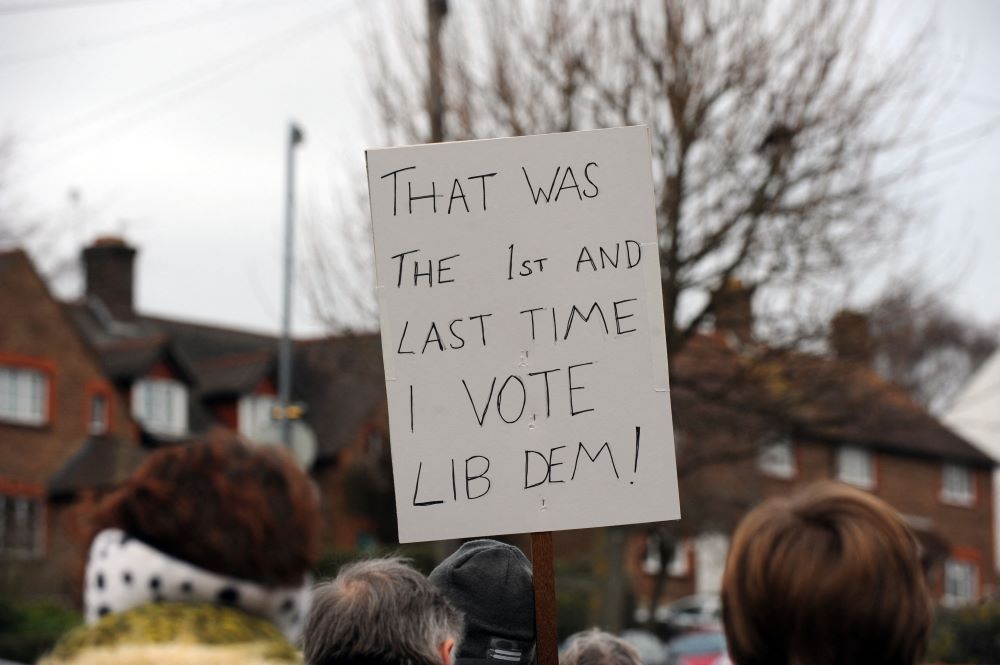
He added that “a lot of graduates have been prepared to put their misgivings about the Liberal Democrats behind them and actually have forgiven us or moved past those issues”.
“On this particular issue, it is important that we are mindful that we let this cohort down before and we…absolutely don’t want to do that again to the very same people,” he told PoliticsHome.
Why exactly does Sollom think the memory of the Lib Dems’ coalition U-turn lingered for so long?
“If I knew the answer, we might be able to make more progress,” he said.
“Like it or not, as a party, it was the defining thing that people associated the Lib Dems with in the period of coalition.”
Farron, who voted against the move in 2010, believes that the issue is no longer a problem for the Lib Dems.
“Even though I voted against the tuition fee rise, it was a thing that I was nervous of when I was leader, but that’s nearly 10 years ago,” he told PoliticsHome. “It’s right that we moved on. It doesn’t mean that it doesn’t matter, but it doesn’t constrain us now.”
Farron added: “That nervousness is a thing that those of us who spend a lot of time talking about politics might care about, but not 99 per cent, and so there’s a real liberation.”
Lib Dem MP Bobby Dean, who was at university himself when the rise in tuition fees was announced, told PoliticsHome that now is “absolutely the right time” for the party to take up the mantle on this issue, adding “a lot of time has passed since [the] coalition government”.
“If we’re going to be a serious national party with a serious national offer, then we can’t stand here and worry about the impression of a policy area from 15 years ago.”
Chris Annous, senior associate at More in Common, told PoliticsHome that people in Westminster can overplay the extent to which the rest of the country cares about decisions made by the coalition government.
“I don’t think many students now attribute their tuition fees to Liberal Democrats, because it’s been 15 years since that decision was made. They [fees] have increased further. The party’s not been in government for a long time.”
He added: “The impact of the coalition is not as extreme or perverse as many people in politics or Westminster like to assume.”
More in Common polling conducted in April last year found that the tuition fee increase was neither the most well-known nor most disliked coalition policy among respondents who were considering voting Lib Dem. Asked what coalition government decisions Lib Dems should be most proud of, respondents saw the bedroom tax and privatisation of Royal Mail in a more negative light than the tuition fees rise.
Amira Campbell, President of the National Union of Students, said it is not “impossible” for Davey’s party to rebuild trust with students.
“But it is certainly not an easy task. Students need tangible proof that they have a plan for real change and will actually deliver for them if given another chance.”
Campbell said that politicians from other parties “simply dismissing” the Lib Dems on the subject of student finance because of decisions taken fifteen years ago is “not only frustrating, but disrespectful to students”.
“Every party that has been in government over the last 28 years, since tuition fees were introduced, is at fault for the mess we are in,” she told PoliticsHome.
spiked is funded by readers like you. Only 0.1% of regular readers currently support us. If just 1% did, we could grow our team and step up the fight for free speech and democracy.
Become a spiked supporter and enjoy unlimited, ad-free access, bonus content and exclusive events – while helping to keep independent journalism alive.
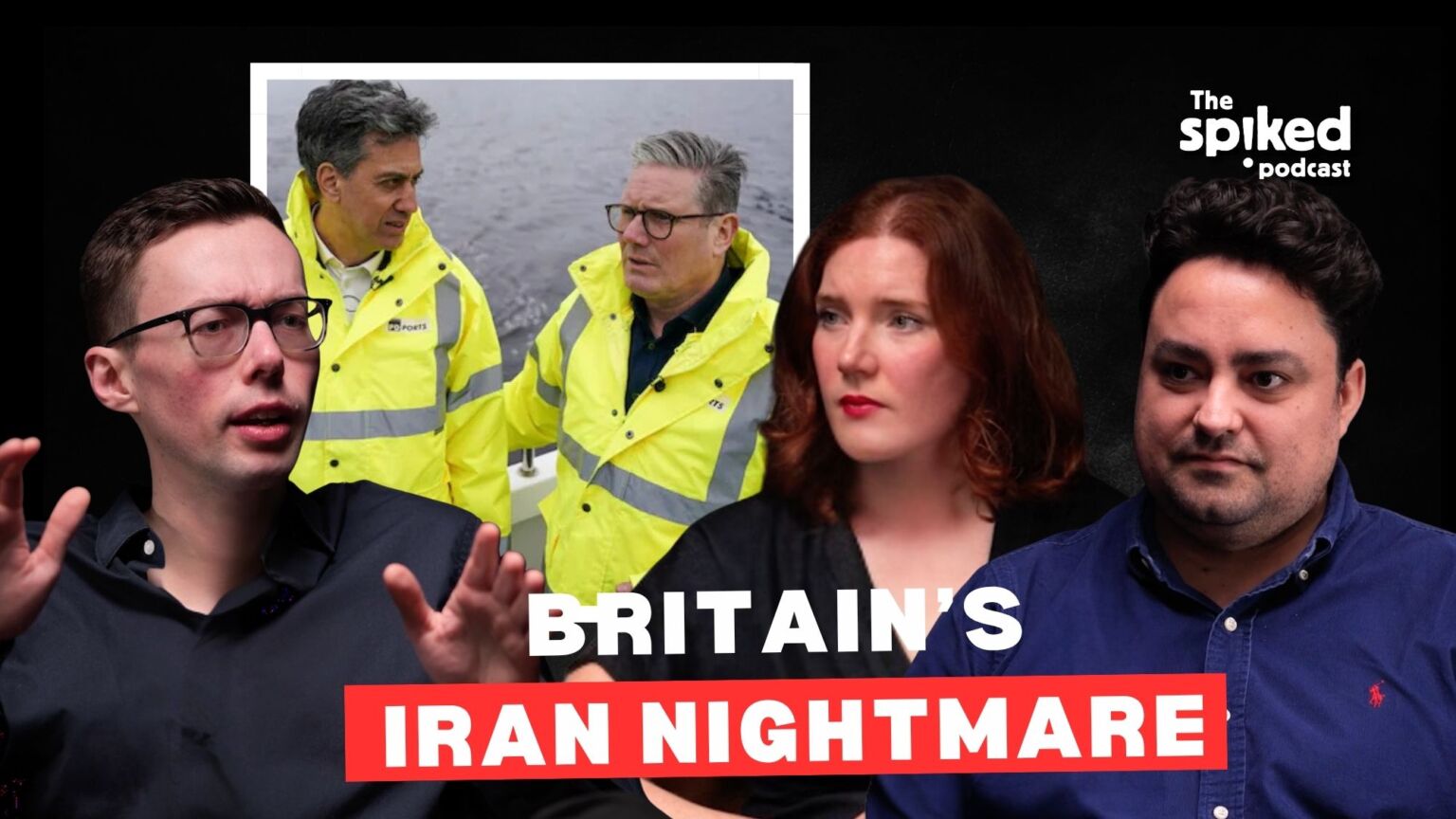
The post The Iran War has exposed Labour’s green delusions appeared first on spiked.
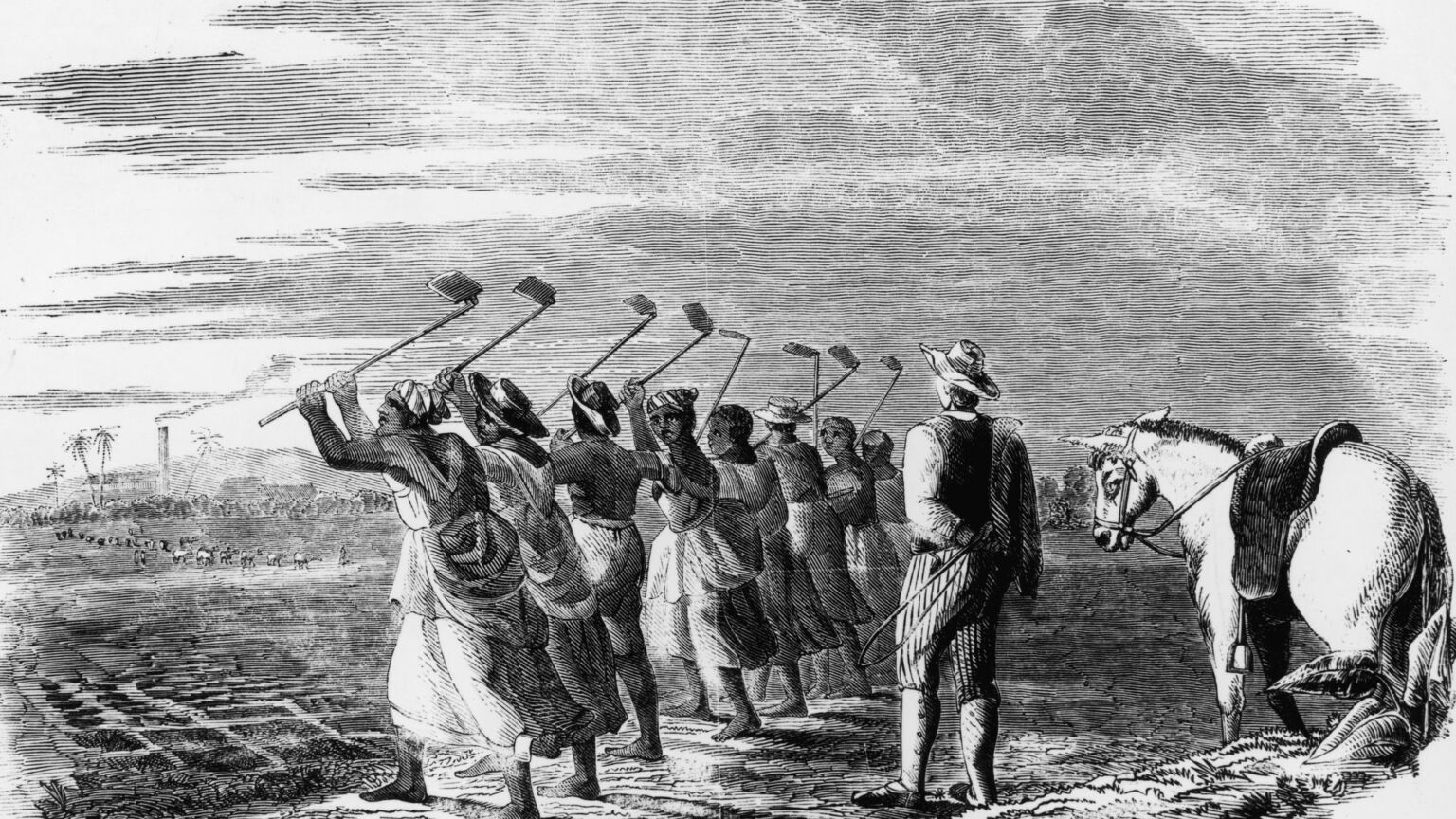
The debate on slavery reparations is showing no signs of dying down. Last week, the United Nations General Assembly voted in favour of a resolution urging members to apologise for the slave trade and to pay reparations to African countries.
The UK was one of 52 countries to abstain from the vote, which was proposed by Ghana and supported by 123 members. But should we not have voted against it, alongside the United States, Israel and Argentina?
The truth is that demands for reparations are opening a can of worms. Identifying which countries should pay up for slavery is more complicated than some might think. While it is true that European colonial powers including Britain participated in the slave trade, it is important that we revisit the very origins of the supply chain.
To begin with, the integral part played by exceptionally wealthy and powerful African kingdoms in selling slaves to European merchants should not be ignored. In the early 18th century, the kings of Dahomey – current-day Benin – established themselves as major players in the slave trade. King Gezo, who was King of Dahomey from 1818 to 1850, labelled the slave trade as ‘the ruling principle of my people’, being ‘the source and the glory of their wealth’. Indeed, there is a certain irony to Ghana proposing this resolution and Nigeria supporting it. The elites of the Asante and Yoruba kingdoms – in present-day Ghana and Nigeria respectively – also benefited a great deal from the slave trade.
It is undeniable that Britain was a leading slave-trading nation. But this fact should be qualified by the knowledge that so too was every seafaring nation or empire in history, prior to abolition. China, Arab states and indeed many African countries were enthusiastic participants in this evil practice. And, in many of these countries, slavery lingered on for many centuries longer than it did in Britain.
Indeed, Britain’s only unique contribution to the slave trade was in ending it before anyone else. In the early 19th century, Britain became the home of abolitionist campaigning, thanks to the efforts of leading philanthropist William Wilberforce. Britain then played a pioneering humanitarian role in suppressing the trade at great human and financial cost – especially to the Royal Navy’s West Africa Squadron, which patrolled the coast of West Africa, capturing slave ships and freeing in the region of 150,000 Africans destined for the Americas.
This was a costly and arduous campaign, which lasted decades. The squadron ships were generally not as sophisticated, dynamic and well-equipped as many of the slave vessels, contributing to high mortality rates for the sailors and significant expenses for the Royal Navy. Have those who are part of the reparations lobby called for a compensatory fund for the descendants of these fallen sailors, who made the ultimate sacrifice in the name of fighting the slave trade? Of course not.
So the role played by Britain, and the West, in the slave trade is far from straightforward. It can also be said that the part played by Africa’s powerful elites and rich kingdoms in supplying slaves – generating considerable wealth in the process – is commonly overlooked.
Nor should we be entirely trusting of the motives of those now calling for reparations. Many African countries need to look within to better understand the root of ongoing failures. The quality of internal governance and rampant institutional corruption would be a good start. In this light, calls for ‘reparatory justice’ could even be considered a deflection tactic. Slavery was indeed a great evil, but it is not the sole reason, or even the primary reason, why African countries are impoverished compared with their Western counterparts.
We are just a few years away from the 200-year anniversary of abolition in the British Empire. Britain should not shy away from acknowledging its historical role. But when all of its victims and beneficiaries have been dead for generations now, it is surely high time we moved on. Certainly, we should not be paying a penny in reparations.
Rakib Ehsan is the author of Beyond Grievance: What the Left Gets Wrong about Ethnic Minorities, which is available to order on Amazon.
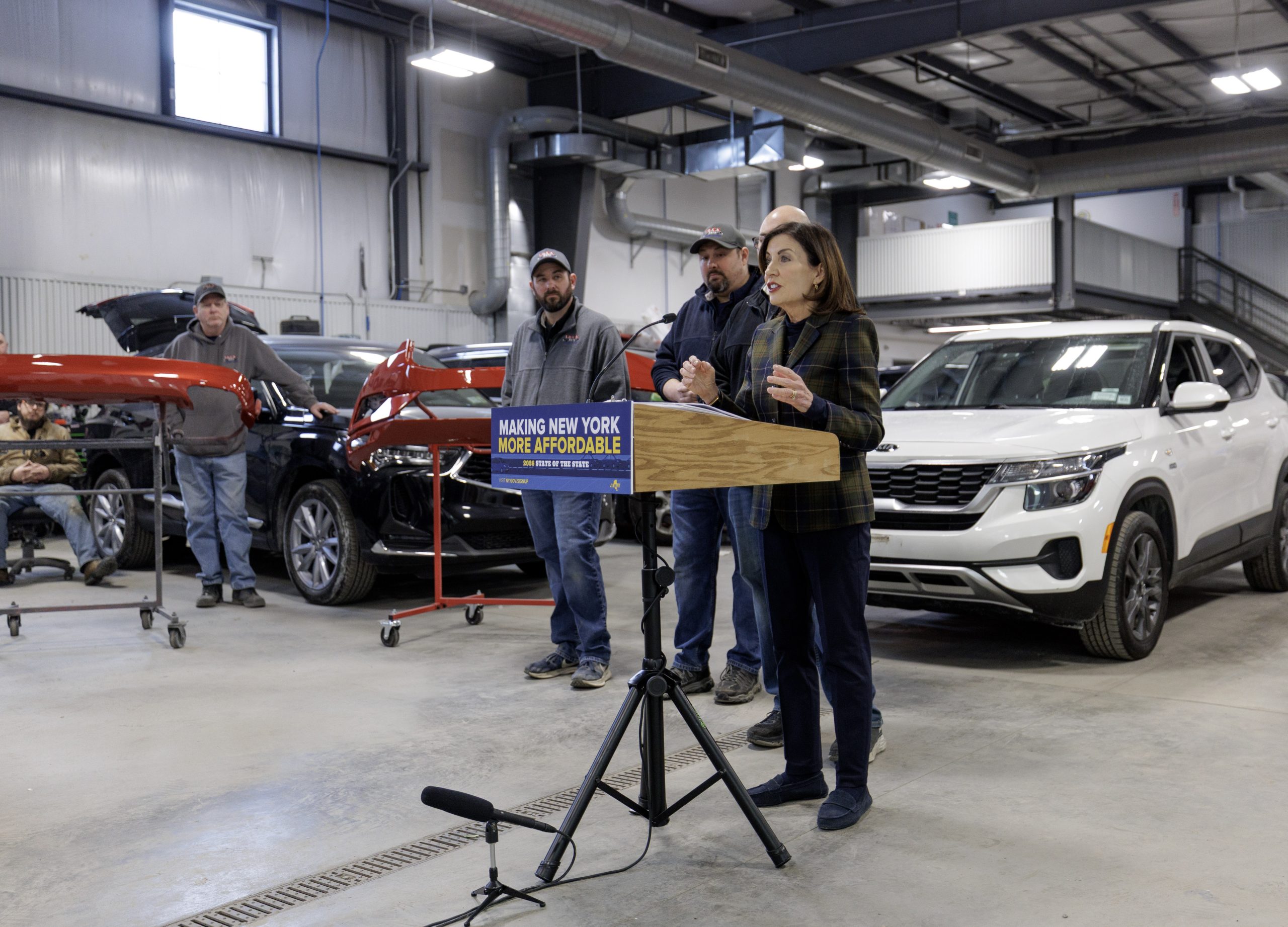

FRAUDTUITOUS: Gov. Kathy Hochul has spent the last four months beating the auto-insurance affordability drum and fighting the trial lawyers and unconvinced lawmakers who stand in her way.
She’s proposing limiting the ways car crash victims — especially those deemed at fault for the collision — can sue for damages, a move she says will cut the cost of auto insurance. She also wants to target insurance fraud and staged crashes.
It’s been a massive sticking point in negotiations to finish her now-late budget.
“If, God forbid, you are the majority reason that there’s an accident, you will no longer be entitled to pain and suffering,” Assembly Speaker Carl Heastie told reporters Wednesday. “That’s a pretty serious thing for people to accept. I mean, accidents do happen.”
But as Hochul hopes to draw the Assembly and Senate to her side, it just so happens that federal prosecutors in the Southern District of New York dropped indictments this week targeting a close personal friend of former Mayor Eric Adams and alleging a massive car-crash-victim-fraud scheme.
Perfect! Timing!
“This alleged scheme is exactly the type of fraud Governor Hochul’s auto insurance reforms are designed to curb in New York State,” Hochul spokesperson Kristin Devoe told Playbook in a statement.
Her office is arguing that the scheme might never have happened had Hochul’s proposed changes been in place.
“The Governor’s proposals would strengthen enforcement, allow more time to investigate suspected fraudulent claims and crack down on the networks and providers that make this type of fraud possible in the first place,” Devoe said.
Our colleague Chris Sommerfeldt reported this morning that federal prosecutors dropped a superseding indictment Thursday in their fraud case against Zhan “Johnny” Petrosyants, the man who hobnobbed, dined and clubbed with Adams during his tenure, as Hizzoner tested New York City’s nightlife “product.” The superseder alleged businessmen Vladislav Stoyanovsky and Dmitriy Khavko participated in the scheme as well. All three men pleaded not guilty.
Prosecutors claim the men had car crash victims in medical clinics undergo dubious procedures conducted by clinicians who were part of the scheme. The indictment also alleges the men behind the operation billed insurers for procedures that never happened.
Petrosyants, Stoyanovsky and Khavko then allegedly filed no-fault claims to the insurance companies, who, under state law, are required to pay out the claims in just 30 days. The scheme brought in tens of millions of dollars, prosecutors said.
Hochul’s office wants to change that. The governor says she’d give insurers more time to investigate whether a no-fault claim is fraudulent. Right now, if an insurer delays a payout, it can’t defend itself in court by saying it was busy investigating the claim. Insurers would still have to pay interest on delayed payouts. And if someone sues to force a reluctant insurer to pay up, the insurer would have to cover attorneys fees.
The cost of paying out bogus insurance claims is a main factor in the high cost of auto insurance in New York, contends Team Hochul. Last year, insurance carriers reported 43,811 incidents of suspected auto insurance fraud to regulators, an 80 percent jump compared to 2020.
The Trial Lawyers Association says Hochul’s proposals would give insurance companies more time to delay and deny claims.
“Stripping away consumer rights while insurers rake in record profit is a giveaway to the industry that leaves New Yorkers to pick up the tab,” association spokesperson Sabrina Rezzy said in a statement. — Jason Beeferman
From the Capitol

TIGHTENING ALBANY’S BELTWAY: The much-derided I-787 — an asphalt apron familiar to Capital Region drivers who commute downtown to the statehouse — is one step closer to a makeover.
Hochul announced Thursday the state is opening a community outreach center amid an environmental review focused on how to improve waterfront access. I-787 runs parallel to the Hudson River.
“Reimagining the I-787 corridor is a once-in-a-generation opportunity to shape the future of downtown Albany, so it is imperative that the people who live and work in the area have a major voice in how this project progresses,” Hochul said. — Nick Reisman
FROM THE CAMPAIGN TRAIL

BLACKBURN’S BONDI PAST: In 2016, years before she became one of the Trump administration’s most prominent and polarizing officials, then-Florida Attorney General Pam Bondi had a young intern in her office named Conrad Blackburn.
That fact is now being seized on by Blackburn’s critics as he runs for a Harlem-based Assembly seat as a democratic socialist and unabashed enemy of Trump.
“It is unconscionable that Conrad Blackburn chose to work for Pam Bondi at the very moment she was leading the charge to keep more than a million Floridians, including one in five Black adults, permanently locked out of the voting booth,” Uptown Democratic Club President Donna-Marie Gibbons told Playbook, referencing Bondi’s effort to preserve a Florida law that made it difficult for felons to regain voting rights after serving time. “Anyone who signed up to work in that office while she was fighting to preserve this racist, Jim Crow-era machinery has questions to answer about their commitment to our community.”
Trump fired Bondi as his U.S. attorney general Thursday.
Blackburn, who grew up in Florida, said criticism of his stint with the attorney general there says more about his haters than it does about him.
He told Playbook he took the unpaid, two-month internship in Bondi’s criminal appeals bureau while in law school — and the experience drove him to become a public defender, a role he continues to serve in to this day.
“I did not need very long to say that the system was broken and I needed to spend my time working to protect Black folks from it, with actions, not just words,” Blackburn said.
“I am happy to debate my record on its merits,” he continued. “But harkening back to my days as a 1L, as a poor kid trying to work in the criminal appeals bureau of the Florida AG’s office as some kinda gotcha? That is everything wrong with politics now. If the powers that be in this district focused on the issues, they would have to explain the lack of meaningful change in the community…Heck, if the powers that be did their jobs, I may not be running in this race at all.”
Blackburn is facing off in June’s Democratic primary against Assemblymember Jordan Wright, the son of Manhattan Democratic Party head Keith Wright.
New York Focus reported today that Charlie King, a longtime aide to former Gov. Andrew Cuomo, is launching a super PAC to boost Wright, whose district Mayor Zohran Mamdani comfortably won in last year’s election. — Chris Sommerfeldt
IN OTHER NEWS
— ARRESTS SURGE: ICE arrested more New Yorkers between November and January than in any comparable period since 2022, according to federal data. (Times Union)
— ONE MAN’S TRASH: Reports show that progress in New York’s composting push slowed after officials halted fines and enforcement efforts. (Gothamist)
— BLESS THIS MESS: Competing lobbying groups in Hochul’s car insurance reform fight are clashing over dueling clergy letters and even disputing who actually signed which. (City and State)
Missed this morning’s New York Playbook? We forgive you. Read it here.
Let’s just deal with this quickly.

Because the truth is that we should all be quietly sending BBC Scotland bouquets in appreciation for doing the independence movement a favour for once.
Belief in an independent Scotland IS as strong as ever, which is to say it’s pretty much where it’s been since 2014 – two or three points either side of 50%. But while it’s true, that fact certainly WASN’T demonstrated by last Saturday’s pathetic march and cursory “rally”, which at the very, very highest estimate was attended by just a twentieth as many people as used to regularly show up at such events.
“We are the 45”, a performer sang at one point to a crowd which numbered only slightly more than that.

“With strength in numbers, Scotland shall prevail”, he continued, leading any rational observer to conclude that Scotland’s chances of prevailing must be roughly on a par with those of our capturing the World Cup in America this summer.

The march was the latest in a series of similar embarrassments, which would have attracted nothing but mockery and pity if broadcast on the evening news. What it demonstrated was that the roughly 50% of people who support independence are as actively committed to making it happen as the roughly 50% of people who want to bring back hanging and the roughly 50% who want to get rid of Trident, two things which are just as far away from the current political agenda.

This is an extraordinary misunderstanding of news values from someone who used to be the editor of a national newspaper. The march was announced seven months ago, has been relentlessly promoted since then, was officially supported by the SNP (which the 100,000+ AUOB marches never were), took place in the runup to an election and featured the First Minister as its headline speaker AND STILL ALMOST NOBODY BOTHERED TURNING UP.
That’s the only thing even remotely and tentatively approaching being a news story here: Widely Promoted Event About Supposedly Incredibly Vital And Urgent Subject Supported By Half The Population And Government Party Who Will Win Imminent General Election Attracts Comically Low Attendance.
We should be weeping with gratitude that the BBC didn’t run that story. Even the march organiser didn’t show up, and nor did most of the SNP, who were focused on keeping their members on the gravy bus come May.

Breaking: 3,000 people mooching down the High Street for an hour and half of them climbing Calton Hill to listen to a desultory handful of awful speeches for another 45 minutes is NOT, in fact, “more than enough” to end the British state’s 300-year control of Scotland. (If it was, obviously, we’d have been independent by Monday.)

Once again: if it had really had the potential to do that, why didn’t more people turn up? At least 1.6 million Scots support independence. Yet fewer than two out of every thousand of them could be arsed with getting a bus or train to the nation’s capital on a bright sunny day to register their interest and have a nice social day out.
Not even SNP supporters think independence is on the political agenda.

And nor do they much care. Independence is not even in SNP voters’ top three priorities, because even people so dumb they’re still voting SNP know that the SNP have neither a strategy nor any motivation for achieving independence. The SNP’s interests lie entirely in maintaining the status quo, as the party’s last former CEO accidentally pointed out in The Courier this week.

And even if the SNP did want independence, we know how it goes by now.
[SNP wins election]
SNP: “We demand another referendum!”
UK GOVERNMENT: “No.”
SNP: “Okay then! See you in another five years!”
More to the point, Richard Walker knows that too. In the article, he just comes right out and says “We should deploy this strategy even though we know it won’t work and when it doesn’t work everything will be over”.

For the sake of brevity we’ll draw a veil over some of the more farcically ludicrous passages in the article. But the line below merits a brief mention, because it’s either a breathtakingly audacious lie or self-delusion on level that in less enlightened times would have seen someone put in a jacket whose arms fastened round the back:

Because on the evidence of last Saturday, the biggest favour UK media can possibly do the independence movement right now is to not draw attention to what a pitiful, withered, irrelevant and impotent state it’s in.

Parliament is in recess, and MPs are once again scattered across the country, back in their constituencies. In North West Essex, Kemi Badenoch will be pleased: once again, she tops ConservativeHome’s Shadow Cabinet League Table, with a net satisfaction rating of +82.1 (up 0.5 points).
It is the third Shadow Cabinet League Table in a row in which she has come first. The first time she reached pole position was shortly before Robert Jenrick’s defection to Reform UK. It underlines the marked shift from her earlier performances in ConservativeHome’s polling, when there were times that she was languishing on zero.
But it also reflects the way her personal polling has improved dramatically in recent months. Badenoch is now the most popular of all the party leaders. According to the think tank More in Common, the Tory leader’s net approval rating has risen to -9. That may not sound like much, but it puts her ahead of the pack. Sir Keir Starmer is on -42, while Nigel Farage and Zack Polanski are both on -16, with Ed Davey on -11.
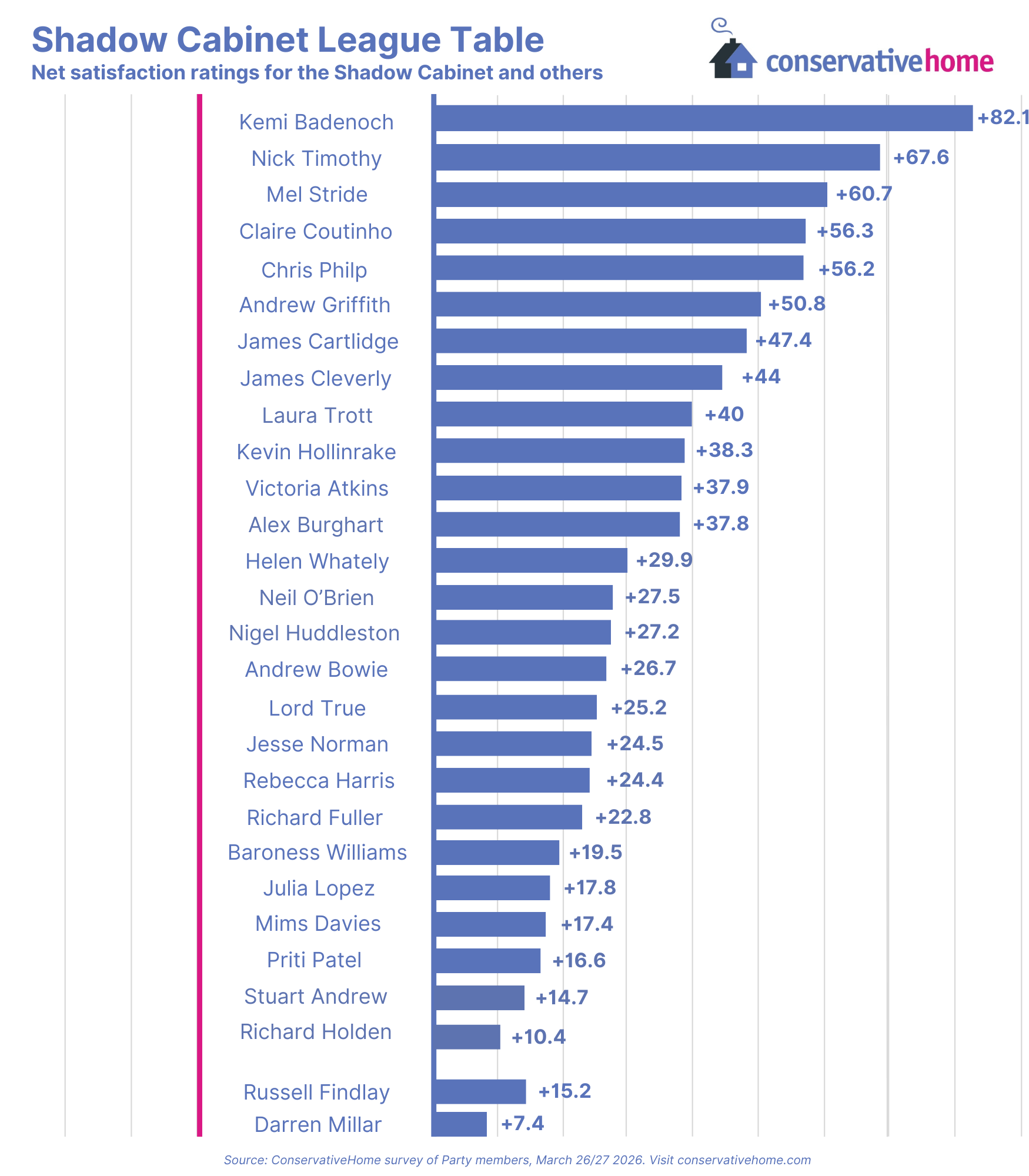
Behind Badenoch in ConservativeHome’s league table is shadow justice secretary Nick Timothy (+67.6), who retains second place since joining the shadow cabinet. He has recently been at the centre of controversy after describing a Ramadan prayer event in Trafalgar Square as “an act of domination” from an “Islamist playbook”.
The Tory leader rowed in behind him, but some fellow Conservative MPs – including some in the shadow cabinet and the whips’ office – have privately raised concerns about Timothy’s comments and his subsequent doubling down, which one senior Tory described as “extremely unhelpful”. But it has done nothing to dent his standing with Conservative members.
This Shadow Cabinet poll was conducted after Timothy’s remarks, and he still sits above all his shadow cabinet colleagues bar the Tory leader herself. In fact, he has increased his rating from +56.9 to +67.6.
The rest of the top five is unchanged from our last league table: shadow chancellor Mel Stride remains in third (+60.7), followed by shadow energy secretary Claire Coutinho (+56.3) and shadow home secretary Chris Philp (+56.2). Despite recent rumours – including in the Mail on Sunday – of a forthcoming reshuffle that would move Stride and Philp, both have held their positions since our last Conservative Home poll.
Another name that has surfaced in reports of a shadow cabinet refresh is shadow foreign secretary Priti Patel, who finds herself near the other end of the table, third from bottom on +16.6 — ahead only of shadow health secretary Stuart Andrew (+14.7) and shadow transport secretary Richard Holden (+10.4), who remains rooted to the foot.
Talk of a reshuffle seemed to lose some of its sheen as Parliament headed into recess. But I understand that, at senior levels within CCHQ, discussions are still ongoing about using a refresh as part of a broader plan to get the Conservative Party back on the front foot after the local elections.
And speaking of those elections: in the run-up to the Scottish and Welsh contests in May, things are not looking especially rosy for either Tory leader. In Scotland, Russell Findlay has slipped from +17 to +15.2 since our last survey. In Wales, Darren Millar is on +7.4, down only fractionally from +7.5. Still, the polls that matter are the ones coming next month.
The post Shadow Cabinet League Table: Badenoch extends her lead, Timothy holds second appeared first on Conservative Home.
I should have felt shocked when I read that one in eight parents now report that their child has a disability. That means that 12 per cent of British children – around 1.7million young people – are classified as suffering from a long-term illness, disability or impairment, according to figures just released by the Department for Work and Pensions (DWP).
These figures have almost doubled since 2015, when around seven per cent of parents reported that their child had a disability. This massive expansion in the number of children deemed to be disabled has been driven by a dramatic increase in the number of kids diagnosed with so-called behavioural issues, such as autism and ADHD. According to the DWP, ‘behavioural issues’ now account for two-thirds of childhood disabilities.
The reason I’m no longer surprised by the rise and rise of childhood disability is that I have been tracking this development for well over three decades. Back in 1996, I remember when UK government officials discovered that between 1985 and 1996, there had been a 40 per cent increase in the proportion of British people who consider themselves disabled. According to the survey, the increase was much higher among teenagers between the ages of 16 and 19. It seemed that the younger you were, the more likely it was that you would have a disability.
The authors of that survey concluded that the difference between the 1985 and 1996 figures ‘appears too large to be explained by a real increase in the prevalence of disability’. This is hardly a surprise. After all, there had been no war or outbreak of serious disease in this period that would have rendered swathes of the population infirm. That the authors couldn’t explain this epidemiologically extraordinary figure in the 1990s is entirely understandable. Thirty or 40 years ago, society had a far more limited view of who was considered disabled.
The explanation for this unexpected rise in the number of young disabled people does not lie in the field of epidemiology, but in the realm of a culture that invites people to classify themselves as infirm. It is important to stress that how people cope with negative experiences is strongly influenced by the cultural and historical factors that shape the way people make sense of them. Such cultural factors may increase or reduce the ability of the individual to cope with adverse circumstances.
In recent decades, the meaning of disability has undergone a dramatic semantic shift. This is part of a broader trend by which negative aspects of human experience and behaviour have become medicalised. In addition, an enormous disability lobby has emerged, which constantly demands that a variety of newly discovered disabilities be recognised with a formal diagnosis. The most important achievement of this lobby has been to alter public perceptions of the relationship between ability and disability. It has also succeeded in transforming what used to be characterised as children’s bad or problematic behaviour into medical issues.
Many of the ‘behavioural problems’ now designated to children have always been part of family life. Disobedience, aggression, disruptive and anti-social behaviour – now defined as ‘oppositional defiant disorder’ – have always posed a challenge to parents and schools. Yet these difficult patterns of behaviour are now often branded as psychological or medical issues. And so they become accepted, rather than something to be amended by adult guidance or firm discipline.
Clearly, parents are now actively courting disability diagnoses for their children. After all, the discovery of newly invented childhood disorders provides a welcome explanation for their children’s bad behaviour or poor performance in school: ‘She isn’t naughty, she is ill.’ It is also undeniable that the many welfare benefits now offered to parents with disabled children have also played a role. Nor can we ignore the role of teachers, some of whom are promoting the diagnosis of ADHD as an alternative to managing bad behaviour in the classroom through discipline and authority. A pupil’s failure to finish homework, inability to focus on class discussion and boredom in school are now blamed on some ‘condition’.
Unsurprisingly, over the past 30 or so years, children have internalised the disability narrative. Today’s young people readily communicate their problems in a psychological vocabulary. They describe their feelings in terms of stress, trauma and depression.
One of the gravest consequences of the disability culture is that many children no longer attend school at all. Last year, it was reported that the number of children missing more than 50 per cent of the school year in Oxfordshire had increased by more than five times in 10 years. This has been put down to ‘emotionally based school avoidance’, in which a child cannot attend school due to anxiety or stress. Half of UK secondary pupils avoided school due to anxiety at some point in the past year.
As a child, I can testify that my friends and I were more than happy to avoid going to school, and we had more than our share of anxiety. But we also knew that our parents and the rest of adult society had no sympathy for our predicament, and that not going to school was not an option. These days, adult society has become complicit in normalising truancy.
It is about time that society woke up to the fact that the current epidemic of childhood disability is not a medical problem. It is a cultural failure. Telling children that they are disabled, and unable to cope with the demands of life, is setting them up for a life of dependency and unfulfilled potential. Our children deserve better.
Frank Furedi is the executive director of the think-tank, MCC-Brussels.
 lead image
Central Bank Gold Statistics: Central Banks Stay The Course On Gold In February

Binance ETH Reserve Hits Lowest Level Since 2024 as Stablecoin Balances Surge
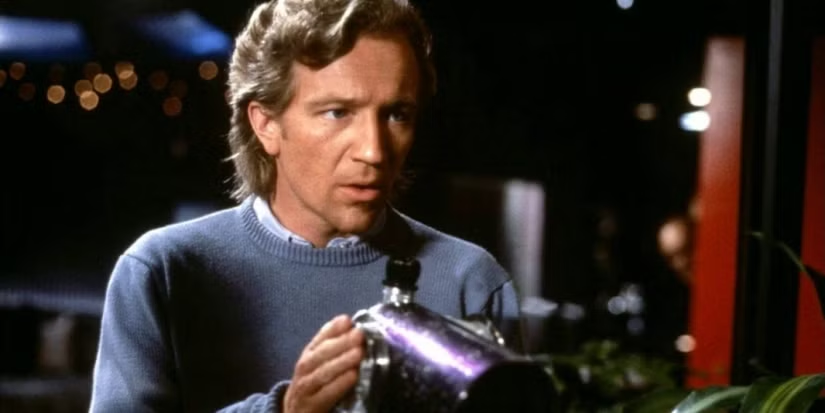
’80s Thriller Movies That Have Aged Like Milk

Smart energy pays enters the US market, targeting scalable financial infrastructure

Why Israel is blocking foreign journalists from entering

Bitcoin: We’re Entering The Most Dangerous Phase

3 Govt Schemes For Women Entrepreneurs? #finance #money #business #gkindia #basicgyaan

Live Analysis Future & Options In Bitcoin & Ethereum | Gold Trading Live 2 April 2026 Delta Exchange

6 Places Your Money Should Go Every Time You Get Paid
-

 NewsBeat2 days ago
Steven Gerrard disagrees with Gary Neville over ‘shock’ Chelsea and Arsenal claim | Football
-

 Business1 day ago
No Jackpot Winner and $194 Million Prize Rolls Over
-
Entertainment5 days ago
Fans slam 'heartbreaking' Barbie Dream Fest convention debacle with 'cardboard cutout' experience
-

 Fashion16 hours ago
Weekend Open Thread: Spanx – Corporette.com
-

 Crypto World3 days ago
Gold Price Prediction: Worst Month in 17 Years fo Save Haven Rock
-

 Tech5 days ago
The Pixel 10a doesn’t have a camera bump, and it’s great
-
 Entertainment7 days ago
Lana Del Rey Celebrates Her Husband’s 51st Birthday In New Post
-
Crypto World4 days ago
Dems press CFTC, ethics board on prediction-market insider trades
-

 Tech5 days ago
Avatar Legends: The Fighting Game comes out in July and it looks pretty slick
-

 Sports4 days ago
Tallest college basketball player ever, standing at 7-foot-9, entering transfer portal
-

 Business2 days ago
Login and Checkout Issues Spark Merchant Frustration
-

 Fashion6 days ago
Amazon Sundays: Soft Spring Layers
-

 Tech4 days ago
EE TV is using AI to help you find something to watch
-

 Tech6 days ago
Elon Musk’s last co-founder reportedly leaves xAI
-

 Tech4 days ago
How to back up your iPhone & iPad to your Mac before something goes wrong
-

 Fashion5 days ago
The Best Spring Trends of 2026
-

 Politics5 days ago
Should Trump Be Scared Strait?
-

 Crypto World4 days ago
U.S. rule change may open trillions in 401(k) funds to crypto
-

 Tech5 days ago
Apple will hide your email address from apps and websites, but not cops
-

 Tech4 days ago
Flipsnack and the shift toward motion-first business content with living visuals
You must be logged in to post a comment Login