Politics
Lessons from the local elections: what can Labour learn from the result in Birmingham?
Matthew Lloyd analyses the recent local election results in Birmingham and the lessons they hold for Andy Burnham as Prime Minister.
Birmingham is the largest local authority in Europe. Like many local authorities, it struggled financially and by 2023 it had joined the list of local authorities which had been declared bankrupt. Before the local elections the city was seen as a Labour stronghold, but after heavy Labour loses, Birmingham has its first ever Liberal Democrat council leader who is supported by a cross-party coalition.
Labour faced multiple electoral threats from pro-Gaza independents, Reform and the Greens, who all threatened different parts of its electoral coalition. Though local politics did have an impact on Birmingham’s local election results, they also offer a snapshot of the electoral dilemma Labour faces across the UK.
If the Labour Party is to rebuild its electoral coalition for the next set of local elections, and ultimately the general election, then lessons must be learnt from what happened in Birmingham.
Labour had run the council since 2012, but at this election the party lost 48 seats, relegating it to the third-largest party. Labour suffered two defections a month after the local elections reducing it to the fourth largest party.
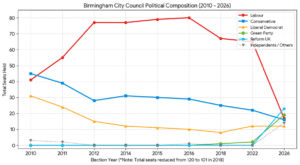

Source: Author generated using electoral data – Changes in number of Birmingham City Council seats between political parties 2010-2026
Reform UK came in as the largest party, gaining 23 seats. The Greens gained 17 seats, becoming the second largest party. The Lib Dems remained even at 12 seats. The Conservatives declined from 22 to 16 seats and the independents, among whom many campaigned specifically on the issue of Gaza, gained 13 seats. The Workers’ Party of Birmingham gained 1 seat.
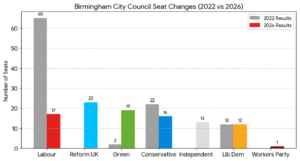

Source: Author generated using electoral data – Changes in number of Birmingham City Council seats in the 2022 and 2026 local elections.
Reform UK’s growing strength in Birmingham did not emerge overnight. It reflected a combination of local and national factors. Birmingham’s financial crisis, declining public services and the prolonged bin strikes created a sense that the city was no longer working. Reform was able to channel that frustration.
At the same time, national debates around immigration, identity and patriotism became increasingly prominent. It was no coincidence that last summer’s flag flying campaign originated in Birmingham. The campaign reflected a growing confidence among Reform supporters and demonstrated that questions of identity had become politically salient well before the local elections. Rather than creating Reform’s success, it revealed a political mood that the party would later convert into votes.
At the other end of the political spectrum, Starmer’s initial handling of the party’s response to Israel’s war in Gaza was used in the Green Party’s and Birmingham independents’ literature, with both opposing the government’s stance (see leaflet graphics below). These local elections revealed Labour’s worst nightmare, as residents in areas such as Kings Heath and Stirchley who had resisted the ‘flaggers’ turned to the Greens as progressive alternative to Reform UK.
Supporters of both Reform UK and the Green Party appeared united around their dislike for Starmer, even if this opinion is grounded in different reasons. Both parties battled to be seen as the party that could ‘stop Labour’ or ‘defeat Starmer’ (see leaflet graphics below).
Nigel Farage claimed that this same anti-Starmer tactic was used in the recent Makerfield by-election, but was less effective as Labour’s candidate and potential future leader, Andy Burnham, was also able to claim he would seek to remove Starmer from Number 10. This provides hope for Labour that a new leader could somewhat recover its electoral appeal.
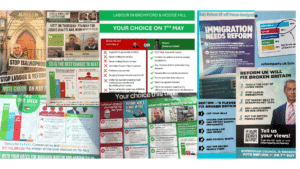

Source: Author generated and collected from leaflets handed out to Birmingham residents during the 2026 Birmingham council elections
Local factors also meant Birmingham Labour always faced a difficult fight. Birmingham’s equal pay crisis arose because successive administrations failed to resolve longstanding pay disparities and bonus arrangements across the workforce. Some local agreements in male-dominated services, including refuse collection, contributed to those liabilities. The council also faced equal pay claims triggered in 2021 partly due to alleged inflated pay, the creation of new roles and new practices such as ‘task and finish’, which were part of settlements to avoid strikes by refuge workers.
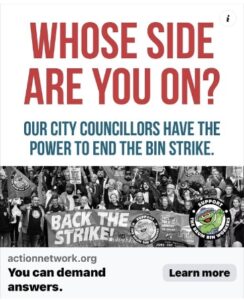

Source: Facebook Ad by ‘Unite for a Workers’ Economy’ Group during the Birmingham Local Elections
Equal pay claims coupled with the costs of a botched implementation of a new IT system contributed towards the council being declared bankrupt and the now infamous bin worker strikes that have meant Birmingham residents have not had their recycling collected since Christmas 2024.
Birmingham’s local elections should be seen as a warning for Labour rather than an exception. The party is losing different parts of its electoral coalition for different reasons. Reform appealed to voters frustrated by economic decline and declining public services. The Greens and pro-Gaza independents appealed to progressive voters who felt Labour no longer represented them.
While local factors made Labour’s position worse, the underlying trends are national. One lesson is that Andy Burnham’s argument for deeper English devolution deserves renewed attention. Giving mayors and local leaders greater powers over economic development, transport, housing and public services would allow places like Birmingham to respond more directly to local challenges and rebuild trust in politics. If Labour is serious about renewing its electoral coalition, it will need to combine a national vision with a stronger model of local government.
By Matthew Lloyd, PhD candidate, Queen Mary University of London and political strategy consultant.
You must be logged in to post a comment Login