Politics
Lord Ashcroft: Should Labour promise a ‘rejoin’ referendum?

Lord Ashcroft KCMG PC is an international businessman, philanthropist, author and pollster. For more information on his work, visit lordashcroft.com
The ten-year anniversary of the Brexit referendum and the musings of Labour leadership hopefuls have combined to revive the debate over Britain’s relationship with Europe.
Would it help Labour to make rejoining the EU a cornerstone of their next election campaign?
How a ‘rejoin’ campaign could help Labour
A decade on from the referendum, Brexit has a poor reputation. My poll found only 11 per cent of people saying life in Britain in recent years has been better than it would have been if the UK were still a member of the EU, with a majority thinking it has been worse. Given a binary choice between the UK needing to accept that Brexit has failed and should try to rejoin some aspects of the EU, and the UK needing to accept that we have left for good and should make the best of it, the former leads by 16 points. When asked how they would vote in a referendum on rejoining the EU, 53 per cent of people said they would vote to rejoin, as against 30 per cent who said they would vote to stay out. These figures become even more favourable for Labour when broken down by party affiliation, as shown below


Rejoining leads by 82 points among current Labour supporters, 74 points among Greens and 69 points among Lib Dems. Current Reform voters would vote to stay out by a 62-point margin but Conservatives are more closely divided, saying they would vote against rejoining by 52 per cent to 33 per cent. Since the decisive factor at the next election will be which party is most able to consolidate support within its own “bloc” (Labour, the Lib Dems and Greens on the one hand, and the Tories and Reform on the other), making the next election about an issue which unites the left but splits the right could clearly be profitable for Labour.
There are other potential advantages.
Tying Nigel Farage to Brexit may give Labour a more promising line of attack than anything they have found to date. A focus on Brexit could also allow Labour to attribute to the Conservatives some blame for the state of the country and to assert that they have learned nothing from 2024, without needing to resort to the much-derided lines about £22 billion black holes. And with six in ten voters saying the current Labour government is no better or even worse than its predecessor, it would save Labour from having to campaign solely on its record in office. Since most voters agree a referendum would be needed to rejoin the EU, such a policy would allow Labour to promise change without having to explain why they didn’t use their vast majority to bring it about. A rejoin policy would also provide a reason to back Labour beyond a tactical vote to stop Reform, and a sense of purpose whose absence has characterised the government’s first two years.
We can examine this further by reference to our political map.
The chart below shows how people currently plan to vote and who has noticed what about the government so far. Bubble sizes are proportional to the size of the relevant voter group, and the closer bubbles are, the more similar the respective groups of voters. In the party colours, we have the locations of current support for the five largest parties. The ten grey bubbles come from a regular question where we ask respondents to recall, unprompted, things this Labour government has done (whether they agree with them or not). This shows the ten most-noticed acts (as opposed to failures and omissions to do things). We also highlight the people who identified improving relations with Europe as something the government has done so far.


This shows a number of things.
One is that Labour’s message is simply not cutting through much beyond its core support, even in the bottom left quadrant which is historical Labour territory and where the party has shed votes to the Greens. Another is that very few people have noticed the government policy on Europe, and those who have tend to be slightly closer in political outlook to Lib Dem voters rather than Labour voters. Labour proposing rejoining would eclipse the Lib Dem policy on a customs union. It would polarise the electorate in a way the current policy does not.
But it would be noticed.
It is too early to quantify the potential impact on Labour’s electoral prospects if they back rejoining the EU – we don’t know how they will perform in other areas in the coming months and years, or even who the prime minister will be. But there is an arguable case that a rejoin policy would make some of the campaign obstacles and electoral dynamics less unfavourable for Labour. In their current predicament, some chance of a way out may be preferable to no chance at all.
The risks for Labour of a rejoin policy
Admiral Nelson’s maxim that the boldest measures are the safest has some application to 21st century politics as well as 19th century naval combat. Election results worldwide suggest that incumbent parties cannot retain office by simply playing it safe (witness the successes of Mark Carney and Anthony Albanese and the failures of Chris Hipkins, Kamala Harris and Hillary Clinton). As against that, we have Sir Humphrey’s dictum that “controversial” means “this will lose you votes,” but “courageous” means “this will lose you the election”. What are the risks of Labour nailing its colours to the rejoin mast?
One obvious risk is that public support for rejoining may turn out to be weaker than it first appears, especially once questions of detail emerge.
Testing every potential sticking point in hypothetical negotiations with the EU is clearly not practical, so we asked about three potential conditions which might be attached to the UK’s readmittance: joining the euro, paying a higher membership fee than before Brexit and joining the Schengen area. We also asked people which came closer to their opinion in a forced choice between the UK needing to agree that Brexit has failed and should seek to rejoin some parts of the EU, and the UK needing to accept that the UK has left the EU for good and should try to make the best of it.
Based on these questions, as well as the voting intention in a hypothetical referendum on rejoining the EU, we can divide the population into four categories:
- Strong Rejoiners, who say that they would vote to rejoin, agree that Brexit has failed and would consider at least one of the conditions acceptable
- Hesitant Rejoiners, who say that they would vote to rejoin but either consider all three above conditions unacceptable or agree that the UK needs to accept that it has left the EU for good, or both
- Rejoin Rejecters, who say that they would vote to stay out or are unsure how they would vote, consider all three potential conditions unacceptable and agree that the UK needs to accept that it has left the EU for good
- Others, who do not fall into the above three categories
We could reasonably expect the Strong Rejoiners to vote to rejoin in a referendum and the Rejoin Rejecters to vote against rejoining. Having any expectations about how the hesitant rejoiners would vote is harder. If they perceived the UK as having secured favourable terms, they might come out in favour of rejoin; if the terms seemed unacceptable, they may well break strongly against rejoining. If we treat the hesitant rejoiners as undecided voters, then the 23-point lead for rejoin in headline referendum voting intention shrinks to six points.
This analysis is necessarily speculative and is certainly not intended as a prediction. But there is a temptation to see such a large lead on a subject as being decisive and thus to believe the result of a referendum is a foregone conclusion. If people have made up their mind about Brexit, that is not the case with rejoining.
A second risk is that, as with Brexit, a campaign around rejoining could divide Labour’s voter base. The chart below shows how the different categories we defined above break down based on current voting intention.
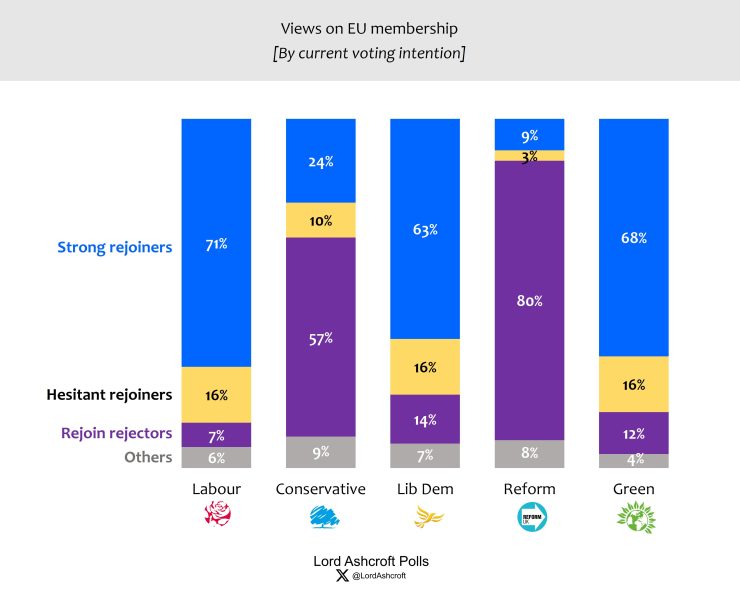

This is the sort of picture which would vindicate a rejoin-centric election campaign. It shows that current Conservative voters are divided on the issue: around a quarter are Strong Rejoiners whereas a slender majority are Rejoin Rejecters. Whichever stance the Conservative leadership took on the issue, at least one of these groups would be disappointed. Conversely, current Labour voters skew heavily towards Strong Rejoiners and are more united on this issue than current Lib Dem or Green voters; they are about as unified in favour of rejoin as Reform voters are in favour of staying out.
However, by 2024 vote the picture is somewhat different and significantly more ominous for Labour:
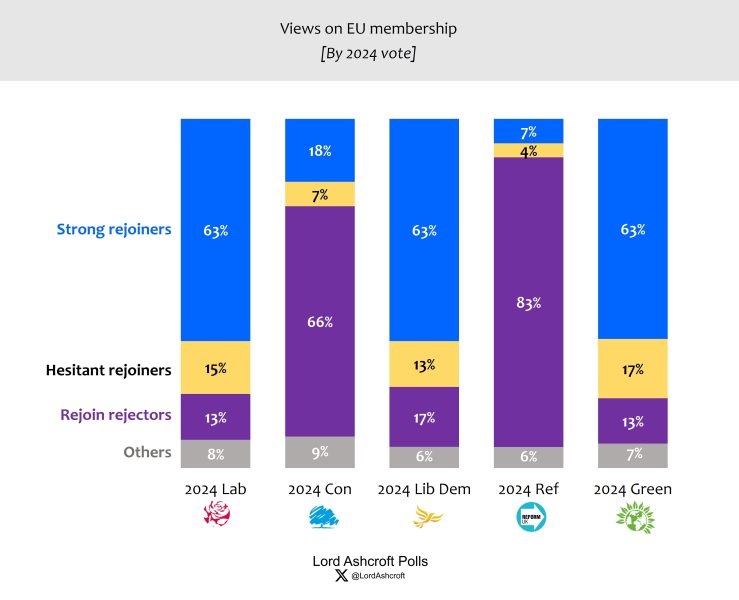

By 2024 vote, Labour are at least as divided as the Conservatives (and no more united than the Greens or Lib Dems). If a tactical benefit of placing rejoin front and centre of an election campaign is that it helps parties which are united on this issue, the primary beneficiaries going by 2024 vote would be Reform. Current voting intention is a snapshot of a dynamic situation. By the time of the next election, will the profile of opinion on rejoining the EU still look like the breakdown by current voting intention, or revert to something closer to the 2024 breakdown (even if headline voting intention does not change)? In the latter case, making the election about an issue which unites Reform voters but splits the other parties could hand Nigel Farage the keys to Number 10.
But waiting to see how things look in 2028 is not a credible option, largely because of the third risk: relevance.
Successful parties fight elections based on voters’ priorities.
For putting rejoin at the centre of an election campaign to pay political dividends, voters would either need to consider Britain’s relationship with the EU a high priority, or believe that rejoining the EU would enable meaningful improvement on some of their big concerns. Otherwise, the campaign looks irrelevant and out of touch. The last time I asked people to name the three most important issues facing the country, Brexit languished outside the top ten, chosen by just six per cent of voters.
Could things be changing?
Since January 2025, those preferring a closer relationship with the EU rather than the US has risen by nine points to 76 per cent. Even so, it is hard to see EU relations beginning to rival immigration, the NHS or the cost of living in the near future.
The best politicians are, to an extent, able to set the agenda; however, no amount of political skill or leadership ability allows this to be done overnight.
Whatever the issue or policy – be it small boat crossings, net zero, a wealth tax, or Brexit itself – none of these materialised without trace on the British public’s consciousness. But far from banging the drum for rejoin, Labour have been cautious and equivocal. How would rejoining improve the NHS, help address concerns over immigration or make the average person better off? If rejoining is to be the centrepiece of a future Labour general election campaign, then Labour need to be making those arguments and be comfortable doing so.
Next is the risk of polarisation.
Andy Burnham cited the division reopening the Brexit debate would cause as a reason for drawing back from advocating an immediate return. Even if this is a fig leaf for saying one thing to the voters of Makerfield and a different thing to the Labour membership, the risk of returning to parliamentary paralysis and government gridlock is real. If sufficient time has passed to warrant reconsidering the 2016 vote, the SNP will leap on this as justification for a re-run of the Scottish independence referendum. Again, this risk is difficult to quantify. Division and polarisation are inevitable consequences of putting rejoin on the political agenda; the question is whether Labour decide the benefits of rejoining outweigh the downsides of reviving the Brexit wars.
The fourth risk to Labour is perhaps the biggest of all.
What if they were to win the election but lose the subsequent referendum?
Their parliamentary coalition would collapse. They would be damned by rejoiners for having failed, and damned by opponents of rejoining for having tried at all. Predictions of long-established parties being finished as political forces are made too lightly in political commentary, but it is no hyperbole to say that if Labour bet everything on rejoin and lose the referendum, the consequences could be existential.
There is a common thread running through these four risks.
Labour voters uniting rather than dividing, EU relations becoming more relevant, people believing that polarisation is a price worth paying for putting the issue on the agenda and rejoin winning a referendum will only happen if the groundwork has been laid. Laying the groundwork will require patience, discipline, strong communication and a lot of political skill – all of which have so far been scarce in this government. If, on the other hand, Labour declares its support for rejoining as a last-minute roll of the dice, these risks will bite harder and the party’s reward could be to turn a very bad election result into a disastrous one.
Coming soon: ‘How should the Conservatives respond to a rejoin campaign?’ Full data tables at LordAshcroftPolls.com
The post Lord Ashcroft: Should Labour promise a ‘rejoin’ referendum? appeared first on Conservative Home.
You must be logged in to post a comment Login