
Politics
Lord Ashcroft: Who is most trusted on the economy, preferred coalitions, the pensions triple lock, should Starmer resign, and are Reform like the Tories?

Lord Ashcroft KCMG PC is an international businessman, philanthropist, author and pollster. For more information on his work, visit lordashcroft.com
My latest polling looks at preferred coalitions and tactical voting, which parties have momentum, whether Reform UK are like the Conservatives (and in a good or bad way), whether Keir Starmer should resign, and which Labour leadership contender would make the best prime minister. Ahead of International Women’s Day, we also look at favourability towards current and recent female politicians.
Preferred coalitions
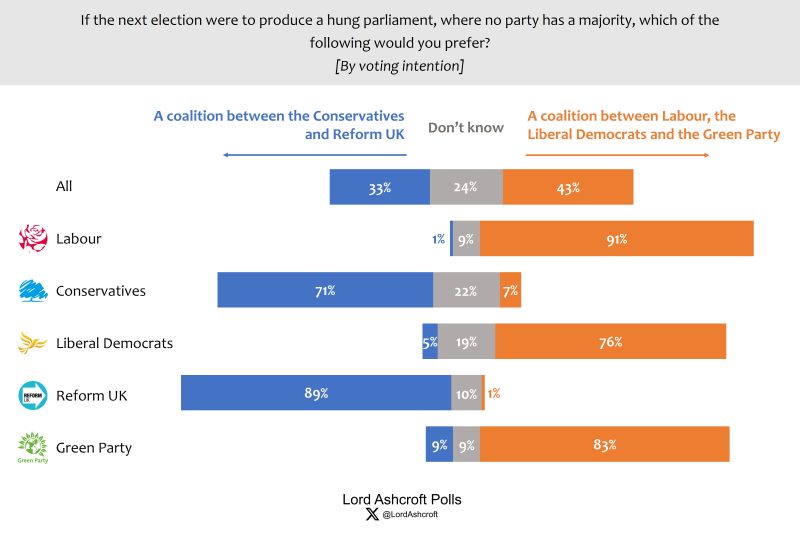
Overall, voters were more likely to say they would prefer a Labour-Lib Dem-Green coalition (43 per cent) than a Conservative-Reform coalition (33 per cent), with just under a quarter saying they didn’t know.
Those currently intending to vote Labour, Green and Lib Dem overwhelmingly preferred a coalition of their parties. On the other side, nearly nine in ten of those leaning towards Reform said they would prefer a coalition of their party and the Conservatives. However, only just over seven in ten of those intending to vote Conservative said they would prefer a coalition with Reform; more than one fifth of current Tories said they didn’t know which coalition they would prefer.
The Labour government
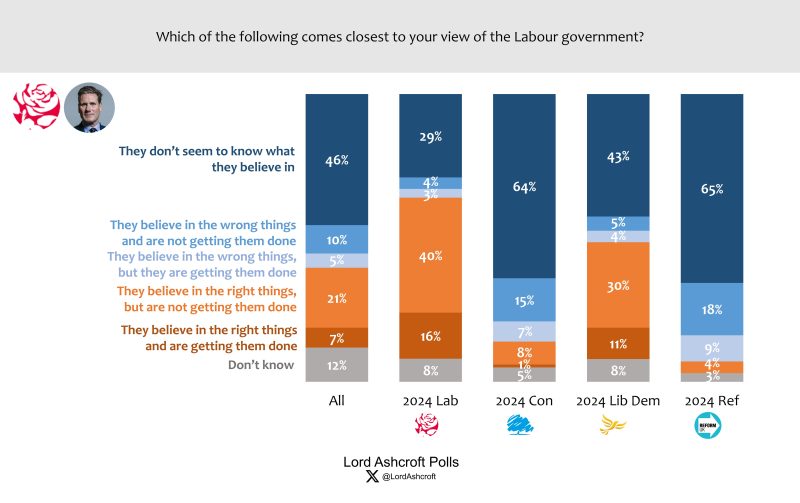
Only 7 per cent of voters overall (including only around one in six 2024 Labour voters) said they thought the current Labour government believed in the right things and was getting them done. A further one in five (including 40 per cent of 2024 Labour voters) thought the government believed in the rights things but were not getting them done. Nearly half of all voters, including nearly three in ten 2024 Labour voters, said the government did not seem to know what it believed in.
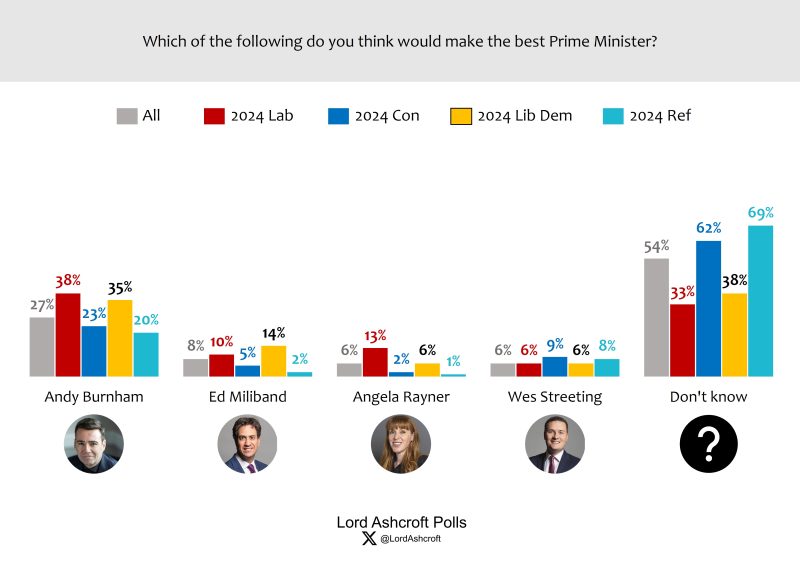
Among those spoken of as potential future Labour leadership contenders, Andy Burnham was comfortably ahead both among voters as a whole and among current and 2024 Labour voters. While there was little to choose between Rayner, Streeting and Miliband in the country as a whole, Labour supporters put Rayner in second place, with Streeting a distant fourth.
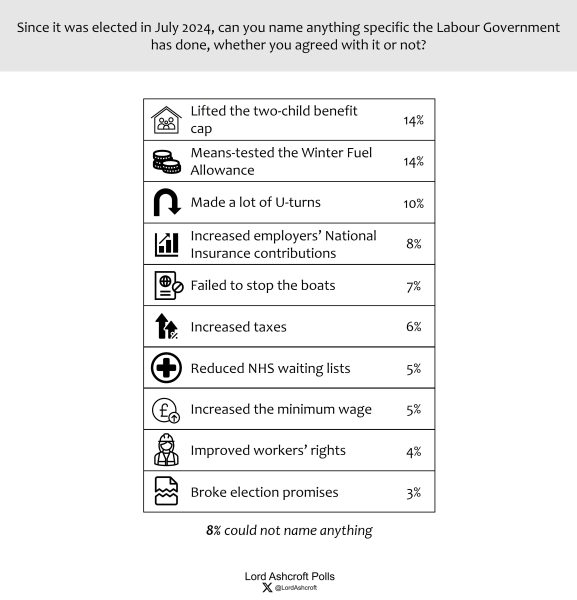
When we asked people to name without prompting what they remembered that the Labour government had done since being elected, the two most common answers were lifting the two-child benefit cap and means testing the winter fuel allowance. U-turns and raising employers’ National Insurance were next on the list.
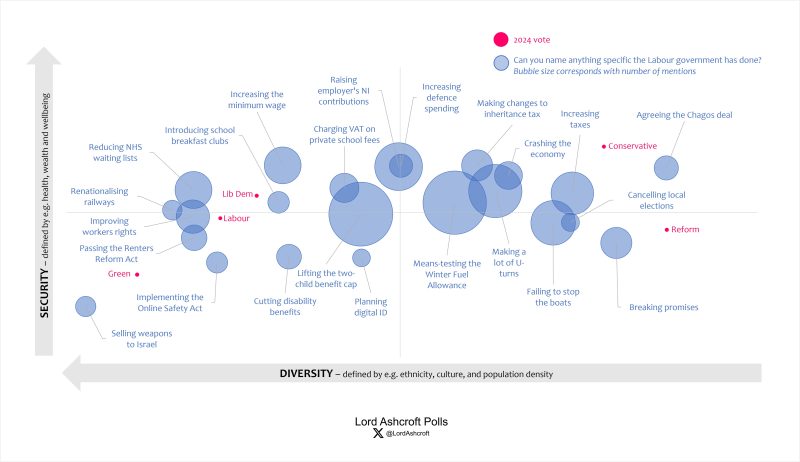
Our political map shows what kind of voters have noticed which government actions. Means testing the winter fuel allowance and lifting the two-child benefit cap both appear close to the centre of the map, showing they were recalled across the electorate rather than by any particular group. The Chagos Islands deal, U-turns and tax rises were most likely to be mentioned by those on Conservative and Reform-supporting side of the map, while the minimum wage, NHS waiting lists, rail renationalisation, workers’ rights and school breakfast clubs were more likely to be recalled in Labour, Lib Dem and Green territory.
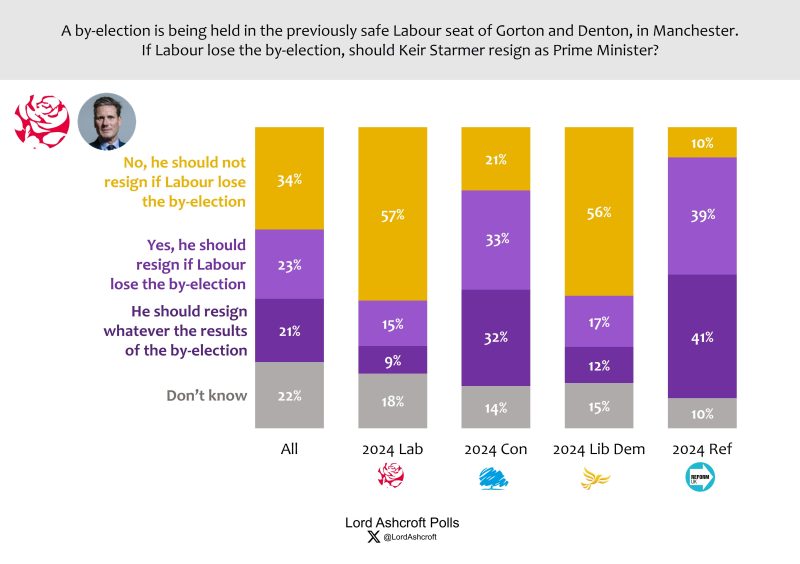 Nearly a quarter of voters said Keir Starmer should resign if Labour lose the Gorton & Denton by-election, while just over one third said he should not. However, a further 21 per cent said he should resign whatever the result of the by-election.
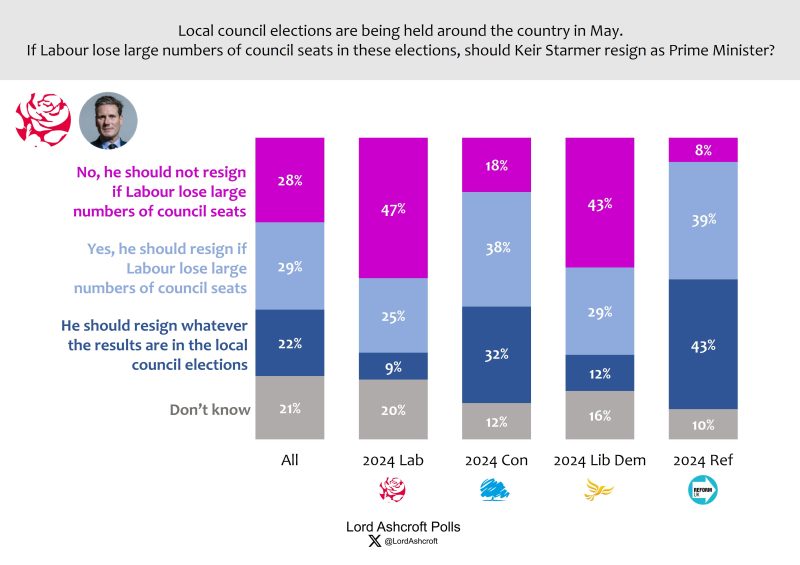
Slightly more said Starmer should resign if Labour badly in the council elections in May, with 28 per cent saying he should not. Again, just over one in five said he should resign whatever the local election results.
The pension triple lock
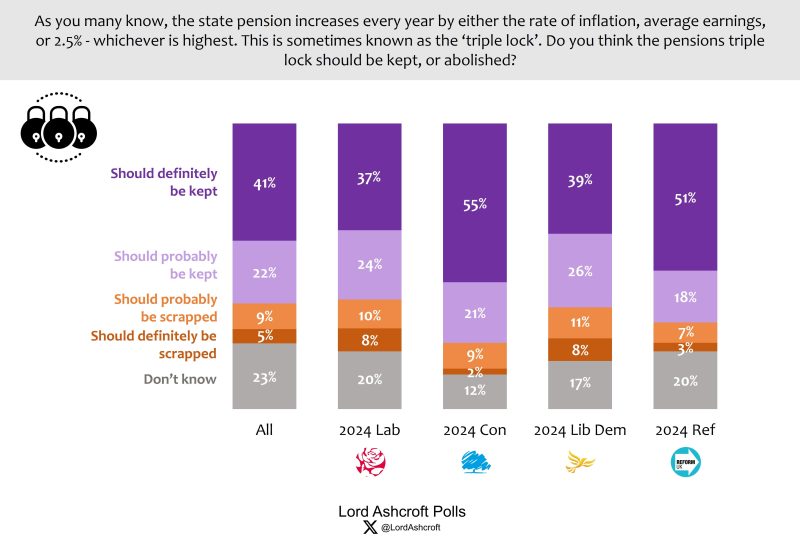
More than six in ten voters, including majorities of all parties’ supporters, said the pension triple lock should be kept. Nearly 90 per cent of those aged sixty-five or over said it should be kept, compared to four in ten of those aged 18-24.
Are Reform UK like the Conservatives?
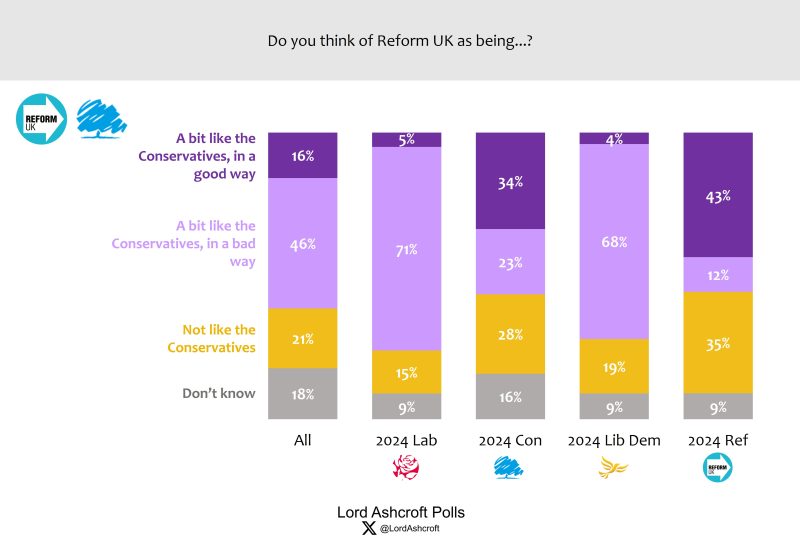
Just under half of all voters, including around three quarters of current Labour, Lib Dem and Green voters, said they thought of Reform UK as being a bit like the Conservatives, in a bad way. Just over half of those currently intending to vote Reform said they thought of the party as being a bit like the Conservatives in a good way, while just over one third of them thought Reform were not like the Conservatives.
Party momentum
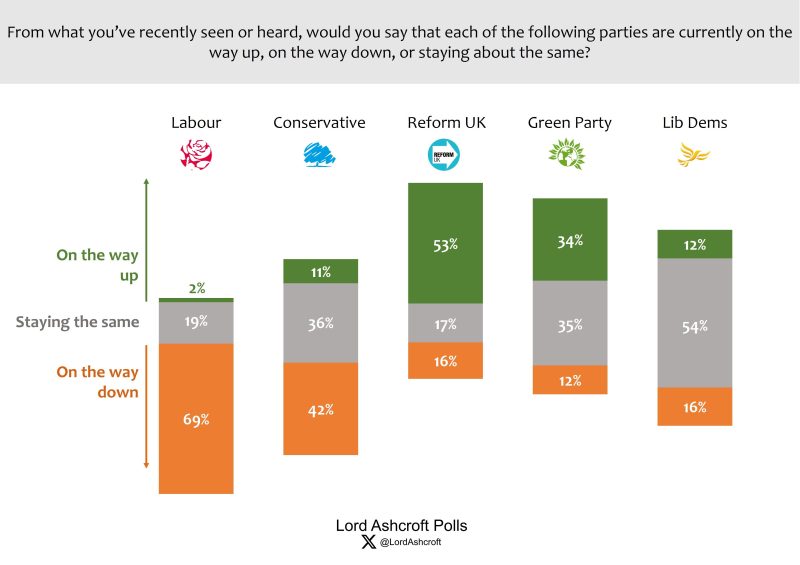
Reform UK were the party most likely to be considered “on the way up”, followed by the Greens. Nearly seven in ten said they thought Labour were on their way down, including a majority of those who voted Labour in 2024.
Female politicians
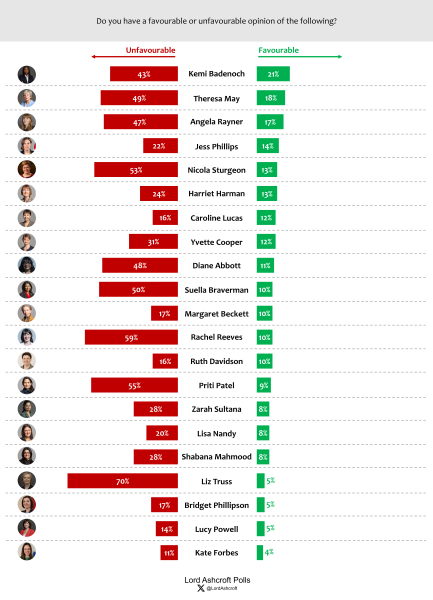
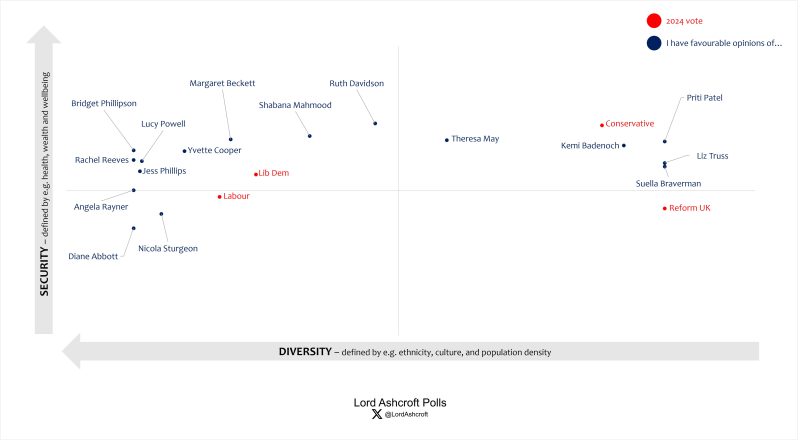
In advance of International Women’s Day, we asked how favourable people felt towards various current and recent living female politicians. Ranked in order of the proportion saying they had a favourable view, Kemi Badnoch topped the list, followed by Theresa May, Angela Rayner and Jess Phillips. Next were Nicola Sturgeon, Harriet Harman, Caroline Lucas and Yvette Cooper. Below, our political map shows how favourability towards these individuals is distributed across the population:
Trust on the economy
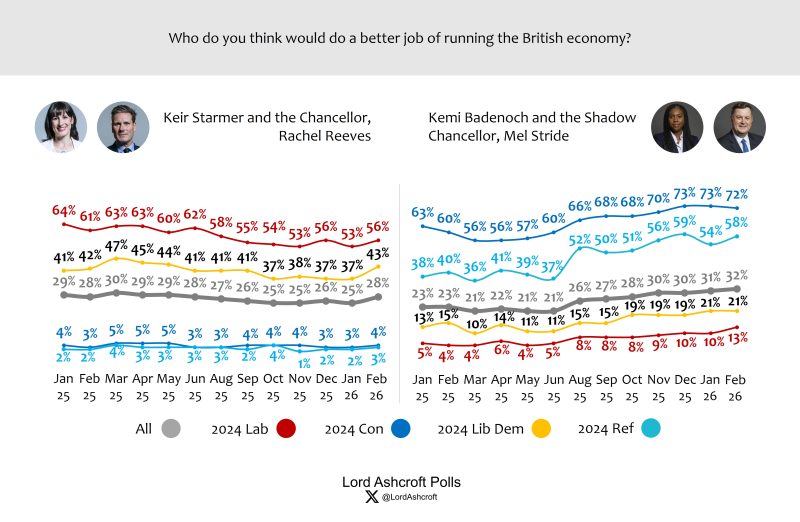
Asked who would do the better job running the economy, voters chose Kemi Badenoch and Mel Stride over Keir Starmer and Rachel Reeves by a 4-point margin, with 40 per cent saying, “don’t know”. Only just over half of 2024 Labour voters named the Labour team; more than seven in ten 2024 Conservatives chose the Tory team.
Best (and most likely) prime minister
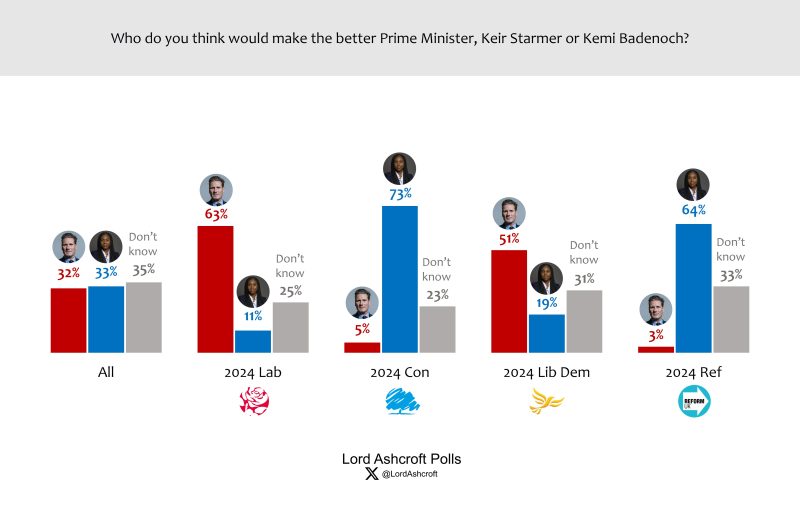
In a head-to-head question, Badenoch led Starmer by one point with just over one third saying “don’t know”. Just over six in ten 2024 Labour voters say Starmer would make the better PM, while nearly three quarters of 2024 Conservatives named Badenoch. Those who voted Reform UK in 2024 said they preferred Badenoch to Starmer by a 61-point margin, with one in three saying “don’t know”.
Given a choice between Starmer and Farage, voters as a whole chose Starmer by 13 points. 2024 Conservatives chose Farage over Starmer by 53 per cent to 15 per cent, while 2024 Labour voters chose Starmer by 75 per cent to 8 per cent. Lib Dems chose Starmer by a 58-point margin, and Green voters did so by 57 points.
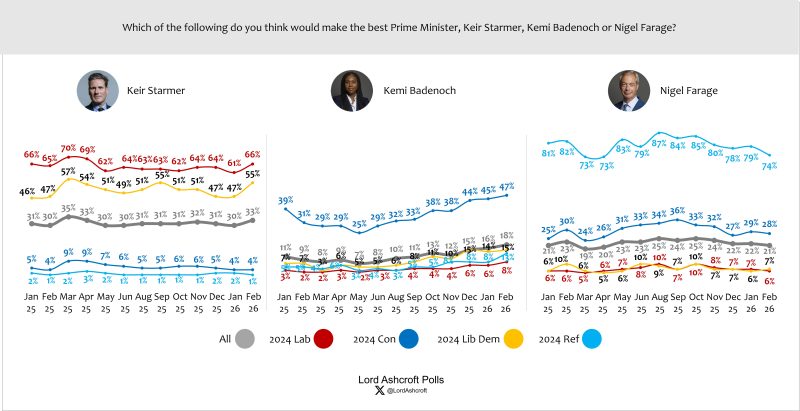
Offered a choice between Starmer, Badenoch and Farage, voters chose Starmer over Farage by a 12-point margin, with Badenoch in third place on 18 per cent. 2024 Conservative voters preferred Badenoch over Farage by a 19-point margin (up from 6 points in November), and 2024 Labour voters preferred Starmer over Badenoch by 58 points.
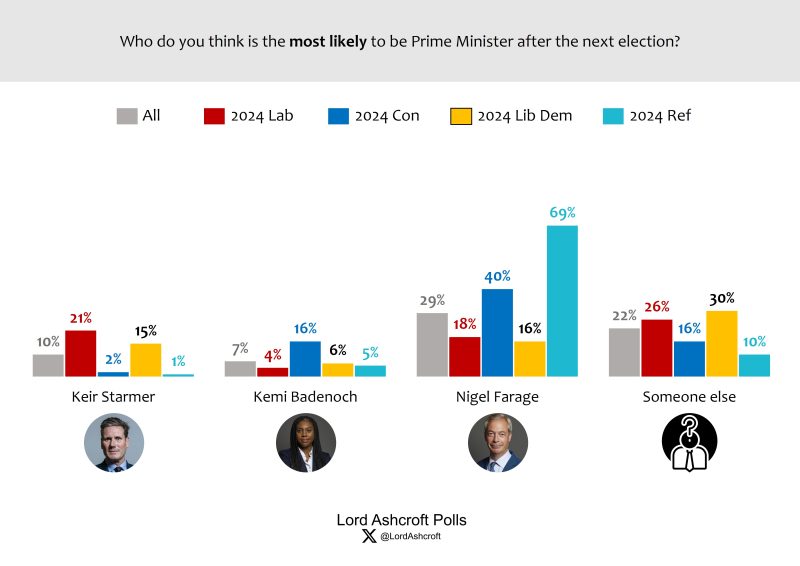
Nigel Farage was thought the most likely person to be PM after the next election, with 29 per cent naming him as the most likely candidate. Only one in ten thought Starmer would still be in the job and 7 per cent named Badenoch. More than one fifth thought someone other than these three would be PM. More than eight in ten of those currently intending to vote Reform thought Farage would be PM, compared to fewer than four in ten current Labour leaners who thought Starmer would be PM and just over a quarter of current Conservative supporters who thought Badenoch would have the job.
When we asked how likely people were to end up voting for each party at the next election on a scale from zero to 100, those who voted Labour in 2024 put their chances of doing so again at the next election at an average of 43/100. Those who switched to Labour in 2024 put their chances of voting for the party again next time at 34/100, and those who switched from the Conservatives to Labour in 2024 put their chances of voting Labour again next time at an average of 27/100. Looking at those more likely than not to vote for a particular party (those whose highest likelihood of voting for one party was at least 50/100), this implies current vote shares of Reform UK 22 per cent, Conservative 20 per cent, Green 19 per cent, Labour 17% per cent, Lib Dems 11 per cent, Others 10 per cent.
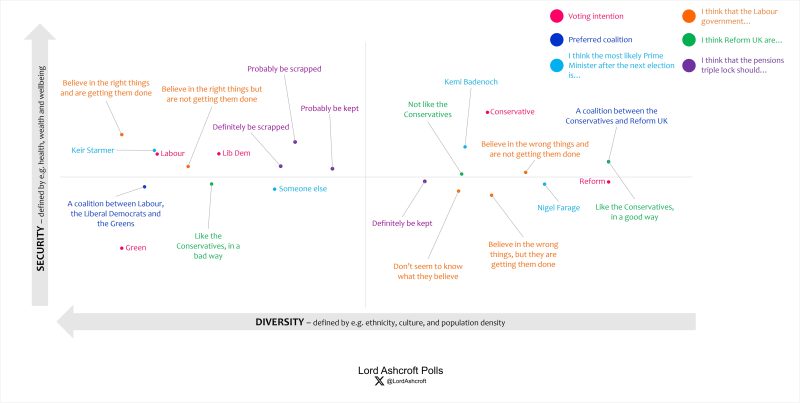
As above, our political map shows how different issues, attributes, personalities and opinions interact with one another. Each point shows where we are most likely to find people with that characteristic or opinion; the closer the plot points are to each other the more closely related they are. Here we see the distribution of opinion on the Labour government, the pensions triple lock, most likely prime minister and whether or not Reform are like the Conservatives.
Full data tables available at LordAshcroftPolls.com


We hope you love the products we recommend! All of them were independently selected by our editors. Just so you know, HuffPost UK may collect a share of sales or other compensation from the links on this page if you decide to shop from them. Oh, and FYI – prices are accurate and items in stock as of time of publication.
I’ve already waxed lyrical about how bright pops of colour are a particularly hot trend in the fashion world right now.
Cool girl celebs from Zoë Kravitz to Dakota Johnson have been seen sporting bold-coloured accessories that add an eye-catching, not to mention chic, touch to their off-duty outfits.
But the colour I’m seeing the most, and the colour I’ve found myself craving, is big, bold, vibrant red.
It’s the perfect antithesis to the clean-girl beige that’s been everywhere for years, and I can’t get enough.
If you feel the same, do me a favour and have a gander through my spring shopping wish list. If I’m lucky, dear readers, you’ll buy up everything on it before I lose the will to resist…
Politics
Lord Ashcroft: My latest focus groups -“This is the only time I’ve agreed with Keir Starmer in a while”

Lord Ashcroft KCMG PC is an international businessman, philanthropist, author and pollster. For more information on his work, visit lordashcroft.com
My latest focus groups took place in the North-East, where we heard from regular Labour voters in Newcastle East and Wallsend who might be tempted elsewhere, and from people in Bishop Auckland who switched from the Conservatives to Labour at the last election.
Most participants felt that recent political news had been dominated by the Iran conflict, the causes of which remained opaque to many.
Explanations included a Trumpian need to project power, a desire to control oil supplies, a response to the murder of protesters by the Iranian regime, and an attempt to stop Iran building nuclear weapons – the last of which some accepted as the right and reasonable explanation, though a few said they were reminded of claims about Iraqi weapons of mass destruction.
“This is the only time I’ve agreed with him in a while”
Whatever the reasons for the military action, most were glad that Britain was not taking a leading role in it. They tended to back Keir Starmer’s cautious approach and his willingness to defy President Trump, often saying it was the first time for ages that they could remember approving of anything he had done: “I don’t like Keir Starmer, even though I voted for him. But I don’t mind that he didn’t dive straight in on this one. This is the only time I think I’ve agreed with him in a while. He had a bit of balls about him just to hang back and upset them;” “It feels like we’re being cautious as a country, Keir Starmer is being cautious. I think he’s learning from past mistakes with Iraq. I think he’s doing as much as he needs to without getting us heavily involved and bearing arms as a country ourselves, and seeing how it unfolds over the coming weeks.”
Even so, some worried about Starmer’s apparent prevarications and the potential repercussions on our relationship with the US: “They wanted to use the airfields in Chagos, wasn’t it, and it took two days to respond. So I appreciate the fact that he hasn’t got into the war, but they’re still a key ally of the UK and if anything happens going forward, it could be concerning;” “Sometimes he comes across as scared to make a decision and say ‘right, this is what’s happening’;” “I think we should be more involved because America is our ally. And without America… well, we haven’t got the war machines we need to actually go to war. We should have stood by America. If Russia ever attack us, who’s going to help us?”
At the same time, some worried that Britain’s position had been dictated by our diminished military capability as anything else: “I don’t think our military are capable. We haven’t put the money into the military as much as we should have;” “It’s embarrassing. We’ve got one boat and it’s taken a week and a half to decide whether to send it;” “They attacked Cyprus, the British base, and the Americans had to go and protect us. We didn’t protect our own.”
None of our participants had registered any opposition politicians’ stance on the conflict – usually assuming they had sensibly kept their heads down: “I think it’s very muted, what the other parties’ views are. I don’t think anybody’s been very noisy about it, probably because they don’t want to take that responsibility;” “I imagine Farage would probably be more likely to help, just because him and Trump are quite friendly, from what you hear on the news. But I haven’t actually heard anything.”
“It will come out of our pockets no matter what, won’t it?”
The groups had noticed petrol prices creeping up as a result of the conflict. Some thought the government should step in and help consumers if domestic gas and electricity bills rose significantly, but some were doubtful: “It will come out of our pockets no matter what, won’t it? They’ll help, but they’ll claw it back in another way.”
Several also argued that the conflict highlighted showed the need to prioritise energy costs and security of supply over net zero targets: “If the energy price is going to keep going up, big companies aren’t going to invest in growth in the UK because they’ve got to keep the lights on, keep the heating on. Haven’t we already got the highest prices for energy in Europe?” “We should be looking at what we’ve got in this country, what we can use. If stuff is happening in Iran, do we have oil and gas coming in – rather than talking about green renewables, where apparently everything’s made in China anyway, so the net zero green project is contradicting itself.” A few argued that the conflict showed the need to be less dependent on oil and gas in the first place.
“Everybody knows somebody that’s fiddling the system”
There was a guarded welcome for the government’s latest plans on welfare reform, including a new apprenticeship scheme, incentives for firms to take on younger people and requirements for some disability benefit claimants to look for work. However, there were doubts that the scheme would come to fruition (“they tried it before and it got rejected by their own backbenchers”). They also doubted that this government in particular was willing or able to tackle what they regarded as a huge and deep-rooted problem: “I think any working-class person would know five or ten people who are fiddling the system. They know what to do, what to say, what ailment to go for to obtain these things;” “Where I work there are kids who get PIP, and some of them literally brag about how much money they get;” “We work full time and more. I have to do two jobs and my little boy’s dad works two jobs, just to live nowadays. Parents who don’t work get £15 per child a week for food, but working parents have to have two jobs;” “I don’t know you change it, it’s so deep. It’s like an epidemic.”
“I don’t know how accurate this was, but I read on social media something about asylum seekers being given £40,000 to go. We’d pay them to leave!”
Participants in several groups spontaneously mentioned government plans to offer failed asylum seekers £40,000 as an incentive to leave the UK. Most thought it must have been fake news, or that they had misread the story – they couldn’t believe it was actually true: “I don’t know how accurate this was, but I read on social media something about asylum seekers being given £40,000 to go. We’d pay them to leave. Is that right?” “If that was accurate and true I’d be absolutely outraged. They took money off pensioners and are giving it to people who literally broke into the country;” “It will be ‘let’s pop over there for six months, get the money and get the boat back.”
As with the proposed welfare changes, there was qualified support for Shabana Mahmood’s move to make refugee status temporary, to be reviewed every 30 months, with individuals expected to return to their country of origin when it is deemed safe: “It’s a start. I don’t believe it will happen, but it’s not the worst idea I’ve ever heard.” A few disagreed, saying children and families should not be removed if they are settled and contributing.
“Why are we protecting one religion only?”
Some were also concerned about the government’s recently announced plans on community cohesion and tacking anti-Muslim hostility. Most felt that community relations in and around Newcastle were very good – better than in other parts of England, they believed – but there were questions as to why efforts should be focused on one part of society: “It’s not just Muslims that get hate. Why is it just their culture? Why not Jews, why not Christians? Why not Hindus and Sikhs? Why are we protecting one religion only? Shouldn’t everybody be protected?”
Though generally critical of Starmer and the government, the groups (especially longstanding Labour voters) praised policies including energy price caps, scrapping the two-child benefit limit, breakfast clubs, expanded childcare, and the higher minimum wage. Several of these were prepared to give Labour the benefit of the doubt for now: “I think they’ve sort of stopped the rot with inflation. It’s not necessarily getting much better, but it hasn’t got worse;” “There’s been Brexit and covid and two wars. You can’t magic money out of thin air. They’ve been dealt a bad hand, I think;” “I’d like to see what they can do over the next year. It’s a bit like a football club. If you chop and change your manager all the time, you get nowhere.”
“They keep saying ‘the previous government’. Get over it. You’ve been in nearly two years.”
Those who voted Labour having backed the Tories in 2019 tended to find fewer redeeming features. Higher taxes, U-turns and a habit of blaming the previous government after nearly two years in office were recurring themes: “They’ve given me a couple of pay rises that I suppose weren’t coming before that. But they gave them with one hand and took it with the other hand;” “You don’t have any faith in what they’re going to do next, because you don’t know how well thought-out it’s been;” “They promised not to raise taxes, and effectively they have;” “Rachel Reeves. I can’t stand that false smile. She’s like an assassin;” “They keep saying ‘the previous government’. Get over it. You’ve been in nearly two years. You’ve had time to change. You quickly took the money off the pensioners, that didn’t take two years. They don’t take accountability or responsibility for anything;” “If they get in again it could end up being that 12-year span of badness that the Tories ended up having. I feel like it’s best to get them out now before they can do any more damage.”
“I do think she talks a lot more sense. But when they were in, they didn’t change it.”
These groups were still some way from returning to the Conservatives, even though there were some positive words for Kemi Badenoch: “They could promise ten things which I would like, but I wouldn’t vote for them after what happened the last 14 years;” “She’s trying hard but she’s treading water from what I can see. The party doesn’t seem to be behind her. She always seems to be out on her own;” “I do think she talks a lot more sense. But when they were in, they didn’t change it.”
Instead, a number were considering Reform UK.
As well as tougher action on migration, the main appeal was the prospect (or at least the chance) of change: “It’s time to give somebody else a go because the other two have done a horrendous job my whole life;” “I’m not sure they’ll be the answer to everything. But they’re the best of a bad bunch, I think.” There were reservations, however, including rumours of planned NHS privatisation, Nigel Farage himself (“he seems more fame hungry than anything else”), his relationship with Donald Trump, unrealistically easy solutions (“his manifesto was a bit like a fantasy, I think;” “I don’t know how they think they can come in and fix immigration overnight when the other parties have lost government because of it”), and large numbers of Tory defectors (“that’s a red flag for me”).
“I just feel like it’s a good idea to go for someone whose purpose is to just try and make everything better.”
There was also some interest in the Green Party and what they had heard of their policies. More important, however, were the general air of “hope” that some detected, as well as Zack Polanski: “I like how hopeful all of their ideals sound, with the state of the world as it is. I just feel like it’s a good idea to go for someone whose purpose is to just try and make everything better;” “They seem quite hopeful, but they need to build up their political presence because they’re sort of like a backseat party. But if they do, then it could be on the cards for me;” “When he talks about Israel and Iran or Palestine, anything like that, he can’t be labelled as an anti-Semite because he’s Jewish. He’s very well spoken. Whatever is thrown at him, he can either brush it aside without any effort or face it head on with a cool and collected, informed argument.”
Some had their doubts as to how realistic their solutions were – and about Polanski himself: “Anything green – it’s great, but it just costs far too much money;” “More for a younger person, students and stuff;” “As nice as everything he puts out sounds, it’s a little bit fantastical. But I feel like the only reason why it doesn’t sound realistic is because they haven’t had a chance to be in power and start putting things into place;” “Was it him that told women that if you get hypnotised, your boobs will get bigger? Does he know it’s a lie? I can’t have him on my telly. He’s crazy. And he tells you that men are really women.”
“I don’t think he’d invite anybody because he doesn’t want to upset people who don’t have that religion”
Finally, with Easter on the way, if Labour were to get together for Sunday lunch, what would it be like? “It would just be for the people off the boats because they get everything. He’s not going to invite anyone like us;” “The conversation would be very dull and self-promoting. ‘Look at us, what an amazing dinner we put on’;” “Five peas, two bits of broccoli, one Yorkshire pudding;” “I don’t think he’d invite anybody because he doesn’t want to upset people who don’t have that religion. He’d keep the door shut and wouldn’t dare invite people round.”
What about the Reform Sunday lunch? “It would be more of a fun gathering. Their own branded Easter eggs. Farage dressed as an Easter bunny;” “It would be in a pub with a big loudspeaker outside in the car park. A double-decker bus with his face on it;” “Beer on tap in the corner;” “Expensive cognacs, lots of bragging. Someone else is cooking, obviously. Female maids running around.”
The Conservatives? “It would be raucous, but behind closed doors;” “They’d go fox hunting;” “Four people in the corner and a dog;” “They’ll be sitting round the table with £100 bottles of wine saying ‘Keir Starmer’s done this and he hasn’t done that’. But they wouldn’t put a pound on because they’ve got chefs cooking for them and it’s lobster and caviar.”
And the Green Sunday lunch? “It would be a different kind of Sunday joint. They’d be passing it round. Big bags of Monster Munch.”
Trump claimed to have destroyed Iran’s nuclear capability last year, only to launch fresh attacks on the country alongside Israel more than three weeks ago.
In the past few days alone, the president has threatened to “obliterate” Iran’s power plants, before calling off the attacks and claiming that peace talks with Tehran are underway.
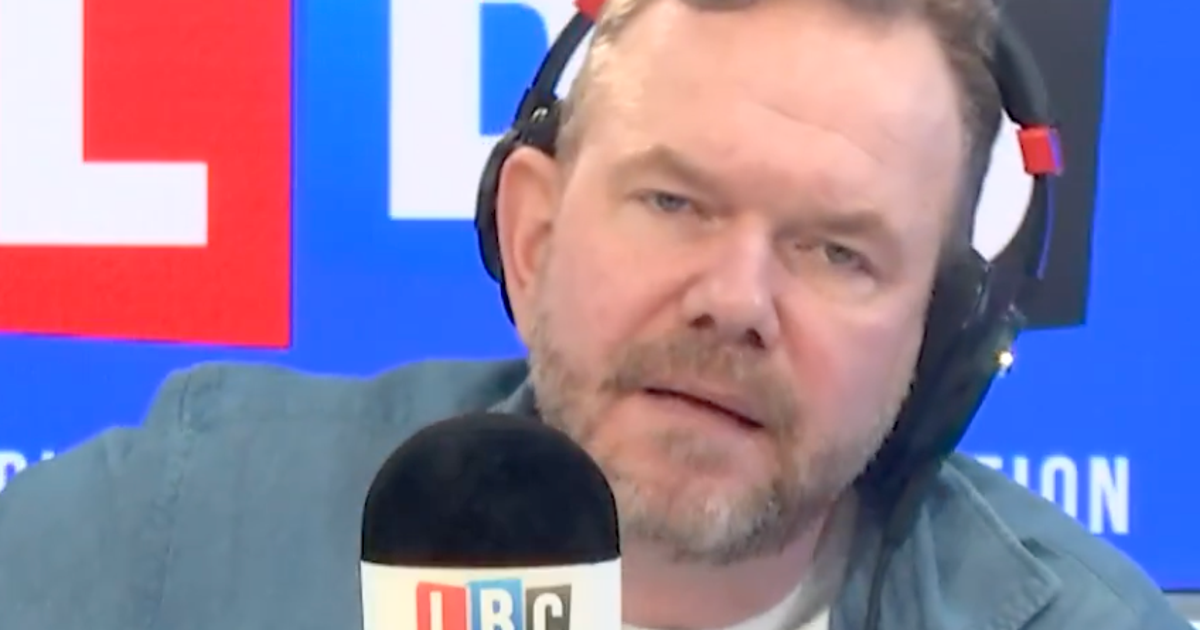
But in a brutal monologue on LBC on Monday, O’Brien said both sides “haven’t even sent each other a postcard”.
“Other things that you know include the claim that there was a 48 hour deadline in place for Iran to re-open the Strait of Hormuz otherwise he would start bombing power plants in Iran,” he said. “To which Iran responded by saying ‘we’ll start bombing power plants all over West Asia’.
“Guess what, Taco? ‘When you claimed that you had completely obliterated our abilities to launch attacks nine months ago, you were lying. And when you claimed it last week, you were lying. And when you claimed it the week before that, you were lying, because we’re still launching attacks and we’ve still got the Strait of Hormuz by the proverbial short and curlies’.”
O’Brien added: “You may have thought over the course of the last three weeks that I was exaggerating just how mad all of this is, and just how utterly, utterly thankless it is to attribute any inkling of sense or sensibility or normality to Donald Trump.
“The only way you can report on this stuff is by acknowledging the derangement and the lies.
“He is a deranged liar, and therefore everything he does needs to be viewed through the lens of his deranged lies.”
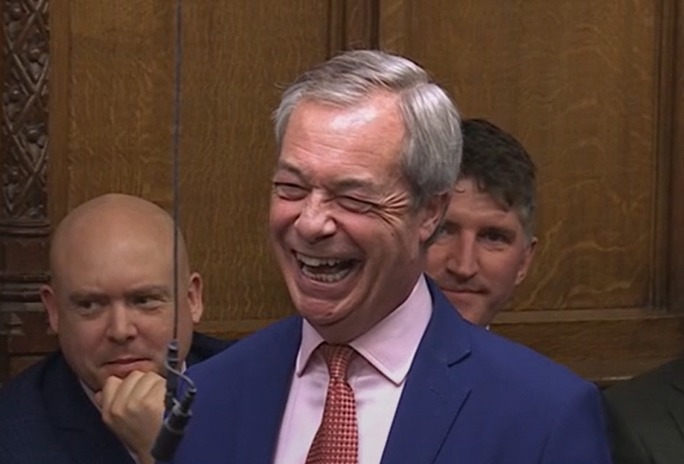
Peter Franklin is an Associate Editor of UnHerd.
Just because you’re not paranoid, it doesn’t mean they’re not out to get you. And for the avoidance of doubt, Nigel Farage is out to get us.
When he predicts the “extinction” of the Conservative Party, make no mistake: he’s looking forward to it. Indeed, he wants to be the asteroid that wipes us out like the dinosaurs he thinks we are.
This isn’t just some personal grudge, it’s central to Reform UK’s political strategy. Not unreasonably, the Reform leadership sees the split on the Right as their number one problem. In 2024, the Reform vote elected a handful of the party’s candidates, but ensured the defeat of a much more significant number of Tories. Next time, Farage fears it’ll be the other way round. From his point of view, the most hassle-free scenario in which this doesn’t happen is if his Tory rivals somehow give up and go away.
And yet we’re still here.
Our party conference last year was meant to be a wake, but it didn’t turn out that way. There was a second attempt to strike a mortal blow earlier this year with a run of defections, but the result of all that fuss was a polling stalemate for both parties. Now, for Farage, it’s third time lucky — or so he hopes.
Last week, Kemi Badenoch launched the Conservative local election campaign. Once again she delivered a barn-storming speech, but the Reform calculation is that this won’t matter. The last time that these council seats were fought (plus those in the Scottish Parliament and Welsh Senedd) we were polling at roughly twice the level we are now — and Reform was an irrelevance. Given the dramatic change in the parties’ respective fortunes, it’s hard to see how there won’t be major Tory losses on the 7th May, plus sweeping gains for Reform.
In last year’s locals, we lost 674 councillors and 16 councils while Reform gained 804 councillors and 10 councils. That was bad enough, but not as bad as what happened afterwards to the national polling picture. This is shown most clearly in the Nowcast seat projection for each party, which uses polling data to model out a corresponding general election result.
This time last year, Conservative poll ratings were still high enough to win us a hundred-odd seats. But in the wake of the local election campaign there was a rapid deterioration in our position. All of a sudden, the Nowcast model — along with other projections — showed that the Conservatives would end up with well under fifty MPs. That reflects a slump in vote share of only a few percentage points, but in our electoral system that’s enough to push a party over the cliff-edge.
Of course, Kemi Badenoch’s make-or-break conference speech pulled us back from the brink. We’ve witnessed a partial recovery in our ratings and a definite loss of momentum for Reform. But that’s why Farage has got so much staked on the reaction to this year’s May elections. If, as in 2025, we see a tranche of the Tory base turning turquoise, then that would wipe out all the gains of the “Badenoch bounce”. A demoralised and defeated Conservative Party would then have no choice but to bend the knee to Nigel.
And, yes, I’m assured that actually is the thinking among Reform strategists. But how realistic is it?
As I say, they can look forward to a good night on the 7th May. However, there are several reasons why what happens afterwards won’t be the same as last year.
Firstly, the significance of the 2025 result was the proof it provided that Reform had truly arrived. For wavering Tories wondering whether Reform was electable, here was the indisputable evidence. A vote for Farage is not a wasted vote — or, worse still, a vote that allows Labour to get in. But in 2026, we’ve become accustomed to the new normal. Reform is well ahead in everyopinion poll and Farage favourite to become Prime Minister after the next general election. So a turquoise tsunami this year won’t be the shock to the system that it was last year.
A second big difference for 2026 is that Reform won’t be the only big winners. We can expect an undeserved comeback for the SNP in Scotland; the best ever result for Plaid Cymru in Wales; and a breakthrough for the Greens in London. Nor will the Conservatives be the only losers. Indeed, Labour faces a meltdown. It’s not just that the results will confirm the party’s loss of the Red Wall to Reform, but also that Labour is being eaten away from the Left in the inner cities. Consider, for instance, the forecast that Labour will be pulverised in Birmingham, losing control of England’s second city to a coalition of Muslim independents and the Green Party. In short, there’ll be no shortage of big stories from these elections — but only some of them will be about Reform.
Of course, the biggest story of the lot would be the fall of Keir Starmer. His Cabinet colleagues clearly want rid of him and this would be their big chance. If they take it, the choice of a new Labour leader and PM would obviously relegate the Tory-Reform psychodrama to the sidelines. Then again, by May, we could be in the middle of the worst energy crisis since the 1970s and/or embroiled in a full-scale war with Iran. But, in that case, we won’t care about party politics anyway.
For the moment, I’ll assume we’ll still have that luxury. So, consider a further party political contrast between 2025 and 2026. A year ago, Kemi Badenoch was struggling, but she’s since hit her stride as leader. Just look at the upward trajectory of her approval ratings. It also helps that her only obvious rival within the party has since absented himself. And on the topic of defections, remember that Nigel Farage has set a 7th May deadline for any Conservative MP or councillor thinking of switching camps. So, before long, that’ll be another destabilising factor that no longer applies.
Of course, Badenoch still needs a reset strategy. Not only must she be ready to blame a bad set of election results on the legacy of her predecessors, she’s going to have to do a lotmore work to distance her Conservative Party from the past. Words will not be enough — and especially not when delivered in the passive voice (e.g. “mistakes were made”).
For a start, faces have to change. That means a comprehensive reshuffle. Obviously, promote new talent — but, more importantly, refresh the top team. Badenoch needs a senior shadow cabinet that looks like the next Conservative government, not the last one. The Kemi Show is great, but it’s time for an all-star cast.
Perhaps on another occasion, I’ll name names. But for the purpose of this argument, the key point is that Badenoch has kept her powder dry. There was a nasty moment, a couple of weeks back, when rumours of an imminent Tory reshuffle swept through newsrooms. That would have been premature. The chance for a post-election reset would have been wasted, and any vengeful ejectees would have been ready-and-waiting on the backbenches to put the boot in.
As it is, the initiative remains with the Conservative leader. If she chooses to take it, there’s reason to hope that she can turn a difficult night on the 7th May to her advantage — by pushing her party further and faster towards renewal. Certainly, she doesn’t have to sit there uselessly while Nigel Farage runs away with another million Tory voters.
Crucially, Kemi Badenoch isn’t just playing defence here. By decisively frustrating Farage’s attempt to kill us off, she might just force Reform to rethink its entire strategy. And once both parties realise they’ve got more important things to worry about than each another, anything is possible.
Expert comment provided by horticultural expert Jack Stooks, former Head Gardener to King Charles at Highgrove House Garden, who’s currently working with Savoo.
It can feel pretty counterintuitive to spend months – even years – perfecting your rosebush, only to lop its branches off.
Even Monty Don admits that pruning can cause “some anxiety”. It can be hard to feel sure you’re cutting at the right time, in the right place, on the right plant, to prevent unwanted dieback.
Thankfully Jack Stooks, former gardener to King Charles, has shared his ultimate pruning tips with us.
“By cutting things down, you’re always trying to encourage growth to come from the very base of the plant,” he explained.
“Doing that keeps the plant healthy because you’re using plant material that’s new year after year, rather than holding on to old dead wood that’s hard and doesn’t properly flower.”
What should I prune?
“With pruning, we always go with diseased, damaged and dying,” Stooks told us.
“If you’re going to prune a rose, for instance, you’ll inspect the rose and see what’s dead. If there are any branches that are dead within it, cut those out.”
And if any parts are diseased, you can cut them off. Once that’s gone, you can see what needs more work.
“Generally speaking, most plants you would take off about one quarter maximum, but you could probably take off a third of the growth. With roses, you can take away more.”
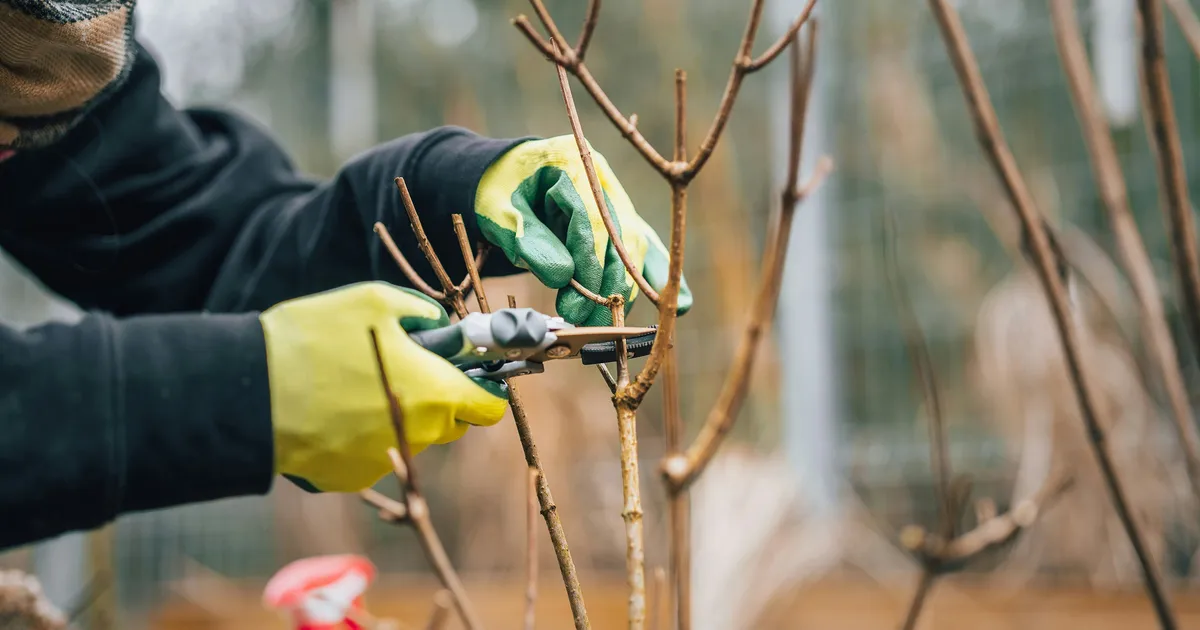
You might also want to remove crossover or weaker branches. “You want to have really sharp secateurs or a really nice sharp saw to use for the bigger branches,” Stooks said.
Once the pruning’s done, fertilise and feed the plants.
“You can dig the manure in, or use some blood, fish and bone for the plant, or get fertilisers. It’s good practice to prune everything, then feed the plants afterwards to maintain good growth.”
What time of year should I prune?
Generally, Stooks said, you want to do the job before spring and after winter.
“You can start pruning things from December into the early months of the year… you don’t want to be pruning when things are trying to grow.”
For example, pruning forsythia in summer will mean it simply won’t flower, he explained.
It’s also illegal to deliberately harm a bird’s nest in the UK, which is why some experts advise against cutting back hedges from March to September.
“There are some plants that are good for a late winter prune, like wisteria. You can also do a late summer prune, like with an apple tree,” Stooks added.
“Once the apples have finished on the branches, you can pick them and do a prune of the plant, which can be done in the late summer, but in the later winter, I’d give them a better prune.”
Ornamental pruning can also “be done during the growing season”.
What should I avoid when pruning?
Stooks said he always prunes plants at different levels (e.g. not to one solid length).
“Some people will get a trimmer and they’ll go into their garden and shape their shrubs. They can shape it into a ball shape and leave it at that. You very often see gardens where the shrubs look like they’re trying to grow but aren’t given the opportunity.
“I don’t necessarily agree with this method, as I do think a natural look always looks better,” he said.
Instead, he recommends a more freehand approach, with “secateurs or a little saw, or loppers if you need, and try and open the shrub up a little bit… That’s the best way of pruning because you’re getting air and light into the plant”.
How can I tell if a plant needs pruning?
“You can usually tell by the growth that a plant has put on, so it is worth inspecting it,” Stooks told us.
“With roses, you can sometimes tell by the height of the plant. You might buy some roses, then they end up growing to around five feet… That’s the same for any shrub.
“You might have had a beautiful view of a field from your garden, but then three shrubs have taken over and are way too big for that space, so taking control of that would be the way forward.”
Festus Akinbusoye is former Police and Crime Commissioner, and local election candidate for Abbey Road Ward on Westminster Council.
We are talking about our cities in the wrong way — and it is beginning to show.
In policy papers, committee rooms and television studios, London is usually described as an engine of economic growth, a hub of innovation or a centre of global finance. All of this is true. But it is not the whole truth; and when we mistake the part for the whole, we end up shaping a city that serves the Treasury’s balance sheet, but not the lives of the people who call it home.
Long before we fix our housing crisis, restore public safety or build a transport system fit for modern life, we need to step back and ask a more fundamental question: what is a city actually for?
Aristotle once argued that the purpose of the ‘polis’, the ancient Greek city-state which served as the centre of political, social, and civic activity, was not merely to enable life; but to enable the good life.
Too often, policymakers treat London as something to be managed rather than somewhere to be lived in. We optimise for output, movement, and efficiency, but neglect belonging, stability, and the simple human need for somewhere to call home.
A successful city cannot just be a hub of economic activity. It is where people begin their lives, form relationships, raise families and try to build something lasting. It is, first and foremost, home.
That may sound obvious. But our policies increasingly suggest otherwise.
At 23, I found myself leaving London not because I wanted to, but because I had to. I had grown up in the East End. My family was there. My friends were there. I had even started a business there with help from the Prince’s Trust. Yet I could not afford to live anywhere near the community that had shaped me. Like so many others, I was pushed out.
I will never forget my first week away, sleeping on the floor of a YMCA in Milton Keynes, more than 70 miles from my family home in Canning Town.
That experience, sadly, is no longer unusual. If anything, it has become more common and more severe. For many, London is now a place to pass through rather than somewhere to put down roots.
And when a city becomes transient, something deeper is lost. It is not just about the cost of rent. It is about the quiet erosion of community. The neighbour who knows your name. The familiar face at the corner shop. The sense that you belong somewhere and are known there. These things rarely feature in policy debates, yet they are what make a place feel settled, human, and worth investing in.
This is not simply a housing problem. It is a failure to be clear about what a city is.
A city must work, first and foremost, as a home.
This becomes even clearer when we consider public safety. It has become an accepted refrain in some quarters that if you want a quieter, safer life, you should simply move out of the city. To me, that is not a serious answer. It is a failure of ambition.
There is no reason why raising a family in London should be seen as inherently less safe than doing so in a rural village. Safety should not be a luxury. It is a basic condition for strong communities, a functioning economy and a place that feels like home. If we accept lower standards of safety in our cities, we are not simply tolerating crime. We are redefining what urban life is allowed to be – and that is a policy choice.
The same applies to the design of our neighbourhoods. Access to much more green space, the availability of well-planned and genuinely affordable family homes, and the sense that even a large metropolis can have continuity, character, and care — these are not secondary concerns to be balanced against growth. They are the very things that determine whether people stay.
We are at risk of creating a city that people pass through, but do not truly feel part of or rooted in – with serious implications such as schools closing due to plummeting pupil numbers to streets of strangers as standard because of a high transient population.
So, if we are serious about the future of the capital, we need to return to first principles. A city exists to provide the conditions in which ordinary people can live well. That means being able to afford a home, feeling safe on your street, and raising children in an environment that supports family life.
Until we are clear about this and articulate it more confidently, we will continue to produce policies that treat cities as systems, not as places. The question is not whether London should be a global city. It already is, and a great one too.
The question is whether it can also remain something more grounded: a place where people can build a life and stay.
In my next article, I will explore what happens when we lose sight of this purpose — and how it has shaped the housing, crime, and transport challenges we now face.

What in the covfefe is going on?
On Monday, President Donald Trump published an all-caps announcement about the Iran war to his website Truth Social that some critics had a hard time processing due to its brutal assault on the English language.

“I am please to report,” the post began, writing “please” instead of “pleased.”
Trump went on to explain the meat of his announcement, which was that he’s ordered the Pentagon to “postpone any and all military strikes against Iranian power plants and energy infrastructure” for five days, saying the two sides held talks over the weekend.
On Saturday, the president issued Iran an ultimatum — if Tehran didn’t open the Strait of Hormuz, a vital oil shipping route on its southern coast, within 48 hours, the US would “obliterate” the country’s power plants.
But it seems that deadline has now been extended.
“Based on the tenor and tone of these in depth, detailed, and constructive conversations, witch will continue throughout the week,” Trump added in his post Monday, butchering the spelling of the word “which.”

NICHOLAS KAMM via Getty Images
“I have instructed the Department of War to postpone any and all military strikes against Iranian power plants and energy infrastructure for a five day period, subject to the success of the ongoing meetings and discussions,” he said.
The post was deleted minutes later, and a new version, free of any typos or weird grammatical decisions, was published, the Daily Beast reports.
But what makes the switcheroo even more embarrassing is that everyone is now well-aware of Trump’s original post because the State Department and Secretary of State Marco Rubio decided to post Trump’s original post — laden with mistakes — to X instead of the updated one that is free of errors.
Trump publishing posts riddled with typos is nothing new. In 2017, the word “covfefe” became an on-going cultural joke after Trump tweeted his first, “Despite the constant negative press covfefe.”
But what makes this particular post hit differently than the “covfefe” kerfuffle is that “covfefe” was clearly a typo. Misspelling “witch” for “which” conjured up new kinds of fears for many X users.
“This moron was typing in ALL CAPS meaning autocorrect was off,” one X user wrote. “He genuinely thought this was the correct form of ‘Which.’”
“Was this written by someone mentally incompetent?” another X user said.
“Which and witch still beating yall ass,” echoed another X user.
“yeah we’re fucked,” another user bluntly said.
Other social media users opted to quell their concerns in lieu of cracking jokes.
Trump critics on X who could get past the glaring gaffes weren’t exactly buying the actual message behind his Truth Social.
Many were wary of Trump’s claim that he held talks with Iranian leaders over the weekend because Iranian officials have denied any such talks occurred, according to Iranian state media, per The Associated Press.
Some also believe that Trump made the announcement on Monday in an attempt to manipulate the stock market, being that it served to drive down oil prices and jolt stocks.
But because the acronym “TACO” began to trend on X Monday shortly after the president’s announcement — which stands for “Trump Always Chickens Out” — most critics on X, including California Governor Gavin Newsom, apparently think that Trump is terrified of the repercussions of his war, which began in February for pretty flimsy reasons.

President Donald Trump had his famous catchphrase flipped back at him by an Iranian military official who rejected claims the nation was in talks to end the war started by the US and Israel.
As Trump continues to insist the Iranian government is clamouring to negotiate for peace, a representative for the nation’s Islamic Revolutionary Guard Corps’ Khatam Al-Anbiya Central Headquarters denied Trump’s account in a video statement.
In a recording translated by Al Jazeera, Brigadier General Ebrahim Zolfaghar addressed “the enemy forces … who prefer fleeing over standing their ground.”
“Those same masters of consecutive defeats who use the Muslim people of the region as their human shields and see fear in every one of their cells until the time of our strikes arrives so that they may be relieved of their fear even before the impact,” he added, calling their defeat retribution for those who cast “malicious intent on the security of our people.”
Switching to English to zing the US president with the signature line from his reality TV show, “The Apprentice,” Zolfaghar said, “Hey Trump, you’re fired. You’re familiar with this sentence.”
“Thank you for your attention to this matter!” he added, deploying the commander-in-chief’s favourite sign-off on Truth Social posts.
Trump described the situation very differently before boarding Air Force One on Monday. He insisted that talks between top Iranian officials and US diplomats were underway.
Dismissing the Iranian government’s claim that no such negotiations were taking place, Trump told reporters, “Well, they’ll have to get themselves better public relations people.”
“We have had very, very strong talks. We’ll see where they lead,” Trump went on. “We have major points of agreement, I would say almost all points of agreement.”

The UK government never wanted to hold an inquiry into the scandal of the grooming gangs. Keir Starmer accused anyone calling for one of jumping on a ‘far right’ bandwagon. So perhaps it is no surprise that the inquiry the PM belatedly launched last year is going nowhere fast. Several victims advising the fledgling inquiry have resigned, accusing the government of yet another cover-up by attempting to sidestep thorny questions about race and ethnicity. The thousands of mostly white working-class girls, who were abused by predominantly Pakistani Muslim gangs, look set to be denied justice once again.
Julie Bindel – journalist and founder of justice for women – has been investigating the rape gangs for decades. She recently appeared on The Brendan O’Neill Show to discuss the latest attempted cover-up, the horrifying scale of the abuse and the complicity of Britain’s elites. What follows is an edited version of that conversation. Watch the full thing here.
Brendan O’Neill: You’ve been writing about the grooming-gang issue for a long time. What’s your overview of where things stand right now?
Julie Bindel: Since the 1980s, I’ve been dealing with the issue of child sexual abuse. I was asking whether it was institutionalised or endemic, and how the authorities and the criminal-justice system have dealt with that. In particular, I looked at the phenomenon of the street-based rape-gang horrors that are otherwise known as the Pakistani grooming gangs.
We all know – or those that are being honest about it do – that this particular group of men, whether they’re Iraqi Muslim or Pakistani Muslim or anything else, are embedded within a very traditional misogynistic culture. They are clannish with their extended families. This enables them to run big drug cartels, as well as cartels of prostituted and sexually abused girls for their own pleasure.
These men are in an absolute prime position to do this, because there are plenty of excuses for authorities not to deal with it. Firstly, there’s plenty of evidence to suggest that the criminal justice system and public services have never really dealt properly with the issue of abuse against girls – particularly against working-class girls. Secondly, there are so many white liberals within those institutions who are genuinely terrified to be called racist. It will spoil the dinner party atmosphere and it will mean that they have a label on their backs that they do not want. It’s solely about their reputation and convenience.
Regarding the police, however, it’s not that they are terrified of being called racist. What they are really concerned about is that by pointing the finger at men predominantly of a certain background, they might trigger a race riot. They want to avoid mayhem on the streets.
People say it’s complicated. It’s actually not. It’s really straightforward. These are gangs of abusers who have got free rein at the moment, because they’ve tapped into the idiotic progressive left and asked it to defend and support them. This alliance is maintained by throwing out terms such as ‘Islamophobia’, which send white people scrambling to look less racist. This aspect of the problem is quite simple.
That said, it’s not like the police have got a good record in dealing with institutionalised abuse, whether it’s in children’s homes (which many grooming-gang victims are from), or by care-home staff, teachers, Catholic priests, within the BBC – these instances have just been allowed to happen. I think we need to look at that picture as a whole. One of the reasons we have failed the victims of grooming gangs is, first and foremost, because we tend to blame the girls. We will find any excuse to let the perpetrators off the hook.
O’Neill: There’s a tendency to talk about this scandal as if it’s something that happened in the past. But are these gangs really history?
Bindel: Absolutely not. I was utterly furious when Sadiq Khan denied the existence of grooming gangs in London when they’ve been around for as long as I’ve been researching the issue. When he was race-baiting the Conservatives’ Susan Hall at the London Assembly, we all knew what he wanted her to say. He wanted her to specify these perpetrators by race, by ethnicity, by religion. He really is a nasty piece of work. He wanted to discredit her, and he wanted to embarrass anyone who raised the issue going forward.
I think that the police have perhaps disrupted some of the gangs in various towns and cities, but they’ll regroup eventually, because there’s very little consequence for them. They haven’t got the sword of Damocles hanging down on their heads. I think with this cohort of girls in particular, people are choosing not to believe the victims. Worse, they’re actually saying that these girls are responsible. That they egged the men on or were bored of their own potential white boyfriends and wanted to experiment with different men. There is racism involved, but it’s directed towards the girls because the majority are white. They’re called white slags for having sex with brown Muslim men.
O’Neill: How many perpetrators are going unpunished?
Bindel: If you look at our overall national figures for reported rape convictions, it is slightly under one per cent that result in conviction. That’s pretty scary. I’m not suggesting that every single report is accurate. I’m not suggesting that there aren’t sometimes mistakes made or even wilful false reporting, but these cases are very rare. You just have to look at what the complainants go through to understand how extremely rare this is. Every piece of research, including Home Office research, shows how rare it is.
If you look at the figures coming out of Rotherham, there are 1,400 victims that are known of, from over a decade ago. Multiply that at least tenfold. The last thing that we want to do is for people to stop listening to this because of hyperbole and exaggeration, but if you were to take a very conservative estimate, you’re looking at several towns and cities where girls are being abused and targeted by a very similar type of perpetrator. The real number will be well over 100,000 – and that’s a conservative estimate. That is a terrifying number of victims, the vast majority of whom will never see justice. Almost none of them will have counselling or any kind of psychological support. We’re talking about thousands of ruined lives. It is an extraordinary stain on our nation and on the wellbeing of working-class communities.
O’Neill: Do you feel this government will carry out a sufficient inquiry?
Bindel: I don’t rate the government’s record on violence against women and girls at all. It’s long left the working classes behind and the unemployed behind. Labour knows that there’s not much point in schmoozing these people, because many have stopped voting. They don’t have the cultural capital of the Islington set.
I have no faith whatsoever that the Tory Party would be any better. They’ve taken money away from really vital services that address the problem of violence against women and girls. I find myself, for the first time in my entire life, politically homeless. If there was an election tomorrow, I would have to spoil my ballot because I couldn’t vote for any of them.
There are other things I can do though. We mustn’t feel powerless just because we can’t vote for any of these muppets. The inquiry has to go ahead, and it has to be a statutory one, because it’s critical we can compel people to give evidence. If it’s not statutory, then people can just decide if they’re going to be questioned, cross-examined and scrutinised. Councils like Bradford can simply decide to not give over the necessary data or paperwork. We wouldn’t be able to analyse the causes of their failures.
What we can’t do is repeat the mistakes of previous inquiries such as the Independent Inquiry into Child Sexual Abuse, which was very broad and not very useful. Victims of these specific grooming-gang crimes were not heard. We need to look at where the evidence is coming from and listen to people with direct experience. We need to look into areas where victims are saying there is a problem, like Bradford. If we don’t do that then the Home Office will, yet again, commission some absolute plonker academics who are more concerned about claiming their anti-racist badges than carrying out real research into the issue. They will inevitably conclude that this has nothing to do with the Pakistani-Muslim community because – as they would put it – the majority of sexual abuses of children are by white perpetrators. Well, guess what? That’s because 70-odd per cent of the country is white!
If what we get is another round of disbelief and disrespect towards the victims, we’re in trouble. These women and girls will simply fade away if the terms of the inquiry are not ironclad. Most of them cannot sustain yet another complete let-down by this government. We’ve got to force the inquiry to happen, and we’ve got to make sure none of the hotspots for grooming-gang activity escape scrutiny this time.
Julie Bindel was talking to Brendan O’Neill. Watch the full conversation below:

When you’re about to ask your child to get their uniform on for the 60th time in the space of 30 minutes, patience can begin to wear thin.
Each morning in my home there would be battles over getting dressed, brushing hair, cleaning teeth, putting shoes on. It would be a different issue that would trigger huge emotions each time. Meltdowns would occur over the seemingly smallest thing.
I’d be stressed, my kids would be stressed – our emotions would play ping pong, reaching crescendo until one of us finally exploded.
8am would come and go, still not dressed. 8.15am passed and teeth still weren’t cleaned (not for lack of trying, mind you!). 8.20am hurtled past and hair wasn’t brushed or tied back, despite several attempts to do so. Cue, my cries of despair:
“Why aren’t you dressed yet?”
“Can we please stop getting distracted?!?!”
“Shoes on now! We’re going to be late!”
Cortisol levels would be flooding through my body – and theirs. I’d be walking on eggshells because I knew one of my kids was just milliseconds away from having a tantrum over having to wear socks.
8.30am. 8.45am. We were late. Again. Now I was late for work, too.
I knew it wasn’t sustainable, I just didn’t know how to shift out of these morning spirals. I tried sticker charts, visual ‘getting dressed’ charts, timers. Then I read about positive parenting – and I thought, at this point, why not?
What’s positive parenting?
I’ve always tried to look on the bright side, but since becoming a parent and feeling the ginormous weight of responsibility – needing to earn enough; keep them safe; make sure they’re fed, happy and healthy; the list goes on – while also watching my own needs fall by the wayside, I’d be lying if I said I haven’t felt negativity seep in. And that includes my parenting.
Positive parenting is about being mindful of this negativity and trying to keep a lid on it. Per NCT, it’s about focusing on your child’s strengths rather than trying to correct weaknesses: “You recognise, reward and reinforce positive behaviours and impulses. You aim to show empathy and offer warmth and support.”
As the BBC explains, the philosophy “encourages parents to ‘catch their children being good’ and give more positive than negative feedback, instead of focusing on bad behaviour”.
What happened when I tried it
I’d already learned that kids’ cortisol levels naturally peak around 30-45 minutes after waking, which often results in tears, throwing things and storming off in our household.
So, in addition to giving everyone a full hour to get ready in the morning (so there’s less pressuring and rushing on my part, and we’ve factored in time for any big emotions to evacuate the body), I’ve also adopted the personality of what can only be described as a hyperactive (slightly delirious) cheerleader:
“Wow, look how quickly you got your knickers on. Let’s do that again, but with our socks!”
“Let’s keep the momentum going and brush those teeth!”
“Oh my goodness, you tried so hard to get yourself dressed today! I love what you’ve chosen.”
“If we brush our hair in the next five minutes, we’ll have time to ride the bike to school.”
“You were really kind then helping your sister get her shoes on!”
“You’re making so many good choices today!”
It’s not a foolproof method, but I’ve noticed the meltdowns around getting ready are fewer, to the point where we can actually get out of the door on time. Building in extra time for connection – whether that’s sitting and having a chat over breakfast or reading a few pages of a book – also seems to have helped.
Don’t get me wrong, on some mornings no amount of positive spiel can keep the angries at bay (usually towards the end of the week when tiredness has crept in), and on the days when we’re running especially late it can be hard to muster the extra upbeat calls to action and responses.
But for now, at least, it appears to be helping get two under-fives calmly out of the door most mornings. And long may it continue…

Alan Ritchson’s Beatdown Of His Neighbor Takes New Turn Amid Viral Clip

Dana White wants Oleksandr Usyk to fight undefeated Zuffa champion: “The best vs the best”

Trump Administration To Pay French Company $1 Billion To Stop Offshore Wind Farms


-
 Crypto World3 days ago
NIO (NIO) Stock Plunges 6.5% as Shelf Registration Sparks Dilution Worries
-

 Fashion4 days ago
Weekend Open Thread: Adidas – Corporette.com
-

 Politics4 days ago
Jenni Murray, Long-Serving Woman’s Hour Presenter, Dies Aged 75
-
 Tech7 days ago
Are Split Spacebars the Next Big Gaming Keyboard Trend?
-

 Crypto World2 days ago
Best Crypto to Buy Now: Strategy Just Spent $1.57 Billion on Bitcoin During Fear While Early Investors Quietly Enter Pepeto for 150x Potential
-

 News Videos6 days ago
RBA board divided on rate cut, unusually buoyant share market | Finance Report | ABC NEWS
-

 Crypto World2 days ago
Bitcoin Price News: Bhutan Sells $72 Million in BTC Under Fiscal Pressure, but the Smart Money Entering Pepeto Sees What the Market Does Not
-

 Politics6 days ago
The House | The new register to protect children from their abusers shows Parliament at its best
-

 Tech4 days ago
inKONBINI Lets You Spend Summer Days Behind the Register
-
 Politics7 days ago
Real-time pollution monitoring calls after boy nearly dies
-

 Crypto World6 days ago
Canada’s FINTRAC revokes registrations of 23 crypto MSBs in AML crackdown
-

 Sports20 hours ago
Remo Stars and Kano Pillars Strengthen Survival Hopes in NPFL
-
 NewsBeat5 days ago
Residents in North Lanarkshire reminded to register to vote in Scottish Parliament Election
-

 News Videos6 days ago
PARLIAMENT OF MALAWI – PAC MEETING WITH REGISTRAR OF FINANCIAL ON AMARYLLIS HOTEL – INQUIRY LIVE
-

 Politics5 days ago
Gender equality discussions at UN face pushbacks and US resistance
-

 Business2 days ago
No Winner in March 21 Drawing as Prize Rolls to $133 Million for Next
-

 Business5 days ago
Who Was Alex Pretti? 5 Key Facts About the ICU Nurse Killed by Federal Agents in Minneapolis
-

 Sports19 hours ago
Gary Kirsten Accuses Pakistan Cricket Board Of ‘Interference’, Mohsin Naqvi Responds
-

 Tech1 day ago
Give Your Phone a Huge (and Free) Upgrade by Switching to Another Keyboard
-

 Sports4 days ago
2026 Kentucky Derby horses, odds, futures, preview, date: Expert who nailed 12 Derby-Oaks Doubles enters picks
You must be logged in to post a comment Login