Politics
Lord Ashcroft: Who is most trusted on the economy, preferred coalitions, the pensions triple lock, should Starmer resign, and are Reform like the Tories?
Lord Ashcroft KCMG PC is an international businessman, philanthropist, author and pollster. For more information on his work, visit lordashcroft.com
My latest polling looks at preferred coalitions and tactical voting, which parties have momentum, whether Reform UK are like the Conservatives (and in a good or bad way), whether Keir Starmer should resign, and which Labour leadership contender would make the best prime minister. Ahead of International Women’s Day, we also look at favourability towards current and recent female politicians.
Preferred coalitions
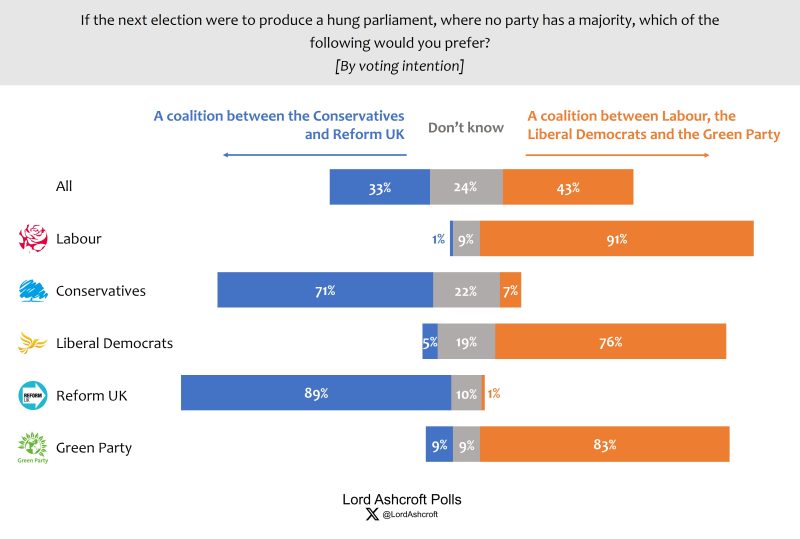

Overall, voters were more likely to say they would prefer a Labour-Lib Dem-Green coalition (43 per cent) than a Conservative-Reform coalition (33 per cent), with just under a quarter saying they didn’t know.
Those currently intending to vote Labour, Green and Lib Dem overwhelmingly preferred a coalition of their parties. On the other side, nearly nine in ten of those leaning towards Reform said they would prefer a coalition of their party and the Conservatives. However, only just over seven in ten of those intending to vote Conservative said they would prefer a coalition with Reform; more than one fifth of current Tories said they didn’t know which coalition they would prefer.
The Labour government
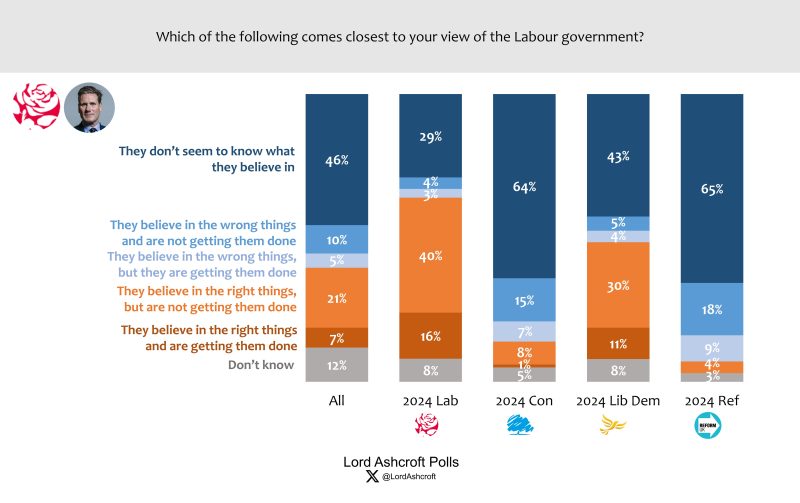

Only 7 per cent of voters overall (including only around one in six 2024 Labour voters) said they thought the current Labour government believed in the right things and was getting them done. A further one in five (including 40 per cent of 2024 Labour voters) thought the government believed in the rights things but were not getting them done. Nearly half of all voters, including nearly three in ten 2024 Labour voters, said the government did not seem to know what it believed in.
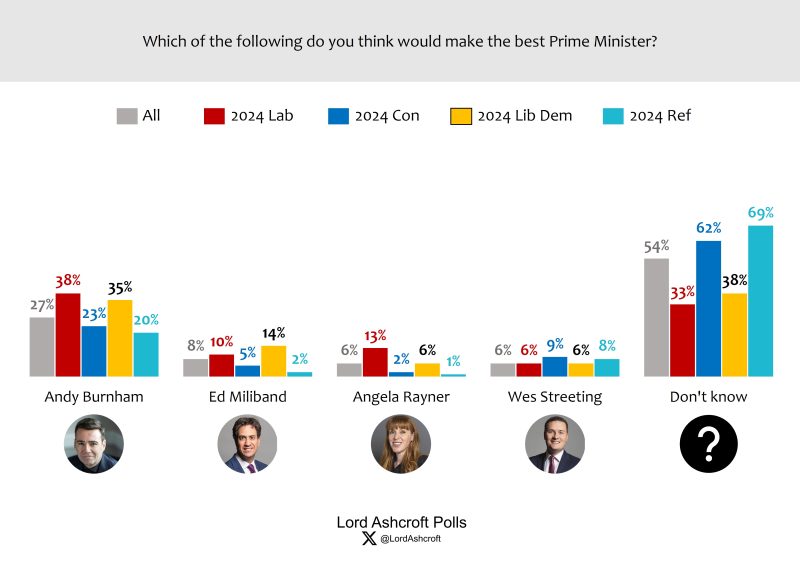

Among those spoken of as potential future Labour leadership contenders, Andy Burnham was comfortably ahead both among voters as a whole and among current and 2024 Labour voters. While there was little to choose between Rayner, Streeting and Miliband in the country as a whole, Labour supporters put Rayner in second place, with Streeting a distant fourth.
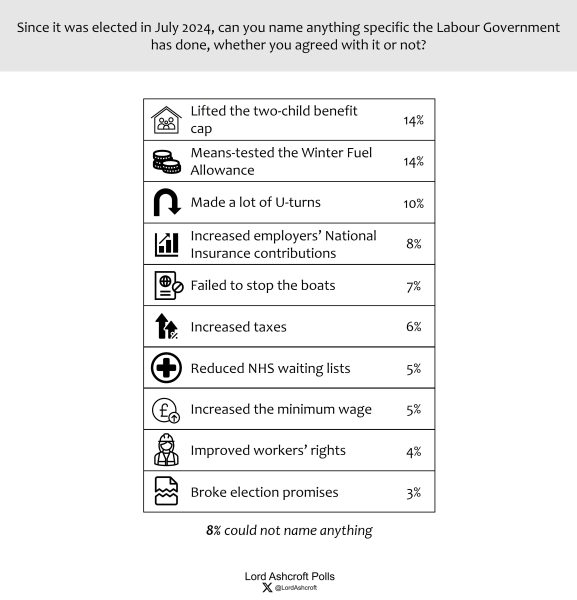

When we asked people to name without prompting what they remembered that the Labour government had done since being elected, the two most common answers were lifting the two-child benefit cap and means testing the winter fuel allowance. U-turns and raising employers’ National Insurance were next on the list.
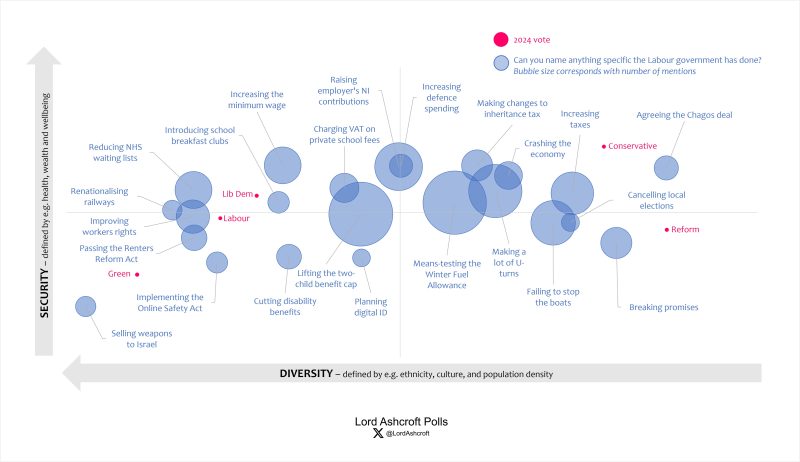

Our political map shows what kind of voters have noticed which government actions. Means testing the winter fuel allowance and lifting the two-child benefit cap both appear close to the centre of the map, showing they were recalled across the electorate rather than by any particular group. The Chagos Islands deal, U-turns and tax rises were most likely to be mentioned by those on Conservative and Reform-supporting side of the map, while the minimum wage, NHS waiting lists, rail renationalisation, workers’ rights and school breakfast clubs were more likely to be recalled in Labour, Lib Dem and Green territory.
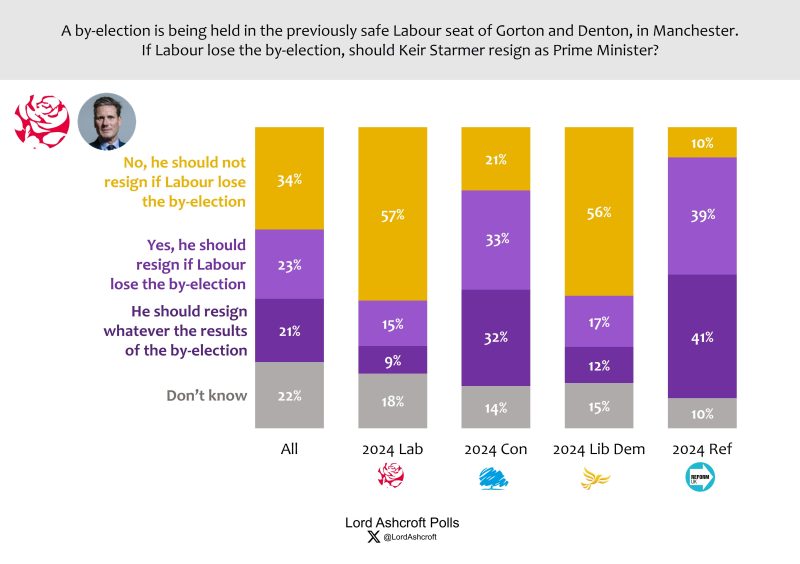

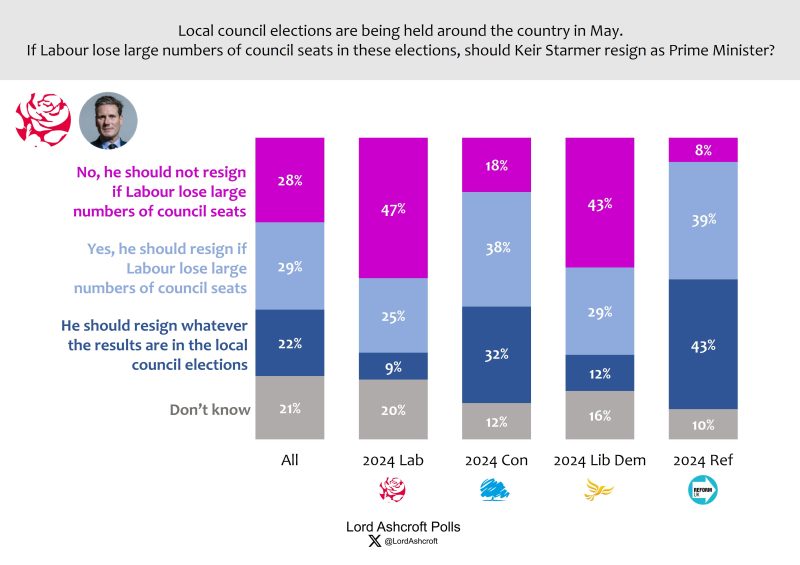

Slightly more said Starmer should resign if Labour badly in the council elections in May, with 28 per cent saying he should not. Again, just over one in five said he should resign whatever the local election results.
The pension triple lock
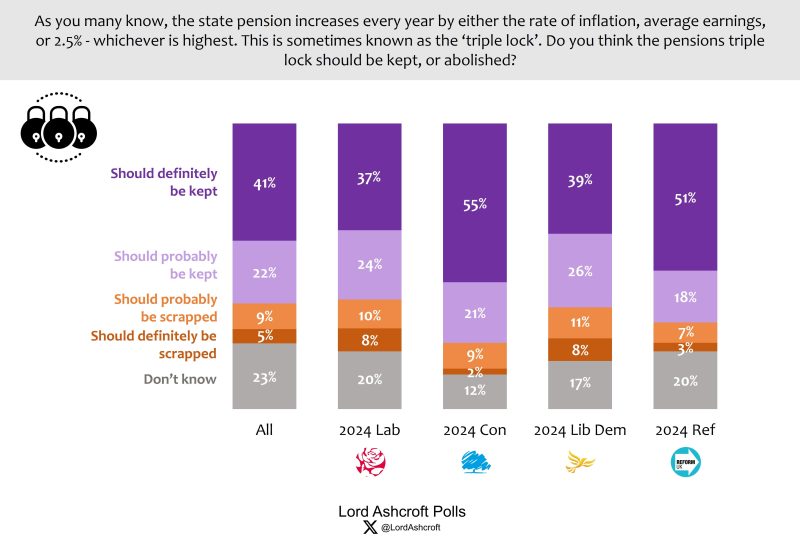

More than six in ten voters, including majorities of all parties’ supporters, said the pension triple lock should be kept. Nearly 90 per cent of those aged sixty-five or over said it should be kept, compared to four in ten of those aged 18-24.
Are Reform UK like the Conservatives?
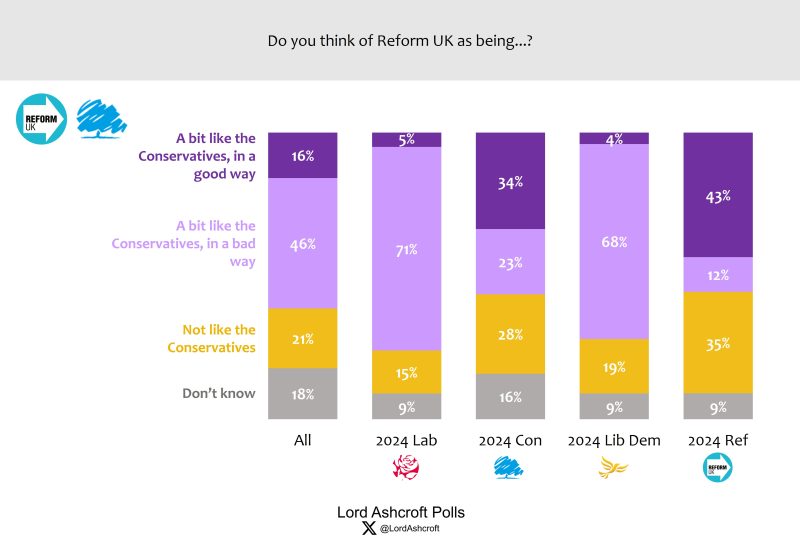

Just under half of all voters, including around three quarters of current Labour, Lib Dem and Green voters, said they thought of Reform UK as being a bit like the Conservatives, in a bad way. Just over half of those currently intending to vote Reform said they thought of the party as being a bit like the Conservatives in a good way, while just over one third of them thought Reform were not like the Conservatives.
Party momentum
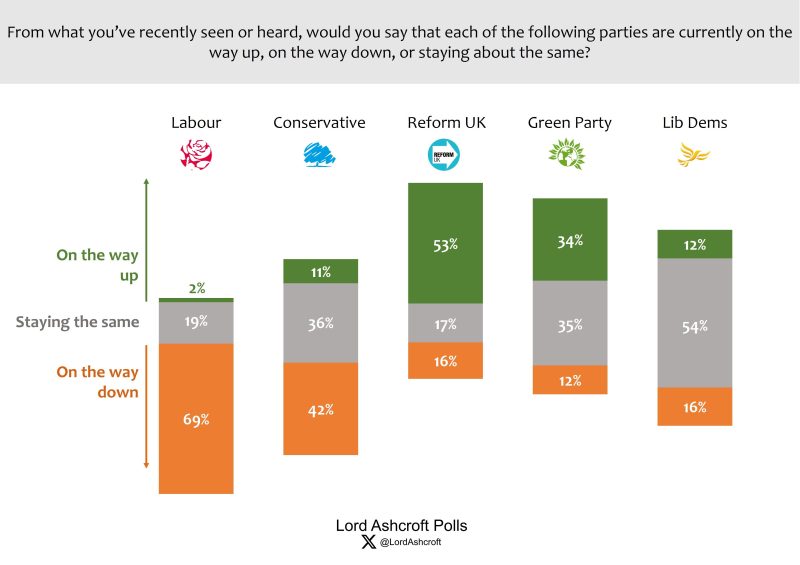
Reform UK were the party most likely to be considered “on the way up”, followed by the Greens. Nearly seven in ten said they thought Labour were on their way down, including a majority of those who voted Labour in 2024.
Female politicians
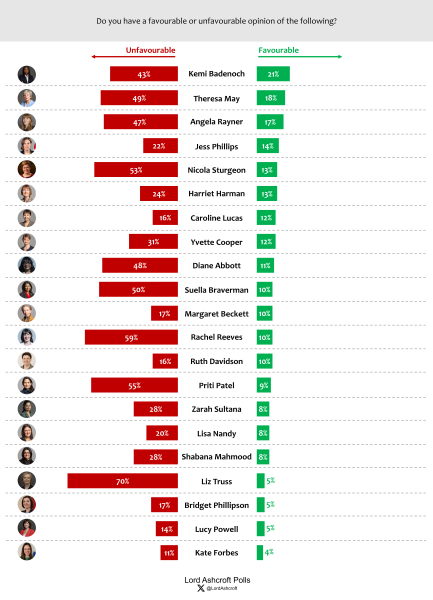

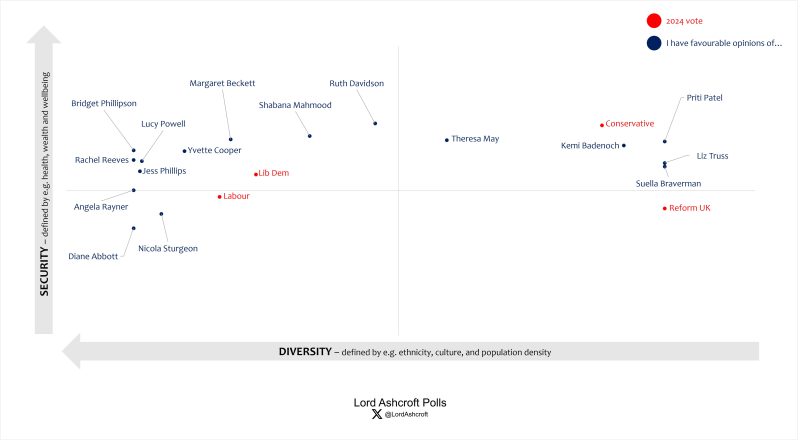
In advance of International Women’s Day, we asked how favourable people felt towards various current and recent living female politicians. Ranked in order of the proportion saying they had a favourable view, Kemi Badnoch topped the list, followed by Theresa May, Angela Rayner and Jess Phillips. Next were Nicola Sturgeon, Harriet Harman, Caroline Lucas and Yvette Cooper. Below, our political map shows how favourability towards these individuals is distributed across the population:

Trust on the economy
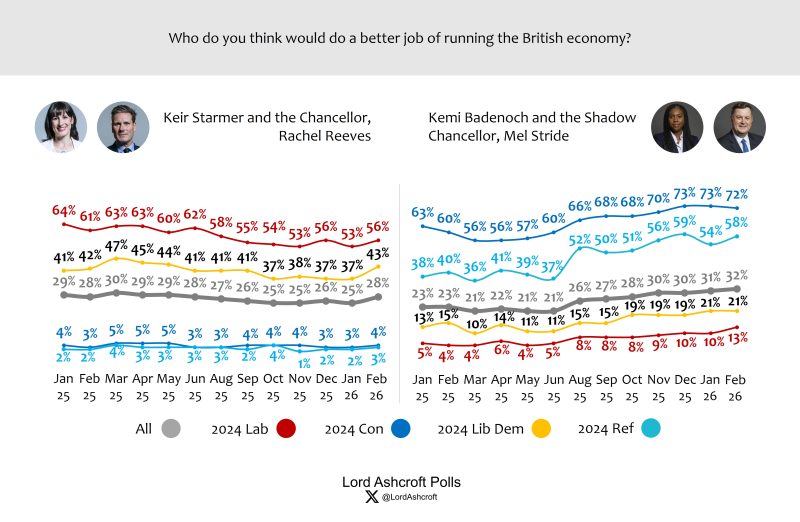

Asked who would do the better job running the economy, voters chose Kemi Badenoch and Mel Stride over Keir Starmer and Rachel Reeves by a 4-point margin, with 40 per cent saying, “don’t know”. Only just over half of 2024 Labour voters named the Labour team; more than seven in ten 2024 Conservatives chose the Tory team.
Best (and most likely) prime minister
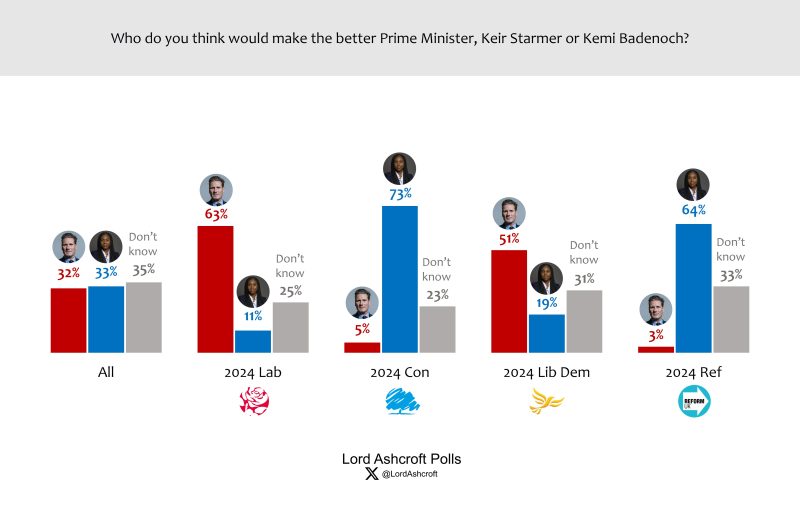

In a head-to-head question, Badenoch led Starmer by one point with just over one third saying “don’t know”. Just over six in ten 2024 Labour voters say Starmer would make the better PM, while nearly three quarters of 2024 Conservatives named Badenoch. Those who voted Reform UK in 2024 said they preferred Badenoch to Starmer by a 61-point margin, with one in three saying “don’t know”.
Given a choice between Starmer and Farage, voters as a whole chose Starmer by 13 points. 2024 Conservatives chose Farage over Starmer by 53 per cent to 15 per cent, while 2024 Labour voters chose Starmer by 75 per cent to 8 per cent. Lib Dems chose Starmer by a 58-point margin, and Green voters did so by 57 points.
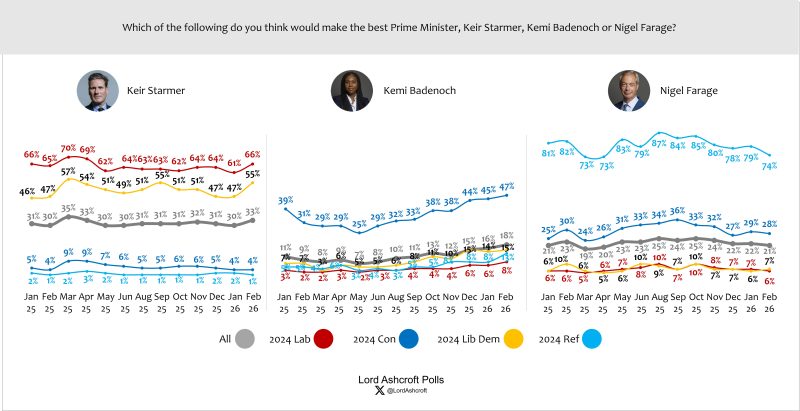

Offered a choice between Starmer, Badenoch and Farage, voters chose Starmer over Farage by a 12-point margin, with Badenoch in third place on 18 per cent. 2024 Conservative voters preferred Badenoch over Farage by a 19-point margin (up from 6 points in November), and 2024 Labour voters preferred Starmer over Badenoch by 58 points.
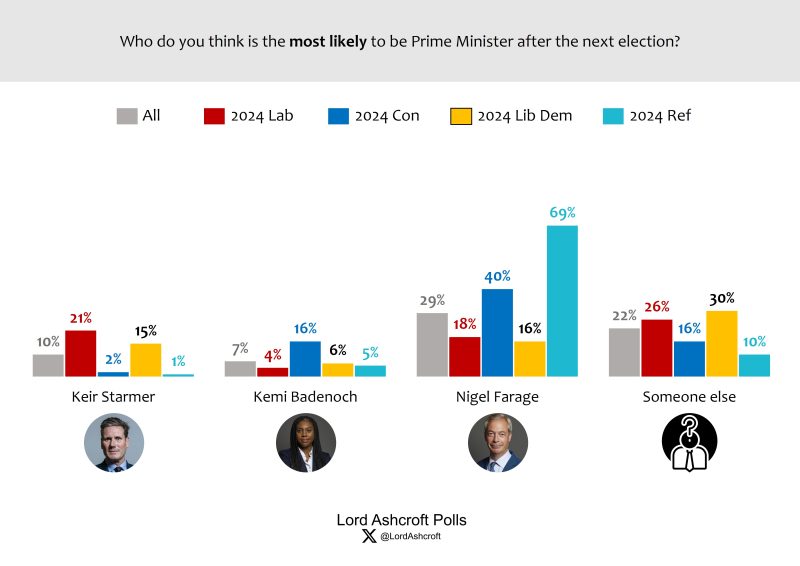
Nigel Farage was thought the most likely person to be PM after the next election, with 29 per cent naming him as the most likely candidate. Only one in ten thought Starmer would still be in the job and 7 per cent named Badenoch. More than one fifth thought someone other than these three would be PM. More than eight in ten of those currently intending to vote Reform thought Farage would be PM, compared to fewer than four in ten current Labour leaners who thought Starmer would be PM and just over a quarter of current Conservative supporters who thought Badenoch would have the job.
When we asked how likely people were to end up voting for each party at the next election on a scale from zero to 100, those who voted Labour in 2024 put their chances of doing so again at the next election at an average of 43/100. Those who switched to Labour in 2024 put their chances of voting for the party again next time at 34/100, and those who switched from the Conservatives to Labour in 2024 put their chances of voting Labour again next time at an average of 27/100. Looking at those more likely than not to vote for a particular party (those whose highest likelihood of voting for one party was at least 50/100), this implies current vote shares of Reform UK 22 per cent, Conservative 20 per cent, Green 19 per cent, Labour 17% per cent, Lib Dems 11 per cent, Others 10 per cent.
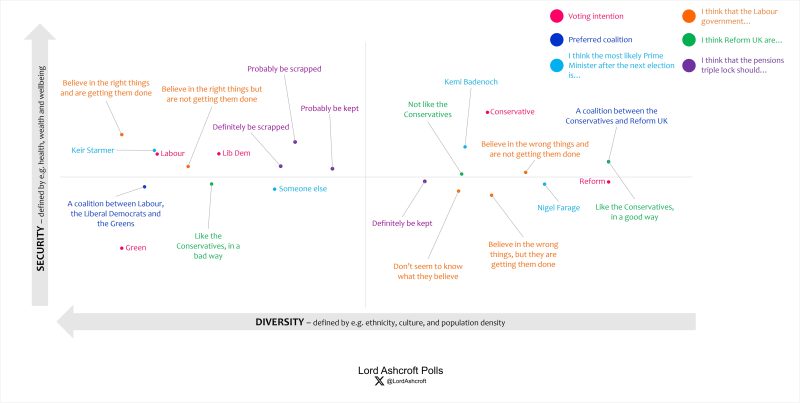

As above, our political map shows how different issues, attributes, personalities and opinions interact with one another. Each point shows where we are most likely to find people with that characteristic or opinion; the closer the plot points are to each other the more closely related they are. Here we see the distribution of opinion on the Labour government, the pensions triple lock, most likely prime minister and whether or not Reform are like the Conservatives.
Full data tables available at LordAshcroftPolls.com
You must be logged in to post a comment Login