
Politics
Met Police announced successful repression of antiwar protest

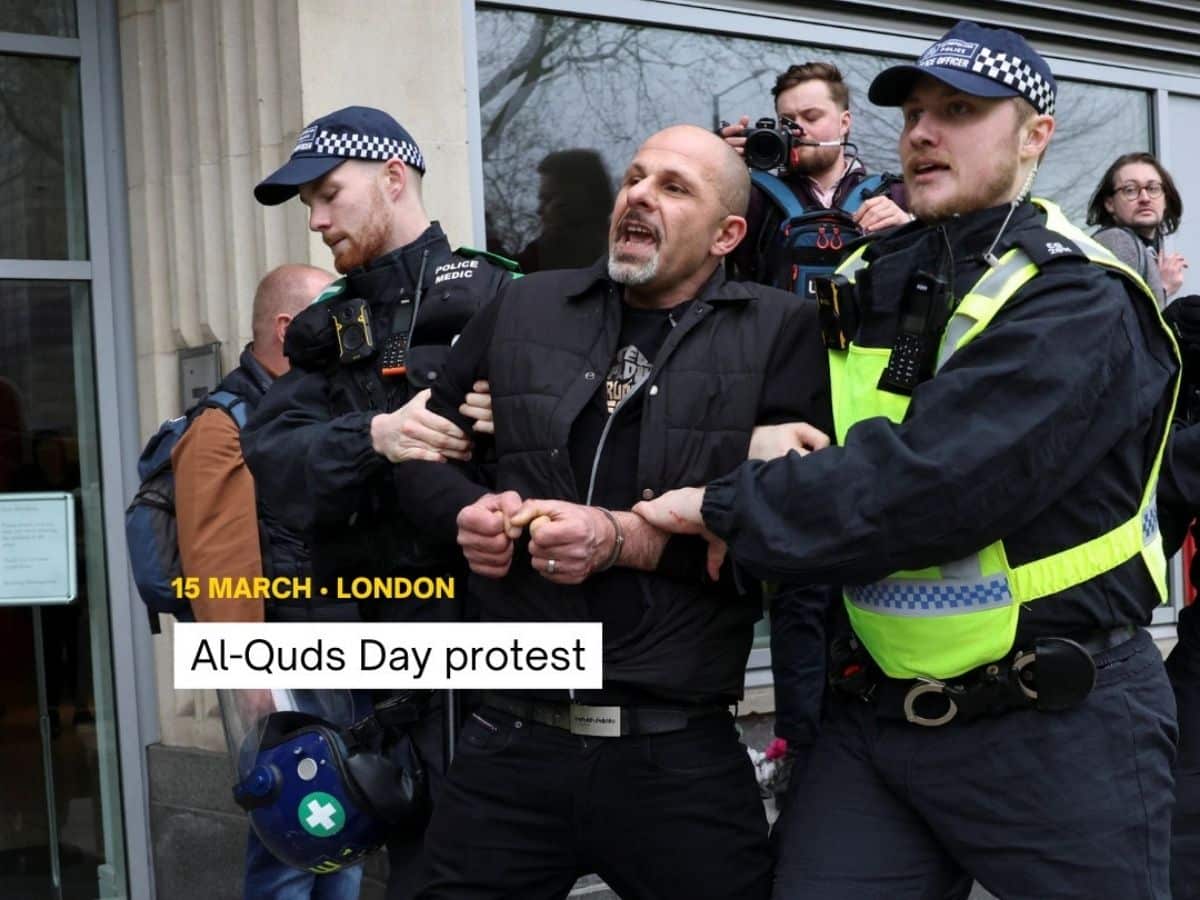
The Met Police has issued a statement praising itself for its decision to ban today’s London march against the Iran war. The force allied with the Israel lobby to ban the annual Al Quds Day march and limit it to a ‘static rally’. Then it boasted how great its decision had been because its repression of British citizens’ right to march in peaceful protest had caused some not to attend. It ended by thanking police officers for coming from all over the place to prevent an anti-war protest and “keeping protestors and Londoners safe”:
News – 15 March 2026 17:05
Public order update
Today’s policing operation at the Al Quds day protest and counter-protest concluded this afternoon.
Assistant Commissioner Ade Adelekan, Public Order lead said:
“Our policing plan worked, with both groups kept apart and we saw no attempts from either side to breach conditions by marching. Both sets dispersed as planned from 15:00hrs.
“We saw significantly fewer people attend than we had anticipated. The restrictions and conditions meant many people chose to stay away and not to attend the protest or counter-protest.
“This shows our decision to apply for the ban was the right one. A static protest meant it was easier for officers to keep the two groups apart and prevent serious public disorder.
“We made 12 arrests including for showing support for a proscribed organisation, affray and for threatening or abusive behaviour. We are also investigating chants made by a speaker at the Al Quds protest.
“As I said from the outset, the decision to ban the protest march does not set a precedent and we will continue to consider each protest on a case-by-case basis.
“I want to extend my thanks to the officers, including those from across the country who supported us. Their professionalism and commitment helped us to keep protestors and Londoners safe.”
Yeah, well done lads and lasses. You protected us all from the big bad mob that doesn’t want the UK to assist two genocidal regimes from killing people. Bravo 👍.
Met Police, happy to repress
The Met doesn’t say so in its statement, but the “chants made by a speaker” were rapper Bob Vylan repeating his Glastonbury 2025 “Death death to the IDF” chant. As well he might, since police and the CPS already looked at the exact same chant then and decided just four months ago, in December 2025, that the chant merited no further action. Ok then, ok now — unless of course the point is to smear the protest rather than to prosecute.
But the dishonesty ran even deeper. Both the anti-war protest and the several phone-booths worth of pro-war, pro-Israel counter-protesters were treated as if equal in size and significance — when in fact, tens of thousands still turned up to demand peace, despite police and state repression:
Contrast this with the open racism and tiny numbers of the pro-Israel hate-gathering:
Today, at the Al-Quds Day counter-protest in London, the Mossad-linked hate group “Stop the Hate UK” played a tune gloating about the death of Iran’s Supreme Leader.
They’re such incredibly sick and hateful people. pic.twitter.com/JhTeWwugBO
— Wokerati Marty (@WokeratiMarty) March 15, 2026
Contrary to its claims of keeping both ‘sides’ apart, sources at the scene said the Met also allowed far-right pro-Israel ‘auditors’ in among the peaceful anti-war protest.
In reality, the Met Police and its bosses in Whitehall and Downing Street are repressing the will of the British public. More than twice as many UK people oppose the US-Israel war of aggression on Iran. Almost as many oppose the Starmer regime allowing the US to use British airbases to attack Iran. Even more certainly would, if they understood that this enabling consists of directly refuelling and re-arming the carpet-bombing B-52 high-altitude bombers Trump is using to slaughter Iranian civilians:
Keir Starmer has turned Britain into a police state over the heads, and against the will, of the people of this country. He is a war criminal just as surely and just as guiltily as Trump, Netanyahu and their racist enablers.
Featured image via Middle East Eye


There’s a lot to be said for No-Mow May and other initiatives that encourage gardeners to leave some, or all, of their lawns wild. That can help wildlife to flourish.
But to maintain a healthy lawn, sometimes, a haircut is necessary.
Here are 11 rules to help you do it perfectly:
1) Wait for 7°C to start mowing…
Grass begins to grow at this temperature, so there’s no point cutting it when the weather’s any colder. Wait until it’s 7°C or warmer consistently to whip the strimmer out.
2) …And stop mowing at 6°C or lower.
The grass isn’t growing at those temps, which usually begin in late October.
3) Never mow a wet lawn
That can clog your mower, weaken your grass, and leave unsightly imprints.
4) Wait until any new grass is at least 5cm tall to cut it
Any shorter, and you risk “scorching” a new lawn.
5) Do your first mow on the highest blade setting, too
Even if you have an established lawn, do your first mow of the year on your mower blade’s highest setting. If you cut the grass too short early on, you increase the risk of disease, dehydration, and bare patches.
6) Mow at different rates according to season and lawn type
Per the RHS, the following schedule works for these lawns in spring and autumn:
- Conventional lawn: Every 1-2 weeks,
- Wildflower lawns or flower-rich meadows: Leave to grow wild.
- Conventional lawn: Weekly, unless in drought; then, mow fortnightly or less,
- Wildflower lawns or flower-rich meadows: Every 4-6 weeks,
- Long-grass lawns: 1-2 times per summer.
It’s not usually necessary to cut lawns in winter.
7) Follow the one-third rule
Regardless of whether it’s your lawn’s first-ever cut or your third strim of the summer, don’t cut off more than a third of the grass’s height at once.
Even established lawns risk forming clumpy, unpleasant patches and becoming weaker if you cut off a high proportion of their height all at once.
8) Keep your mower blades sharp and clean
Blunt mower blades and mower blades with lots of clogged-up grass in them can make mowing your lawn harder and less effective. Always ensure your mower is switched off before going anywhere near blades, and seek specialist help for cylinder mowers.
9) Skip the job in May
We mentioned No-Mow May before. It involves not cutting your lawn in the month and can boost wildlife, but it doesn’t have to be all or nothing; a “low-mow May,” meaning you mow some parts of your garden but leave others wild, can help too.
10) Clear the lawn before mowing
Check for loose stones and hidden objects, like toys and bulbs, in the garden before mowing. Clear them along with any garden furniture before beginning the task.
11) Change direction every month or so
If you change the direction you mow in about once a month, you’ll be able to cut any blades of grass you’d previously missed and can avoid unsightly wheel ruts.

Police in England are still making arrests and investigating ‘illegal’ pregnancy terminations, according to the responses to a Guardian Freedom of Information (FOI) request.
That’s in spite of the fact that legal amendments decriminalising abortion are currently passing through parliament. The move was part of Labour’s Crime and Policing Bill, submitted by backbencher Tonia Antoniazzi. In June 2025, it progressed with a massive 379 votes in favour, versus just 137 against.
Abortion: ‘Victorian-era law’
The dystopian treatment of women continues under this Victorian-era law despite the House of Commons being clear that this has no place in modern society. The police and wider criminal justice system cannot be trusted with abortion law.
Women have been targeted, vilified and imprisoned following complications in their abortion treatment, miscarriage, stillbirth or premature labour. Forced to endure acute trauma at the worst moments of their lives for absolutely no reason, because criminalisation is completely unnecessary for upholding abortion law and safeguards.
The amendment would decriminalise abortion in England and Wales. This means that an individual could no longer be prosecuted for obtaining a termination, whether within or outside of a legal framework. However, the popular change has not yet passed into law.
Currently, the framework sets limits on the timeframe for an abortion, and requires two doctors’ signatures. The proposed amendments would do nothing to alter this legislation.
‘Utmost sensitivity and compassion’
The Metropolitan Police and Nottinghamshire Police both responded to the Guardian’s FOI. Both confirmed that, between June and January, they had made arrests over suspected illegal terminations.
However, abortion providers also highlighted the fact that we’re not seeing the full picture from these responses. They stated that they were aware of arrests by polices forces which refused the FoI. Worse still, some of the forces which did respond also made arrests for illegal termination, but didn’t record the cases under relevant legislation.
A spokesperson for the National Police Chiefs’ Council said:
Police do not routinely investigate unexpected pregnancy loss. An investigation is only initiated where there is credible information to suggest criminal activity, and this would often be because of concerns raised from medical professionals.
Each case would have a set of unique factors to be assessed and investigated depending on its individual circumstances.
It would be at the discretion of the senior investigating officer leading the case to determine which reasonable lines of enquiry to follow, again depending on the merits of the specific case.
We recognise how traumatic the experience of losing a child is, with many complexities involved, and any investigation of this nature and individuals will always be treated with the utmost sensitivity and compassion.
That claim of the “utmost sensitivity and compassion” is a bare-faced lie.
Inappropriate, insensitive and harmful
Jonathan Lord, a co-chair of the Royal College of Obstetricians and Gynaecologists’ abortion taskforce, explained:
It is the investigations that cause most harm; few progress to charging and fewer still to prosecutions.
The police and CPS have shown consistently – in multiple areas and in numerous cases – that they do not act appropriately or with sensitivity. In several cases they have only targeted the woman, and not investigated potential abuse by a coercive partner.
In one case, police arrested a woman in her 40s, who had safeguarding concerns and a history of being targeted by domestic abuse.
She called an ambulance after delivering a foetus still inside its gestation sack. Paramedics found her panicking and hyperventilating. Despite believing that she was still early in the pregnancy, the foetus was found to be around the 24-week mark.
Her children witnessed their mother’s arrest, and were forced to leave their home over Christmas whilst police searched the house.
‘What happened was horrifying’
In another case, a woman miscarried at 17 weeks, shortly after arriving in hospital. Staff called the police after finding tablets in her vagina. At the time, a clinician claimed that:
When I called the police, I really thought they would offer her support and protection. What happened was horrifying.
Cops arrived to arrest her whilst she was still in the delivery suite, in spite of her denial of seeking an abortion. Officers searched her home while she was detained on the ward. They confiscated devices that the woman used to monitor her unstable diabetes, which is notoriously difficult to control after pregnancy.
The woman later said that she felt unsafe around both police and the NHS, following their betrayal of her trust.
Harriet Wistrich, chief executive of the Centre for Women’s Justice, stated that:
In some of the cases we have seen women being arrested from hospital shortly after the abortion when they may be extremely traumatised and certainly there is no need to arrest them then and there.
But arrest, investigation and charging will be determined by two tests – is there sufficient evidence that an offence has been committed and if so is it in the public interest. There is a strong argument to make that in circumstances where the House of Commons have voted by a large majority to stop criminalisation, that discretion should be exercised in the public interest not to arrest.
‘A historic opportunity’
Louise McCudden, head of external affairs at MSI Reproductive Choices UK, said:
We know from providing reproductive healthcare across six continents that criminalisation harms women and makes abortion less safe. The House of Lords now has a historic opportunity to end the threat of prosecution once and for all, pardon women who have been previously convicted and drop ongoing investigations.
At a time when we are seeing rollbacks in reproductive rights around the world, most notably in the US, it’s encouraging that our parliament is standing up for women.
On 18 March, the House of Lords will debate Antoniazzi’s abortion decriminalisation clause. The proposed amendments run the gamut from striking the clause altogether, to halting ongoing police investigations, and even pardoning people who were already convicted under the previous law.
Investigations for suspected illegal terminations serve only to deepen the distress of the victims of heavy-handed policing. Our parliament must show their compassion by passing Antoniazzi’s amendment – or confirm themselves willing participants in the degradation of reproductive rights.
Featured image via the Canary

The NHS is one of Britain’s most cherished institutions, providing care to millions of patients each year. Yet questions remain about whether every resource is directed towards its core purpose of treating patients. One example is a law predating the NHS that requires it to pay out vast sums each year for private treatment that may never be used.
This is the real-world consequence of an obscure provision: Section 2(4) of the Law Reform (Personal Injuries) Act 1948.
The provision requires courts, when awarding compensation for clinical negligence, to disregard NHS care and assume the claimant will use private healthcare. Yet nothing in law obliges the claimant to do so. Someone injured through negligence may receive compensation for private treatment but still return to the NHS – effectively charging the NHS twice. Repealing this provision would not force claimants to automatically return to the NHS for their future care. Rather, it would allow courts to decide what is reasonable in each case.
The Act was introduced to modernise personal injury law. Yet unlike many other legacies of the Attlee ggovernment, this change has failed to stand the test of time. Much of the Act has since been repealed or replaced. The survival of Section 2(4) is therefore all the more puzzling.

MDU warns Chancellor clinical negligence system ‘not fit for purpose’

Northern Ireland RE curriculum is ‘indoctrination’ – Supreme Court
When Section 2(4) was drafted, the NHS was only just being established, and the healthcare landscape looked very different. Private treatment was more common, and the idea of a universal health service untested, so the provision could be justified. In today’s world, it no longer makes sense.
In practice, courts must calculate the cost of private treatment even when the claimant has no intention of using it, and even when equivalent NHS services are available. This inflates settlements and creates a financial burden that falls on the public purse. Every pound spent here is a pound diverted from frontline healthcare.
The problem has been recognised for decades. In 1973, a Royal Commission – commonly known as the Pearson Commission – examined the issue and recommended repealing Section 2(4) when it reported in 1978, warning of the risk of double payment. But by then Jim Callaghan was in Downing Street without a workable majority, and the proposal went nowhere.
Calls for repeal persisted. The matter resurfaced repeatedly in parliament, and in the 1990s Rosie Barnes introduced a private member’s bill to abolish the provision, backed by figures including Tony Blair, Jeremy Corbyn and Charles Kennedy. Like most such bills, it ultimately failed to progress.
Today the stakes are even higher. The current clinical negligence framework – including Section 2(4) – is contributing to spiralling costs. In 2024/25 the NHS in England spent £3.6 billion on clinical negligence, according to the latest National Audit Office (NAO) report. This figure is projected to exceed £4 billion a year by the end of the decade. Patients harmed by negligence must receive appropriate compensation, but it’s difficult to deny that our current system is costing more than necessary, in part because of this law.
Escalating costs have brought renewed attention to Section 2(4). Late last year, the National Audit Office recommended re-examining the provision. The public accounts committee followed in January, urging the government to set out within six months what legislative steps it will take to address this outdated law.
Support is also growing across the political spectrum. Since the General Election, MPs and peers from Labour, the Conservatives and Liberal Democrats have raised questions about the provision’s future. The tide is clearly turning in favour of reform.
This week a bill introduced by Catherine McKinnell will directly address Section 2(4) as part of a wider package of clinical negligence reforms. It is the first such legislation in years, and parliament should seize the opportunity.
With cross-party support, authoritative reports and legislation now before parliament, the question is simple: why not act now?
Politics.co.uk is the UK’s leading digital-only political website. Subscribe to our daily newsletter for all the latest news and analysis.

Sinners cinematographer Autumn Durald Arkapaw made Oscars history last night. She’s the first woman to win an Academy Award for Best Cinematography, and on receiving the accolade, she invited women in the audience to stand with her.
Of course, plenty of other women have won in non-gendered Oscars categories (ie, not “best actress,” which, of course, women have always won).
Cassandra Kulukundis, for instance, just won the new Best Casting Oscar category for One Battle After Another; Kate Hawley snagged the Costume Design win for Frankenstein, too.
But given that the Oscars have been running for almost a hundred years, a woman winning in this specific category may seem a little, well, late.
In fact, the first woman to even be nominated for best cinematography – Rachel Morrison, whom Arkapaw shouted out in her speech – reached the coveted status in 2018.
The American Society of Cinematographers didn’t accept its first woman member until 1979, 60 years after it was founded.
Women made up 7% of cinematographers working in the top 100 films in 2025, compared to 28% of producers, 20% of writers, and 10% of directors. In the same year, 75% of the top-grossing 250 films employed 10 or more men in “pivotal behind-the-scenes roles”, while only 7% did the same for women.
With that in mind, it might not be so shocking to learn that many other non-gendered categories were later to award women than you might realise.
The first year a woman won an Oscar in every non-gendered category
In order of oldest to most recent, here are the first years in which a woman won a non-gendered Oscars category:
-
Best Original Screenplay (1930) – Frances Marion – The Big House
-
Best Adapted Screenplay (1933) – Sarah Y Mason – Little Women
-
Best Original Song (1936) – Dorothy Fields – The Way You Look Tonight’s ‘Swing Time’
-
Best Film Editing (1940) – Anne Bauchens – North West Mounted Police
-
Best Costume Design (1948) – Dorothy Jeakins Karinska – Joan of Arc
-
Best Production Design (1948) – Carmen Dillon – Hamlet
-
Best Documentary Feature (1955) – Nancy Hamilton – Helen Keller in Her Story
-
Best Short Film (Animated) (1962) – Faith Hubley – The Hole
-
Best Short Film (Live Action) (1969) – Joan Keller Stern – The Magic Machines
-
Best Documentary Short Subject (1972) – Martina Huguenot van der Linden – This Tiny World
-
Best Picture (1973) – Julia Philips – The Sting
-
Best Makeup and Hairstyling (1982) – Sarah Monzani and Michèle Burke – Quest for Fire
-
Best Original Score (1983) – Marilyn Bergman – Yentl
-
Best Sound Editing (1984) – Kay Rose – The River
-
Best Visual Effects (1986) – Suzanne M. Benson – Aliens
-
Best International Feature Film (1995) – Marleen Gorris – Antonia’s Line
-
Best Director (2008) – Kathryn Bigelow – The Hurt Locker
-
Best Sound (2010) – Lora Hirschberg – Inception
-
Best Animated Feature (2012) – Brenda Chapman – Brave
-
Best Cinematography (2026) – Autumn Durald Arkapaw – Sinners.

The charity StepChange have raised alarm bells at the ever-increasing debts facing ordinary people from essential services in the UK. Pointing to housing, utilities, and council tax, they highlight how low-income households face rising arrears through unavoidable cost increases.
Costs have increased yearly in response to poor investment and bad management with increases imposed by local government and regulators. With the US‑ and Israeli‑led conflict in Iran driving up global energy and living costs, those costs are likely to rise even further. Now, the debt charity is urging the government to step in with stronger support and intervention.
Subsequently, StepChange called on the government to take action to prevent households from falling further into debt simply to meet essential costs. Pushing for national social tariffs for energy and water, Chief Executive Vikki Brownridge stated they would:
bring costs back down to a level that is affordable for those with low incomes or high needs.
High levels of debt on essential UK bills are the ‘new normal’, warn campaigners
StepChange’s data shows there were significant numbers of households behind with energy bills, even though prices had fallen from the highs of 2022. Over a third of clients were in debt to energy… pic.twitter.com/ygGA7TIFkf
— ECIU (@ECIU_UK) March 16, 2026
Debts: fleecing ordinary people is the ‘new normal’
Despite a much-needed slower rise in rent and mortgage costs, StepChange described how its clients are increasingly falling behind on meeting exorbitant household bills. Furthermore, the debt charity pointed out that rent and mortgage arrears have increased by 15% and 22% respectively. This just goes to strengthen the argument that bills are reaching impossible levels that ordinary people are being priced out of essential services.
Moreover, the brutal and illegal war of aggression against Iran will inevitably push the cost of living even higher, making life more backbreaking for those already struggling to survive. Low-income households and people with greater needs, particularly the disabled community, will suffer the most because the super-rich owners of our utilities are driving up prices they cannot afford to bear.
People will run out of money, but their needs won’t vanish with their savings. The concern grows even greater for disabled and older communities, whose essential needs cannot simply be ignored or scaled back.
StepChange’s data shows there were significant numbers of households behind with energy bills, even though prices had fallen from the highs of 2022. Over a third of clients were in debt to energy companies, which was down from 40% in 2024, but the average debt had grown by £220 to £2,560.
Two in five of the clients seen by the charity over the year were receiving universal credit, and three in five lived in rented accommodation.
Vikki Brownridge, CEO of StepChange, said:
The reality is that rising essential bills and with that rising arrears types across housing, energy, and consumer credit debt, have become the new normal for many households.
The cost of everyday essentials remains prohibitively high for many households, and our client data has reflected this pressure for several years. Rising household arrears show little sign of slowing down.
Debt Awareness Week 2026
People have faced relentless increases to essential services and goods which have left budgets at breaking point for many. With the costs imposed being related to essential services and needs, people are forced to look into high-interest debts through loans and credit cards. This can only exacerbate the misery in daily life for struggling households across the UK, as debts just continue to grow.
Due to the devastating impacts of debt, campaigners have designated this week as ‘Debt Awareness Week‘, purposed to raise awareness of its inevitable harms and push for necessary change.
We wrote recently about how a significant number of ordinary people are left with just £25 a week after meeting their bills. Highlighting how difficult life has become for British people, James Wright wrote:
The neoliberal system leaves 40 percent of Britons with less than £25 at the end of each week, a survey by the Cost of Living Action (COLA) group has found. This is a pittance and unlikely to stretch far under the cost of living crisis, where even employed people are finding themselves out of pocket.
Our money will run out, our needs will not
This issue is urgent and is only becoming more entrenched in British society which will only make it harder to remedy. Calls to move away from privatisation have long been made however leaders refuse to listen. Instead, they bow to super rich shareholders and punish ordinary people.
With councils across the country increasing council tax by approximately 5%, the government must finally reckon with the very real struggle facing families and vulnerable people across the country. After all, budgets disappear and money runs out, but essential needs do not.
Essential services should never operate for profit. All they have done is give the super-rich a captive market to fleece.
Featured image via the Canary

UN experts have slammed the illegal US-Israel war on Iran. And as the UK government fails to reflect public opposition to British involvement, one newspaper is putting others to shame with its firm and honest coverage.
US-Israel war is “entirely illegal” and the media must stop covering for it
Most establishment media outlets have either been putting out war propaganda or sidestepping key context like:
The National, however, has been representing the public interest and amplifying public opposition. And it has put this sentiment front and centre:
Tomorrow’s front page 📰
Poll finds majority oppose use of Scottish airports by US to wage war on Iran pic.twitter.com/W1JEWgnX14
— The National (@ScotNational) March 12, 2026
And they’re right to highlight this. Because although the UK and other Western governments have tried to get us to ignore international experts since 2023, the UN has been clear that the US-Israeli aggression against Iran and Lebanon is “entirely illegal”, insisting that:
U.S. and Israel should stop waging and expanding wars, and considering themselves as above international legality.
I have issued this press release with fellow UN experts about the aggression against Iran and Lebanon and the need to end the impunity of powerful States that consider themselves above the law. https://t.co/9pYqyWaWAU
— UN Special Rapporteur on the right to housing (@adequatehousing) March 12, 2026
The experts also called for an end to the “total impunity” the US and Israel have had. And they’ve said that no behaviour within Iran justifies waging a potentially “catastrophic” war of aggression:
Independent human rights experts condemn the ongoing military assaults on Iran & Lebanon as “flagrant violations of international law.”
“The conflict risks engulfing the wider region in catastrophic armed violence, threatens to set yet another precedent of total impunity.” 1/3 pic.twitter.com/tWZchA0qZw
— United Nations Geneva (@UNGeneva) March 13, 2026
“The orders issued to the inhabitants of South Lebanon & southern Beirut to leave their homes are blatantly illegal. Combined with heavy and indiscriminate bombardment, these orders have resulted in the forced displacement of at least 700,000 people.” 3/3https://t.co/ANOMFnMtzL
— United Nations Geneva (@UNGeneva) March 13, 2026
Amnesty International, meanwhile, has asserted that:
All states, including the UK, must refrain from any conduct that could fuel further violations.
States have a clear obligation not to aid or assist internationally wrongful acts and a duty to bring such breaches to an end.
International humanitarian law is clear: military actions must not cause disproportionate harm to civilians or damage civilian objects.
The protection of civilians must be at the centre of all military decisions.
Attacks on energy infrastructure risk devastating civilian… pic.twitter.com/IpOCJ7KA6g
— Amnesty UK (@AmnestyUK) March 12, 2026
The UK government, however, continues to ignore its duties in service of the US and Israel:
This is what British complicity in an illegal war looks like. https://t.co/avM4sdZuZ2
— Jeremy Corbyn (@jeremycorbyn) March 12, 2026
It is absolutely possible to take a stand for international law and peace, as Spain has shown. And to push our own government to act in this way, we desperately need more media outlets like the National which are willing to represent the public interest rather than the interests of US-Israeli war criminals.
Featured image via the Canary

Vladimir Putin’s foreign minister has mocked Donald Trump for “miscalculating” his strikes against Russia’s ally, Iran.
The US president launched a coordinated attack with Israel against the Middle Eastern country at the end of February, killing Iran’s supreme leader Ayatollah Ali Khamenei.
But Tehran has still not folded – despite Trump’s claim that the US has already “won”.
Iran has instead caused widespread chaos by targeting US military bases in the Middle East and effectively closing a major oil shipping lane in retaliation.
Speaking to reporters on Monday, Russian foreign minister Sergei Lavrov said: “If they [the Americans] thought they could subjugate [Iran] in a day or a few hours, they probably realise now just how seriously they miscalculated, how wrong they were.”
This dig comes days after Trump controversially chose to temporarily ease sanctions against Russia to free up its oil exports, upending united western efforts to punish Putin over his invasion of Ukraine.
The US president hoped this would help bring the global oil price down.
But allies, including the UK, have made it clear they will not follow suit.
Lavrov’s remarks are also surprising because Russia has been mocked for once claiming it could seize Ukraine in a matter of days.
Despite invading in February 2022 and enduring more than a million casualties, Putin controls just a fifth of Ukraine’s sovereign land.
Russia was humiliatingly repelled from the capital Kyiv in the first weeks of the conflict and has not even been close to seizing since.
Putin is in a bizarre position when it comes to the Middle East war, even as he tries to position himself as a “global peacemaker”, according to the UK’s Ministry of Defence.
Moscow has consistently defended Tehran over the last few weeks and some reports suggest the new Supreme Leader was even flown to Russia for private medical treatment.
The UK’s defence secretary John Healey suggested Putin’s “hidden hand” is clear in Iran’s war tactics, as Iranian’s tactics replicate Russian strategies.
Yet, after Trump’s easing of sanctions, the decline in oil coming from the Middle East evidently has boosted interest in Russia’s own cheap exports.
Trump’s focus on Iran has reduced American pressure on Moscow to end its own war against Ukraine, too.

Doctors and human rights groups are demanding that NHS trust bosses stop using a ‘nothing special’ patient data management platform provided by ‘murder tech’ firm Palantir.
Disgraced Blairite peer Peter Mandelson pushed for Palantir to receive huge UK government contracts, without a competitive process. The Starmer regime awarded them despite – or because of – the firm’s involvement in Israel’s genocide. Despite, too, the fact that Palantir’s bosses are linked to serial child-rapist Jeffrey Epstein. And boast about using their systems to murder people they don’t like and musing about spraying others with fentanyl-laced piss.
Palantir OUT
The so-called ‘Federated Data Platform’ (FDP) gives Palantir access to patients’ information from all parts of the NHS, supposedly so hospitals can provide more effective treatment more efficiently. But medics and campaigners say there’s “nothing special” about Palantir’s system and no particular benefit to using it – and they decry the government’s “drive” to push hospitals to use it.
Human rights group Amnesty has asked the NHS and all public bodies to dump Palantir completely. Its AI and human rights researcher Matt Mahmoudi said the firm:
has a track record of flagrantly disregarding international law and standards, both in the violations of the human rights of migrants in the United States, which it risks contributing to, and its ongoing supply of artificial intelligence products and services to the Israeli military and intelligence services.
Dr Rhiannon Mihranian Osborne said the company’s involvement is destroying trust in the NHS among patients and staff. She said health workers want the system dropped completely to:
put the interests of patients and workers above American big tech corporations. We know the rollout isn’t going to plan – NHS analysts have told us the software offers nothing special, implementation costs are spiralling and the drive to adopt Palantir tech risks pushing out local, trusted data solutions.
Featured image via the Canary

!function(n){if(!window.cnx){window.cnx={},window.cnx.cmd=[];var t=n.createElement(‘iframe’);t.display=’none’,t.onload=function(){var n=t.contentWindow.document,c=n.createElement(‘script’);c.src=”//cd.connatix.com/connatix.player.js”,c.setAttribute(‘async’,’1′),c.setAttribute(‘type’,’text/javascript’),n.body.appendChild(c)},n.head.appendChild(t)}}(document);(new Image()).src=”https://capi.connatix.com/tr/si?token=19654b65-409c-4b38-90db-80cbdea02cf4″;cnx.cmd.push(function(){cnx({“playerId”:”19654b65-409c-4b38-90db-80cbdea02cf4″,”mediaId”:”a74eac74-008d-44ff-a2f9-46a9b222f1e6″}).render(“69b80f53e4b0fa6e89808b19”);});

In response to the Iran conflict, fossil fuel prices are yo-yoing faster than the UK prime minister’s policy agenda. Roughly 20 per cent of the world’s supply of oil and natural gas passes through the Strait of Hormuz, a chokepoint separating Iran from the Gulf States. Unfortunately, much of that passage sits squarely within range of Iranian missiles and drones.
Oil prices have risen sharply again after a brief period of tranquility last week. Traders either believed the conflict would end soon, or they thought that alternative supplies would soon come on stream. But both options were always uncertain – particularly the former. Trump’s promise to end the war quickly is, at the end of the day, a Trump promise. There are Persian sand dunes with more consistency and permanence.
Given this uncertain state of affairs, wouldn’t a country with an established oil and gas sector be crazy, bordering on reckless, to stand in the way of developing it as fast as possible? Apparently not. According to UK energy secretary Ed Miliband, the latest war in the Middle East is ‘yet another reminder’ that the ‘only route to energy security and sovereignty’ is Net Zero. It is further proof, Miliband said, that the UK must ‘get off our dependence on fossil-fuel markets, whose prices we do not control, and on to clean homegrown power we do’.
Miliband’s statement shows that the weakest arguments deployed in 2022 – when Russia’s invasion of Ukraine caused global energy prices to skyrocket – are making a return. Fossil fuels are too expensive, no one wants to invest and it’s a depleted basin anyway, we are told. Plus, domestic production can’t affect prices, the future is electric, the public doesn’t like it, a ladder fell over during test drilling and greedy corporations are profiteering. And will no one think of Greta’s sad face as she pines for the fallen ayatollah on her next diesel-yacht jolly to a warzone?
The reality is this. The UK uses oil and gas for around 75 per cent of its energy needs, just over half of which is imported. We will continue to use oil and gas for decades to come, and access to secure supplies remains an imperative, wherever it comes from. The alternative is lights out and heating off in winter, not a utopian counterfactual of nymphs frolicking in meadows around windmills. If resources come from the UK’s own soil or seabeds, we can ensure they are drilled to our own standards, and that we reap the benefits – both through economic activity and tax.
If it’s imported, we cannot. We instead pay the taxes and wages for others and consume a grubbier product, emitting 50 per cent more CO2. This is moronic. ‘Leave it in the ground’ isn’t a policy stance. It is an admission of being so blind in your pursuit of a cleaner, greener world that you’re prepared to deliver a dirtier, greyer one to avoid making adult choices.
But what about our genius Net Zero mission and clean power plan? Surely three to four fossil-fuel crises in 50 or so years are an endorsement of this strategy? Not really. Net Zero means trying to replace gigawatts of reliable power from old nuclear, coal and gas as fast as possible with wind and solar and, much later, any new nuclear power that can get past British regulations. The fly in the ointment – or cod trapped in a fish disco, if you prefer – is that wind and solar power also rely on gas.
By now, it should hardly need stating that weather-dependent power is unreliable and infirm. When the wind isn’t blowing and the sun isn’t shining, our energy is provided by gas – kept on standby at vast expense, to ensure power grids can keep running on overcast and windless days. Renewables also require a vast amount of land and infrastructure. That infrastructure of wire, concrete, steel, solar panels and turbines relies on fossil fuel-intensive manufacturing and mining. This is also true of hypothetical future solutions like batteries and hydrogen, neither of which are remotely viable at scale at present.
This is why our energy prices continued to rise after oil and gas prices fell in 2023-24. It was what the system costs. Selling sunlight and breezes to the public as free energy – without mentioning the cost of capturing, converting, connecting, balancing, storing, financing and backing them up – was always a catastrophic folly.
The obvious low-carbon substitute is nuclear. If we build it under a sensible regulatory regime, it can compete with both gas and older renewables. If we can do that cost-effectively in a decade hence, why load the grid with gas-dependent renewables capacity today? It is the height of absurdity.
So what can be done about the latest, inevitable energy crisis? It would be good if the government had a plan. One where predictable policy levers are pulled in reaction to the length and extent of the higher prices. This does exist at the extremes – there are emergency plans for grid failure, and the civil disorder that may follow. But solutions to exorbitant energy prices caused by the shocks we are now witnessing are thin on the ground. So here are some suggestions.
Short-term, it is easiest to bring down pump prices for transport. With roughly 65 per cent of people commuting by car and over 90 per cent of those not in electric vehicles, cutting fuel duty, cutting the VAT rate from 20 per cent to five per cent and suspending or ending the biofuels mandate would have an immediate impact. That MPs are still debating planned increases in fuel duty in September shows the metropolitan disconnect of current ministers with how most people live their lives.
The most obvious thing to do would be to scrap Labour’s crippling policy on the North Sea oil and gas industry. Ditching the 78 per cent ‘windfall tax’ is common sense, but this alone will not restore investor confidence. The only sensible thing to do is reverse Labour’s ban on new drilling in the North Sea.
The 2008 Climate Change Act, which set legally binding decarbonisation targets, also needs to go. This will avoid never-ending judicial reviews and appeals to international courts that prioritise a right to a hypothetical global temperature over national economic security.
We are in this mess as a result of deliberate political choices that have placed utopian ideals above reality. The goal of UK energy policy should be to have energy supplies that are secure, affordable and abundant – in that order, delivered through a competitive set of energy markets that make efficient choices.
Decarbonisation will only be rational when it doesn’t damage those ends. But that remains a long way off. Britain’s energy crisis, however, is now. Only by abandoning Net Zero will we be able to get ourselves out of it.
Andy Mayer is chief operating officer and energy analyst at the Institute of Economic Affairs.

Farro: The Best Ancient Grain For Fibre And Protein

NCP set to enter administration putting more than 1,000 jobs at risk

Foundation’s new mandate sparks debate about its role, priorities


-
 Tech5 days ago
A 1,300-Pound NASA Spacecraft To Re-Enter Earth’s Atmosphere
-
 Crypto World2 days ago
HYPE Token Enters Net Deflation as HyperCore Buybacks Outpace Staking Rewards
-

 Business6 days ago
ExxonMobil seeks to move corporate registration from New Jersey to Texas
-

 Fashion3 days ago
Weekend Open Thread: Addict Lip Glow
-

 Tech6 days ago
ChatGPT will now generate interactive visuals to help you with math and science concepts
-
Sports2 days ago
Why Duke and Michigan Are Dead Even Entering Selection Sunday
-

 NewsBeat5 days ago
Residents reaction as Shildon murder probe enters second day
-
 NewsBeat7 days ago
Pagazzi Lighting enters administration as 70 jobs lost and 11 stores close across Scotland
-

 Business5 days ago
Search Enters Sixth Week With New Leads in Tucson Abduction Case
-

 Business21 hours ago
Search for Savannah Guthrie’s Mother Enters Seventh Week with No Arrests
-

 Business2 days ago
US Airports Launch Donation Drives for Unpaid TSA Workers as Partial Government Shutdown Enters Fifth Week
-
Crypto World2 days ago
Coinbase and Bybit in Investment Talks: Could Bybit Finally Enter the US Crypto Market?
-

 NewsBeat5 days ago
I Entered The Manosphere. Nothing Could Prepare Me For What I Found.
-

 Business7 days ago
Search Enters 39th Day with FBI Tip Line Developments and No Major Breakthroughs
-

 Business2 days ago
Country star Brantley Gilbert enters growing non-alcoholic beer market
-

 Business6 hours ago
Australian shares drop as Iran war enters third week
-
 Crypto World6 days ago
Will Chainlink price reclaim $10 amid volatility squeeze?
-

 Sports5 days ago
PWHL, Senators discussing plan to keep Charge in Ottawa
-

 Crypto World6 hours ago
Crypto Lender BlockFills Enters Chapter 11 with Up to $500M in Liabilities
-

 Sports3 days ago
College Basketball Best Bets: Conference Tournament Semifinal Picks


You must be logged in to post a comment Login