
Politics
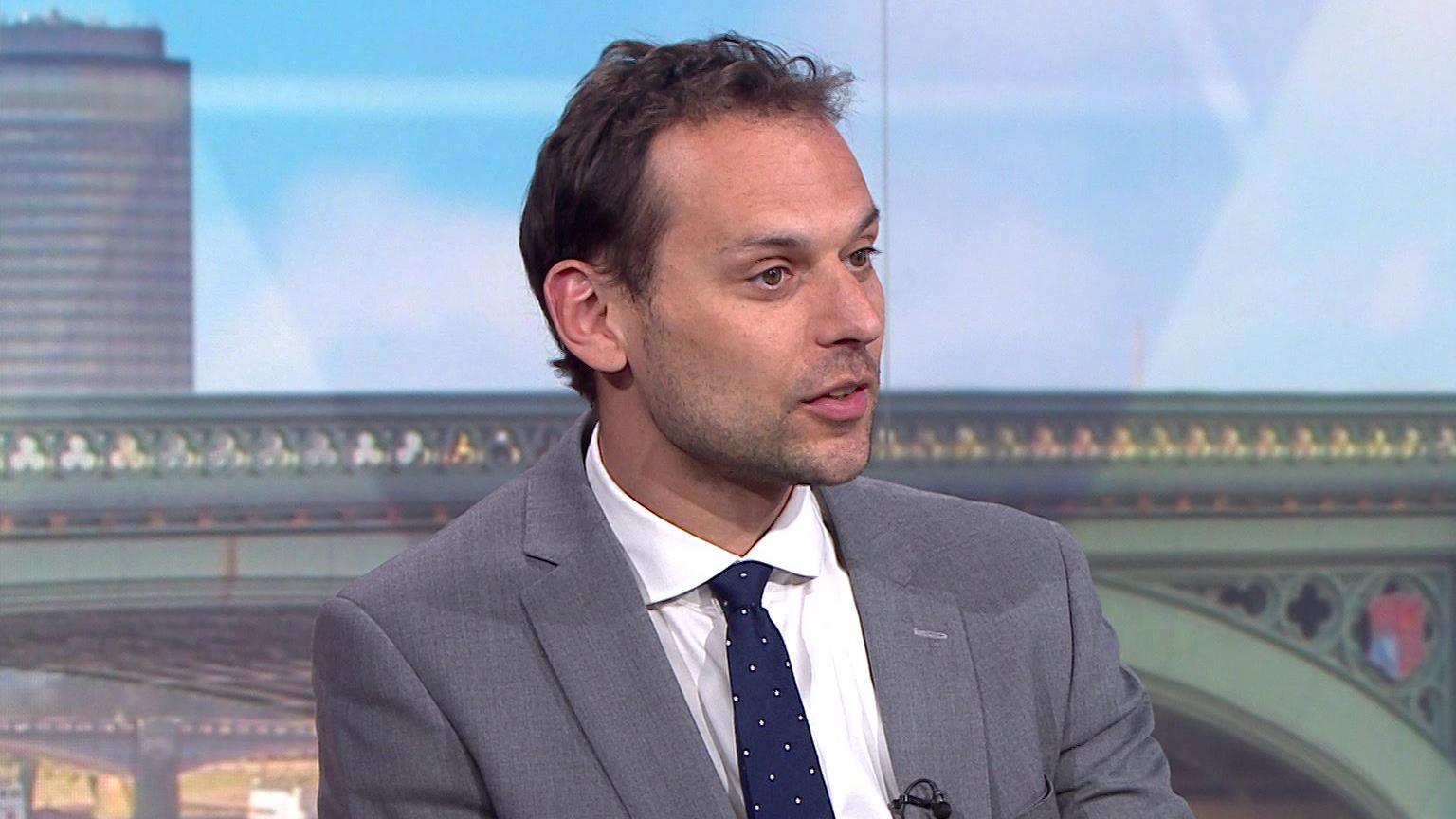
Minister Josh Simons Resigns Over Labour Smear Scandal

Minister Josh Simons Resigns Over Labour Smear Scandal


The post Hannah Spencer and the curse of millennial politicians appeared first on spiked.

Expert comment provided by the European Institute for Gender Equality.
A Cambridge study found that in the UK, boys typically perform worse than girls in exams, from early years through to university.
Some researchers, including those commissioned by parliament’s Education Committee, have sought to find out why that is, while headlines posit that schools might be “biased” against boys.
We aren’t seeking to explain that difference here. Instead, we wanted to know whether the higher grades girls tend to get in school actually translate to better wages once they enter the workplace.
Here, we asked a spokesperson for the European Institute for Gender Equality (EIGE) about the topic.
“These stronger school outcomes do not automatically translate into equal outcomes later in life”
An EIGE spokesperson said that girls’ academic achievements are a “long-standing achievement in the EU”.
Women increasingly outnumber men in completing third-level education, they added.
But “these stronger school outcomes do not automatically translate into equal outcomes later in life.
“Evidence consistently shows that structural inequalities in households, the labour market and public life continue to shape women’s opportunities, earnings, and career progression.”
Indeed, the author of the Cambridge study we mentioned earlier said that “apparent advantages” suggested by girls’ academic successes “are not necessarily carried through to employment”.
At its current rate, the Trade Union Congress says, the UK’s gender pay gap is not expected to close for another 30 years.
Why don’t girls’ higher grades appear to lead to better pay?
The EIGE spokesperson said that one-third of young men aged 15-24 believe men are better leaders than women, compared to 15% of young women.
“These attitudes shape unequal outcomes over the life course, [and] contribute to a persistent divide in the labour market, where women are overrepresented in public sectors such as education, health, and care – roles that are essential but often undervalued and lower paid,” they added.
Men, meanwhile, are likelier to work in higher-paying sectors.
Additionally, when women choose lucrative jobs, these tend to become lower-paid if others join them and the career is deemed “feminine”. The inverse appears to have happened in e.g. programming, when a formerly feminised role became male-dominated.
And “even when women enter the workforce with strong qualifications, they face barriers to career progression. Women remain underrepresented in senior and decision-making positions, which has a direct impact on earnings,” the spokesperson said.
For instance, in education, which is 76% female, men make an average of 17% more than women in the UK. As a percentage, men are significantly more likely than women to be headteachers (5.8% vs 3.9%).
“In addition, unequal sharing of care responsibilities means women are more likely to work part-time, take career breaks, or adjust their working patterns, all of which can slow career advancement and reduce lifetime earnings,” the EIGE spokesperson said.
“Women are also twice as likely as men to provide over 35 hours of childcare per week and, on average, receive only 75% of men’s pensions.”
Ultimately, “the assumption that better school results lead to better professional outcomes does not hold in reality. Addressing these gaps requires tackling structural inequalities that continue to limit women’s economic equality.”

Donald Trump has shared a Saturday Night Live UK sketch mocking Keir Starmer.
The US president posted the skit from the new Sky UK comedy show on his Truth Social account on Sunday.
In it, Starmer is portrayed as a weak and ineffectual prime minister who is scared of the US president.
At the start of the two-and-a-half minute clip, the PM is shown at his desk in 10 Downing Street waiting on a phone call from Trump.
At one point, he says to deputy PM David Lammy: “Oh golly, but what if Donald shouts at me? What day I say Lammy?”
To laughter from the audience, Lammy replies: “Just be yourself, prime minister. Yourself is who everyone likes.”
When Trump phones and says hello, Starmer screams and slams the phone down.
He then says: “Sod that scary, scary wonderful president. Why is he so difficult to talk to?”
Later in the sketch, Starmer says: “I’m out of my depth here, Lammy. How did Liz Truss make this job look so easy?”
When told by a “Gen Z adviser” what he should do to connect with Trump, the PM says: “I’ll try anything, I’ll do anything – except make a stand.”
Trump’s decision to post the sketch to his 12 million followers is another shot across Starmer’s bows as the war in Iran continues.
The US president has been angry with the PM ever since he initially refused his request for American jets to use RAF bases to attack the country.
Starmer has since said America can use the bases, but only to launch “defensive” missions against Iranian launch sites.
Trump has repeatedly attacked the PM, saying he is “not Winston Churchill” and accusing him of acting too slowly over the conflict.
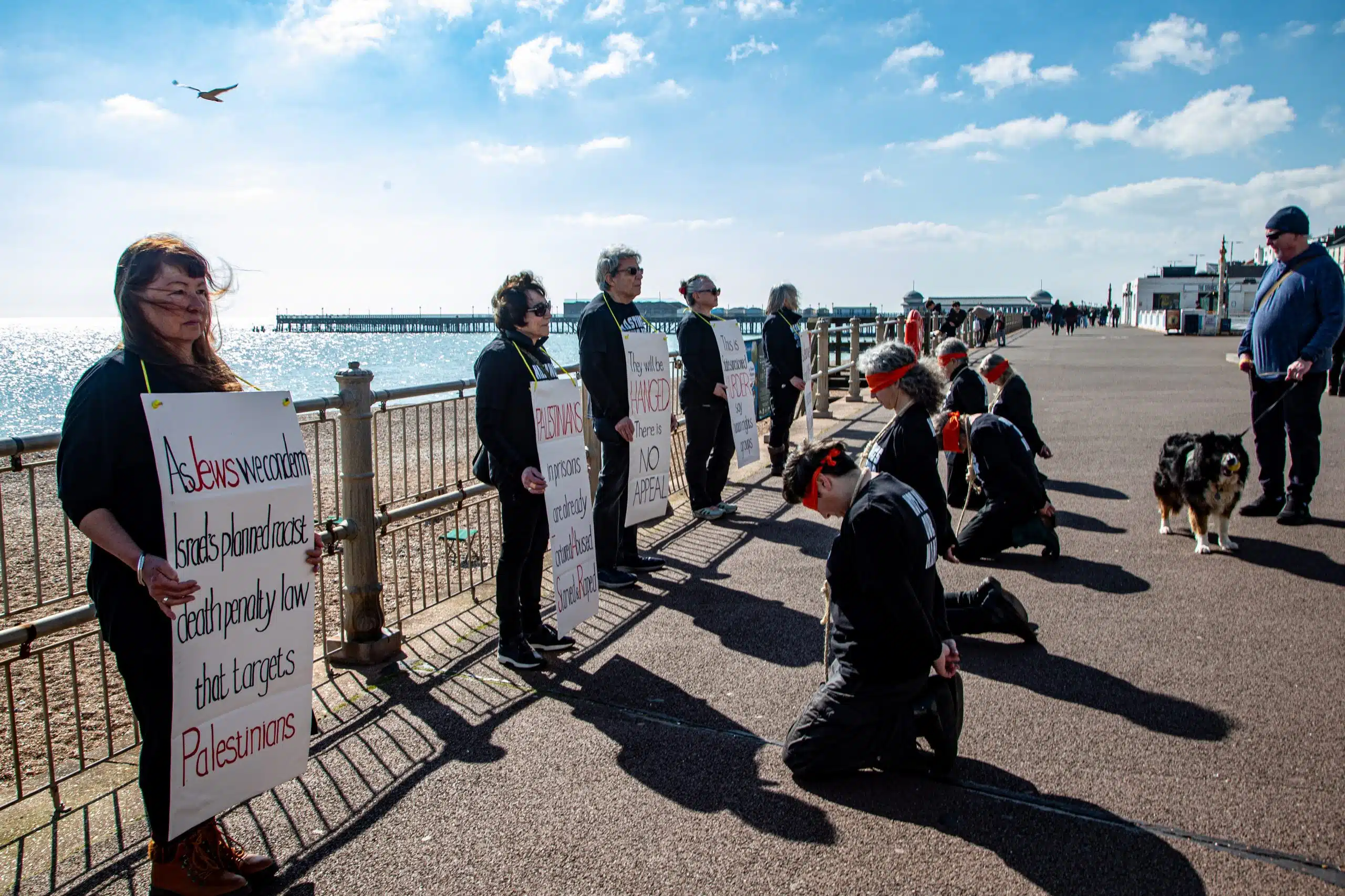
Jews in Hastings, Sussex, took to the streets on Saturday, 21 March, to protest the planned execution law currently going through the Israeli parliament, which targets Palestinians only.
Hastings sees a powerful protest
A video showing the silent, powerful action has now gone viral, viewed tens of thousands of times on social media:
Veteran British artist Annie Lennox, who shared the video, praised the action as a ‘moving example of how local activism can be incredibly powerful’.
She wrote:
Speaking up about what the Israeli government is doing is not antisemitic! It never was and it never will be. When your government is carrying out war crimes and crimes against humanity it is a moral right and obligation to speak up and challenge it.

Dressed all in black with T-shirts that read ‘Not in our Name’, five members of the group Hastings Jews for Justice wore a noose each around their necks and blindfolds to denote the ‘condemned’ while others held placards that read:
As Jews, we condemn Israel’s planned racist ‘death penalty’ law that targets Palestinians.
Palestinians in Israeli prisons are already tortured, abused, starved and raped.
They will be hanged. There is no appeal.
This is state-sanctioned murder say human rights groups.
As Jews we call on all MPs to condemn this vile law.

They handed out leaflets explaining that the bill had passed its first reading in November with Amnesty International stating that this amounted to the Israeli government ‘brazenly granting itself carte blanche to impose death sentences on Palestinians.
‘Any death sentences imposed under these amendments would constitute a violation of the right to life and, when imposed by a military court, may also amount to war crimes.’
‘Shamefully silent’
A spokesperson for Hastings Jews for Justice said:
Our representatives have so far remained shamefully silent about this law.
But this new death penalty law fits right into the existing brutalization of Palestinians – it is a racist, apartheid law as it applies only to Palestinians.
Israel is an apartheid state, according to most human rights groups and the International Court of Justice in its advisory opinion of 2024. Israel is also committing genocide in Gaza and has now launched an illegal and unprovoked war on Iran.
With policies such as these, we cannot continue to pretend that Israel operates as a democracy. We cannot continue to sell arms to Israel that are being used to kill Palestinians in the West Bank, East Jerusalem and Gaza.
It is worth remembering that in 1969 our government finally abolished capital punishment in the UK, arguing such punishment was a ‘barbarous penalty’. How much more barbarous then to enact this policy in a discriminatory system that targets just one group of people?
We call on the British government condemn this appalling apartheid law, to end all arms sales and other military cooperation and to impose sanctions now.
Featured image and additional images supplied

Green Party leader Zack Polanski just got serious on the economy. Not just on substance. His 32-minute speech at the New Economics Foundation on Wednesday 18 March saw a change in tone.
“Our fiscal framework is hypersensitive to market movements, and this creates policy uncertainty that then fuels the very market jitters it was there to supposedly prevent” is one phrase that stood out for me. There was lots of talk of productivity and fiscal multipliers.
This was Zack answering his critics. He can do the heavyweight economics.
Zack Polanski: a shift
Is this a shift away from insurgency? Kind of. It had to happen. To hold power in this country, especially with a media that is equally hostile and banal, you have to talk money. The vast majority of the British people agree that the Iran war is terrible and the Gaza genocide is criminal. But they feel the cost-of-living crisis every day.
I’ve been advocating that we need to appeal to the “Green Curious”. The people who would like to see a government serious about climate action, on poverty. On restoring crumbling infrastructure and creaking public services. There are millions of Green Curious people who see the benefits of compassion and long-term investment. But they want reassurance that their taxes will be spent wisely and their mortgages won’t shoot up. If you want their cross on the ballot paper, you have to look like a safe pair of hands.
Polanski still communicates clearly in everyday language. Rents have gone up by £3300 per household since 2022, he said. That’s £18 billion countrywide. That could have been an extra £18 billion people spent with local businesses. The bakery on the way to work. The local pub at the end of the week. That’s why we’ve got hollowed out high streets. He’s right, and that’s a clear way to explain it.
It’s a welcome change from the long shopping lists the left often recite. We want more money on schools, colleges and universities. Hospitals and care homes. Trains, buses, metros and trams. Of course we do. But unless you answer the question “how?” the public are justified in being sceptical. They’ve been let down by too many politicians too many times.
This speech gets us into the territory of how you actually fix things. Something I’ve been banging on about for years.
Fixing
A wealth tax is a day one priority. Not because it can fund everything, said Polanski. Although £15 billion a year will buy you quite a bit. But because it’s far better for society to spend that on productive infrastructure and long term investment in energy, housing, health and education than it is sitting in private equity funds. The billionaires will still be mega-rich.
There was detail on equalising Capital Gains Tax with Income Tax. That’s another £12 billion. This is bleeding obvious and it’s a scandal that Labour haven’t done it. We should not tax people more for working for a living than we do for owning things. Unlike Income Tax, it’s only taxed on the profits made, anyway.
There was detail on replacing the Office of Budget Responsibility. Established in 2010 to bring down the debt and the deficit, it has obviously failed. I’ve written about it before. It makes unfounded assumptions and always, and I mean always, gets its forecasts wrong. So let’s have an Office for Fiscal Transparency whose job it is to publish the hidden assumptions in Treasury and Bank of England forecasts.
Instead of assuming that all investment has no benefit after five years, let’s get the real evidence. And let’s stop obsessing over GDP as the only measure of economic success.
Polanski is working for everyone
Let’s have a wellbeing measure than includes health, education, and economic security.
I was the first Mayor to introduce one. We used it to guide policy decisions. We still smashed the job creation target, beating our 15 year target in just four years. Every £1 we invested in job creation returned over £3 to Treasury in payroll taxes alone, above and beyond the economic benefits of people having money in their pockets. This stuff works.
And yes, we’d look at borrowing for investment, and when there are adverse economic events, we’d look at quantitative easing. “I’m not an ideologue,” said Polanski, “I’m a pragmatist.”
I liked it. You could deliver it all in the first term of a government. Realistic. Effective. It would make life better for everyone. Even the billionaires would live in a safer country.
Featured image via the Canary

From where I’m currently sitting, Keir Starmer’s “we will not be drawn into a wider war” bullshit is looking more and more like bullshit by the day.
I’m only fifteen minutes away from a very noisy RAF Fairford. It is quite clear we have already been dragged into a conflict that a vast majority of the British public wants absolutely nothing to do with.
We’ve been here before, haven’t we?
Starmer: flip-flop, flip-flop
This masterclass in spineless triangulation echoes Tony Blair’s Iraq catastrophe note-for-note.
Keir Starmer initially told us he ‘refused’ Trump’s demand to let US bombers use British bases for offensive strikes. He knew it wouldn’t fly with the Parliamentary Labour Party and he is fully aware what voters think about fighting other people’s wars.
While Starmer called it a “deliberate” decision, rooted in British national interest and legality, he was simply looking for a way to repackage and deliver Britain’s involvement in Trump and Netanyahu’s war of terror.
Let us be absolutely clear: Keir Starmer isn’t “playing a blinder”, folks. He may as well be loading the missiles on to the Stealth bombers himself.
So, the Prime Minister that said we won’t be dragged into the Zionists’ war on the Middle East is said to be “working with allies” on reopening the Strait of Hormuz. Once again, Keir Starmer has folded like cheap cardboard.
But this isn’t really a sudden escalation. The facts speak for themselves, loud and clear.
On March 1 — mere hours after his apparently defiant stance — Starmer flip-flopped, and granted the US permission for “specific and limited defensive” strikes from UK bases.
By March 5, Starmer was sending four extra Typhoon jets to Qatar. By March 7, US forces were actively using British bases for these defensive (LOL) operations.
How can we be drawn into a wider war that Keir Starmer has already drawn us into?
Ignoring lessons, then invoking them
Donald Trump is already raging, calling him weak, nothing like Winston Churchill, and threatening the mythical special relationship with all sorts of very, very terrible things.
Why bend over backwards for someone that really hates your fucking guts, Mr Starmer?
Starmer’s response to being trashed by the fascist American despot? No parliamentary vote. No exit strategy. Just mission creep dressed as defence.
Britain has seen this film in Iraq and Afghanistan before. Limited support becomes full entanglement, dead British military personnel, dead civilians, and a generation scarred. We cannot go back there.
Millions of us warned against Iraq. We’re warning again now. Keir Starmer isn’t listening — because listening would mean ultimately defying Washington, and that’s the one red line that Keith the invertebrate will never cross, despite the bluster.
Keir Starmer invokes the lessons that have been learned from Iraq in one breath, then repeats the same disastrous pattern in the next.
Keir Starmer has urged for de-escalation — as if anyone would actually listen to the irrelevant wooden plant pot — but his own actions quite clearly undermine this apparent plea for peace.
Starmer may well be delighting the easily-pleased liberal media with this fake stance of defiance, but it’s not making the slightest bit of a difference to Labour’s horrendously bad polling.
And whilst Starmer is laser-focused on delivering death for Donald, the domestic Labour revolt is well underway.
A revolt is afoot
Former Deputy PM Angela Rayner tore into Labour’s immigration crackdown as “un-British” and warned the party is “running out of time”. I didn’t even think it was possible to agree with Ange these days, but even a broken clock is right twice a day.
Mayor of London, Sadiq Khan wants Labour to campaign to rejoin the single market and push for full EU membership at the next general election. I voted Remain, I would vote Remain again, but Labour is not the vehicle for progressive EU membership.
Scottish Labour leader Anas Sarwar still wants Starmer gone yesterday. Unite’s Sharon Graham is predicting “decimation” in the May 7 elections — and she’s really not wrong.
That’s the membership, the unions and the mayors all saying the same thing. This cautious, centrist, craven Starmerism is electoral suicide.
Starmer says he loves our country, apparently — just not enough to deliver the change people voted for. No wealth taxes. No green new deal. No public ownership. Just more austerity-lite, more deference to Trump, more sleaze tolerated until it explodes.
Starmer: finished?
The left inside Labour must stop pretending this disaster is salvageable under Starmer. Demand a full, warts-and-all independent inquiry into the Peter Mandelson appointment — no more grubby cover-ups. Force a binding Commons vote on any further Iran escalation and stop writing blank cheques for imperialism.
The May elections loom as judgment day for Keir Starmer. If he clings on with this record — Epstein-enabler, Iran flip-flopper, and utterly tone-deaf on the base — Labour faces a widespread wipeout.
Featured image via the Canary

Dietitian comment provided by registered dietitian Melissa Jaeger, head of nutrition at MyFitnessPal.
In recent weeks, we’ve asked dietitians to share the healthiest type of egg, rank the best breads, and tell us once and for all whether wholemeal pasta is always better than plain.
And this week, we’re speaking to registered dietitian Melissa Jaeger about cheese.
Is it ever good for us? If so, what are the best kinds? And how do the pros make cheese healthier?
Is cheese good for us?
“Cheese can absolutely be part of a balanced diet and offers several nutritional benefits. It’s an excellent source of high-quality protein and rich in calcium, which supports bone health,” Jaeger told us.
Calcium aside, its vitamin K content also helps to support your bones.
It contains vitamin B12, riboflavin, zinc, vitamin A, and phosphorus, too – “all nutrients that play vital roles in overall health”.
“There’s even an interesting benefit for dental health: eating cheese can increase pH levels in your mouth, leading to lower acid levels and less enamel breakdown, whilst calcium and phosphorus are boosted in saliva after consumption, helping to remineralise teeth,” the dietitian added.
But yes, there are some downsides.
“Cheese does contain 6 to 10g of fat per ounce, with more than half coming from saturated fat… guidelines recommend keeping saturated fat to around 7% of total calories (roughly 10-20g depending on your calorie needs),” Jaeger said.
“Elevated saturated fat intake can contribute to increased risk of cardiovascular disease and type 2 diabetes, so it’s worth being mindful of portion sizes.”
What are the healthiest types of cheese?
Jaeger said that different cheeses have different nutritional benefits, so it really depends on your goals.
“Swiss cheese stands out for having the lowest sodium content at around 55mg per ounce, making it a smart choice if you’re watching salt intake,” she said.
And if you’re trying to up your protein intake, sheep’s milk cheese contains “75% to 100% more protein than cow’s milk cheese and offers higher levels of phosphorus, vitamin B6, vitamin E, and calcium”.
Goat’s cheese also contains more protein on average than cow’s milk cheese (though less than sheep’s milk cheese), and is also higher in calcium, niacin, potassium, and iron.
Fresh goat’s cheese, or chèvre, “is a lighter option with only 4g of saturated fat per ounce”.
Lastly, if you have issues digesting lactose, you might benefit from trying harder cheeses.
“These are often well-tolerated because lactose is removed with the whey during cheese production, and what remains is broken down further during the ageing process,” said the dietitian.
Goats’ and sheep’s milk is also a little easier to digest, too.
How can I make cheese healthier?
If you do want to reduce your saturated fat intake, some naturally lower-fat versions include fresh goat’s cheese (chèvre), hard Parmesan, or feta, said the expert.
Of course, you can also opt for low-fat or reduced-fat varieties. “However, if you’re watching sodium intake, do check the nutrition label as these versions can be higher in salt compared to full-fat varieties,” she added.
But, Jaeger noted, “that doesn’t mean full-fat cheeses are off the table! You can absolutely work them into your diet whilst being mindful of saturated fat intake”.
She ended: “Try smaller amounts by sprinkling them over vegetables, soups, or salads rather than eating large portions on their own.
“Full-fat cheeses with more pungent, intense flavours are particularly brilliant for this approach, as you need less to achieve satisfying flavour.”

The International Atomic Energy Agency (IAEA) is ‘monitoring’ the situation at the Dimona nuclear plant in Israel, after Iran hit the towns of Arad and Dimona, despite Israel refusing inspections and safeguards since 1969.
IAEA noticed a “nuclear research center” in Dimona! Tomorrow they will notice that they’ve no permission to inspect it. On Tuesday they will notice that it’s expanding since many yrs. On Wednesday they’ll notice that some🇮🇱ministers proposed the use of nuclear bombs in Gaza&co. https://t.co/Pk24S8aTVF pic.twitter.com/yAC449RD4d
— Lorenzo Kamel (@lorenzokamel) March 22, 2026
Non-proliferation treaty
Experts estimate that Israel possesses around 90 plutonium-based nuclear warheads. It has produced enough plutonium for between 100 and 200 weapons.
Israel produces the plutonium for its nuclear program at the Negev Nuclear Research Centre, also known as Dimona.
Additionally, Israel has refused to sign the Nuclear Non-Proliferation Treaty (NPT). This is an international agreement which was designed to:
prevent the spread of nuclear weapons, promote cooperation between states on peaceful uses of nuclear energy, and advance nuclear disarmament.
Only four other countries have not signed the NPT: India, North Korea, Pakistan, and South Sudan.
Israel also refuses inspections and IAEA safeguards on its nuclear activities.
Despite all of this, the world seems to have collectively agreed to ignore the fact that Israel has nukes.
Because noticing them, let alone inspecting Israel’s nuclear weapons facility, would of course be ‘antiseptic’.
Noticing is antisemitic. https://t.co/G5uD5MnPD2
— The FIX Collective 🔻🔻🔻 (@ThatTylerPopp) March 22, 2026
Meanwhile, Israel has spent the last 30 years telling the world that Iran is only two weeks away from building Nukes.
Arad and Dimona
Now, Iran has bombed the towns of Arad and Dimona.
IAEA has always been a total joke, serving the Western empire https://t.co/NKJHDjfVAE
— M Silvennoinen 🇨🇺 (@mrSatias) March 22, 2026
How funny!! As Israel supposedly doesn’t have nuclear weapons!
And lol and behold!! A nuclear centre in Israel!
Well what do you know!! https://t.co/7rpx8Wa0YT— convencia (@convencia) March 22, 2026
But Iran issued an evacuation notice a few days ago for the same area. By Israel’s standards, that makes it a valid target, and anyone who stayed in the area was probably a terrorist.
Didn’t Iran issue a warning to evacuate a few days ago? By your logic doesn’t that make it okay? You said that warning people in advance of firing missiles on their homes makes you the most moral army in the world. Well, Iran did the same thing. I guess they’re the moral army… https://t.co/e3O3zMgqtf
— susan abulhawa | سوزان ابو الهوى (@susanabulhawa) March 22, 2026
Israelis living near Dimona should have evacuated to the US, or Europe, or wherever the hell their second passport is from.
Absolutely zero sympathy for Israel! Iran gave warning so the civilians could have escaped back to the US or Europe or wherever they came from! #IranWar #Dimona #Israel https://t.co/rsqHNdUGty
— Yip82 (@yipmann82) March 22, 2026
You know who can’t escape with their second passports? The native citizens of Gaza, Lebanon, and Iran. We would need them to count back from 1 million — twice — while balancing on one leg in order to give them visas anyway.
Additionally, why were Israeli citizens living so close to an undeclared, uninspected nuclear site?
Sounds a little bit like, erm, human shields to me?
Why were there civilians shielding the Israeli undeclared uninspected nuclear programme, (producer of at least 200 weapons) which Iran warned would be bombed after Israel bombed Iran’s declared, regularly inspected nuclear enrichment site which has produced no weapons? https://t.co/gsiDR0pbTM
— maura (@curlymo_99) March 22, 2026
Then again, Israel’s conscription means that most Israeli citizens have served in the IDF. Again, by Israel’s standards — who hit military targets once they were home at night, while their families slept — that makes them valid targets.
The irony is that Israel has banged on and on for years about Iran’s nuclear enrichment site, which has been declared, regularly inspected, and has produced no weapons.
Meanwhile, they’re producing nukes and using Israeli citizens as human shields. Something they also accused Gaza of. Funny how all of the things Israel accused Gaza of are actually just their guilty conscience, or lack thereof.
Feature image via Al Jazeera English/YouTube
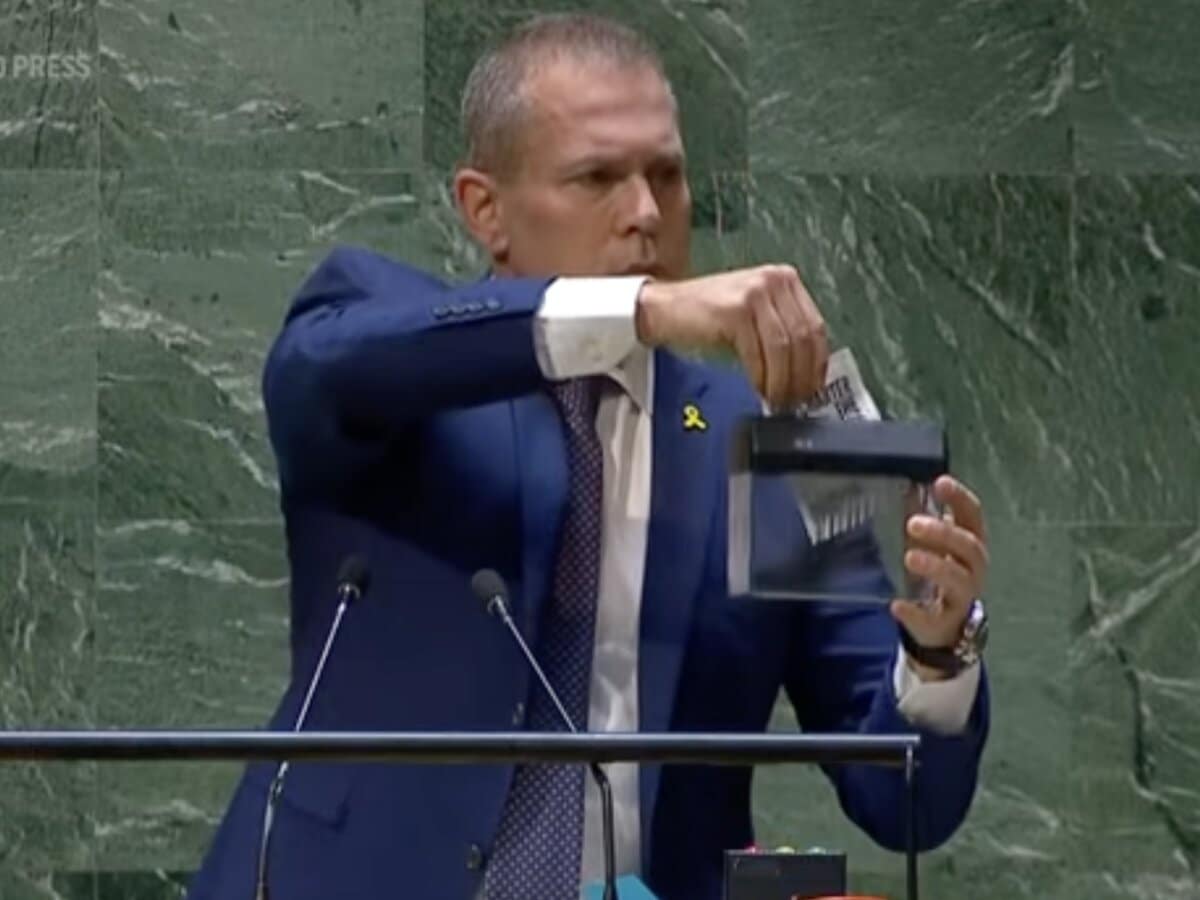
Israel has asked the United Nations (UN) Security Council for urgent intervention, after previously shredding its charter.
Same Israel that shredded the UN Charter, at the UN? https://t.co/NM2Fl2CbqL pic.twitter.com/OC8MahemuN
— Laura Blum (@laura8blum) March 21, 2026
Iran made Israel ask for an urgent United Nations Security Council intervention
🤣🤣🤣🤣
— Tumi Sole (@tumisole) March 21, 2026
Playing the victim
In 2024, the UN General Assembly enhanced Palestine’s rights within the organisation and called for its admission as a member.
Israel immediately threw its dummy out of the pram. The state’s UN ambassador, Gilad Erdan, destroyed the UN charter with a tidy shredder in front of the whole assembly.
Ultimately, the US vetoed Palestine’s bid for full membership.
One day people in the future will ask how on earth were these people not institutionalised let alone have power to commit one genocide after another?! https://t.co/MrP0X1Bv5v
— Natalie Strecker (@JerseyPSC) March 21, 2026
But this is the same Israel that has killed more UN employees than anyone else.
In 2024 alone, the zionist entity murdered 126 UN personnel in Gaza — all but one of these served with UNRWA, the agency that assists Palestinian refugees.
Israel has killed more than one in every 50 UNRWA staff in Gaza. It is the highest staff death toll in United Nations history.
Illegal IDF attacks have also repeatedly hit UN peacekeepers in Lebanon.
Omg i completely forgot about this. Not to mention repeatedly firing and harrassing the UN forces at the Lebanon Blue Line https://t.co/D9yFzgD5Yt
— Senbonzakura~ (@Cman_koba) March 21, 2026
Additionally, Israel’s UN Ambassador Danny Danon publicly called Francesca Albanese, UN Special Rapporteur on the Occupied Palestinian Territories, a “witch”, after her report exposing Israel’s genocide in Gaza.
Now the UN is good? https://t.co/HKPAaajCes
— Vanya Vucinic🌾 (@VanyaVucinic) March 22, 2026
Israel — no regard for the rules
Since its inception in 1948, Israel has shown no regard for the rules of international law.
These wankers now seeking international support after making an absolute mockery of international law. Turn Israel into a parking lot. #payback https://t.co/dWsJSZVkyZ
— Goodvibecouncil (@bringthemvibes) March 22, 2026
The zionist entity must have thought it was invincible. That the expensive (and now failing) Iron Dome, its US weapons, and its moral superiority, would protect it from the consequences of committing genocide.
How’s that one going for you, Deadanyahu?
They never thought the violence will reach home. They believed their defense and the US will help them take out missiles and drones like last year. They shit on every international organization. Bombed UN buildings in Palestine and Lebanon. Bombed Ghanaian peacekeepers last week. https://t.co/DfR4kwQqWr
— Cephas (@Cephas_me) March 21, 2026
Life comes at you fast when you’re murdering innocent children, blowing up schools, and ignoring international law.
When you shredded the UN Charter because of your genocidal killing at Gaza, you have no right whatsoever to have a say at the UN. https://t.co/InRTfJ3VGJ
— Eric Cheung🐋🇭🇰 (@HBS_Eric) March 22, 2026
‘We will kill you all’ quickly turned into crying to the UN when Israel got its feelings hurt.
Israeli PM 24 hours ago: We need to be like Genghis Khan.
Israel right now: Where’s the UN? Where’s international law? https://t.co/JUqE6kdEsd pic.twitter.com/kPYR56xamd
— Radio Muft Baluchistan (@DerArschloch) March 21, 2026
Iran has literally bombed Israel into being a UN-conscious state. Who’d have thought it was possible…
Funny right?
The same council that they’ve been disrespecting and even torn the UN chartered on the podium.It’s just magical what Iran is doing, bombing Israel into being an UN law conscious state. 🤣😂 https://t.co/itOTDbEKWk
— Abdulwasi’i Alabi (@Con_quis_tador) March 21, 2026
It’s funny how a few bombs will suddenly make you crave the limits of international law. But you don’t get to shred the rules and then beg for help when someone else breaks them. Israel fucked around and is now finding out, and no one believes the crocodile tears.
Feature image via Associated Press/ YouTube

It’s hard to think about anything else when your bowel habits are off. But one doctor recommends giving yourself a break – and rethinking how you approach the way you poop going forward.
Gastroenterologist Dr. Trisha Pasricha, makes the case for changing up the way you poop in her upcoming book, You’ve Been Pooping All Wrong: How to Make Your Bowel Movements a Joy.
In fact, she swears that “pooping without judgment” is the way to go, noting that people – especially women – should think about their bowel habits less.
Data suggests that up to 20% of Americans have chronic constipation, meaning they regularly have trouble pooping, don’t poop often or feel like they don’t get everything out when they go. Women in particular face unique biological challenges that can make healthy bowel habits harder to achieve, Pasricha said.
That includes having more mast cells in the gut, which raises the odds of experiencing gut discomfort compared to men. Many women face GI symptoms like constipation, diarrhoea, and increased gas around their period, too.
“Progesterone levels rise and fall throughout the menstrual cycle every month, and this directly impacts how quickly the stomach empties and how sluggish the intestines feel,” Pasricha told HuffPost.
Prostaglandins, the compounds responsible for period cramps, also stimulate contractions in the gut, she points out. “That can cause diarrhoea at the most inopportune times,” Pasricha said.
If you’re dealing with bowel issues or if you simply feel a little concerned that your pooping habits aren’t up to snuff, Pasricha said it’s time for a change. Here’s what she suggests:
Stop assigning judgment to pooping and allow yourself to go whenever the urge strikes
Pasricha’s philosophy on “pooping without judgment” means a few different things.
“I want people to define a normal bowel habit by what’s comfortable for them, rather than by measuring yourself against some imaginary standard of ‘normal’ that likely doesn’t exist,” Pasricha explained.
“In my clinic, I find people often spend a lot of energy worrying that they should be pooping once a day like clockwork, or that their stool should look a certain way, or that needing a laxative is some kind of personal failure.”
Research suggests that there is a wide range of normal when it comes to pooping habits. What’s considered healthy for bowel movements can mean anywhere from pooping three times a day to three times a week.
“The range of ‘normal’ is enormous,” Pasricha said. “It’s going to vary so much for each individual – and will likely fluctuate over time – because of your diet, exercise, stress and other lifestyle factors that influence the pattern.” What really matters is whether your bowel movements are comfortable and whether they’re interfering with your life, she added.
But there’s more to pooping without judgment than that. “Pooping without judgment also means feeling free to respond to the call of nature without shame,” Pasricha said.
“People are so mortified to use the bathroom at work or at a friend’s house. That leaves you with such a limited window in which to finish your business and your body isn’t always primed to go when you decide it’s the optimal moment from a social standpoint.”
She stressed the importance of removing judgment for yourself and others when you do what your body needs you to do. “Spritz a little bathroom spray, give a courtesy flush and move on,” Pasricha said.
“Spritz a little bathroom spray, give a courtesy flush and move on.”
– Gastroenterologist Dr. Trisha Pasricha
Why is judging pooping bad for your gastrointestinal health?
Pasricha stressed that you can’t have comfortable, effortless bowel habits unless pooping is the least of your concerns – and that you just go when your body is ready.
“Suppose your body signals to you that you need to use the bathroom in the middle of the work day and you are worried about using the bathroom for fear of judgment,” she said. “Eventually, your colon may stop squeezing, which is what gives you that feeling of urgency, and you’ll feel like you can get back to normal so you can do your business at a more appropriate time later.”
Here’s the problem: Even though it may feel more socially appropriate to use the bathroom when you get home, it’s not necessarily best for your body.
“Once you get home from work, your colon is no longer offering you that extra ‘push,’ so you’re going to have to strain harder for the magic to happen,” Pasricha said.
Regularly avoiding the urge to go raises the odds you’ll end up dealing with constipation, too. This is because stool becomes drier and harder when it sits in your rectum, making it harder to push out than if you had simply gone to the bathroom when you had the urge to go, Pasricha explained.
What’s normal (and not) with poop changes
In general, Pasricha said you should simply do your business when the need strikes and move on. But it’s understandable to check out what lands in the toilet bowl.
There is a range of consistency, patterns and colours that are considered normal, according to Pasricha. But if you’ve spied something that’s concerning, she recommends taking a picture to show to your doctor.
“Red, maroon or black stool has me worried for bleeding, and you should seek help immediately,” Pasricha said. But bowel movements that wake you up in the middle of the night or severe abdominal pain should also be checked out quickly.
“Outside of these bigger red flags, any symptom that bothers you or interferes with how you’re enjoying your daily life is worth discussing with your physician,” Pasricha said.
“Even if it seems like ‘no big deal,’ if any discomfort, bloating, or other pattern related to your bowels is keeping you from enjoying activities you love or causing you significant distress, talk to someone sooner rather than later.”

Stock Futures Are Falling, Oil Rising as Iran Tensions Grow

Paramount+ Is Removing ‘The Batman’ Director’s Viral Sci-Fi Franchise-Starter

Mavado – Big Money | Official Music Video


-

 Fashion2 days ago
Weekend Open Thread: Adidas – Corporette.com
-

 Politics2 days ago
Jenni Murray, Long-Serving Woman’s Hour Presenter, Dies Aged 75
-
 Tech5 days ago
Are Split Spacebars the Next Big Gaming Keyboard Trend?
-

 Crypto World24 hours ago
Best Crypto to Buy Now: Strategy Just Spent $1.57 Billion on Bitcoin During Fear While Early Investors Quietly Enter Pepeto for 150x Potential
-

 News Videos4 days ago
RBA board divided on rate cut, unusually buoyant share market | Finance Report | ABC NEWS
-

 Crypto World1 day ago
Bitcoin Price News: Bhutan Sells $72 Million in BTC Under Fiscal Pressure, but the Smart Money Entering Pepeto Sees What the Market Does Not
-
 Crypto World2 days ago
NIO (NIO) Stock Plunges 6.5% as Shelf Registration Sparks Dilution Worries
-

 Business7 days ago
Australian shares drop as Iran war enters third week
-

 Crypto World7 days ago
Crypto Lender BlockFills Enters Chapter 11 with Up to $500M in Liabilities
-

 Politics5 days ago
The House | The new register to protect children from their abusers shows Parliament at its best
-

 Fashion6 days ago
25 Celebrities with Curly Hair That Are Naturally Beautiful
-

 Tech3 days ago
inKONBINI Lets You Spend Summer Days Behind the Register
-
 Politics5 days ago
Real-time pollution monitoring calls after boy nearly dies
-

 Crypto World4 days ago
Canada’s FINTRAC revokes registrations of 23 crypto MSBs in AML crackdown
-
 NewsBeat4 days ago
Residents in North Lanarkshire reminded to register to vote in Scottish Parliament Election
-

 Business6 days ago
Meta planning major layoffs as AI spending and automation reshape workforce
-

 News Videos4 days ago
PARLIAMENT OF MALAWI – PAC MEETING WITH REGISTRAR OF FINANCIAL ON AMARYLLIS HOTEL – INQUIRY LIVE
-

 Business7 hours ago
No Winner in March 21 Drawing as Prize Rolls to $133 Million for Next
-

 Business4 days ago
Who Was Alex Pretti? 5 Key Facts About the ICU Nurse Killed by Federal Agents in Minneapolis
-

 Politics3 days ago
Gender equality discussions at UN face pushbacks and US resistance
You must be logged in to post a comment Login