Politics
My Mother Broke A Generational Curse By Learning How To Swim

My grandmother never stepped foot in a swimming pool. The closest she ever came was the afternoon I held my phone in front of her face, tilting the tiny glowing screen so she could see her great-granddaughters slicing through bright blue water at a swim meet. They were still little then, just beginning to race. Her eyes were tired but sharp.
“Shana,” she said, squinting at the screen, “what is that girl doing in that water?!” There was real fear in her voice; the kind that doesn’t come from ignorance, but from history.
“She’s racing, Grandma,” I told her. “That’s Zuri. Don’t worry – she’s safe.”
She leaned closer, watching those small arms churn. “Do they like swimming?”
She nodded slowly, and looked on. “I never did learn to swim, baby. Never even been in a pool.” I squeezed her hand. “I know. But we aim to change all that with Zuri and Amara.”
What I didn’t say was that this wasn’t just about safety. It was about rewriting something.
My grandmother never learned to swim, but my mother did. In her childhood, sparkling public pools were not invitations. They were exclusions.
During segregation, Black families had been barred from entry. When desegregation came, many towns chose to close pools rather than integrate them. Access to water – something so innocent and basic – became a quiet marker of who belonged.
The effects are still visible today. According to the Centers for Disease Control and Prevention, Black Americans drown at rates about 1.5 times higher than white Americans, and the disparity is especially stark for children. In swimming pools, Black children ages 10–14 drown at rates 7.6 times higher than white children. Public health researchers have linked these disparities in part to generations of unequal access to pools and swim instruction.
But in the late ’70s, my mama stepped into the water anyway. Two months after she gave birth to me – the first of her seven children – she signed up for swim lessons. If she learned, her children would not inherit fear as instinct.
When we were little, she made sure every one of us took lessons. We grew up in Charleston, where sometimes it feels like there is more water than land. Rivers stretch wide. Marshes wind through neighbourhoods. The ocean is never far. Every summer, we went to W.L. Stephens pool. The smell of chlorine. The echo of whistles. The sting of sun on wet shoulders.
Each year, we grew stronger. My brother and I kept up our lessons into high school – we were not racers, but continued swim education for safety: yardage, endurance, treading water until our legs shook. In our family, swimming was non-negotiable.
But “basic” has not always meant “accessible”. Many of our Black and brown friends didn’t take lessons. They came to the pool, yes, but they stayed close to the sides, where the waves slipped gently into the gutters and onto the deck. My siblings and I could go much farther out – not recklessly, but confidently. The water was our friend, not a stranger.

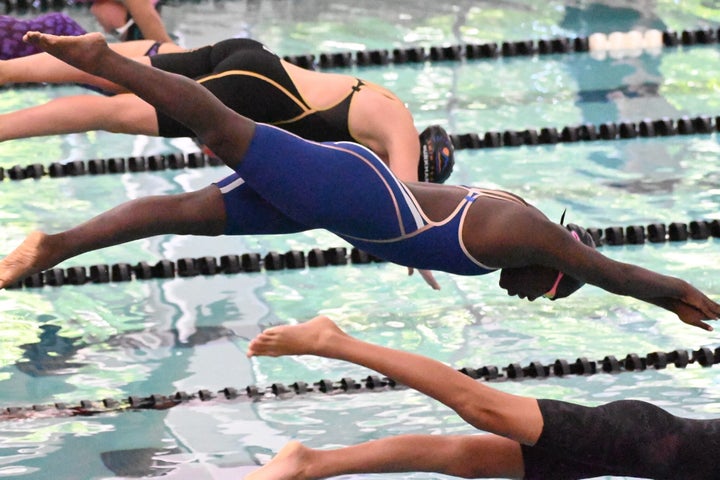
Photo By James Singletary
Years later, I found myself sitting in the bleachers at that very same pool – W.L. Stephens – but this time as a mother. Zuri was seven. It was her first swim meet. She stepped up for the 25-yard freestyle – tiny, serious, goggles slightly crooked. The buzzer sounded. She dove. She touched the wall first.
Her coach ran up to me, wide-eyed: “Looks like her time was one of the fastest in the state for her age group.”
One of the fastest in the state. In the same pool where I learned to tread water. In the same water my mother insisted we master. I felt the past and future colliding in chlorinated air.
What I did not expect was that Zuri would fall in love with racing. At eight, she swam anchor at the 8 & Under State Championships. Her team was seeded low. The role of anchor, or the last team member to swim in a relay, is often filled by the fastest or most experienced swimmer. She dove and touched first. The tiny swimmers took first in the state.
“I covered my mouth before I realized I was crying. It was not just her time. It was the inheritance, interrupted.”
Years later, at her final Age Group State Championship, she stood on the blocks again as anchor. Same pool, but she was older, stronger. The natatorium hummed. The starter beeped. She dove with quiet poise and remarkable strength. I didn’t breathe. When she touched the wall, the scoreboard flashed: 24.91.
Under 25. On a relay. At 14 years old.
Three other girls had already poured everything into that water before she dove in. Four bodies. One finish. They broke their team record and placed third in the state – less than a second from first.
I covered my mouth before I realised I was crying. It was not just her time. It was the inheritance, interrupted.
There were not many girls who looked like her in that heat. USA Swimming reports roughly 2% of its membership is Black. Two percent. Better than my grandmother’s day. Better than my mother’s. Still small enough to notice.
I do not let Zuri carry that weight. From me, she gets steadiness. Her dream is hers.
My grandmother passed away in March 2024. She never stepped into a pool. But she empowered the next three generations to step forward anyway.
In just four generations, a grandmother was barred from entry, a mother stepped in anyway and a daughter made swimming non-negotiable. Now a great-granddaughter anchors relays and breaks swimming records with her teammates. Four generations of unconditional love. Lifetimes of growth and development.
I miss my grandmother. But she saw the beginning of this change, and that matters more than I can fully explain. Water once represented exclusion. Now, in our family, it represents possibility. And that feels like victory.
Do you have a compelling personal story you’d like to see published on HuffPost? Find out what we’re looking for here and send us a pitch at pitch@huffpost.com.