Politics
My time as Lord Speaker has taught me that experience, independence and thoughtful consensus can deliver real change


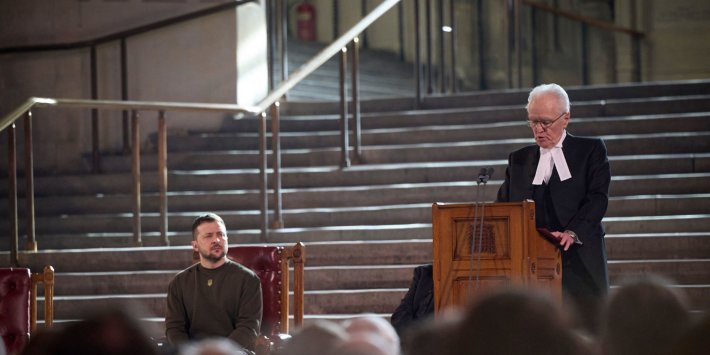
Lord McFall delivers remarks before introducing Ukrainian President Volodymyr Zelenskyy at Westminster Hall in 2023 (Pool Photo/Ukrainian Presidential Press Office/Alamy Live News)


4 min read
As I step down as Lord Speaker after almost 40 years at Westminster, one lesson stands out: lasting progress is not achieved by shouting the loudest or wielding the biggest majority. It is achieved by persuasion and consensus.
That truth sits uncomfortably with modern politics, which often prizes theatre over thought. Yet it is precisely why the Lords plays a vital role in serving our democracy, and why sensible reform must strengthen, not weaken, what it does best.
Politics should be a common endeavour, in pursuit of the common good. This is not a naïve aspiration. It is practised every day in the Lords, whose members include judges, scientists, engineers, doctors, entrepreneurs, economists, diplomats, three former directors-general of MI5 and six former heads of the home Civil Service.
When I became Lord Speaker, I set out to make the House of Lords work better, and its work better understood. Too often it is caricatured as a relic or a convenient punchbag.
However, as political commentator Ian Dunt puts it, in How Westminster Works… and Why it Doesn’t, the Lords is “one of the only aspects of our constitutional arrangements that actually works”. He states that it is the independence and expertise of the second Chamber that make it so effective.
That spirit animates Lords committee work. Recently, cross-party Lords committees have shone a light on Britain’s failure to scale science and creative technology firms, and on delays in removing Grenfell-style cladding.
These are not abstract discussions or processes: they go to the heart of effective government.
As senior deputy speaker, I refocused Lords committees to examine issues that fall between departmental silos. The creation of the Industry and Regulators Committee addressed a glaring gap: until then, no parliamentary body consistently asked who was holding powerful regulators to account.
Recently, our Environment and Climate Change Committee launched an inquiry into the illegal dumping of waste, exposing “multiple failings” by the Environment Agency, among others. This triggered a national debate, generating 1,000 pieces of media coverage. This is the Lords at its most effective: setting agendas and forcing uncomfortable questions.
The Lords has also expanded its digital presence, and Lord Speaker lectures from eminent figures such as physicist professor Brian Cox and former prime minister Baroness May reflect a simple belief: good policy is strengthened by listening to those with experience. Engaging with young people is important, and outreach to schools has seen our ‘Learn with the Lords’ initiative reach 100,000 young people since April 2021.
Wider afield, I was the first Lord Speaker to address the Irish senate and to visit the Polish parliament and meet UK troops serving with Nato.
The Commons may thrive on confrontation but when legislation moves from principle to practice, another type of politics is required. In the Lords, bills are examined line by line by experts who understand how policy works on the ground. Since the election, the Lords has considered more than 7,500 proposed changes while scrutinising some 70 government bills.
Members pressed the government for action, and examined decisions, over the more than 1,700 hours of business considered over the same period. In the 12 months to 31 March 2025, they heard from experts, organisations and government in more than 600 committee meetings.
This is improvement, not obstruction. The government sets direction; the Lords shares the task of making and shaping laws, sense-checking and challenging.
What would be reckless is to throw away what works
None of this means the Lords should be immune from reform. An appointed Chamber must justify itself through restraint and public service. That means reducing its size, improving transparency in appointments, strengthening regional balance and making clear that peerages are about public duty, not patronage.
What would be reckless is to throw away what works. The House of Lords offers thoughtful change, grounded in experience, independence and consensus.
Finally, I express my gratitude to have been elected Lord Speaker, the greatest privilege of my public life, and send my warmest wishes to my successor Lord Forsyth as he embarks on a new chapter.

You must be logged in to post a comment Login