Politics
No EEA-sy options

Joël Reland argues that the Lib Dems’ call for the UK to join the EU single market may not survive contact with political reality.
David Cameron promised that his referendum would settle the EU debate “once and for all”. But, ten years on, we’re still arguing about what Brexit should look like. The latest gambit comes from Ed Davey, who wants the UK to join the EU single market.
This is a step up from the Lib Dems’ previous position of advocating a UK-EU customs union. The single market would bring greater economic dividends than the customs union because it entails systematic alignment with EU law and, therefore, greater market access.
Davey’s shift in position makes sense politically. Most voters who are deserting Labour are opting for other parties of the liberal-left, and therefore likely to be amendable to ambitious pitches on closer EU relations. The single market allows the Lib Dems to outgun the Greens on that front (at least for the time being).
It also widens the gap between them and Labour. Davey explicitly attacked “Labour’s red lines” – no single market, customs union or free movement – which he says “are holding Britain back”.
But good politics does not necessarily make good policy. At first glance, the single market might seem like the perfect compromise for Remainers: getting much closer economically to the EU without opening the Pandora’s box of a second referendum.
But there are good reasons to think that – were a government to seriously pursue it – they might quickly discover numerous downsides.
Let us stop and consider what single market membership actually entails. The UK would have to adopt the vast majority of EU legislation – fisheries and agriculture are two notable exceptions – while having only a superficial ability to influence that law.
The EEA/EFTA states (Norway, Iceland, Liechtenstein) who are in the single market but not the EU can participate in legislative consultations but have no voting rights. Private lobbying is widely seen to be a more effective tool than these notional decision-shaping powers.
Being a ‘rule-taker’ has historically made sense for Norway and Iceland. They accept near-blind adherence to EU law in most areas, as a price worth paying for a) access to the single market and b) crucially, maintaining full autonomy over two sectors of vital economic and cultural importance: fisheries and agriculture.
But it’s not clear why that trade-off would work for the UK’s largely services-based economy, giving Paris more say than London over City regulations.
The government would have to explain why it was opting for something which brings all of the ‘pain’ of EU membership – accepting EU law, free movement of people and making major budget payments – without one of the chief gains: actually having a seat at the decision-making table. It is also less economically beneficial than full membership because there are customs-related barriers to trade.
Voters seem to sense that tension. Net likelihood of voting for Labour is much lower were it to propose joining the single market (-13%) than were it to offer a referendum on rejoin (+2%). Only fractionally more voters (four percentage points) would consider Labour were it to propose single market membership than if it stuck with the status quo.
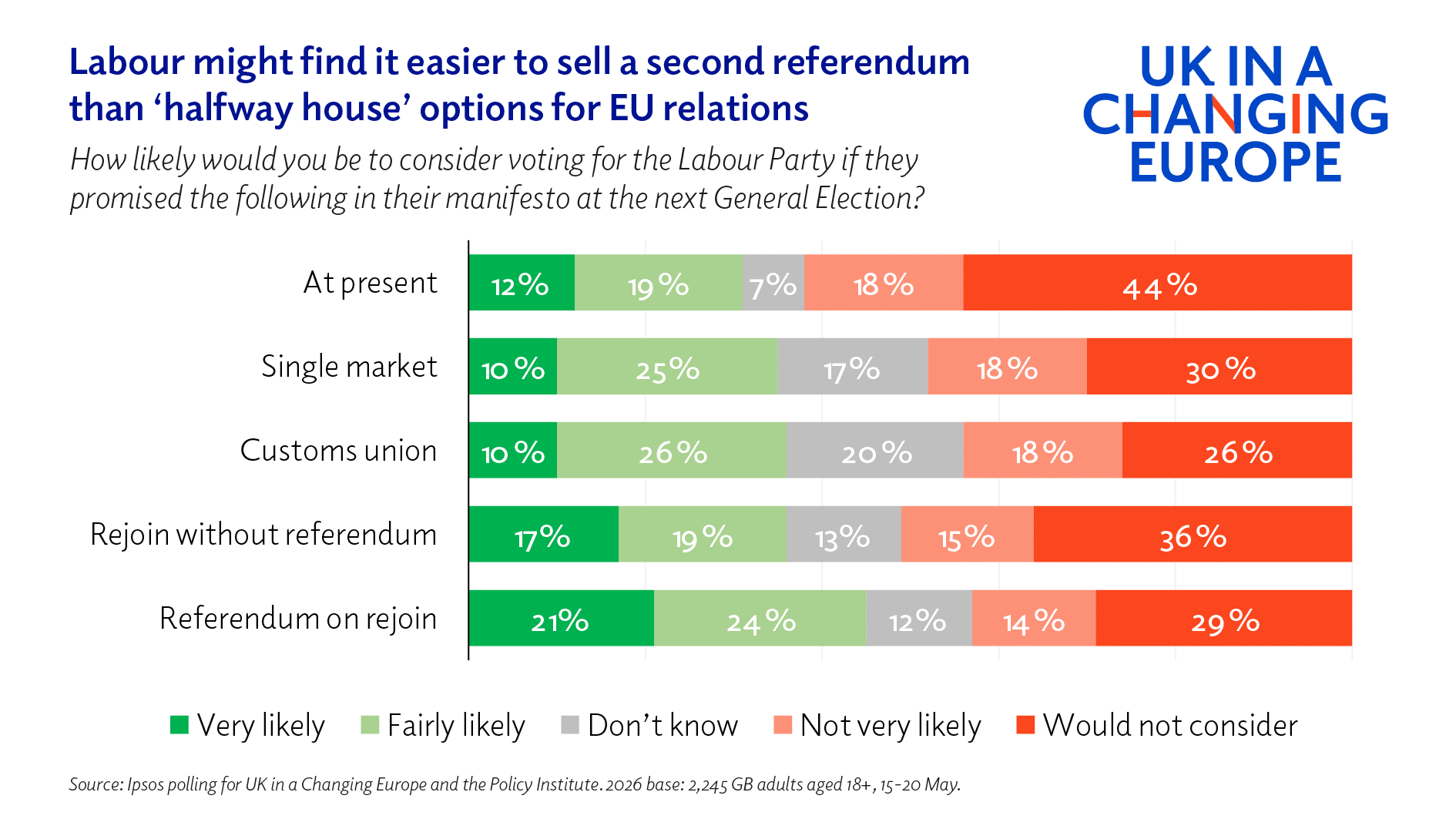

Even among those intending to vote for Reform, a rejoin referendum is more popular than the single market. Which is perhaps unsurprising: they would rather the UK have a meaningful say over EU law than be in a position of “vassal state”.
Moreover, both Iceland and Norway are now reconsidering their position. As the US commitment to NATO recedes, and Commission competencies expand to cover a growing range of security and resilience policies, there is a question of whether being outside the EU is too much of a geopolitical liability. Iceland set is to hold a referendum in August on starting an EU membership application – which could lead Norway to follow suit.
It’s also worth thinking about what single market membership would look like day-in, day-out. The UK would be required to systematically transplant new EU legislation into UK law, which is both a major administrative task (there is a current backlog of around 600 acts awaiting implementation by EEA states) and a likely source of regular political friction.
Even in Norway, where the EEA is a simple fact of life, disagreement over an EU energy package recently led to the collapse of the government. In the UK, such disagreements would likely play out far more often, and with greater combustion.
Every controversial piece of EU legislation would be an opportunity for Brexiter MPs to grandstand and, potentially, vote it down. Moreover, a future Conservative or Reform-led government might simply choose to stop implementing the necessary EU legislation: likely leading to the suspension of the EEA agreement, leaving the UK on worse trading terms than now.
The Lib Dems’ single market proposal puts politics before policy: designed more as a stick with which to beat the government than a serious proposal for the UK’s future. In that sense, it is a perfect ode to the last ten years of Brexit debates.
The post No EEA-sy options appeared first on UK in a changing Europe.
You must be logged in to post a comment Login