Politics
Our survey: Members convincingly back the new Conservative policy of banning under 16s from social media
That 64.5 percent of our members survey are in favour of banning under 16’s from social media is quite a sea change. Societally it has ‘something of a journey.’
I have been on it.
Two of my children are over 16. The eldest in their twenties, the second late teens. And they loved and still love their screens.
I definitely allowed a smart phone too soon, and know that it’s my fault when I observe even today that they can spend way too much time just looking at their phones. When they were younger I was using Twitter extensively for work, so I was just as bad, and my example was not a good one. I mention my kids because there is a symbiosis of their generation with the whole phenomenon of social media.
Twitter (now X) and Facebook (Meta) – certainly not the prime choice of today’s younger generation – are now the ‘grandads of social media’ and they are still only 20 and 22 years old. Now there’s Tik-Tok, Instagram, and Snapchat, who if they were children under the ban the Conservatives are looking at for under 16’s would not be able to use themselves as they are way too young!
These companies grew up with my kids. And I was just as fascinated by it.
Early adopters of social media were constantly learning and finding new ways to use it. Experimenting with how different behaviours and styles could be created, which say the advent of the meme, the ‘sh*tpost’, ratioing, YOLO, ROFL and now a lexicon of user generated slang, methods and motivations that would making learning Hungarian seem easy.
However all the time the developers and owners, of these increasingly powerful behemoths were learning all about us. And we handed so much to them without giving it a second thought or every wondering what that might ultimately mean.
This is not a piece about Digital ID, but one of the biggest arguments levelled at the idea is that we already effectively have it. All packaged up in those ever more sophisticated slices of metal and plastic we seem not to be able to do without, we constantly spray out data we often have no idea we’ve tacitly agreed to give away.
Nine years ago I started working at the Office of the Children’s Commissioner for England under Anne Longfield, and then Dame Rachel de Souza. The single most common question we were asked by politicians, the media, teachers, just ordinary members of the public either officially or just privately was “do you think it’s ok for my kids to be spending so much time online, on their phones?”
The answer by the way is less about time and quantity, but light touch supervision and quality, but that’s never going to be and effective slogan. Besides we did not believe ‘it was ok’ but not everyone agreed. Age verification became a battle over adult privacy. Privacy primacy became a locked door to the investigation of grooming, abuse, county lines drug running, exploitation and bullying and a whole host of very dark stuff that had nasty, sometimes fatal real world consequences.
The companies always fielded their ‘heads of responsibility’ or some such with bountiful and seemingly sincere claims of taking child safety more seriously than anything else. It was transparently untrue. Yes, they did take it seriously but not whenever is clashed with exponential company growth and market share. Then for a variety of reasons having said they’d stop at nothing to make their social media worlds safer, they stopped and did nothing if it was really going to hurt the ‘bottom line’.
Yesterday the BBC made a good attempt to prove this. They had talked to whistleblowers inside the companies Meta and Tik-Tok who all told the same story: push the boundaries of acceptable content because ‘outrage drove engagement’.
One ‘engineer’ described orders from above to allow more borderline harmful content in users feeds:
“They sort of told us that it’s because the stock price is down”
Times have changed. My youngest child is 7. His mother doesn’t want him having more than quite strictly rationed screen time, no smart phone for some time, and – to show my age and how things sometimes go full circle – for us to emulate the iconic Jerry Lee Lewis-esque theme song to 80s children’s TV classic “Why don’t you?”
Yesterday the Government had Keir Starmer himself tweeting about the BBC story and how much he’s personally determined to tackle the problem.
The Conservative Party has changed. A past reticence about taking on the platforms than can sway voters opinions, a nervousness about how far any Online Safety legislation should go, seems to have been shelved in the face of public concern, and mounting solid evidence. Kemi Badenoch and shadow education secretary Laura Trott, have been determined that whatever the previous position may have been the party would now ban under 16s from using social media because of the damage it can cause.
There are still voices that say this is intolerable interference in freedom of choice, state interference in people’s privacy and I’m not going to argue they don’t have valid points, indeed some may make the case on ConservativeHome, but it seems many people have just moved on.
That includes Conservative Party Members.
Our February ConservativeHome survey produced convincing backing for the banning of under 16s from social media.
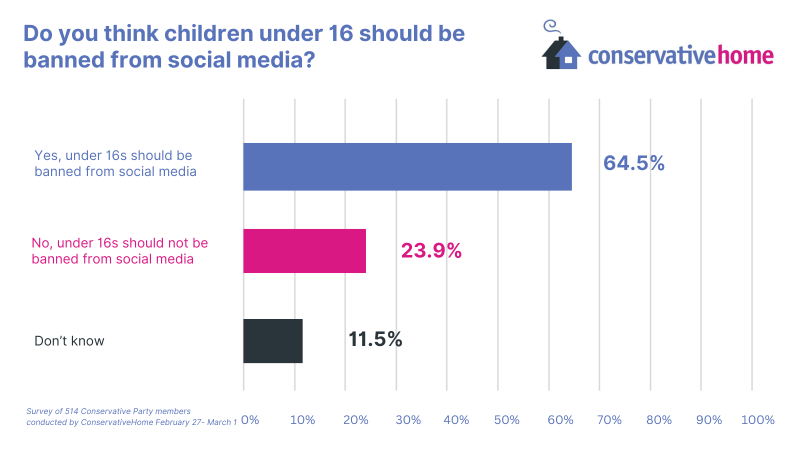

Now let’s be honest many of our members are not teens wanting to use social media, far from it, but they do care about freedom of choice and have less nanny-statism. But 64.5 percent of responders said the policy was the right one. Just 23.9 percent said no. That’s still nearly a quarter, but with don’t knows at just 11.5 percent it’s pretty decisive.
The key, as always is how you enforce it? However from work done some years ago across a range of child protection pilots in the online sphere, the harder you made it, the more socially acceptable it was not to be involved at all. The more you not only prevented it, the more young people got over their thirst for it in the first place. Not all, probably never all, but most.
It is why most schools in some form or another do actually ban the use of mobile phones in school hours, and have done so for some time, and why banning them altogether from schools makes sense.
The policy is a step change from what I saw outside the last government but looking in and worth pointing out to those who say change is beyond the party, a marked change from where they were before.
It would seem members are broadly happy with that, too.
You must be logged in to post a comment Login