
Politics
Pete Hegseth Says Media Coverage Of Fallen U.S. Troops Is Meant To Hurt Trump


US Defence Secretary Pete Hegseth on Wednesday suggested the media’s reporting of American troops killed after the US went to war with Iran is only to make President Donald Trump “look bad.”
In an astonishing attack on journalists during a news briefing at the Pentagon, the former Fox News host and Army veteran was touting the early achievements of Trump’s conflict in the Middle East when he complained about “tragic things” making “front page news.”
His comments came after six US military members were killed over the weekend in a drone strike in Kuwait.
In pointed remarks aimed at the “fake news,” Hegseth told the press conference: “We’ve taken control of Iran’s airspace and waterways without boots on the ground. We control their fate. But when a few drones get through or tragic things happen, it’s front page news again.”
Hegseth went on to claim: “I get it, the press only wants to make the president look bad. But try for once to report the reality.” (Watch a clip of his remarks below.)
The soldiers killed on Sunday by an Iranian drone strike were based at an operations center in the heart of a civilian port in Kuwait, miles away from the main Army base.
Four of the six fatalities were members of an Iowa unit of the US Army Reserve, the Pentagon said on Tuesday.
The department identified them as Sgt. Declan Coady, 20, of Des Moines, Iowa; Sgt. 1st Class Nicole Amor, 39, of White Bear Lake, Minnesota; Capt. Cody Khork, 35, of Winter Haven, Florida; and Sgt. 1st Class Noah Tietjens, 42, of Bellevue, Nebraska.
Two soldiers have yet to be publicly identified.
“Sadly, there will likely be more, before it ends. That’s the way it is,” Trump said of US troop deaths on Monday.
Hegseth’s comments were raised with White House press secretary Karoline Leavitt on Wednesday at her first briefing with reporters since airstrikes on Iran triggered counterattacks.
Pressed by Kaitlan Collins, CNN’s chief White House correspondent, Leavitt initially dismissed the idea that Hegseth was complaining about the media.
“That’s not what the secretary said, Kaitlan. And that’s not what the secretary meant and you know it. You know you’re being disingenuous,” she snapped.
When Collins read out the Hegseth quotation verbatim, Leavitt replied: “The press does only want to make the president look bad. That’s a fact.”
Throughout his briefing, Hegseth was at pains to stress how the US is dominating the five-day-old war, which Trump entered without congressional approval.
Even so, the defence secretary conceded that some Iranian attacks would still hit their targets.
“This does not mean we can stop everything, but we ensured that the maximum possible defence and maximum possible force protection was set up before we went on offence,” he said.
Dismissing reported concerns about the US’s diminishing stockpile of munitions, he claimed that the US can continue to fight the war “easily as long as we need to.”
“Iran cannot outlast us,” Hegseth insisted. “We’re going to ensure through violence of action, and our offensive capabilities and our defensive capabilities, that we set the tone and the tempo of this fight.”

Signaling a potentially longer conflict than has previously been hinted at by the Trump administration, he added: “You can say four weeks, but it could be six, it could be eight, it could be three.”
“Ultimately, we set the pace and the tempo,” he added.
Dan Caine, the chair of the Joint Chiefs of Staff, echoed Hegseth, noting that the US “has sufficient precision munitions for the task at hand, both on the offense and defense.”
Their comments follow reporting by Reuters stating defence contractors are expected to visit the White House on Friday as the Trump administration wants to ensure it has adequate weapons stocks, given that the Iran conflict has forced the US to use many of its munitions.


The post England’s football regulator has already gone woke appeared first on spiked.

A Lib Dem councillor was left stunned after being asked by Reform UK to stand for the party at the local elections in May.
Sam Webber, who sits on Bromley Council in south east London, was phoned out of the blue by the party’s membership team and asked if he wanted to be a “paper candidate” on May 7.
A paper candidate is someone whose name goes on the ballot representing a party but is not expected to win or do any campaigning.
Speaking to HuffPost UK, Webber accused Nigel Farage’s party of “making a mockery of the election nomination process”.
He said: “Is Reform just randomly calling up people across the country and asking them to stand for election?
“Nominations open in five days time. How much vetting will the party be doing on their candidates in that time? This runs the risk people getting nominated who would be ineligible to serve even if they were elected.
“That would see costly and unnecessary by-elections having to take place after May 7, as we saw after the 2025 local elections.
“Reform UK is making a mockery of the election nomination process. As we have seen in authorities like Kent County Council, it would be total chaos if the party gets anywhere near power. I suspect voters will not like being taken for fools.”
Reform has been contacted for comment.
A staggering 65 Reform councillors who were elected at last May’s local elections have since either resigned as councillors, defected or quit the party.
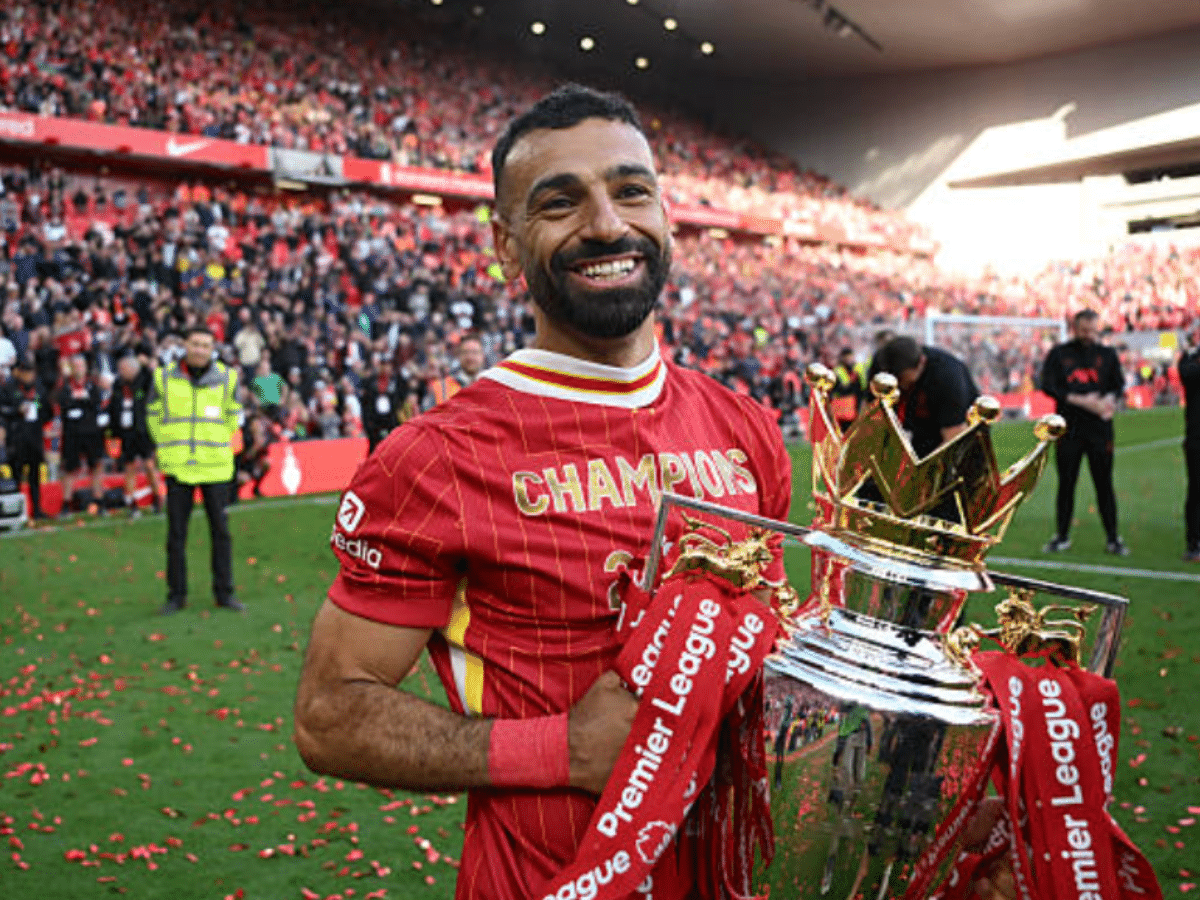
Egyptian star Mohamed Salah has announced he will be leaving Liverpool at the end of the season, bringing to a close one of the greatest eras in the club’s history and a golden age in the Premier League.
Mohamed Salah is not just a departing player; he represents the end of an exceptional career that has inspired the club and fans worldwide.
Unprecedented
When Salah arrived at Anfield in the summer of 2017 from Roma for around $50 million, it seemed like just another big-money move. But the next few years proved that the club hadn’t signed an ordinary player, but an unprecedented football phenomenon.
His journey to the top wasn’t easy. He had a disappointing spell at Chelsea before rediscovering his form in Italy and returning to England as a more complete player, finding in Jürgen Klopp’s project the perfect environment to flourish.
From his very first season, Salah established himself as a formidable attacking force, scoring 44 goals and announcing the birth of the ‘Egyptian King.’
During his nine seasons with Liverpool, he scored 255 goals in 435 appearances, placing him third on the club’s all-time top scorers list. He also contributed 281 goals in the Premier League, the most by any player for a single club. He won the Golden Boot four times, equaling Thierry Henry’s record, confirming his dominance and consistent goal-scoring prowess.
His impact wasn’t limited to individual statistics; it extended to major titles. He was instrumental in Liverpool’s triumphs, securing eight significant trophies: two Premier League titles, a Champions League title, an FA Cup, two League Cups, a Club World Cup, and a UEFA Super Cup. The highlight of his career was winning the Champions League in 2019, following the heartbreak of the 2018 Kyiv final, when he scored in the final against Tottenham and led the team to European glory.
An enduring legacy
Salah’s impact wasn’t limited to the pitch; it extended to the human dimension as well. He went through difficult times, most notably the death of his teammate Diogo Jota, and witnessed some tensions within the team, but the relationship between the player and the club remained based on respect and achievement.
When Mohamed Salah leaves, it’s not just a goal-scoring player who departs, but an entire chapter in the club’s modern history closes. A player who transformed Liverpool, inspired fans around the world, and etched his name in gold. The legacy of the “Egyptian King” will live on, etched in the memory of Anfield and in the heart of every fan, forever. Mohamed Salah was more than just a goalscorer; he wass an entire era in Liverpool’s history.
Salah’s extensive achievements with Liverpool
• Most Premier League goals by an African player: 189
• Most assists by an African player: 92
• Most Premier League goals as a winger: 190
• Most Premier League goals with his left foot: 152
• Most goal contributions in a 38-game season: 47
• Most goals in a single season with Liverpool: 44
• Most goal contributions against Manchester United: 19
• Most goal contributions in a single month: 14
• Most goal contributions for a single club: 281
• Premier League Golden Boot: 4 times
• Player of the Month: 7 times
• More Liverpool’s Premier League goals: 189
• Most Champions League goals for an English club: 45
• Liverpool’s all-time Champions League top scorer: 50
• First player to have over 40 goal contributions in two seasons
• First player to have 10+ goal contributions in three months
• Only player to score a hat-trick at Old Trafford
Featured image via the Canary
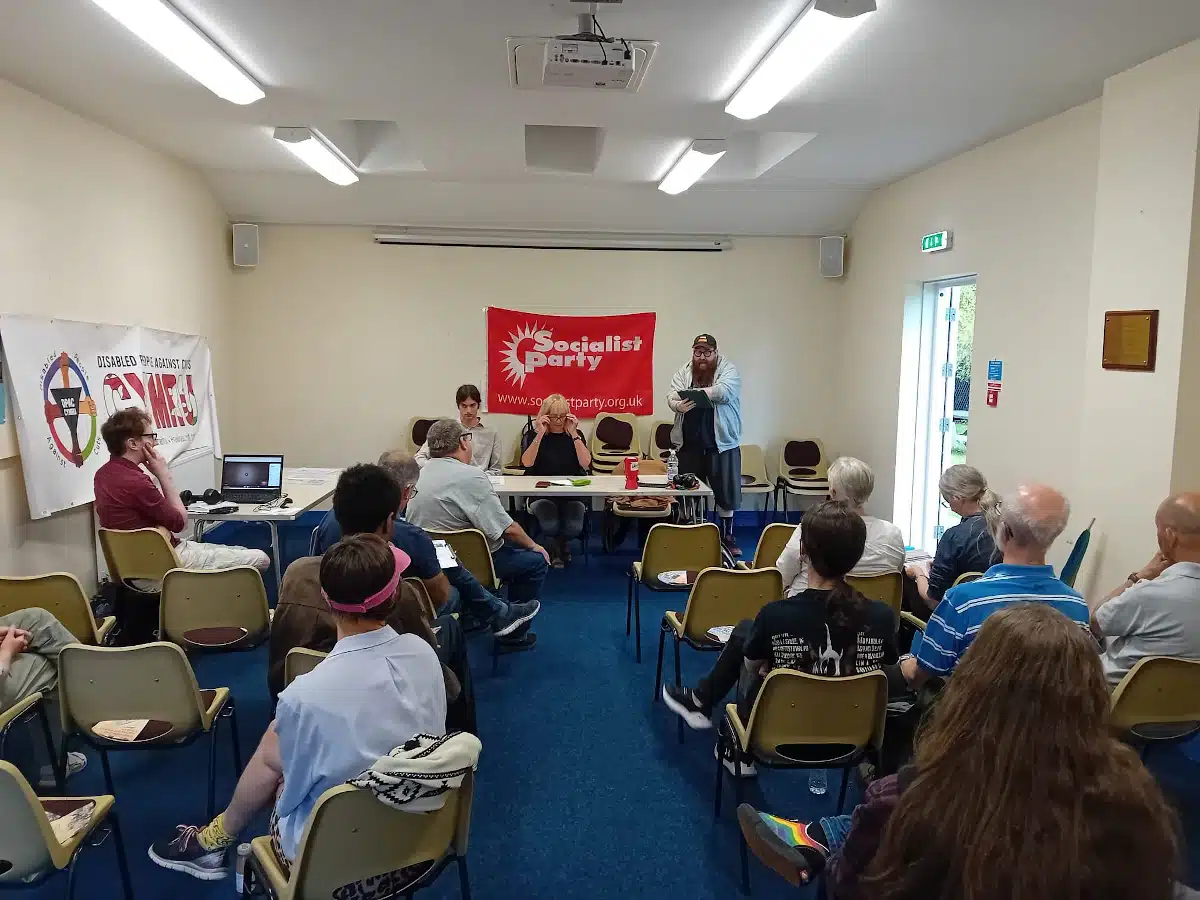
The Socialist Party has announced today that it will be standing in the Senedd elections under the banner of the Welsh Trade Unionist and Socialist Coalition (TUSC).
The candidates are standing to make the case for trade unions taking the lead in forming a new workers’ party. This is to address what the party calls “the crisis in working-class political representation.”
The Socialist Party says that its candidates are proven campaigners in their workplaces and communities. Its key policies are “democratic public ownership; a future for young people without debt, war or climate disaster; and a united fight for jobs, homes and services to combat racism and division.”
Ben Golightly and Mark Evans
In Gŵyr Abertawe, the lead candidate is Ben Golightly, one of the elected coordinators for Disabled People Against Cuts Cymru, a high-profile campaign fighting disability cuts.
Joining him on the TUSC party list for Swansea & Gower is Mark Evans, a long-standing Unison trade unionist, and Secretary of Swansea & District Trades Council. Mark has been a consistent campaigner against local government job cuts, council tax increases, and cuts to services.
The party is also standing three candidates in Caerdydd Ffynnon Taf.
John Williams
John Williams is a hospitality worker, LGBT+ activist, and chair of the Cardiff general branch of Unite the Union.
He says he is “proud to have supported striking workers across Cardiff and South Wales, including ambulance staff, nurses, and bin workers. I’m proud also to have stood shoulder to shoulder with reps facing anti-union tactics from Cardiff Council, and of my work bringing trade union solidarity to Trans Day of Remembrance and Trans Pride.”
Helen Perriam
Helen Perriam is a nurse at Llandough Hospital. She is a Unison member and trade union campaigner.
She says she has “seen first hand what Labour and Tory cuts and privatisation have done to our NHS” and “will stand up in the Senedd to fight every cut and speak up passionately for more resources to allow nurses and health workers to provide the services we need.”
Dave Bartlett
Dave Bartlett is secretary of Cardiff Trades Union Council and a leader in the campaign that saved health facilities at Cardiff Royal Infirmary.
He says that “campaigning in our communities isn’t enough, we need a voice for the working class in the Senedd. It is time for the trade unions to end the funding of Labour and to form a mass new workers’ party instead.”
Wage Pledge
All Welsh Trade Unionist and Socialist Coalition candidates have pledged that, if elected, they would forgo the full £76,380 Senedd member salary, and take home only a worker’s wage.
The coalition is also standing nearly 200 candidates in the English council elections.
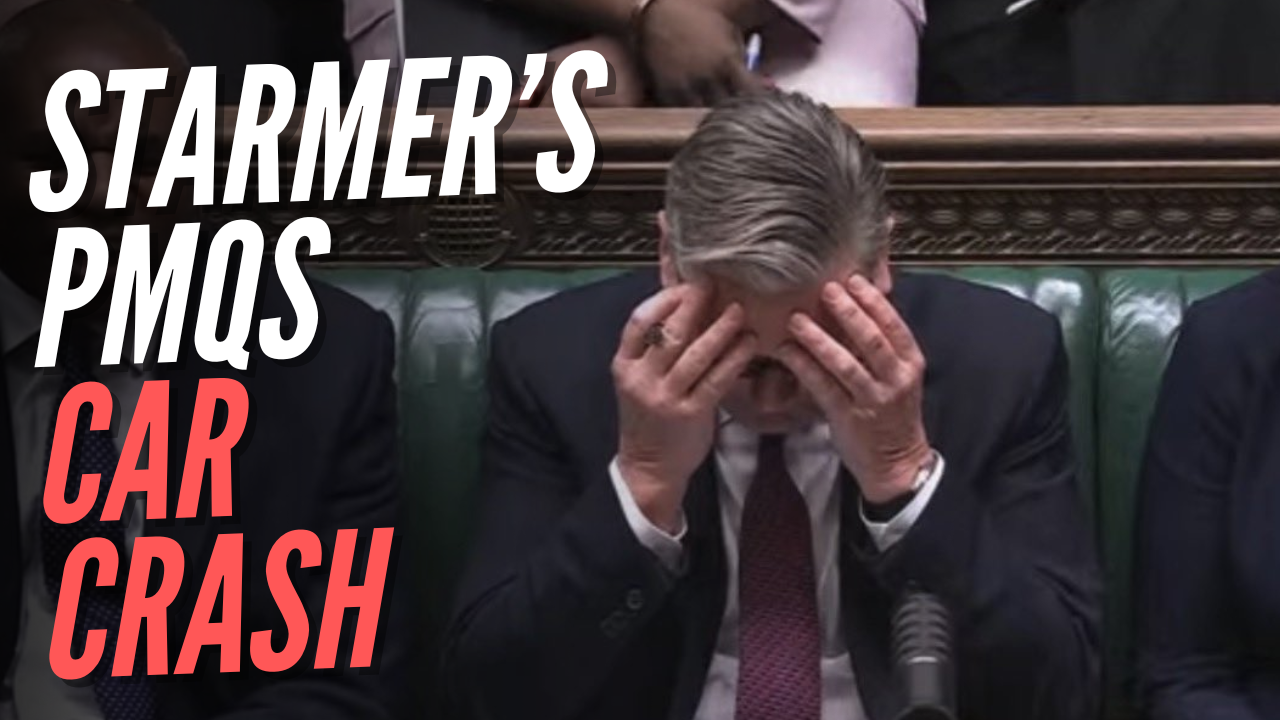
Starmer’s worst performance in a long time, and the bar is low. There is always a “process” that stops him doing anything. Always another ‘review’. Is he aware he lives in Number 10?
Politics
Revolut Banking Licence Saga Exposes Painful Negativity of UK Regulators and Business Media – Guido Fawkes
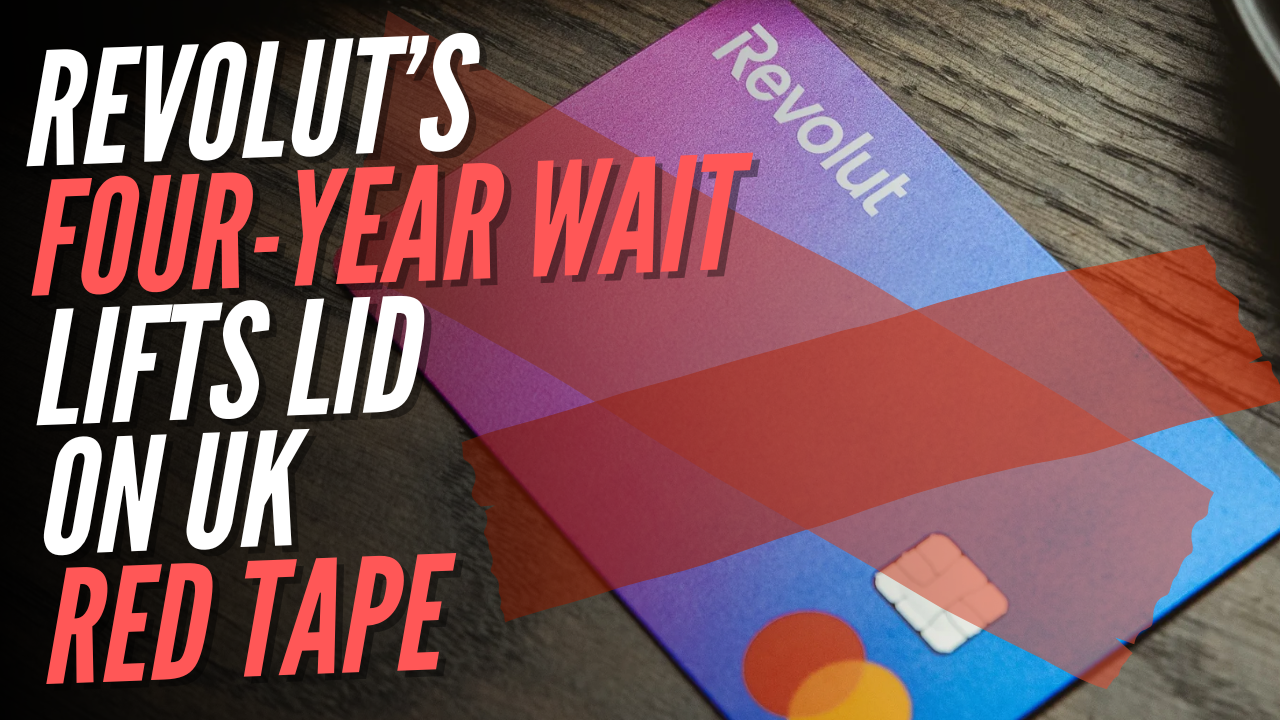
Fintech company Revolut was finally granted a full UK banking licence earlier this month. The app-based company has been used in the UK for years and has 13 million British customers…
The length of time it took to get the regulatory approval has been cited as another example of the UK’s sclerotic processes – it is more than four years since Revolut first applied for a licence. The Bank of England’s Prudential Regulation Authority repeatedly extended Revolut’s approval timelines…
Reform’s Richard Tice is among the politicians who have called the process “absurd”. Another take is available in the FT this morning, where the influential Lex column urges Revolut to “move slowly” with its ambitions to become a full bank in Britain, even though it has just been granted a licence. With regulators and a financial media like that, it’s a miracle the approval didn’t take a decade…

Sports nutritionist Itziar González has reignited controversy within Real Madrid, amid escalating criticism directed at the club’s medical staff regarding their handling of French star Kylian Mbappe’s injury.
Spanish journalist Miguel Ángel Díaz alleged that:
Real Madrid, in their initial diagnosis, got the knee wrong. Instead of examining Mbappé’s left knee, they examined his right.
According to Díaz, this meant Mbappe played football when he should have been resting, potentially aggravating the injury.
Mbappe injury storm
González – who no longer works for Real Madrid – ignited a media firestorm after González intervened, asserting on her Instagram account that some of the medical staff’s decisions were based on free artificial intelligence programs, a direct reference to ChatGPT. She considered this evidence of a lack of professional standards within the club’s medical system.
A translation of her remarks asks whether scanning the wrong knee is worse than the alleged use of ChatGPT:
Although I don’t know what’s worse: this, or them prescribing supplements based on free Chat-GPT.
The conflict between González and Real Madrid’s management is not new. She has clashed repeatedly with the doctors throughout her tenure, due to her insistence on a central role for nutrition in injury treatment, rather than simply preparing meals.
According to the website Espana, these tensions culminated in her dismissal, before she later resorted to legal action last December, a move aimed – according to those close to her – at exposing what she describes as “internal dysfunctions.”
In scathing remarks, González addressed Mbappé directly, saying, “we hope to find competent and well-trained people, instead of ignorant narcissists who obtained their positions through connections,” adding that some employees “remain in their positions despite the damage they cause.”
However, Mbappe has distanced himself from the rumours and furore:
My knee is fine. It’s getting better.
It’s going quite well, and I know there’s been a lot of speculation about it and some false things have been said.
It’s the life of a top athlete, and we’re used to people saying things without verifying them or having any basis in fact.
Featured image via the Canary

Duffy has announced she’ll tell her story for the first time in a new documentary.
The chart-topping singer winner became a household name in the late 2000s thanks to her hits Mercy and Warwick Avenue, taken from her Brit Award– and Grammy-winning album Rockferry.
In the years that followed, she took a major step back from the limelight, and in 2020, she disclosed that she had been “raped and drugged and held captive over some days” a decade earlier, leading to her withdrawing from public life.
Six years after coming forward with her story, it’s been announced that Duffy will be the subject of a new Disney+ documentary about her experiences.
An official press release teased: “Documenting her life in this way for the first time, the documentary will be a retrospective film traversing Duffy’s life, from her upbringing in Wales, through to her meteoric rise to fame and her withdrawal from public life following her unfathomable experience.
“The original documentary film will be driven by new, unprecedented access to Duffy, along with a rich and nostalgic archive, and interviews with family, friends, and close peers in the music industry.”
Streaming platform Disney+’s vice president of unscripted content, Sean Doyle, said in a statement: “This film will give Duffy the chance to tell her story in her own words. I am grateful to our collaborators at Rare TV for this unprecedented access, along with Stellify Media for handling this project with sensitivity and care.
“We set out in a search for impactful, female-led stories in collaboration with Northern Ireland Screen, and it’s a privilege that Duffy’s is the first we’re able to help tell. But above all, I’m especially in awe of Duffy – for her honesty and courage to share her story.”
Last year, it was reported that the Welsh performer had been privately working on new music, which would mark her first major release since the release of her second album Endlessly in 2010.
Her last top 40 was in 2008, when she released the single Rain On Your Parade from a repackaged version of her Rockferry album.
Help and support:
- Rape Crisis services for women and girls who have been raped or have experienced sexual violence – 0808 802 9999
- Survivors UK offers support for men and boys – 0203 598 3898

It turns out that tiny changes – minutes more exercise, a few grams more veggies – can make a surprisingly large difference to your longevity and heart attack risk.
And Dr Dominic Greenyer, a private GP at The Health Suite, said that those lifestyle changes become medically obvious in time.
“If you followed two twins over time, you would often see clear differences in their skin, body composition, energy levels and overall health depending on how they live,” Dr Greenyer said.
“Ageing is not just about time passing. It’s about how well the body is maintained.”
Here, he shared the five factors he feels make all the difference:
1) Building and maintaining muscle
As we age, our muscles begin to wane – a process called sarcopenia. If we do nothing to maintain or build it, some research says we’re expected to lose half our muscle mass by 80.
“One of the biggest predictors of healthy ageing is muscle mass,” Dr Greenyer said.
2) Prioritising sleep and recovery
“Chronic poor sleep can accelerate ageing at a cellular level,” Dr Greenyer said.
“It affects hormones, recovery, inflammation and even visible signs like skin quality.”
Experts think that following a “7-1” sleeping rule (getting at least seven hours of sleep a night, with no more than an hour’s variance between bedtimes and wake-up times) could add years to your life.
3) Reducing inflammation through lifestyle choices
In and of itself, inflammation isn’t a problem – it can help our bodies to heal and may be an important part of muscle growth.
But “inflammaging” can occur when inflammation is chronic, and might contribute to conditions such as heart disease, type 2 diabetes, dementia, and frailty.
It “is influenced by diet, stress, alcohol intake and overall lifestyle,” Dr Greenyer said.
Those who eat whole foods, stay active, and manage stress well may have less unwanted inflammation, he added.
4) Enjoy life, in moderation
There’s lots of research to support the idea that enjoying ourselves – be it through socialising or even eating some candy – might help us to live longer.
“There is good evidence that polyphenol-rich foods such as dark chocolate can support cardiovascular health when consumed in moderation,” Dr Greenyer added. “Just as important is maintaining strong social connections, which are consistently associated with longer lifespan and better mental wellbeing.”
He ended, “The difference comes from small choices repeated over years – but they should still allow you to enjoy life.”
Politics
Lord Ashcroft: The SNP’s record, the independence debate, what matters to voters, and is Nicola Sturgeon an asset or a liability? My latest Scottish polling
Lord Ashcroft KCMG PC is an international businessman, philanthropist, author and pollster. For more information on his work, visit lordashcroft.com
With Holyrood elections just over six weeks away, my latest polling looks at Scottish public opinion towards the SNP government’s record, the parties and leaders, the independence debate, and the issues that will shape the outcome in May. The full report, including thoughts from our focus groups around the country, is here. My commentary on the research for Holyrood magazine is here.
The SNP government’s record

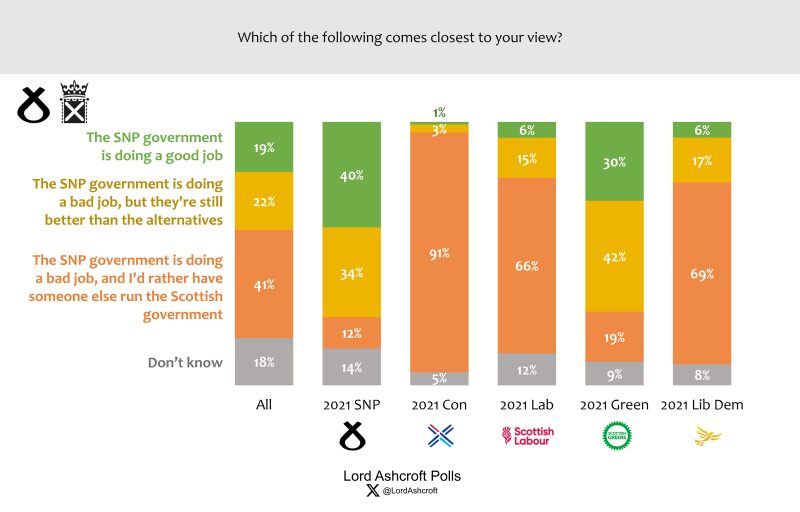
Offered three statements about the SNP government’s record, just under one in five Scots said they thought it was doing a good job. This included 40 per cent of those who voted SNP in 2021, and only just over half of those intending to back the party at the 2026 election. A further 22 per cent overall, including nearly four in ten likely SNP voters, said the SNP was doing a bad job but was still better than the alternatives. The combined overall total of 41 per cent thinking the government was doing a good job or was better than the alternatives matched the proportion who said the SNP was doing a bad job and they would rather have someone else running the Scottish government.

Looking in more detail at the SNP government’s record, its best marks overall were for “standing up for Scotland” – a majority of all voters say it has done a good job on this score, including three quarters of 2021 SNP list voters and nearly nine in ten of those intending to vote
for the party this year. On other things, the proportion saying the SNP government had done a good job did not exceed 35 per cent (“making life better for people in Scotland”) and fell to as low as 26 per cent for “honesty and integrity” – though majorities of both 2021 and likely 2026 SNP voters said the Scottish government had performed well on this score.
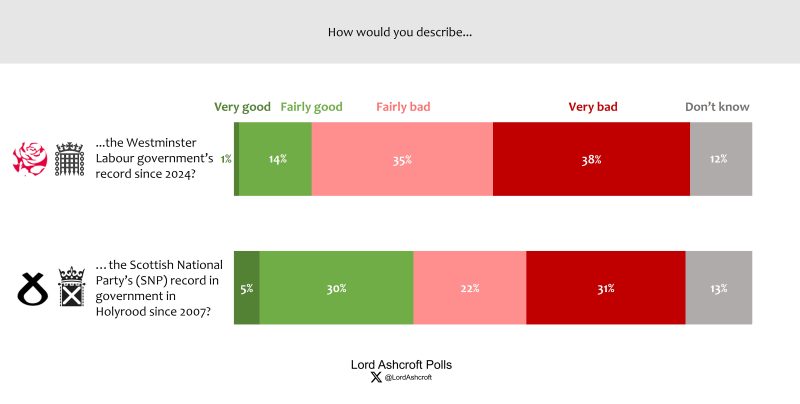
Scots said they thought the Westminster Labour government’s record since the 2024 election was bad, by 73 per cent to 15 per cent. Those who had voted Labour in 2024 said it was doing a bad job by 68 per cent to 23 per cent. However, they thought the SNP government’s record in Holyrood since 2007 was bad by a narrower 18-point margin. Nearly two thirds of 2021 SNP list voters said they thought their party had done a good job in government, as did nearly eight in ten of those intending to vote SNP in the regional list vote.
Issues and priorities

Asked to name the three most important issues facing Scotland at the moment, Scots as a whole chose health and the NHS, the cost of living, and the economy and jobs as their top three priorities. These were followed by immigration, poverty and inequality, housing, education and climate change. However, there were notable differences between political groups. Health and the cost of living topped the list for those intending to vote SNP, Labour, Conservative and Green in the regional list vote. For the first three of these the economy was in third place, but for Greens this spot went to poverty and inequality.
Getting Scottish independence was the fourth biggest priority for those intending to vote SNP, and was named by just under a quarter of likely SNP voters. For Greens, getting independence ranked equal eighth. It was named by 12 per cent of them, on a par with Brexit and welfare, and after health, the cost of living, poverty, climate change, the economy and jobs, housing and immigration.
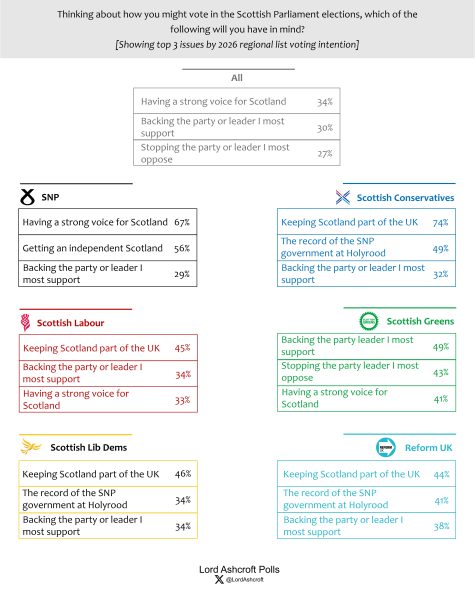
Asked what they would have in mind when deciding how to vote in the Holyrood elections, Scots were most likely to choose having a strong voice for Scotland, followed by backing the party they most support or stopping the party they most oppose. Only 26% overall mentioned the record of the SNP government, putting it in fourth place.
Again, however, there were sharp differences between political groups. Two thirds of those intending to vote SNP chose having a strong voice for Scotland, with just over half saying they would be using their vote to try and get an independent Scotland. For Reform, Lib Dem
and Conservative voters, the biggest motivating factor was keeping Scotland in the UK. For Greens, the top two places went to backing the party they most support and stopping the party they most oppose.
Independence
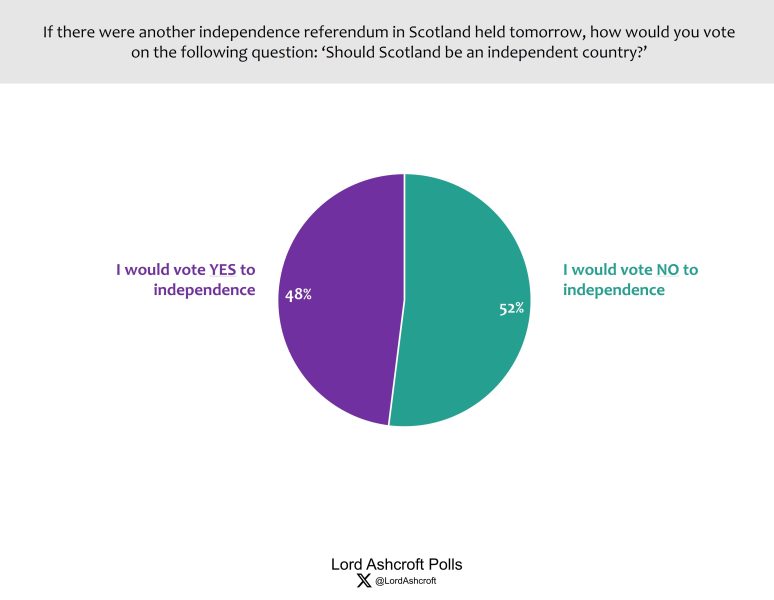
Asked how they would vote if an independence referendum were held tomorrow, respondents said they would vote No by a three-point margin, with 18 per cent saying they didn’t know or would not vote. Including only those giving a voting intention, this gives a result of Yes 48 per cent, No 52 per cent. (This compares to a 12-point margin for No in our previous survey in February 2023).
Among those currently intending to vote SNP in the regional list vote, 84 per cent said they would vote Yes to independence, while 7 per cent would vote No and 8 per cent said they didn’t know. Ninety-four per cent of those intending to vote for the Scottish Conservatives in the regional list vote said they would vote No, as did nearly three quarters of those intending to back Scottish Labour, six in ten of those backing the Scottish Lib Dems and nearly eight in ten of those intending to vote Reform. Those intending to vote Green said they would back independence by a 50-point margin, with 12 per cent saying they didn’t know or wouldn’t vote.

A plurality of Scots thought a referendum tomorrow would result in a No vote on independence, but the reverse was true if a referendum were to be held in five years’ time.
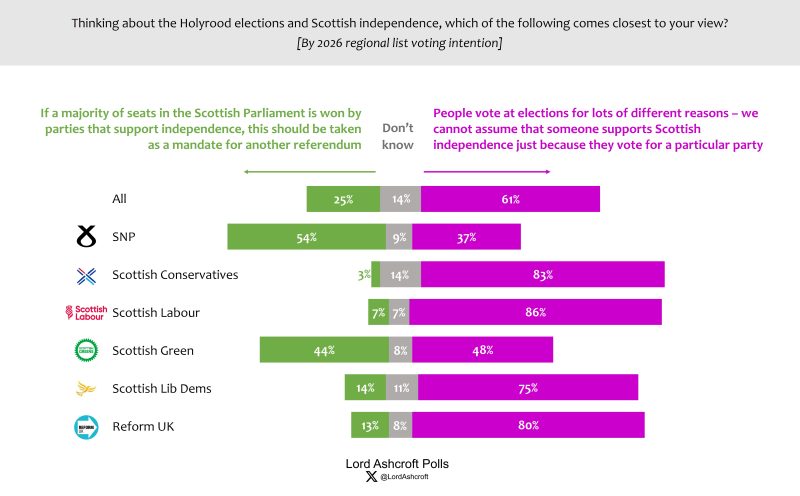
Only a quarter of Scots overall – including only just over half of likely SNP voters – said that pro-independence parties winning a majority of seats in the May election should be taken as a mandate for another independence referendum. More than six in ten agreed with the alternative proposition that someone cannot be assumed to support independence just because they support a particular party. Those intending to vote Green chose the second statement by a four-point margin.
Parties and leaders
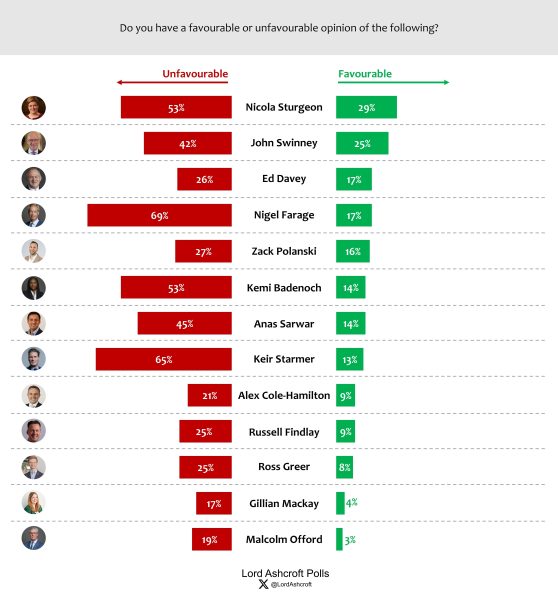
When we asked how favourable or otherwise people felt towards various politicians, Nicola Sturgeon emerged with the most positive score (but also one of the highest negatives). Nigel Farage had a higher favourable score than Keir Starmer, but their net scores (favourable minus unfavourable) were the same.
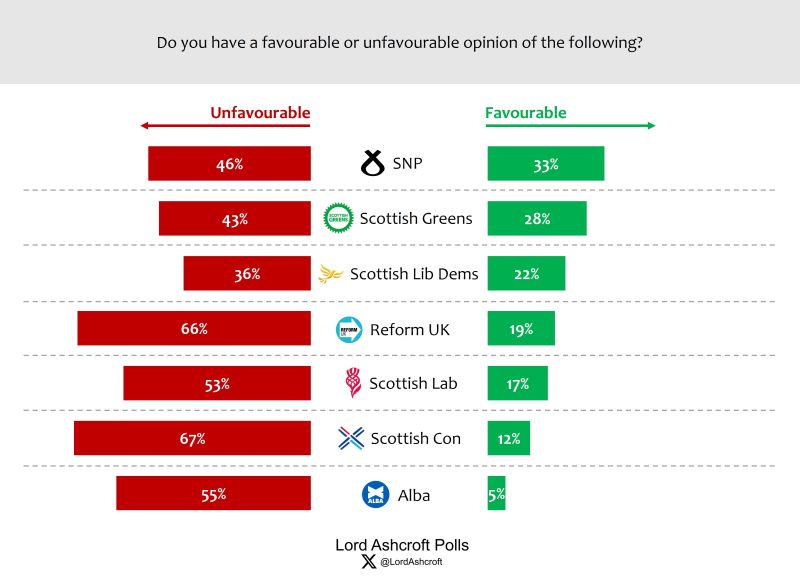
Comparing these favourability ratings with the figures above, we can see that Anas Sarwar, Zack Polanski, Ed Davey and Kemi Badenoch are more popular (or less unpopular) than their respective parties. While same is also true of Gillian Mackay, Alex Cole-Hamilton and Russell Findlay, this owes more to their relatively low recognition figures than to high favourability scores.
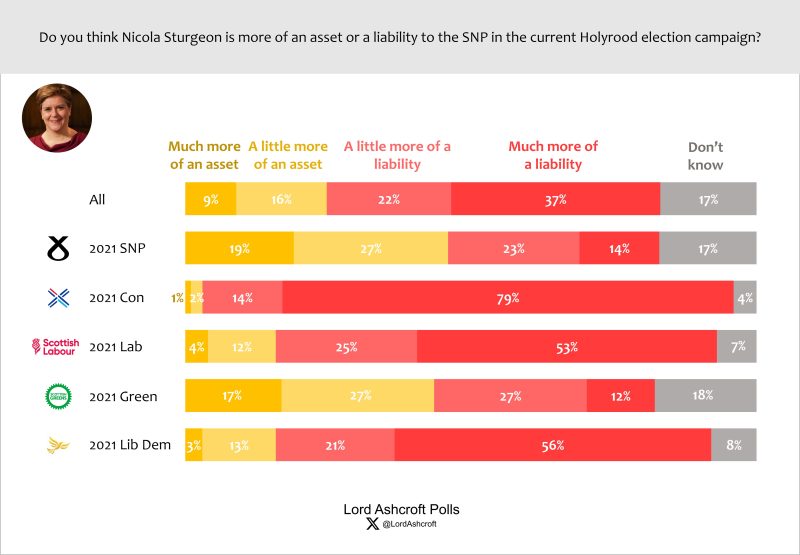
A majority of Scots said they saw Nicola Sturgeon as a liability rather than an asset to her party. Likely Green voters were also more likely to see her as a liability. However, SNP voters themselves were more likely to take the opposite view: those intending to back the party in the regional list vote this year saw her as an asset by 50 per cent to 33 per cent.
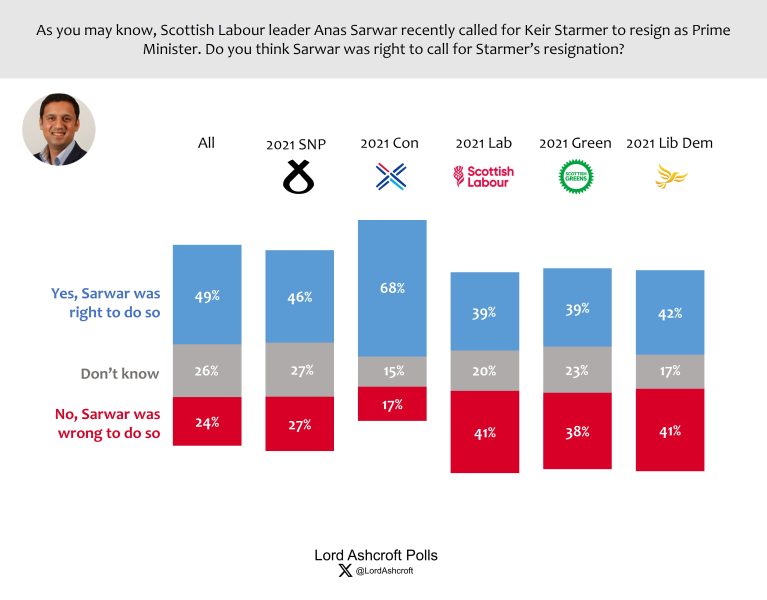
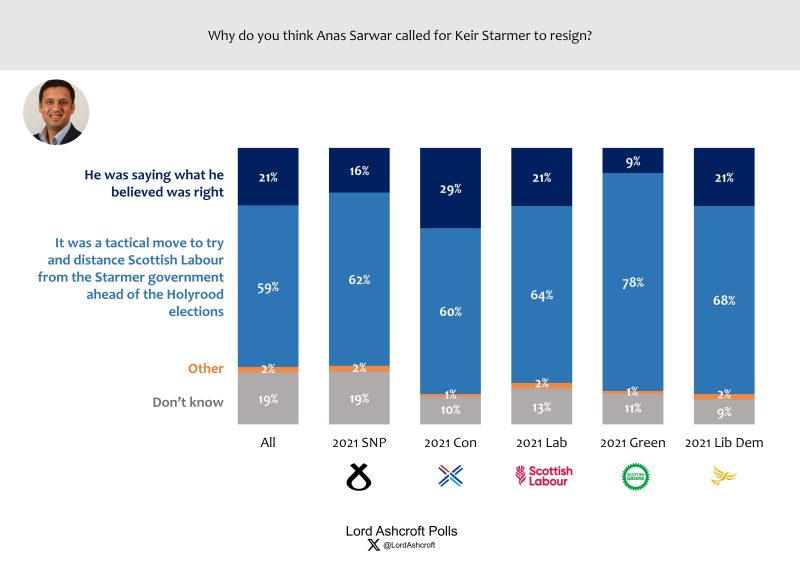
By a margin two-to-one margin, Scots thought Scottish Labour leader Anas Sarwar was right to call for Keir Starmer to resign as prime minister (indeed those intending to vote for Scottish Labour in the Holyrood elections were the only group to disagree). However, a majority of all parties’ voters thought Sarwar had made the call as a tactical move to distance Scottish Labour from the Starmer government, rather than that he was saying what he believed was right.
Attitude to Reform UK
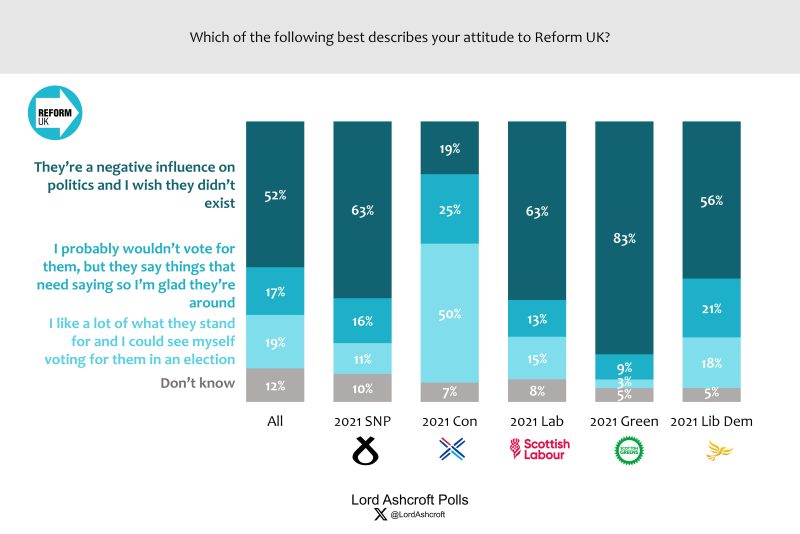
Just over half of Scots (including around three quarters of likely SNP and Labour voters) said they thought Reform UK were a negative influence on politics and they wished the party didn’t exist. A further 17 per cent, including one third of likely Conservative voters and more than one in five likely Lib Dems, say they probably wouldn’t vote Reform but they say things that need to be said so they’re glad the party is around. Just under one in five, including half of all 2021 Conservative voters, say they like a lot of what the party stands for and could see themselves voting for it in an election.
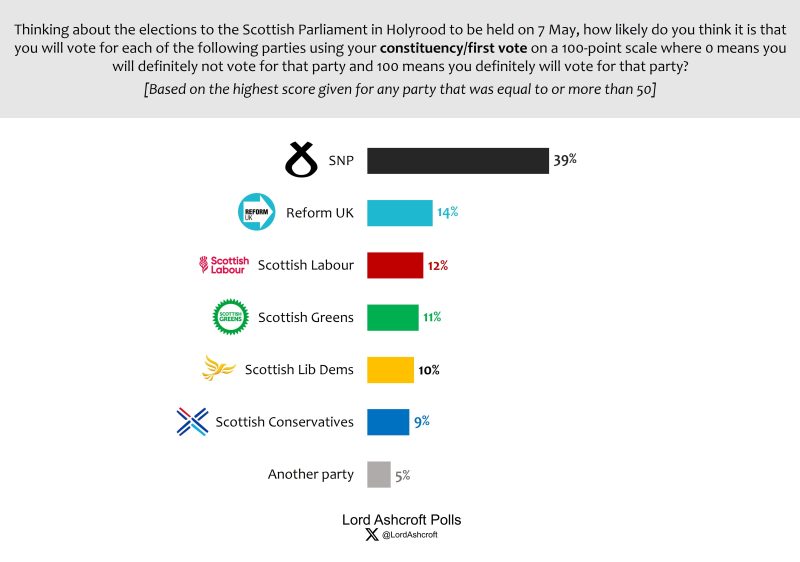
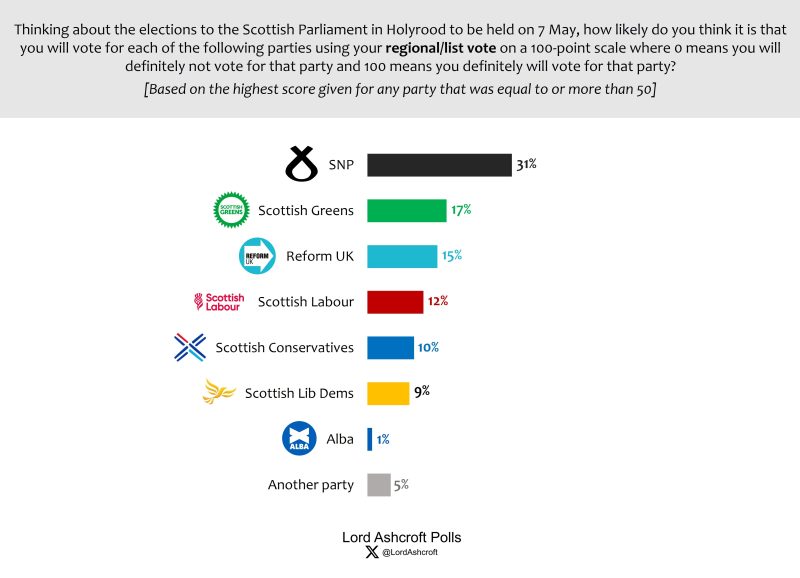
We asked people how likely they thought they were to vote for each party in the Scottish Parliament elections in May on a scale from 0 to 100 – where 0 means there is no chance, they will vote for that party and 100 means they will definitely vote for that party. Looking at those saying they are more likely than not to vote for one party (those whose likelihood of voting for one party was at least 50/100), this implies the following state of the parties in the constituency and regional list votes at the outset of the campaign:
Six segments
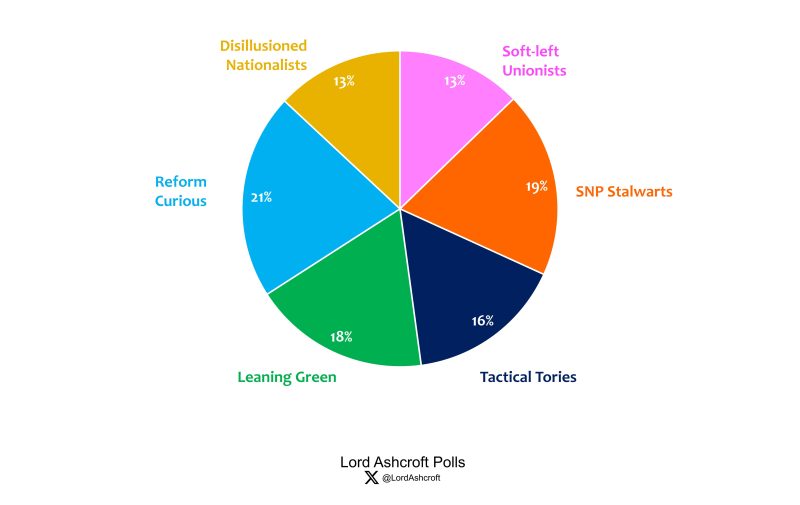
Our analysis identifies six similarly sized segments within the Scottish electorate.
- The SNP Stalwarts have given the party strong support at the last two general elections and are the most likely to vote SNP in May, although a significant minority will use their list vote for the Scottish Greens. Their vote in the Scottish Parliament elections tends to be about having a strong voice for Scotland and getting an independent Scotland. They think the SNP government is doing a good job and overwhelmingly prefer a SNP-Green coalition to any alternative. Economically they are very optimistic for their local area and for Scotland, but far less so for the UK. They support Scottish independence and are the only segment to agree that a majority of seats being won by pro-independence parties constitutes a mandate for a second referendum. They are evenly divided as to whether Scotland should keep using North Sea oil and gas reserves.
- The Lib/Lab Unionists are most likely to vote Labour or Lib Dem both in Holyrood and Westminster elections and have consistently done so in the past. They are most likely to identify education, the economy and the NHS as major issues. They tend to say the SNP government is doing a bad job and they want them replaced, although a significant proportion don’t know. They strongly oppose independence and expect that Scotland would reject it in a referendum held tomorrow, but are far less sure about a result in five years’ time. They have a strong preference for a coalition between Labour and the Liberal Democrats over an SNP-Green coalition; this preference persists but becomes much weaker if the Conservatives are added as a coalition partner. However, they prefer a SNP-Green coalition to any coalition involving Reform.
- Though the Open to Tories segment has the highest support for the Conservatives as things stand, their voting intention is currently spit between the Conservatives, Labour and Reform. They backed the Conservatives by a fair margin in 2019, but switched to Labour in 2024. These voters are most likely to care about defence, welfare the economy and immigration. They are the least likely of any segment to be concerned about the cost of living. In the Holyrood elections they are most likely to be motivated by keeping Scotland in the UK and SNP government’s record. About two-thirds of this segment disapprove of the SNP’s performance in government and want them replaced; there are consistent clear preferences for any coalition of unionist parties to a SNP-Green coalition.
- The Leaning Green segment are currently more likely to give their list vote to the Greens than the SNP and show the strongest Green support overall, despite having voted heavily for the SNP in the last two general elections. They are most likely to name poverty and inequality, drug addiction and climate change as the key issues, and say their Holyrood vote will be motivated by getting a strong voice for Scotland and Scottish independence, although not to the same extent as the SNP Stalwarts; they are also the most likely to want to stop the party they most oppose. They are most likely to think the SNP government is not doing a good job, but is better than the alternatives. They are the most likely to want to stop issuing North Sea oil and gas licences, and the most likely to be students or unemployed.
- The Reform Curious group had the strongest support for the Conservatives in 2019, but the Tory vote among this segment dropped 25 points in 2024 with Reform the primary beneficiaries. They show the strongest support for Reform in Holyrood and future Westminster elections. They are most likely to consider immigration and crime as important issues facing Scotland. Over 80 per cent of them say the SNP government is doing a bad job and want them replaced, and they are the most likely to expect the economy in their local area and the Scottish economy to perform badly over the next year.
- Having voted overwhelmingly for the SNP in 2019, the party’s vote plunged among the Disillusioned Nationalists in 2024 and they are now the most likely of any segment to say they will not vote. The few voters considering backing Alba are largely in this group. They say the cost of living is the most important issue by some margin, and tend to disagree that a pro-independence Holyrood majority would be a mandate for another referendum. They are unenthusiastic about the SNP government’s record and deeply pessimistic about the economy, both for themselves and the country.
Full report and data tables at LordAshcroftPolls.com

Lyra McKee murder accused linked to scene by clothing and physical features

Naturgy Energy Group, S.A. (GASNY) Shareholder/Analyst Call Transcript

BlackRock CEO Fink Says $150 Oil Prices Could Spark Recession


![Iran Deal Will Shock Markets [Bitcoin Is Ready]](https://wordupnews.com/wp-content/uploads/2026/03/1774461503_maxresdefault-80x80.jpg)

-
 Crypto World5 days ago
NIO (NIO) Stock Plunges 6.5% as Shelf Registration Sparks Dilution Worries
-

 Fashion5 days ago
Weekend Open Thread: Adidas – Corporette.com
-

 Politics5 days ago
Jenni Murray, Long-Serving Woman’s Hour Presenter, Dies Aged 75
-
 NewsBeat9 hours ago
Manchester United reach agreement with Casemiro over contract clause amid transfer speculation
-

 Crypto World4 days ago
Best Crypto to Buy Now: Strategy Just Spent $1.57 Billion on Bitcoin During Fear While Early Investors Quietly Enter Pepeto for 150x Potential
-

 Crypto World4 days ago
Bitcoin Price News: Bhutan Sells $72 Million in BTC Under Fiscal Pressure, but the Smart Money Entering Pepeto Sees What the Market Does Not
-

 Tech6 days ago
inKONBINI Lets You Spend Summer Days Behind the Register
-

 Sports2 days ago
Remo Stars and Kano Pillars Strengthen Survival Hopes in NPFL
-
 NewsBeat7 days ago
Residents in North Lanarkshire reminded to register to vote in Scottish Parliament Election
-

 Politics6 days ago
Gender equality discussions at UN face pushbacks and US resistance
-

 Business3 days ago
No Winner in March 21 Drawing as Prize Rolls to $133 Million for Next
-

 Business7 days ago
Who Was Alex Pretti? 5 Key Facts About the ICU Nurse Killed by Federal Agents in Minneapolis
-

 Sports2 days ago
Gary Kirsten Accuses Pakistan Cricket Board Of ‘Interference’, Mohsin Naqvi Responds
-

 Tech3 days ago
Give Your Phone a Huge (and Free) Upgrade by Switching to Another Keyboard
-

 Tech7 days ago
Inventec’s bizarre VeilBook laptop hides its touchpad under a sliding keyboard just to give cooling fans a little breathing room
-

 Sports5 days ago
2026 Kentucky Derby horses, odds, futures, preview, date: Expert who nailed 12 Derby-Oaks Doubles enters picks
-
Sports6 days ago
Vikings Free Agency Enters Phase 2 with Key Questions
-

 Tech3 days ago
AI enters the chat: New Seattle dating app relies on tech to facilitate meaningful human connections
-

 News Videos7 days ago
Amazing Cardboard Gadget That Turns Paper Into Money #techgadgets #ytshorts
-

 Tech7 days ago
Corsair K100 Air Wireless Mechanical RGB Keyboard Packs Full Power Into a Slim Frame
You must be logged in to post a comment Login