Politics
Politics Home | A unique industrial chemical partnership is addressing real-world challenges


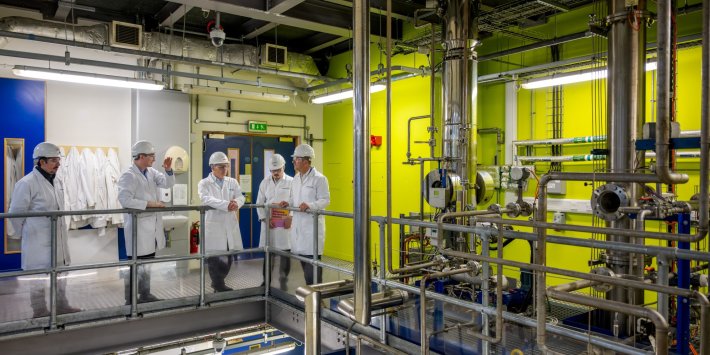
Credit: Fergus Burnett
With the necessary investment, BASF and Imperial College London say their innovations have the potential to create new economic opportunities in the UK
The chemical industry plays a vital role in all our lives. Chemicals and their derivatives are used in more than 90 per cent of manufactured products and materials – everything from construction and automotive products to everyday items like cleaning products and medical devices.
But with the advent of AI and new technologies, innovation is crucial to support the success of the industry.
With that in mind, world-leading chemical company BASF and Imperial College London are working in partnership to share their expertise and develop innovative solutions to real-world challenges. These include meeting sustainability commitments by developing sustainable products and technologies, improving resilience to supply chain shocks caused by geo-political events, and potentially being ready to manufacture pandemic pharmaceuticals at speed.
Our partnership with BASF is unusually close, interactive and genuine
Since 2019, the partners have been pioneering ways to produce chemicals with less energy and fewer materials, implement continuous production techniques at smaller scales, and use AI to optimise manufacturing, thereby ensuring that the industry continues to be as competitive as possible. Innovations like these could improve the performance of BASF’s production sites and support economic growth across the UK.
Working together, the partners are creating advanced technology and know-how to support the green transformation of the chemical industry by accelerating a shift to non-fossil feedstocks and less energy-intensive methods.
At the same time, they are nurturing a new generation of industrial chemists able to boost the industry’s success, resilience and sustainability.
“We are always looking to work with the best and brightest students and the top people in their fields,” says Darren Budd, Managing Director of BASF plc.
“We have around 10,000 researchers globally, and 40 or 50 years ago maybe we could do it all in-house. But research requires a multi-disciplinary approach today and we can’t do everything ourselves. We need to find the best partners – partners who fit with our ethos, allow us to progress our research and bring products to market much faster.
“Imperial has like-minded individuals with whom we can work, collaborate and share best practice. Working with them allows us to pick up new techniques and new ideas to support the way in which the world is changing, whether that’s the labs of the future in terms of digitalisation or getting the best students and training them in new techniques and new technologies.”
“Our partnership with BASF is unusually close, interactive and genuine,” agrees Dr Philip Miller, Associate Professor in Applied Synthesis at Imperial’s Department of Chemistry.
“Having a steer and direction from industry as to what some of the challenges are is really important to us. We get to work hand-in-hand with an industrial partner, so from the ground up we co-create projects together. It means that we can take the fundamental research that we do in our labs and apply it to real-world problems.
“Having early-stage input from industrial chemists, engineers or other scientists within companies is important. When you have support from industries like BASF, it puts the rocket boosters on what you can do over the short and medium term – and hopefully sustain that investment, research and translation into the longer term.”
Advancing the chemical industry, a report on the Imperial-BASF partnership published last autumn (2025), showed how the partners are translating their research findings into technologies that are ready for adoption and roll-out. Turning a lab-scale reaction into a commercial manufacturing process can take anything up to 12 years, but the partners believe that their respective expertise can help bring projects to market more quickly.
To date, the partnership has supported 35 PhD students, many of whom are working on improving the economic and environmental performance of the chemical industry – for instance, by improving the yield and selectivity of chemical reactions and by using digital techniques to reduce the time-to-market for new continuous manufacturing processes. Their research has led to numerous papers in leading academic journals, patents and new technologies.
As the partnership evolves, the partners are increasing their focus on bringing new techniques and technologies to industrial adoption.
Routes include their direct transfer to BASF, joint development with consortium partners, and the launch of start-up companies to commercialise their joint research. The formation of SOLVE Chemistry, for instance, is the first time BASF has jointly launched a spin-out with a university. SOLVE Chemistry is now working independently to provide the whole industry with access to its AI-based solutions to find the best way to manufacture chemicals more rapidly.
BASF and Imperial believe that their partnership is a model for the way industry and academia can work together and benefit from each other.
“The pragmatic, impact-driven mindset is what you find at Imperial,” says Dr Christian Holtze, Open Innovation Manager at BASF and BASF’s lead in the partnership. “Imperial is very advanced in how they’re deploying digital science into every aspect of research. They are very strong in areas such as scientific modelling and optimisation – and the way the students are educated is always integrating a digital component. This is fairly unique when compared to research and education at other universities.”
-060.jpg)

Meanwhile, Professor Mary Ryan, Vice-Provost (Research and Enterprise) at Imperial, sees the partnership as one of the university’s most significant strategic partnerships. “Using Imperial’s advanced expertise in chemicals and digital technologies, the technical advances we now have in the pipeline with BASF are both highly realistic and deliverable and potentially transformational, opening up opportunities for dramatic increases in efficiency and even new value chains,” she says.
Today’s chemists are a world away from the days when they worked at benches cluttered with beakers, burners and rising smoke; they now work in highly controlled environments that blend AI, advanced instrumentation to generate high-quality data and data-driven design.
“If you have sufficient data, you can feed that into a machine learning algorithm that enables decisions to be taken out of humans’ hands and direct the temperature, pressure or flow rate to maximise yield or minimise factors such as cost,” says Imperial’s Dr Miller.
Some of the partnership’s other projects include the introduction of flow chemistry, a form of chemical production that allows the fine control of parameters such as temperature, flow rate and real-time monitoring via sensors. Imperial and BASF are also combining new computational approaches with experimental data to improve crystalline products and make production processes more scalable. A third project is looking at a new technique that uses light instead of heat to set off the chemical reactions needed to produce products such as crop protection chemicals.
BASF and Imperial are confident that with the necessary investment, the innovations under development have the potential to create new economic opportunities in the UK, including new manufacturing facilities and high-skilled employment. To date, their work has been supported by the government through the Engineering and Physical Sciences Research Council and other organisations in the Innovative Continuous Manufacturing for Industrial Chemicals programme, a £17.8 million research scheme in continuous chemical production.
Economic challenges in the chemical sector and in the European societies mean we need support to secure the continuity that is required to deploy our transformative innovations
The partnership’s current priority is to intensify the focus on translation, thereby turning technology innovation into commercially viable businesses – with support from senior stakeholders at BASF, Imperial and UK public funding bodies.
The chemical industry is one of the UK’s foundation industries, producing the core materials on which much of the manufacturing economy depends. As Darren Budd of BASF puts it, it is “the building block of everything”, underscoring its vital role in the UK economy.
It is therefore essential for universities like Imperial to attract the best students from around the world so they can work on new technologies that can then be deployed at scale. The industry also needs the government to enable the regulatory environment and to offer financial support and backing to drive the chemical industry forward.
“But we are at a tipping point,” writes BASF’s Dr Christian Holtze in the partnership’s Advancing the chemical industry report.
“Economic challenges in the chemical sector and in the European societies mean we need support to secure the continuity that is required to deploy our transformative innovations and we need to work hard on removing hurdles to technology translation. This will take a concerted effort by the key stakeholders in our partnership – BASF, Imperial and the public funding institutions.”
Read the full report here: Advancing the chemical industry: A report on the Imperial College London – BASF partnership

You must be logged in to post a comment Login