Politics
Politics Home Article | Can AI rebuild trust in politics?


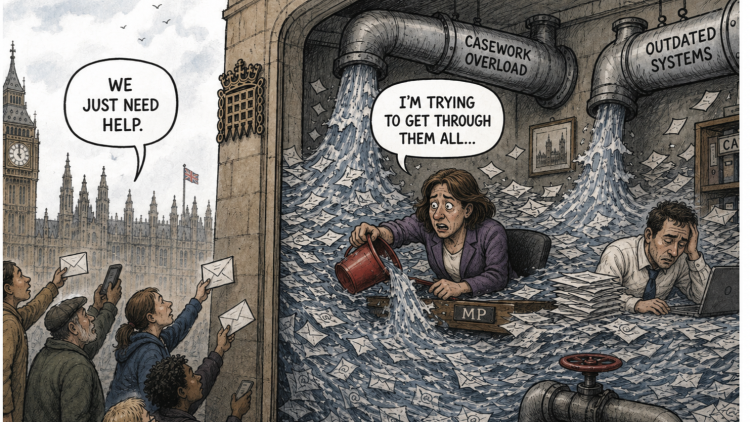
AI generated image
MPs are more accessible and responsive than ever before, yet public trust continues to fall. A growing casework crisis and outdated systems are stretching Westminster to its limits, but new technology could offer a way forward
Most politicians, across all parties, come into public service for the right reasons and work extremely hard for their constituents, as do their staff. The old days of an annual visit to a constituency bazaar being enough local activity are – thankfully – long gone. Now MPs make themselves available dozens of times a month, visiting schools, businesses, community groups and more.
Alongside all these efforts, Hansard is accessible to anyone with an internet connection and clips of Parliamentary speeches circulate far-and-wide online. Voters can now access every word their MP speaks in Parliament and hold them more easily to account for delivering on their electoral promises.
And yet trust in politics and politicians remains depressingly low.
There is, according to a report, A Two-Way Street, by the cross-party think tank Demos, a conundrum at the heart of modern politics: “MPs’ offices are busier than ever, more in demand, and they are hearing from and responding to constituents more than ever before; and yet it is not translating into a better relationship with their constituents.”

The corrosive effects of this distance and distrust are endured by MPs and their staff every day.
Social media means that elected representatives have never been more available to their constituents, who can comment on posts on X, Facebook or Instagram with a few taps on their smartphone, or join a campaign simply by entering their postcode and email address online.
Much of this online contact isn’t urgent, and some of it can be ignored entirely.
But there has also been a huge increase in people looking for urgent help, who don’t know where else to turn.
“Because Local Government is on its knees, MPs are just seeing this massive increase in casework,” one party staffer said.
The dozen or so weekly letters received by MPs fifty years ago are now thousands of emails, calls and tweets. One MP’s office told Demos they reply to 500 emails a day.
“Having seen Starlight’s platform in action, I believe it could allow caseworkers to greatly improve the service we provide to our constituents. That it is a UK-based AI company providing such an innovative, secure solution is also very important as we look to encourage home grown investment in AI.”
Constituency Case Worker, Secretary of State’s Office
Helping people get the support they need on issues like housing, education and immigration is one of the most fulfilling parts of the job for MPs and their staff. Resolving these thousands of pieces of casework is essential, not only to serve constituents but also to have any hope of re-election.
But whilst ensuring that correspondence gets a reply is important, it can leave little time to devote to the more complex cases, to more proactive outreach to communities or scrutiny of legislation.
“We just have an overwhelming number of contacts,” one Labour MP’s office said. “The volume of campaign emails we get has a huge impact on the team’s work, it’s such a challenge to sift through them to get to urgent casework.”
No wonder that so many people who work in the Palace of Westminster suffer from stress and burnout, and that barely a third of Parliamentary staff stay longer than a single Parliament.
Hannah O’Rourke is the co-author of Democracy on Default Settings, a report on the outdated systems undermining the work of MPs, also published by Demos.

“Staff are incredibly committed and often creative in finding workarounds. The frustration isn’t a lack of motivation, it’s that they’re operating in an under-designed system that relies heavily on personal resilience rather than well-built processes,” she said.
The cost of serving constituents – around £200m a year – makes it a significant piece of national infrastructure, and yet too many people feel they are barely keeping their heads above the water.
Offices feel under-resourced and understaffed, but public spending is under so much pressure that there is little-to-no budget to hire more caseworkers from IPSA. We can, and must, do better, but how?
With AI, the technology now exists to solve many of these problems, a technology in which the United Kingdom can become a world-leader.
“There is so much demand in Parliament for tools that we know are available and that we know are transforming the way the private sector operates,” said one senior staffer. “We need what this technology can do.”
However, we must learn from past mistakes and resist the temptation to unquestioningly adopt tools developed by foreign tech giants for such critical national infrastructure.
Ethics, safety and security are vital in the adoption of any new AI tools. That’s why sovereign AI is the only viable option.


Frontier British AI startup and research lab, Starlight, has developed Frontbench, which transforms the way MPs’ offices deal with correspondence and casework for the better. It is an AI-first operating system to help manage MPs’ offices, developed by a company whose tools have already transformed the lives of council leaders, councillors and their staff across the country.
Frontbench can, for example, triage all incoming emails, automatically put them into relevant folders with replies drafted for you in your voice, with referenced sources, always awaiting a human sign-off. All emails are ranked in order of priority so you never miss urgent casework and can handle it quickly.
Mass email campaigns are filtered away from casework and can be replied to in bulk. When a policy question comes in, Frontbench can auto-contact your research service and use their guidance for all subsequent questions on that issue until party policy changes.
At a glance you can see the full history of a constituent’s contact with your office. Ward by ward data analysis allows you to see if a problem is repeated across streets or estates, enabling you to hold surgeries in areas that need your attention the most.
Want to know what your constituents think about an issue? Frontbench draws on the thousands of emails MPs receive and meetings they’ve attended to generate a briefing to inform speeches or articles.
And those hundreds of diary requests? Once you’ve indicated which meetings and events you want to attend, it will auto-find that elusive time in the calendar for you so your staff can easily pop it in.
It can also do much more and is entirely configurable to your needs.
The implications are profound as the prize is greater than just productivity gains. This is not a corporate co-pilot rebadged for Westminster; it’s a second pair of hands. It is a system built from the ground up for the nuanced work MPs and their staff do, with British data staying on British soil. MPs who aren’t drowning in their inboxes, and staff who aren’t burning out keeping them afloat, can do the work that actually matters: being present in the constituency, building genuine relationships, and earning the trust that no campaign leaflet can manufacture. That is what wins re-election and what makes the job worth doing. So yes, AI can rebuild trust in politics, if used wisely.
With one of the most technical and talent-dense teams in Europe, Starlight has developed proprietary, privacy-first AI technology to support public services across all levels of government. And as a British company at the forefront of building Britain’s Sovereign AI capability, backed by British investors with British talent, solving problems for the people of Britain, it is an example of British excellence and British innovation. It is the most secure tool of its kind in the country, and an example of what real sovereignty looks like in practice.
We all know the problem. Now it’s time to embrace the solution.
To join the 20 cross-party MPs and Ministers, who have registered to trial Starlight AI’s Frontbench, contact [email protected]

You must be logged in to post a comment Login