Politics
Politics Home Article | Has Nigel Farage Won Over The Voters Of Clacton?



9 min read
Nigel Farage has resigned as an MP, triggering a by-election in Clacton in which he says he will stand. How do the locals feel about him after his first stint? Harriet Symonds reports
“We don’t see [Nigel Farage], he doesn’t come here,” say a group of dog walkers on a blustery morning on the seafront in Clacton-on-Sea.
On Tuesday, Farage announced that he would resign as MP for Clacton and trigger a by-election in response to growing pressure over his financial backing. He insisted he has done nothing wrong, and described the by-election as “people versus the establishment”. Over the weekend, The Sunday Times revealed that Farage had failed to declare funding from George Cottrell, a convicted criminal involved in crypto gambling.
After the Reform UK leader was elected MP for Clacton in 2024, accusations that he was rarely present in the constituency became a familiar refrain. Farage has consistently dismissed such claims, arguing that the demands of leading a national political party inevitably limit the time he can spend locally compared with most MPs.
Speaking earlier this year, a spokesman for Farage told PoliticsHome: “There are 78,703 registered voters in Clacton. It would be impossible to meet every single one of them. Nigel’s visits are structured to ensure he visits and helps as many community groups, businesses, charities and constituents as possible.”
He does, however, live nearby. In late 2024, his partner, Laurie Ferrari, purchased a detached property in the area for £885,000. The house sits around seven miles up the road in Frinton-on-Sea — “the posh end,” as one Clacton resident describes it.
Last year, Farage denied accusations that he had avoided £44,000 in stamp duty by placing the property in his partner’s name, insisting she bought it with her own funds.
In Spring this year, PoliticsHome visited the constituency, where the MP’s absence was felt by several Clacton residents who told us they were uncertain whether Farage even held constituency surgeries. Nor, they said, were they sure if he had a constituency office at all.
The constituency office is discreetly located on Clacton seafront. Nearby is XO – Greek, a popular restaurant on the seafront owned by Jason Smedley. The restaurant hosted Farage’s election victory party in 2024, and Farage would drop in roughly once a month to catch up over “breakfast and a coffee”.
“The change has been phenomenal,” Smedley said. “Everyone hated him when he first came in, but now everyone is like ‘I love him’. If he’s in here, people flood in to see him and get a picture.”
He admitted he was initially reluctant to host events for Farage but now allowed the local Reform branch to hold meetings there as well.
Sources said that Reform did not want any branding outside the constituency office when it was set up. “At one point I had a big poster which I put in the door, which had got the Reform logo on it – that was taken away. They don’t really want it to be seen.”
Reform said the office location was kept a secret for security reasons. In 2024, Farage himself cited safety concerns when explaining why he did not hold open public meetings with constituents.
“Do I have an office in Clacton? Yes. Am I allowing the public to flow through the door with their knives in their pockets? No, no I’m not.”
Local government sources said the Reform leader did not hold traditional in-person surgeries, though they had heard of “invitation-only” meetings — including sessions with local business owners.
“Nigel has held surgeries online”, his spokesperson said.
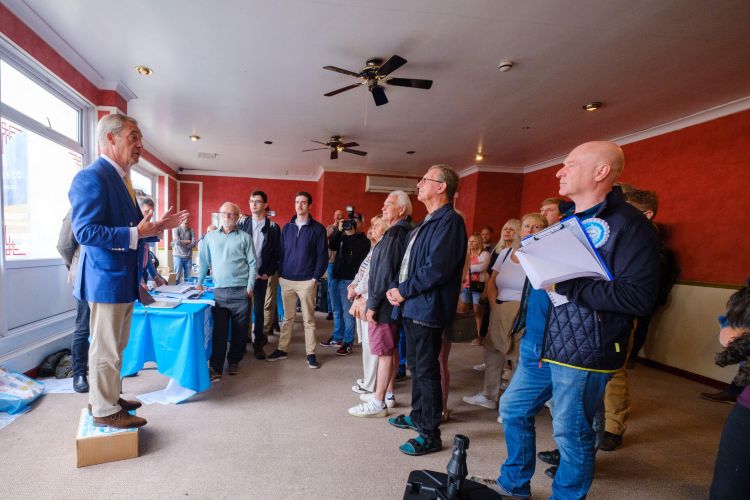

Farage’s social media showed he had visited a handful of local businesses in the constituency since 2024. The business surgeries held with the editor of the Clacton Gazette were also advertised on social media, the local newspaper and community groups online.
Unusually, when PoliticsHome visited his constituency in the Spring, Farage had the lowest total staff spend of all seven Reform MPs of £150,834.40. Farage has repeatedly insisted that his “personal MP expenses” are null.
According to the official staff register, Farage employed five staff to handle his parliamentary and constituency work. Sources familiar with the set-up said Farage’s parliamentary team in London handled his constituency casework, but there was one full-time caseworker based full-time in the constituency.
“Most of it is done by letter and email to be honest,” they said.
Still, some residents said accessing the MP remained difficult.
A local councillor told PoliticsHome they had occasionally taken on casework on Farage’s behalf. “People in my ward have brought issues to me because they’ve not been able to contact the MP,” they said.
“I wouldn’t know where to contact Nigel Farage,” said Vanessa, who had lived in Clacton for six years and had regular contact with the previous MP, Giles Watling.
Watling himself said constituents still occasionally approached him with problems. “People do feel slightly abandoned,” he said. “If it’s being managed at all, it’s being managed at arm’s length.”
Clacton itself presents the familiar paradox of England’s struggling coastal towns: picturesque seafronts and chronic economic malaise. Once a bustling holiday resort, the town now faces entrenched deprivation, high economic inactivity and a declining high street.
Official figures show that parts of nearby Jaywick — within Farage’s constituency — have been ranked the most deprived neighbourhood in England for four consecutive deprivation indices since 2010.
Economic activity in the wider Clacton constituency is significantly below the national average: roughly 60 per cent of working-age adults are economically active, compared with around 78 per cent across the UK.
The constituency is also unusually old. Nearly a third of residents are aged over 65, giving the area one of the oldest demographic profiles in England. Younger people often leave for work elsewhere, while retirees move in from London and the Home Counties.
These conditions have made it unusually receptive to anti-establishment politics. In 2014 the constituency elected Britain’s first UKIP MP when Douglas Carswell defected from the Conservatives and won the resulting by-election. Two years later nearly 72 per cent of voters backed Brexit.
Earlier this year, PoliticsHome did not have to walk far through the town to spot a Union Jack or St George’s flag cable-tied to a lamppost.
“The town looks more scruffy since he’s been an MP”, remarked Vanessa, who moved to Clacton six years ago. “Since [Farage] has been around here, you’re getting more shops being vacant”.
“My daughter is thinking of closing her shop now – she only phoned me yesterday to say I’m thinking of giving it up,” said Janet, another Clacton resident.
Along the high street, empty shopfronts sit beside amusement arcades and fast-food outlets. The town’s landmark pier — refurbished in recent years — remains one of the few clear signs of investment.
“It was on its way there anyway – but I thought [Farage] coming here would have livened it up”, added another resident.
.jpg)

Rachel Goldsmith, who runs the Old Market Café on the high street, said small businesses were struggling to stay afloat.
“It’s a struggle because everything has doubled,” she says. “I counted the other day, and there’s about 13 empty shops here.”
“Our main post office closed down — it’s now flats.”
Some locals complained that the only new businesses opening are nail bars and barber shops — an issue Reform UK has itself highlighted, claiming many such premises are fronts for money laundering and organised crime.
Farage was also known to frequent The Three Jays pub in Jaywick, described by locals as “his favourite pub”, a short drive from Clacton town centre.
“He’s always in the Three Jays having a drink,” chuckles one constituent.
Inside the pub, GB News played on the main television. Above the bar hangs a sign that reads: “Let’s keep the dumbfuckery to a minimum today.”
Union Jack flags hang in the windows, and the building itself is painted in a shade locals jokingly describe as “Reform blue”.
“That’s no coincidence,” said Rob, a regular who moved to Clacton more than 30 years ago and says he has watched the town steadily deteriorate.
Among the pub’s regulars there was little hesitation in expressing support for Farage. Immigration, empty high streets and a sense of national decline dominate conversation. Many saw the Reform leader as one of the few politicians willing to articulate their frustrations.
Yet some pointed out that the town’s current regeneration projects — including government-funded schemes intended to revive struggling high streets — have little to do with their MP.
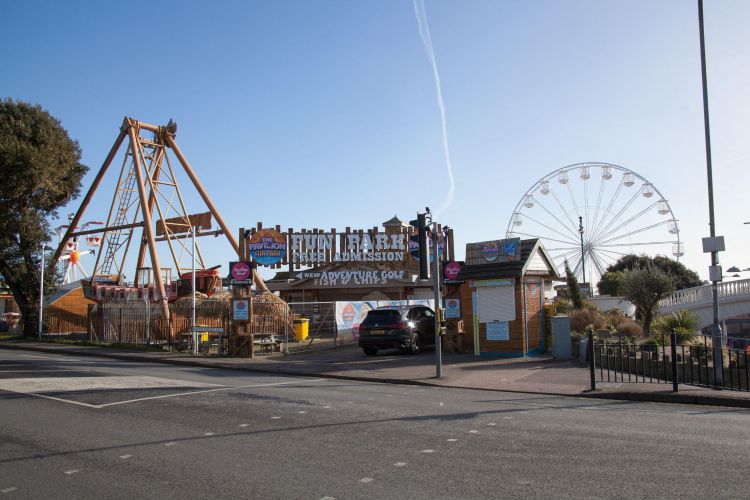
The town has been earmarked for £20m through the government’s “Pride of Place” regeneration funding programme, designed to support a ten-year redevelopment strategy.
A Clacton Town Board was established to oversee the initiative. But Farage — who sits on the board — has not attended any meetings since its creation, according to records, occasionally sending a staff member (George Ivil) in his place.
A spokesperson for Farage said: “Nigel has had a private briefing about the town board from council chief executive Ian Davidson, Council leader Mark Stephenson and the chair of the Clacton town board George Kieffer. He is well briefed on everything that is happening and fully supportive of the Love Clacton campaign.”
However, the complaints about abandonment were a common refrain. “The only time you ever sort of see him is if there’s a photo opportunity,” added another local resident.
Speaking back in the Spring, a spokesperson for Nigel Farage told PoliticsHome: “Nigel Farage is an active Member of Parliament for Clacton and is currently in the constituency as this article is being published.”
They pointed out that he made regular personal donations to charities and good causes, wrote a weekly column for the local newspaper and was the only MP to have ever held a business surgery in the constituency. They also stressed that MRP polls published since the last general election predicted an increased majority for Reform in Clacton.
But the words of some local politicians suggest he’ll be in for a tougher battle this time round than before.
“His excuse always seems to be that he’s the leader of the national party, so therefore he can’t be in the constituency all the time,” said one local councillor.
“But a lot of the time he’s not even in the country.”

You must be logged in to post a comment Login