Politics
Politics Home Article | Nuclear nation: energising communities and catalysing growth


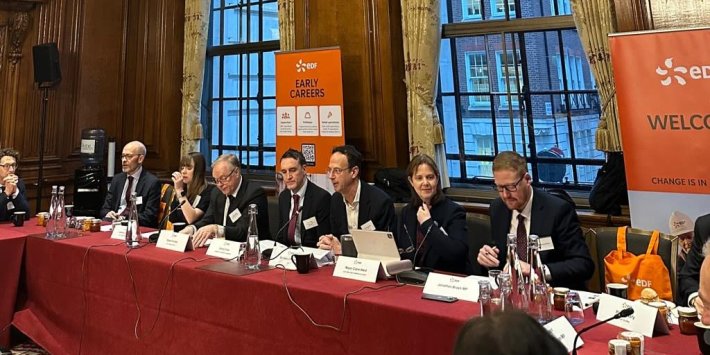
With major projects reaching key milestones and political support at a high, the UK’s nuclear sector is entering a new era. Panellists at an EDF roundtable during Nuclear Week in Parliament discussed how this long-awaited renaissance can drive energy security, regional renewal and generational opportunity – if the moment is seized
With Sizewell C achieving a financial investment decision and Financial Close, the UK has reached an important milestone in its nuclear revival. Alongside continued progress at Hinkley Point C – Britain’s first new nuclear station built in a generation – the selection of a preferred bidder and site for the country’s first small modular reactors, and other exciting future nuclear projects at EDF’s former coal site at Cottam and its generating nuclear site at Hartlepool, nuclear power is experiencing a ‘renaissance’ in the UK.
That sense of optimism was reflected by panellists at a roundtable hosted by EDF during Nuclear Week in Parliament, a programme organised by the Nuclear Industry Association (NIA) to promote the industry and the opportunities it has to offer.
Sir Alex Chisholm, UK Chair of EDF, opened the event by celebrating what he described as “the best year that nuclear has had for as long as anyone can remember.” This was supported by the announcement on the day of the event that EDF have committed to a £1.2bn investment over the next three years to support reliable output from its five generating stations.
The success of nuclear, Chisholm told attendees, is based on partnership – not just between industry and government, but also with the public. He pointed to recent polling by EDF that found that 77 per cent of MPs on average are now favourable towards nuclear energy, which he believes reflects support from their constituents*. This has been driven by concerns around energy security and support for decarbonisation, but Chisholm also stressed the opportunity this has presented for communities across the UK to feel the benefits of nuclear in terms of significant spend with local businesses and skilled, well-paid local jobs.


Panellists agreed that seizing the moment would require not only political will and investment, but also regulatory reform to enable projects to move forward at pace, building on the momentum of the recent Nuclear Regulatory Taskforce recommendations.
Several speakers emphasised nuclear’s deep-rooted impact on place and identity. Jonathan Brash MP reflected on the experience of his constituency, which has been home to Hartlepool Power Station, operated by EDF, for over 40 years. He described how nuclear has provided rare examples of generational employment, embedding skilled jobs within the local community for generations. He argued that the industry has the power to “make places matter again” and reverse long-term economic decline – just as it had done in Hartlepool.
This effect is being felt across the country. Claire Ward, Mayor of the East Midlands, shared how “the region is now emerging as a national leader in clean energy technology generation, and whilst the entire clean energy sector is vital for our green transition, the greatest growth opportunity is in fusion and nuclear energy”. With five former coal-fired power stations and ambitions such as the Trent Supercluster, she argued that nuclear could inspire pride in communities while underpinning national growth and industrial renewal.
Ward also highlighted the role of nuclear in powering the next phase of the UK economy, particularly through energy-intensive technologies such as AI and advanced data centres. With secure, low-carbon and always-on power increasingly seen as a prerequisite for growth, she argued that nuclear could anchor future investment and enable regions like the East Midlands to compete globally.
As the nuclear industry enters its “golden era,” Crooks recognised the work that’s already happening in the UK and challenged the myth that we don’t make things in Britain anymore. He pointed to the UK’s “fantastic engineers, fantastic production facilities, and fantastic manufacturing facilities.” “The quality of work we do in the UK is second to none,” he said. “I can tell you, having been at Hinkley, the stuff we do here is outstanding.”
This would not be possible without its brilliant workforce, which Crooks described as “a family.” A powerful personal perspective came from Anabella Andison, a young apprentice at EDF. Although she was encouraged after school to consider more traditional routes, such as university, she chose instead to join the same EDF apprenticeship programme her father entered 25 years ago. In fact, her grandfather began his career at Hinkley Point A, her father still works at Hinkley B, and her brother is at Hinkley C. Together, their stories offered a striking example of the generational employment the industry can provide, a point previously highlighted by Jonathan Brash MP.
More than simply following a family legacy, Andison told the room: “I wanted to say that I made a difference in the community, and I want to actually help build something that’s going to make a difference to the future.”
The benefits of nuclear are felt far beyond the industry’s workforce. Panellists heard from David Crew, Managing Director of the Somerset Chamber of Commerce, who pointed to the transformative effect of Hinkley Point C on the regional economy. He highlighted the creation of a HPC supply chain programme through the Chamber which has supported over 4,600 businesses to access contract opportunities, with £5.3bn spent locally, and more than 14,000 people trained through Centres of Excellence. Many firms, he noted, have scaled significantly and are now pursuing opportunities beyond Hinkley – demonstrating the long-term economic legacy of nuclear investment and the strength of public-private partnership.

Paul Dicks, Director of Regulation of New Reactors at the Office for Nuclear Regulation, welcomed the work of the Nuclear Regulatory Taskforce as a critical catalyst for reform. He emphasised that regulatory reform must focus on outcomes rather than process, enabling innovation and faster decision-making without compromising safety.
Reflecting on his experience of working in the industry for over thirty years, he told the room: “I’ve never, ever seen anything like this in my life. Let’s grab these opportunities as a whole community, as a whole ecosystem.” If we do this, he says, we will be a country at the front of the nuclear renaissance.
Britain is once again embracing nuclear. And it is already translating into tangible economic, social and regional benefits. The event closed with a shared recognition that nuclear’s contribution to the UK goes far beyond getting energy on the grid. It has a role to play in solving the challenges and opportunities we face as a nation – from energy security and decarbonisation, powering AI and data centres, to regional regeneration and national pride.
As Alex Chisholm emphasised when he opened the event, “there is nothing that any individual organisation, or any individual person, however impressive and dynamic, can achieve on their own.” As EDF continues to strongly invest in the UK’s current operating fleet, the morning’s discussion highlighted that the UK’s nuclear future lies in partnership. The parliamentarians, regional leaders, industry, regulators, academia and the next generation of nuclear talent in the room are all ready to play their part – to ensure that the current renaissance delivers lasting benefits.
The optimism in the industry is clear. “There’s not many things we get to do in our working lives where you’re shaping what will make a difference to four generations away,” Chisholm concluded. “That is very exciting.”
* Polling from Savanta commissioned on behalf of EDF.

You must be logged in to post a comment Login