Politics
Politics Home Article | Public Backs Long-Term Protection For BBC, Poll Suggests


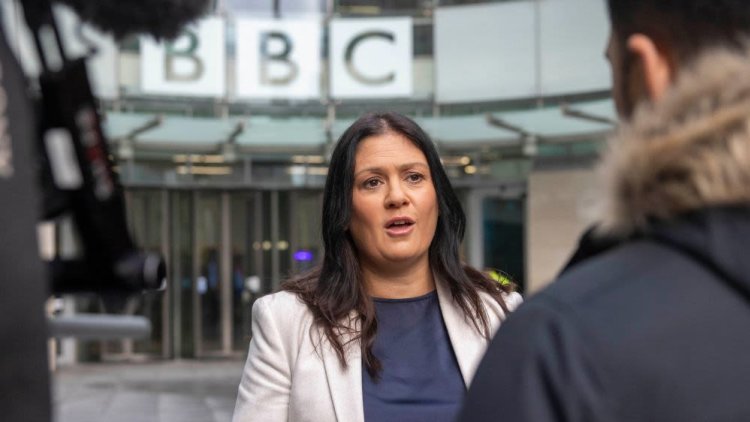
Lisa Nandy announced the move to a permanent charter on Tuesday (Alamy)
3 min read
A poll shared exclusively with PoliticsHome has found widespread public support for the BBC charter being put on a permanent footing, in a move which the government has said will help protect the corporation from “culture wars”.
On Tuesday night, Secretary of State for Culture, Media and Sport, Lisa Nandy, announced that the BBC charter would be put on a permanent footing for the first time.
The cabinet minister said that “while the terms, the structures and the funding for the BBC will continue to be negotiated”, the move would end the “bizarre situation where if the charter isn’t agreed in time, the BBC ceases to exist”.
Under the current setup, the BBC charter is renewed every 10 years. Senior BBC figures, including the outgoing director general, Tim Davie, had been pushing for a permanent arrangement, arguing that it would protect the corporation’s long-term stability.
“We will act to future-proof this vital institution in these stormy times when public debate feels more toxic and polarised than ever, and too often the BBC becomes a lightning rod for the ongoing, exhausting culture wars,” Nandy told a Society of Editors conference in London.
A Survation poll, conducted before the announcement for campaign organisation 38 Degrees and shared with PoliticsHome, found that 44 per cent of respondents supported a permanent charter. In contrast, 13 per cent said they wanted the BBC’s future to be debated every decade.
A majority of people who voted Labour (54 per cent), Conservative (50 per cent), and Green (50 per cent) at the 2024 general election backed a permanent charter for the BBC, while nearly half of Lib Dem voters (49 per cent) did so.
The least supportive voter 2024 group was those who backed Reform UK at the last election, with 36 per cent supporting the move and 21 per cent opposing it.
There was also support across the age groups, with a majority of 25-34-year-olds (52 per cent) and 65-plus (50 per cent) telling Survation they supported a permanent BBC charter.
The BBC’s role and funding have become a growing talking point in recent years, with Nigel Farage’s Reform vowing to end the licence fee if elected.
Controversies such as the corporation’s coverage of Bob Vylan’s 2025 Glastonbury set, when the act chanted “death, death to the IDF [Israel Defence Forces]”, have also led to enhanced political pressure from critics.
However, the government has sought to defend the BBC, with Nandy this week describing it as “one of the two most important institutions in our country”, the other being the NHS.
Nandy insisted, however, that the move to a permanent charter would not lead to a reduction in accountability for the BBC, saying that the Labour government intended “to strengthen the accountability of the leadership of the BBC – not to politicians – but to the people it serves in every nation and region”.
Matthew McGregor, CEO at 38 Degrees, said the 10-year charter renewal system had been “a cloud of uncertainty hanging over one of our most valued national institutions”.
“Voters have no appetite to see our national broadcaster’s very existence under threat every 10 years. In announcing a permanent royal charter for the BBC, the government has made a popular, common-sense decision that is in line with public opinion,” he told PoliticsHome.
Damian Lyons Lowe, founder and chief executive at Survation, said: “The polling points to a clear, broad-based tilt towards greater long-term certainty for the BBC.
“Although many take a neutral view, the balance of opinion suggests the public is more comfortable with a settled arrangement than with periodically reopening the question of the BBC’s future.”
The poll surveyed 2,077 UK adults online between 13 and 16 March.

You must be logged in to post a comment Login