Politics
Politics Home Article | Public Concern About Climate Change Rises After Summer Of Extreme Heat


This summer has been the driest summer in England and Wales since records began in 1836. (Alamy)


4 min read
There is growing public concern about climate change after weeks of wildfires and drought in the UK, according to polling shared with PoliticsHome.
Around three-quarters of people (74 per cent) told an Ipsos poll they are concerned about climate change, up from 69 per cent before the summer. At the same time, the share of people who say they are unconcerned has fallen from 28 per cent to 24 per cent.
Over half (56 per cent) said recent high temperatures had affected everyday activities like work, exercise and sleep either a great deal or a fair amount.
Eighty-seven per cent said it is likely that the country will face similar summer heatwaves in the future, compared with just 3 per cent who said it is unlikely.
The online poll of 1,085 people was carried out against a backdrop of heatwaves, drought and wildfires across the UK.
July was the driest month in England and Wales since records began nearly two centuries ago, with the Environment Agency warning that the heat was affecting farmers, wildlife and water availability. Large parts of the country are subject to hosepipe bans, while a recent wildfire in Suffolk was described as the size of 210 football pitches.
Major wildfires have also impacted European countries like France, Greece and Spain.
Raquel de Luis, Head of Energy and Environment at Ipsos in the UK, told PoliticsHome: “The intense heat this summer and visible wildfires across Europe have served as a visible focus point around discussions on climate change, which may be driving a clear uptick in immediate concern and leaving nearly nine in ten convinced that these heatwaves are our new normal.”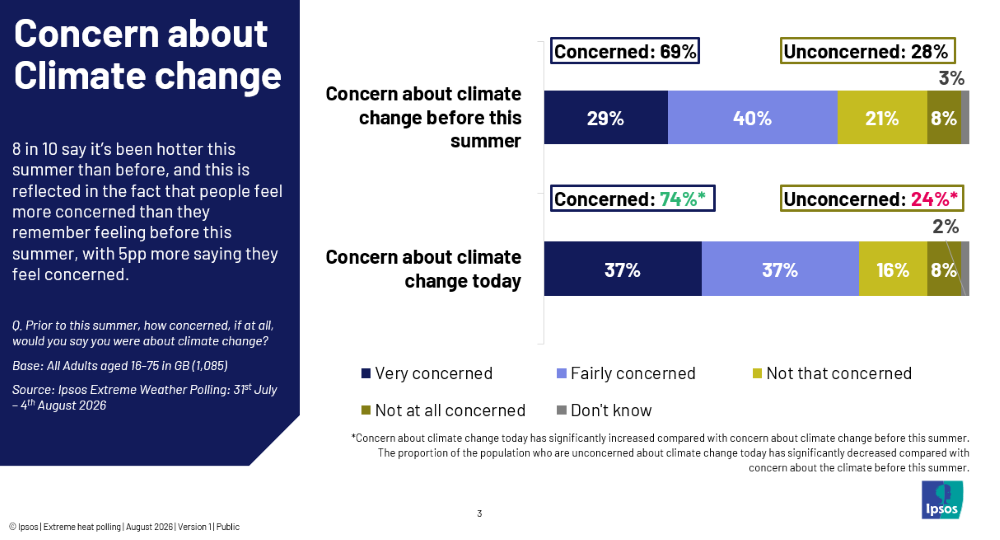

When respondents were asked what measures they planned to install in the next two to three years to help cool their homes, portable air conditioning was the most selected option (29 per cent), followed by a fixed air conditioning unit (23 per cent) and blackout blinds or curtains (19 per cent).
Of those who told Ipsos they do not plan to make changes to their homes to cope with heat, the most common reason was affordability (39 per cent).
“The key challenge for Westminster will be delivering accessible, cost-effective infrastructure and adaptation support that enables households to build resilience against recurring summer heat without adding to their financial burdens,” said de Luis.
Paul McNamee, Director at the Labour Climate and Environment Forum, said the findings show that Labour MPs are right to keep making the case for the UK’s net zero targets at a time when parties on the right are calling for them to be relaxed.
“It has been really good to see Andy Burnham knock some money off energy bills to address people’s concerns [about cost of living],” he added.
“But we also need to keep on rolling out renewables and upgrade our grid to make sure it’s fit for purpose for a future of clean energy, and our main ask is [making] sure that the government makes the absolute most out of the electrification benefits that sit beneath it.”
However, he said there is more that can be done in the short term to boost community resilience in the face of extreme heat, like creating green spaces where people can cool down and better managing land to help avert wildfires.
Managing Director of the Conservative Environment Network, John Flesher, said the government needs to do more on adaptation because the country isn’t “well enough prepared” to deal with the effects of extreme hot weather as things stand.
“We need to think a lot more about preparing for this,” he told PoliticsHome, pointing to water security and agriculture as areas of high importance. “It’s terrible what this [extreme heat] could mean for the cost of food, for farmers’ abilities to conduct their harvest as normal.”
Tom Bradshaw, President of the National Farmers Union, recently told the BBC that the UK has taken its food supply for granted for far too long and called for more resilience planning.
“Those other countries around the world that we currently rely on to produce our food and vegetables, their climates are changing as well,” said Bradshaw.
“It does feel like there is going to be some shortages of [food] products.”

You must be logged in to post a comment Login