Politics
Politics Home Article | Reindustrialising Britain


NESST – photo courtesy of Northumbria University
The North East is already delivering the Prime Minister’s vision
For decades, governments have promised to tackle the North-South divide. Yet despite numerous initiatives, too many communities have continued to see investment, opportunity and economic power concentrated elsewhere.
Prime Minister Andy Burnham’s commitment to the reindustrialisation of the North is built on a simple but powerful principle: “good growth in every postcode.”
It is an ambition that goes beyond economic statistics. It recognises that successful places are built on confidence, skills, educational opportunity and community as much as they are on investment and jobs.
A vision already taking place across the North East
To be clear, reindustrialisation is not about recreating the industries of the past. It is about creating the industries of the future and ensuring that regions with the talent, capability and ambition to succeed are given the opportunity to do so.
The North East region has long been one of Britain’s industrial powerhouses, defined by generations of engineering and manufacturing excellence. Today, it is building a new future around advanced manufacturing, defence, technology and space – sectors that will be critical to the UK’s future economic prosperity and national security.
Few sectors demonstrate this opportunity more clearly than space.
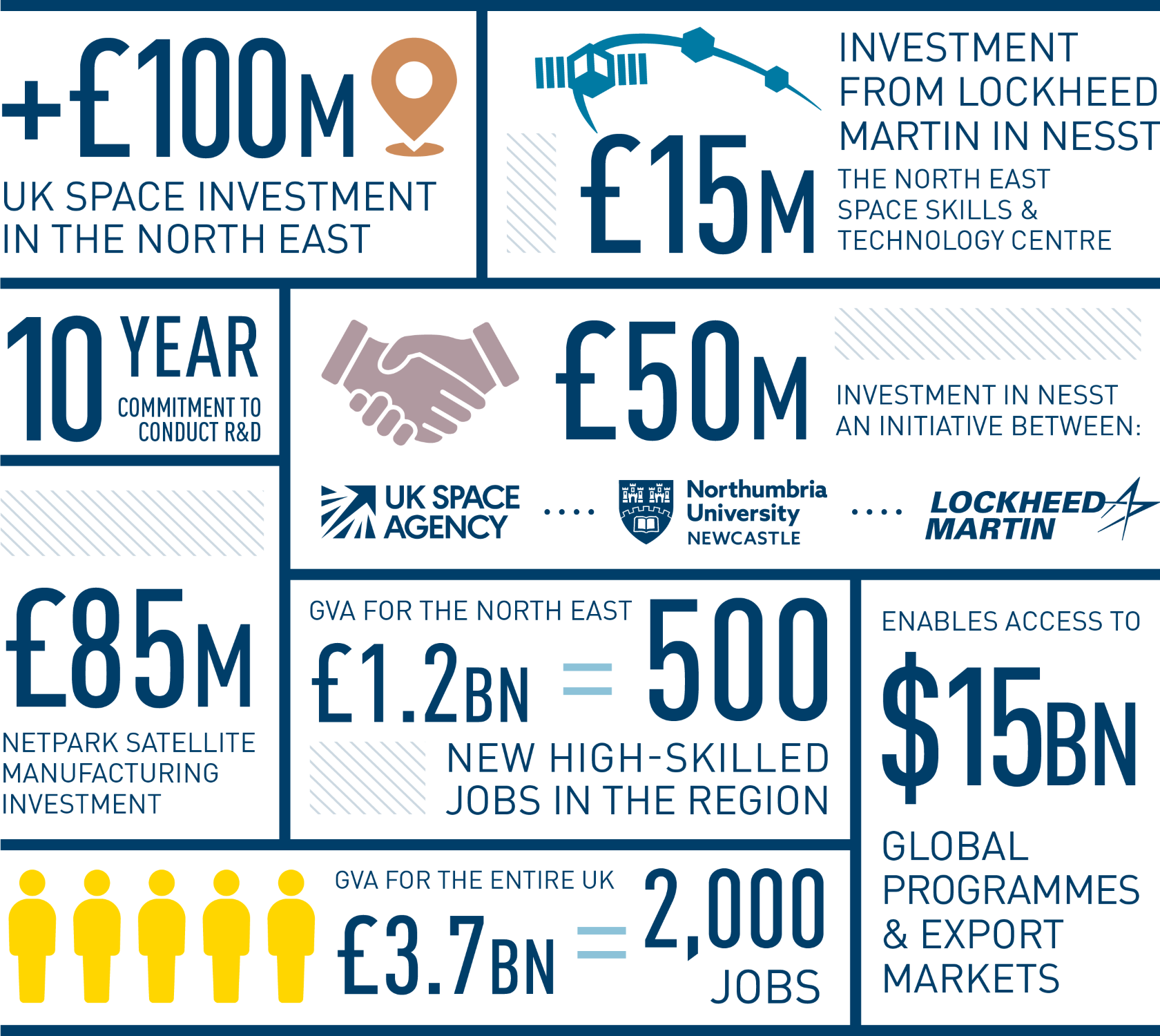
Lockheed Martin Space UK – which has had a presence in the UK for 85 years – has already made a significant impact in the region through its partnership with Northumbria University and the UK Space Agency to create the North East Space Skills and Technology Centre (NESST). The initiative combines industry expertise with academic excellence to develop the technology, innovation and talent pipeline needed to support the UK’s growing space economy.
NESST embodies the collaborative approach that successful reindustrialisation requires. The centre brings together industry, government and education while creating clear pathways into high-value careers for local people.
The company’s commitment to the region could soon expand further through plans for a satellite manufacturing facility at NETPark near Sedgefield, one of the UK’s leading science and technology campuses.
Investing for the future, today
Importantly, the North East is not simply preparing for future investment. It is ready today.
Paul Livingston, Chief Executive UK and NATO for Lockheed Martin said:
“The North East has the talent, ambition and industrial heritage to play a leading role in Britain’s reindustrialisation. By bringing together industry, academia and government, we can create highly skilled jobs and help deliver growth and opportunity across the region.”
More than £20m has already been invested in preparing NETPark for advanced manufacturing opportunities, creating a development-ready location for companies seeking to establish cutting-edge facilities. Combined with the region’s engineering expertise, growing technology ecosystem and strong infrastructure, the foundations for a thriving space manufacturing cluster are already in place.
The skills pipeline is equally compelling. NESST is due to open shortly, with the first cohort of 30 students beginning a new aerospace-focused degree programme designed to equip the next generation of engineers and technologists with the skills required by the UK’s growing space sector.
Such an investment would represent a major boost not only for the North East but for the UK’s ambitions in space and advanced manufacturing. It would directly support the Prime Minister’s objective of creating a North that can manufacture, innovate, export and compete on the global stage.
Championing the future
The company’s confidence in the region is shared by North East Mayor Kim McGuinness, who has consistently championed both the defence and space sectors as engines of future prosperity.
Her argument is simple. The North East already possesses the industrial capability, workforce and determination required to succeed. What it needs is greater investment and the opportunity to compete.
Kim McGuinness, Mayor of the North East, said:
“For too long, too much investment has been concentrated in too few places. But we have a plan to show what is possible when global industry backs the people of the North East.
“Becoming home to this major Lockheed Martin Space UK manufacturing facility would be transformational for our region. Not only would it create high-value jobs and opportunities for people in Durham and across the North East, it would also help to attract further investment, suppliers, innovators and space businesses to locate here. That is how we build a globally recognised space cluster and deliver lasting economic growth for communities across our region.”
That shared ambition led to the recent Memorandum of Understanding between the North East Mayoral Strategic Authority and Lockheed Martin Space UK, strengthening collaboration around investment, skills and industrial development.
The case for investment is strengthened further when viewed through the lens of national security.
As highlighted by the MP for Newcastle Central and West, Chi Onwurah, the North East sends more young people into the Armed Forces than any other region of the UK and yet receives the lowest level of Ministry of Defence spending.
That disparity presents an opportunity as much as a challenge. As the UK seeks to strengthen sovereign capabilities, increase resilience and invest in the industries that support national security, the North East offers a region with a proven record of service, a highly skilled workforce and infrastructure that is ready to support future growth.
Investment in defence and space would not simply support economic growth. It would strengthen national resilience while ensuring that a region which contributes so much to the nation’s defence benefits more directly from the opportunities created by that commitment.
Kim McGuinness, Mayor of the North East, continued:
“The scale of the opportunity is substantial. Plans include approximately £100m of investment and the potential creation of up to 2,000 new jobs across the UK, including around 500 highly skilled roles in the North East. These positions would support satellite manufacturing, advanced engineering, technology development and supply chain growth while helping strengthen the UK’s sovereign space capability.
Supporting that growth will require a strong pipeline of talent. Encouragingly, that work is already underway.”
Establishing the educational pipeline
New College Durham recently secured designation as an Advanced Manufacturing Technical Excellence College (AMTEC), further strengthening the region’s ability to develop the advanced engineering and manufacturing skills required by future employers.
Alison Maynard, Deputy Principal at New College Durham said that “we see AMTEC playing a vital role in connecting and integrating the North East’s rich industrial, research, and innovation assets, creating a bridge between major developments such as NESST and Lockheed Martin’s planned facility at NETPark.”
Together, initiatives such as NESST, AMTEC and NETPark demonstrate that the North East has already assembled many of the ingredients required for long-term success: investment, infrastructure, innovation, skills and collaboration.
For a Prime Minister committed to delivering growth in every postcode, the North East offers a compelling example of what success can look like.
The region is not waiting for growth to arrive. It is creating it.
Through advanced manufacturing, space technology, education and strategic investment, the North East is demonstrating how reindustrialisation can strengthen the economy, support national resilience and create opportunity for future generations. The infrastructure is ready. The skills pipeline is growing. The partnerships are in place.
The future is being built now.

You must be logged in to post a comment Login