Politics
Politics Home | Increasing temperatures are exposing critical weaknesses in UK infrastructure


Credit: Adobe Stock
Recent disruptions across the UK, including rail failures, road damage and large-scale wildfires, serve as a stark warning that our infrastructure is increasingly vulnerable to the effects of extreme temperatures. Addressing the safety, performance, and reliability challenges brought by a changing climate requires a shift from responding to damage after extreme events to proactively adapting our critical national infrastructure.
Many of the hot weather problems experienced by our physical infrastructure stem from the behaviour of most materials, which tend to expand and soften as the temperature increases. This affects roads, railways and bridges directly in several ways.
Most of the UK’s roads are surfaced with asphalt, a composite material comprising aggregates with about five per cent by weight of bitumen binder. The structural performance, serviceability and rate of deterioration of an asphalt road are all directly affected by temperature. During heatwaves, asphalt road surfaces can reach temperatures in excess of 60C. This causes the bitumen binder to soften, leading to deformation, surface depression and bleeding under traffic loads. The current typical emergency response, including deploying gritting vehicles to spread granite dust over melting asphalt, is a reactive, ad-hoc approach that treats symptoms rather than causes.
Various materials and technologies have been investigated to improve the resilience of asphalt pavements to high temperatures and climate-related deterioration. These include modified epoxy asphalt surfaces and modified epoxy chip seals, alongside fibre mastic asphalt, as potentially climate-resilient and long-life surfacing technologies. Advanced pavement materials, including polymer-modified binders and heat-reflective surface treatments, can improve resistance to temperature-related deterioration in vulnerable corridors. At the same time, solutions must look beyond passive protection and towards infrastructure that actively manages thermal conditions. Thermo-active road technology is an intriguing possibility, which uses embedded heat exchange loops to capture excess thermal energy from pavement surfaces during peak heat periods. By regulating pavement temperatures, these systems could reduce heat-induced damage while harvesting renewable thermal energy for beneficial reuse.
Metal bridges and other infrastructure assets are also susceptible to thermal stresses that can affect their long-term performance and safety. This is particularly important for older bridges, which may not have been designed for such extreme conditions. Bridges are designed to move, to accommodate expansion in hot weather and contraction in cold weather, as the temperature changes. With higher temperature extremes, this movement can be larger than anticipated by the designers, leading to the bridge expansion joints – which allow bridges to safely expand and contract – running out of travel and starting to stress bridge girders and decks. Bigger movements may also affect bridge bearings, road surfaces and bridge members.
Excessive thermal expansion of moveable (swing or lifting) bridges may prevent them from properly opening or closing, resulting in jamming. This happened to New York City’s Third Avenue Bridge in 2024, when extreme temperatures led to the bridge being stuck for hours. Concrete structures are also vulnerable because high temperatures can cause drying, exacerbating shrinkage, and worsening cracking, particularly where the concrete is already aged or poorly maintained. Extreme heat can also affect bridge bearings, bridge cables, drainage systems and protective coatings, causing materials such as rubber, polymers, and paints to degrade more quickly.
In our railways, the metal rails (which, like road pavements, can reach temperatures in excess of 60C in direct sunlight on a hot day) tend to expand with increasing temperature. Modern rails are continuously welded into long lengths, which means that they are unable to expand hence develop internal compressive stresses at temperatures above 27C. If the track is not well-supported and/or there is a significant pre-existing imperfection, there is a risk that the track may buckle which could cause a train to derail. A further problem is that the overhead wires by which electrical current is conveyed to trains on overhead electrified railways also expands with increasing temperatures. Although equipped with automatic tensioning devices, these can run out of capacity at very high temperatures. The overhead lines may then sag to the extent that they become caught up by the current-collecting pantographs attached to trains. While constrained by materials technology, solutions can be found at system level for example by ensuring that track is well-supported both vertically and laterally, and investing for increased operational flexibility and the ability to carry out fast interventions.
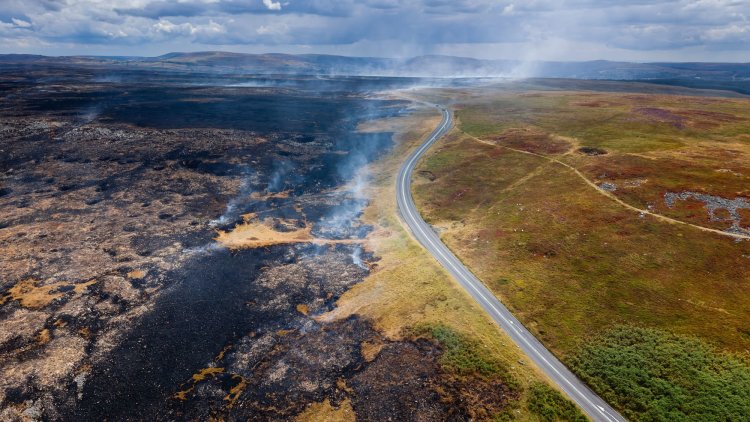
Periods of sustained high temperatures are often also very dry. Hence prolonged heatwaves dry out vegetation and soils, increasing the risk and intensity of wildfires. When fires reach the wildland-urban interface, critical infrastructure, including power and communication towers, can be exposed to intense heat. This can affect the mechanical properties and load-bearing capacity of structural materials, potentially disrupting essential networks at precisely the time when communities are most vulnerable. We have seen in recent weeks how large fires near a major transport corridor can lead to its closure, whether it is a road or a railway.
As clay soils dry, they develop what is termed a ‘soil moisture deficit’ and shrink. This causes problems for roads and railways on clay soils and clay embankments. Shrinkage settlement of an underlying clay soil adversely affects railway track geometry and may lead to a loss of support, both of which increase the risk of track buckling. To mitigate this, sometimes disruptive speed restrictions are imposed. On roads, drying and shrinkage of the underlying ground leads to longitudinal tracks, rutting and bumpiness, as well as accelerating the rate of road surface deterioration. Drying-induced ground movements can also cause water pipes to fracture or break, leading to increased leakage rates.
Rising temperatures are also creating significant operational and occupational challenges for the construction sector, increasing risks to worker wellbeing while reducing productivity and affecting project delivery schedules. Construction workers are among the occupational groups most vulnerable to heat because of the physically demanding nature of their work, prolonged outdoor exposure, the use of personal protective equipment, and limited access to effective cooling measures. This results in high levels of fatigue, reduced concentration and heat-related illnesses, including dehydration, heat exhaustion and heat stroke.
As the UK continues to experience increased temperatures, a more systematic approach to managing occupational heat risk is required, with clearer guidance, improved training and investment in practical adaptation measures. This will help protect workers’ health and safety while improving productivity, programme certainty and the long-term resilience of the construction industry.
The challenge is multifaceted, so needs to be addressed in a number of ways. By investing in more resilient designs capable of withstanding extreme environmental conditions, the UK can enhance infrastructure robustness to extreme heat stress. Improving the ability to predict failures and consequent disruptions will facilitate a proactive approach to enhance resilience. With this, there must come the ability to respond quickly and reconfigure the affected system(s) at national level. A combination of these elements can enhance infrastructure resilience to minimise disruption, protect public safety, reduce risks to workers and ensure that essential services continue to function effectively as heatwaves become more frequent and intense.
This article was co-authored by members of the UK Collaboratorium for Research in Infrastructure and Cities (UKCRIC)
Contributing authors
- Professor William Powrie, University of Southampton
- Professor Mehran Eskandari Torbaghan, University of Birmingham
- Dr Alba Fuertes, University Reading
- Dr Benyi Cao, Dr Yidu Bu and Dr Boulent Imam, University of Surrey

You must be logged in to post a comment Login