Politics
Politics Home | Universal veterans united by a single need


Invitation to a meeting at Tbilisi’s Mirza Gelovani Library at which Prof. Hugh Milroy addressed various Georgian veterans organisations. Hosted by the Georgia Veterans Federation, it was organised by Defend Your Share of the Homeland and the Peace Forum.
Sixty two years ago the singer Buffy St Marie wrote a song called The Universal Soldier. It still stands as a powerful reminder that in every country – regardless of age, faith, colour or creed – there are men and women who are willing to lay down their lives for their country. After a recent visit to Tbilisi, Georgia, CEO of Veterans Aid, Professor Hugh Milroy, reflects on the phenomenon of The Universal Veteran.

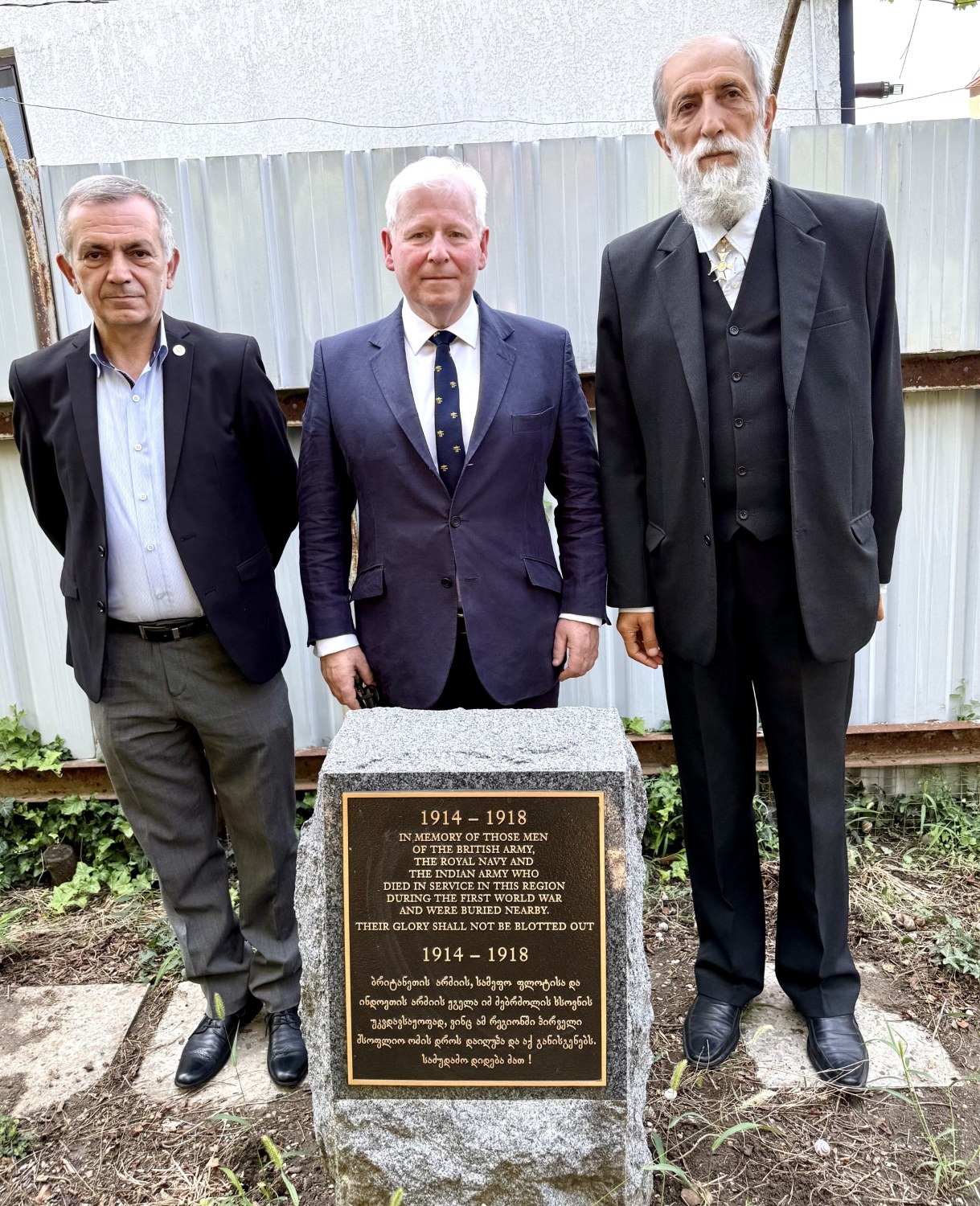
Standing in the shady garden of a family home in the Georgian capital of Tbilisi recently, my thoughts turned to the concept of remembrance, and why it features so prominently in military ceremonial activity – not just in Britain, but worldwide. Birth and death are the bookends of the human lifespan, but there is something especially poignant about the passing of those whose lives are lost in the defence of their country, or in the pursuit of freedom.
I was in that special place to visit two almost forgotten markers, commemorating British troops who had lost their lives far from home, and members of Scottish General Support Medical Regiment (now the 215 Multirole Medical Regiment). In the company of a Veterans Aid colleague, two representatives from the British Embassy and two of our Georgian hosts, I reflected on what being a ‘military veteran’ actually means.
The cemetery, which once housed these all-but-forgotten servicemen’s remains, is long gone. The markers were installed by the Commonwealth War Graves Commission in 2000, but they are rarely visited, and only by arrangement. Once however, the men they commemorate were mourned – as sons, fathers, brothers, cousins and friends, who had been sent to serve the interests of their country.
My visit to Georgia was prompted by exchanges about veterans wellbeing, initiated by the Acting President of the Georgian Veterans Federation (GVF), Michael Tsikaridze. He was aware of my views on the subject, many of which are echoed in a paper of his own in which he explores how Georgia’s veterans’ NGO sector is gradually evolving “from a predominantly commemorative and welfare-oriented environment toward a more diverse, professional, and institutionally mature ecosystem capable of contributing to civic participation, public policy development, social cohesion, and national resilience”.
At this point I suspect many are wondering what relevance plans for veterans in the Caucasus have to do with the wellbeing of British veterans?
The answer is – plenty; because when one strips way the differences in ethnicity, language, national perspective and recent history, it is evident that veterans share common needs and have identical aspirations – to be respected, acknowledged and treated with fairness and dignity.
I’m on record as saying that veterans should not be regarded as ‘apart from society’ but as ‘a part of it’ – and I firmly believe that; but I caveat it by referencing the UK’s Armed Forces Covenant, which states that veterans should be treated fairly, and never disadvantaged by their service.
With what I learned in Georgia – where the turmoil of ongoing, recent and historical conflicts are a daily reality – fresh in my mind, I am prompted to conclude, yet again, that in Britain today, veterans are ‘citizen plus’ in terms of access to support. Yes, some are homeless; yes, some are struggling with PTSD and mental health issues – but the majority of those in crisis are struggling because of poverty – and poverty is the universal enemy.
The criteria for claiming support as a designated ‘veteran’ are vastly different around the world; in the UK just one day’s military service qualifies individuals for a lifetime of access to care, yet many of those claiming it have never seen active service. In Georgia (which has been invaded many times but never initiated an invasion) there are men and women who have taken up arms to defend their very right to exist; variously described1 as partisans, freedom fighters, conscripts, as well as regular military, they are treated very differently.
I could go on. I’ve advised on veterans affairs worldwide – briefing government advisors in Canada, academic audiences in Australia and the UK, diverse visitors from Japan, Argentina, Belgium, the USA and international audiences in Belgrade. On the surface, the issues are different, because each country has its own socio-economic landscape, its own history, political framework and experience of security and insecurity.
Scratch the surface however, and a simple fact emerges; veterans want exactly the same things as everyone else – financial security, appropriate healthcare, employment and a decent quality of life. Many also seek acknowledgement of who they are and what they have sacrificed, hence the importance of commemorative ceremonies, but these public, civic events alone are not enough. Nor I’m afraid, is traditional philanthropy.
The ‘top down’ handout culture that has driven veteran welfare provision for so long is about as much use as a flower to a starving man. We were invited to Tbilisi because the Veterans Aid Welfare to Wellbeing© model struck a chord. It was seen as offering an adaptable, externally endorsed pathway that built on what veterans actually needed rather than what government or traditional welfare organisations assumed that they did.
A Georgian lari is worth around 28p; the country’s population is approximately 3.9 million against the UK’s nearly 70 million, so comparisons in absolute terms are meaningless; but even short acquaintance with members of its veteran community revealed a litany of familiar frustrations.
As far as I know, it is the first time a Georgian veterans organisation has ever extended a formal invitation to a UK counterpart, specifically focused on veterans’ wellbeing and the exchange of practical experience.
GVF Acting President Michael Tsikaridze said, “After more than three decades working with veterans, I have become increasingly convinced that dignity cannot be delivered through benefits and ceremonial recognition alone. Veterans need practical support that begins with the individual – understanding what has happened in that person’s life, what they actually need, and helping them regain independence rather than creating long-term dependency. That is why Veterans Aid caught my attention.
“Hugh Milroy’s Welfare to Wellbeing© approach is not simply another welfare programme; it reflects a philosophy that I believe has real relevance for Georgia – addressing the causes of crisis, working with the whole person and helping veterans move from dependency towards stability, confidence and wellbeing.
“I invited Hugh and his Veterans Aid colleague to Georgia because I wanted us to learn from something that has been tested in practice, not simply import another foreign model. Our objective is to examine what works, understand why it works, and then consider, step by step, what can be adapted to Georgia’s own circumstances and the real needs of Georgian veterans. If we can combine British experience with Georgian knowledge and reality, I believe we can develop something genuinely useful – first for veterans in Georgia, and perhaps, in time, beyond Georgia.”
Needless to say I was delighted to respond. After more than 30 years working alongside veterans and their families, both in the UK and internationally, I have reached a simple but important conclusion. It’s not based solely on one organisation, one community or one country; it has been shaped through engagement with veteran support systems around the world, giving me a perspective that some may consider radical, but one that is firmly grounded in experience and the evidence of my own eyes.
While circumstances differ across nations, generations and communities, many veterans face remarkably similar challenges; feeling disconnected from systems designed to support them and, too often, feeling unheard or left behind. In my experience, the answer is rarely found in new strategies, structures or top-down initiatives. The greatest successes come from the ground up – from community organisations, frontline practitioners, and veterans helping fellow veterans. Wherever I have travelled and worked, these are the people who build trust, restore confidence and change lives every day.
Across the veteran support sector, there are proven approaches delivering real results, yet all too often they are ignored in favour of new ‘solutions’ (sic) that are owned and controlled by those who introduce them. If we are serious about tackling veteran disadvantage, we need to place greater trust in those delivering results on the front line. We must focus less on designing new systems and more on supporting successful ones, prioritising veterans over process and outcomes over bureaucracy. After everything I have seen throughout my career, both at home and abroad, I am convinced that the challenge is no longer about ‘finding the answer’. It is about having the courage to back those who are already providing it.
By recognising what works, empowering those closest to veterans’ needs, and focusing on delivery rather than design, we can strengthen the bond of trust with those who have served, enabling more veterans to thrive rather than merely survive. And if we can do this for veterans, surely we can take the same approach across society.
References
- According to official information provided to the Georgian Veterans Federation by the State Service of Veterans Affairs of Georgia on 26 June 2026: 53,327 people are registered as veterans of hostilities for the territorial integrity, freedom and independence of Georgia; 46 are registered as veterans of the Second World War; 250 are persons with status equivalent to that of Second World War veterans; 2,502 are registered as veterans of hostilities on the territory of other states; 1,049 are registered as veterans of the Defence Forces; in addition, the official statistics include 2,074 family members of fallen/deceased veterans.
Lyrics to The Universal Soldier by Buffy St Marie
He’s five foot-two, and he’s six feet-four
He fights with missiles and with spears
He’s all of thirty-one
And he’s only seventeen
He’s been a soldier for a thousand years
He’s a Catholic, a Hindu, an atheist, a Jain
A Buddhist and a Baptist and a Jew
And he knows he shouldn’t kill
And he knows he always will
Kill you for me, my friend, and me for you
And he’s fighting for Canada, he’s fighting for France
He’s fighting for the USA
And he’s fighting for the Russians
And he’s fighting for Japan
And he thinks we’ll put an end to war this way
And he’s fighting for democracy, he’s fighting for the reds
He says it’s for the peace of us all
He’s the one who must decide
Who’s to live and who’s to die
And he never sees the writing on the wall

You must be logged in to post a comment Login