Politics
Protein Overload Impact On Hair

If protein is a building block of hair, it can only be a good thing to load up on lots of products that contain protein, right?
Popular hair repair options these days include keratin, collagen, peptides and bond-building complexes that claim to improve the health of your hair. But don’t load up on them too fast…
While protein helps maintain strong, healthy hair, strands can actually become stiff and brittle when topically applied protein builds up faster than hair can handle it, leading to breakage, frizz and tangling.
Here, experts explain what protein overload is, how to spot it in your hair and how to rebalance your routine.
Why too much protein can backfire
Protein is made primarily of keratin, which gives each strand of hair strength and structure. Bonds, also known as crosslinks, between keratin chains within the hair allow it to stretch.
“Healthy hair is the state where this protein matrix and its crosslinks are intact enough that fibres resist traction, yet still show good elastic return and cosmetic shine,” explained Caroline Ruggiero, a certified trichologist and CEO at Truly You Hair & Scalp Clinic in Mississauga, Ontario.
But when protein-based shampoos, conditioners, masks and styling products – which are often marketed as strengthening or repairing – are layered too frequently, the result can be protein overload.
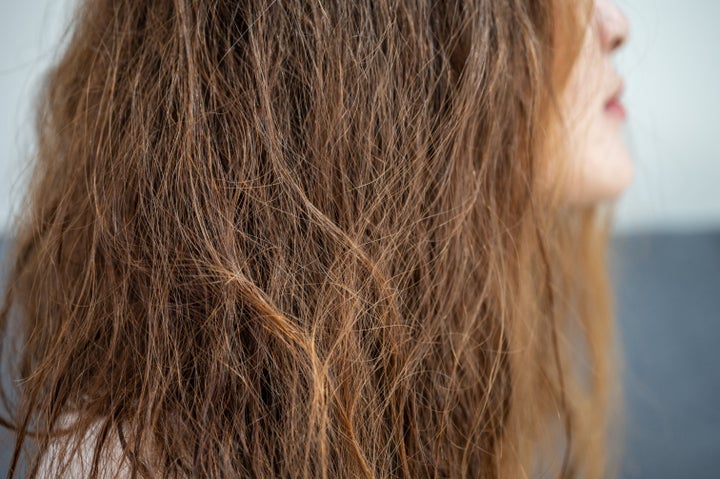
“Like anything, more isn’t always better,” said Emmanuel Mroczka, a trichologist and co-owner at The Hair & Scalp Specialists in Fairview Park, Ohio. “Hair impacted by protein overload typically feels stiff or straw-like, rough even after conditioning, prone to tangling and static and brittle – snapping easily instead of stretching.”

Boy_Anupong via Getty Images
He adds that breakage also often appears in areas that typically remain intact, such as closer to the scalp or around the crown, because the hair has lost elasticity from root to tip.
Protein overload can closely resemble simple dryness, but the key difference is elasticity. “Dry hair often softens with moisture and still has some stretch. Hair affected by excess protein tends to feel rigid and snaps easily, even after conditioning,” Mroczka said, noting that an easy at-home test is to gently stretch a damp strand.
Healthy hair should have a little give and bounce back, and knowing the difference can help you choose the right treatment and avoid overcorrecting.
Why hair absorbs too much protein
Chemical treatments, like bleach, relaxers, perms and repeated colouring, along with heat styling and UV or pollution exposure, can damage the hair cuticle, which is the protective outer layer, and increase shaft porosity.
“When the cuticle is disrupted, hair loses internal proteins and lipids, the cortex becomes more exposed, which causes more hair porosity,” explained board-certified dermatologist and hair transplant surgeon Dr. Divya Shokeen, noting that this is why hair absorbs products more aggressively, making protein buildup more likely.
When hair feels damaged, reaching for protein-repair products is a common instinct. While the ingredients in protein-forward products, such as hydrolysed keratin, collagen, amino acids, keratin peptides and bond-building complexes, aren’t inherently harmful, Shokeen notes that the real risk lies in overcorrecting.
“Damaged hair needs a balance of protein, moisture and lipids, not just high-protein products alone,” Shokeen said. Repeated use of protein-heavy treatments, especially layered in the same routine and paired with infrequent washing, can leave already fragile strands feeling even more brittle.
“Clinical rule of thumb: the more styling layers used, the more important periodic clarifying washes become,” Shokeen said.
How protein overload affects your hair
Protein overload doesn’t typically stop hair growth at the follicle, but it can affect how long and full your hair looks by increasing brittleness and breakage. “If protein-based products are applied directly to the scalp, which, like conditioner, generally isn’t recommended, they can contribute to buildup and irritation around the follicle,” Mroczka said. “Over time, chronic scalp irritation or inflammation can interfere with a healthy growth environment.”
It can also blur the line between shedding and breakage. “Many people think they’re shedding excessively, when in reality they’re experiencing mid-shaft breakage that appears as shorter hairs,” Mroczka said, noting that the typical daily hair shedding is around 80 to 100 strands as part of the natural growth cycle.
“When protein overload is present, breakage often layers on top of this normal shedding, making hair loss feel more dramatic than it actually is.” The good news is that this is often fixable once the routine is rebalanced.
Hair types that are most vulnerable
Fine, chemically treated and low-density hair are especially prone to protein overload. Shokeen said fine strands have less inherent strength and a smaller shaft diameter, which limits flexibility, so protein-heavy products can quickly cause stiffness and breakage.
Porosity also matters. High-porosity hair absorbs protein quickly, due to gaps or damage in the cuticle, making overload likely. This hair type benefits from occasional protein paired with consistent moisture and lipid support. Low-porosity hair, with a tightly closed cuticle, resists absorption. Protein often sits on the surface, causing coating, stiffness and dryness. “Low-porosity hair usually does better with lighter hydrolysed proteins or minimal protein use,” Shokeen said.
Because the ideal frequency of protein treatments depends on both your hair type and the specific formula, experts recommend following label directions closely for best results. “In general, I recommend intervals. For instance, one month on and three months off,” Ruggiero said. “More is not more.”
How to reset your routine
“First, pause all protein-based products, including conditioners, masks, leave-ins and styling treatments labelled ‘repair,’ ‘strengthening’ or ‘bond-building,’” Mroczka said, noting that in some cases, this may also include protein-heavy shampoos.
Next, switch to a hydrating shampoo. Gently cleanse the scalp, letting the lather rinse through the lengths without aggressive scrubbing, and follow with a moisturising conditioner to improve slip and flexibility. “A lightweight hydrating or conditioning spray throughout the day can help support moisture, especially on dry ends,” he added.
If buildup is present, a clarifying shampoo can help, but no more than once every other week. “These formulas use stronger cleansers, and overuse can strip natural oils and worsen dryness or irritation,” Mroczka noted. During this reset, limit heat styling and chemical treatments for a few weeks to allow elasticity to recover.
“Once hair begins to feel softer and more flexible again, protein can be slowly reintroduced,” Mroczka advised. “Balance is the goal, not eliminating protein entirely.”
You must be logged in to post a comment Login