

Politics
Reform council brands Zionist pothole machine ‘uneconomical’


Reform UK has been making a lot of noise about JCB’s pothole-filling machine, and with obvious reason. Voters hate potholes, and JCB is one of the most evil companies in the UK, so of course Farage & co. would want to work with them. As it turns out, though, the magical pothole machine may not be all it’s cracked up to be. And our source on that is a Reform-run council:
This is awkward.
Michael’s own Leicestershire Council have stated the Pothole Pro is impractical:https://t.co/aEICJaRFbW pic.twitter.com/NBnVXq9AfS
— Reform Party UK Exposed
 (@reformexposed) June 17, 2026
Mechanised ethnic cleansing
First things first, we should explain why we called JCB one of the most evil companies in the UK.
As we reported in September 2025, the Stop JCB campaign reported on how JCB supports “ethnic cleansing and genocide in Palestine, India, and Kashmir”. We added:
In Palestine, JCB operates through its sole dealer, the Israeli company Comasco. The corporation holds contracts with Israel’s Ministry of Defence for the same model of JCB machines the Zionist settler state uses in the demolitions and construction of settlements.
JCB has been at it for a long time, with photographers catching Israeli forces demolishing homes in the West Bank using their machinery as early as 2006. We also noted:
Currently, JCB is also complicit in Israel’s ongoing genocide in Gaza. UN Special Rapporteur Francesca Albanese listed JCB in her July report. This was among numerous companies directly aiding and profiting from the genocide. Israel has long used armoured, unbranded JCB High Mobility Engineer Excavator (HMEE) machines, known as ‘Ami’ in Hebrew, and is now using them in Gaza.
Oh, and no points for guessing which party JCB’s billionaire owner and peer Anthony Bamford supports:
JCB owner Bamford: “You can’t get away with £60k benefit handouts.”
Also billionaire brothers Anthony Bamford and Mark Bamford: Not paying a tax bill of up to £500 million.
What greedy, Farage-supporting bastards. pic.twitter.com/KZhpzajO3I
— Politics In The U.K. (@politixintheuk) May 17, 2026
Reform are all filler
Given Farage’s connection to Bamford, it’s unsurprising he made a big deal out of promoting the Zionist pothole machine:
— Politics UK (@PolitlcsUK) March 28, 2025

 WATCH: Nigel Farage arrives on stage at Reform UK’s local election launch on a JCB Pothole Pro pic.twitter.com/B9GKctAExO
Now, a Reform council has suggested Bamford’s hole plugger isn’t all it’s cracked up to be. As reported by the BBC, a 2025 report from Leicestershire County Council (LCC) found:
After two demonstrations, officers concluded that the JCB Pothole Pro did not stack up as an economical piece of kit to repair potholes in Leicestershire
Additionally:
The JCB PP is big – it’s bigger than a normal excavator, it would not be suitable for small defect repairs – the machine is too big and would close the road, it would be inefficient to travel round repairing small potholes.
Another problem was that the quantity of potholes they had to deal with meant they couldn’t:
utilise Pothole Pro’s full potential on a daily basis – which in turn would make it very inefficient
And also:
After two demonstrations, officers concluded that the JCB Pothole Pro did not stack up as an economical piece of kit to repair potholes in Leicestershire
JCB – a company which is happy for its product to be used for ethnic cleansing – suggested that LCC weren’t using the machine correctly, and that a longer test was needed. LCC aren’t the first to criticise what the machine can do anyway:
Reform UK’s ‘right first time’ pothole repairs in @NottsCC should be called ‘shite first time’.
This repair is in Council Leader Mick Barton’s own Mansfield East division: questionable workmanship, unsealed edges, lifespan roughly that of a snowflake in July. Reform UK -… pic.twitter.com/WRBFTYqAhy
— Reform Party UK Exposed
(@reformexposed) November 16, 2025
Bunged up
Given the update, it’s no wonder people are saying things like this:
Leicestershire County Council has found that JCB's pothole machine is not economically viable. I think they will find that it becomes viable when you look at JCB's £200,000 donation to Reform rather than at the extra cost to council tax payers. pic.twitter.com/BIfD4zOigp
— Parody Nigel Farage (@Parody_PM) June 16, 2026
Personally, we don’t think any council should be working with companies that facilitate ethnic cleansing. The fact that these machines may not be all they’re cracked up to be just adds insult to injury.
If Reform should replace Labour in government, we’ve no doubt there’ll be many more questionable contracts, anyway. And the real hole left to fill will be the economic one left behind when they get kicked out.
Featured image via The Canary
By Willem Moore

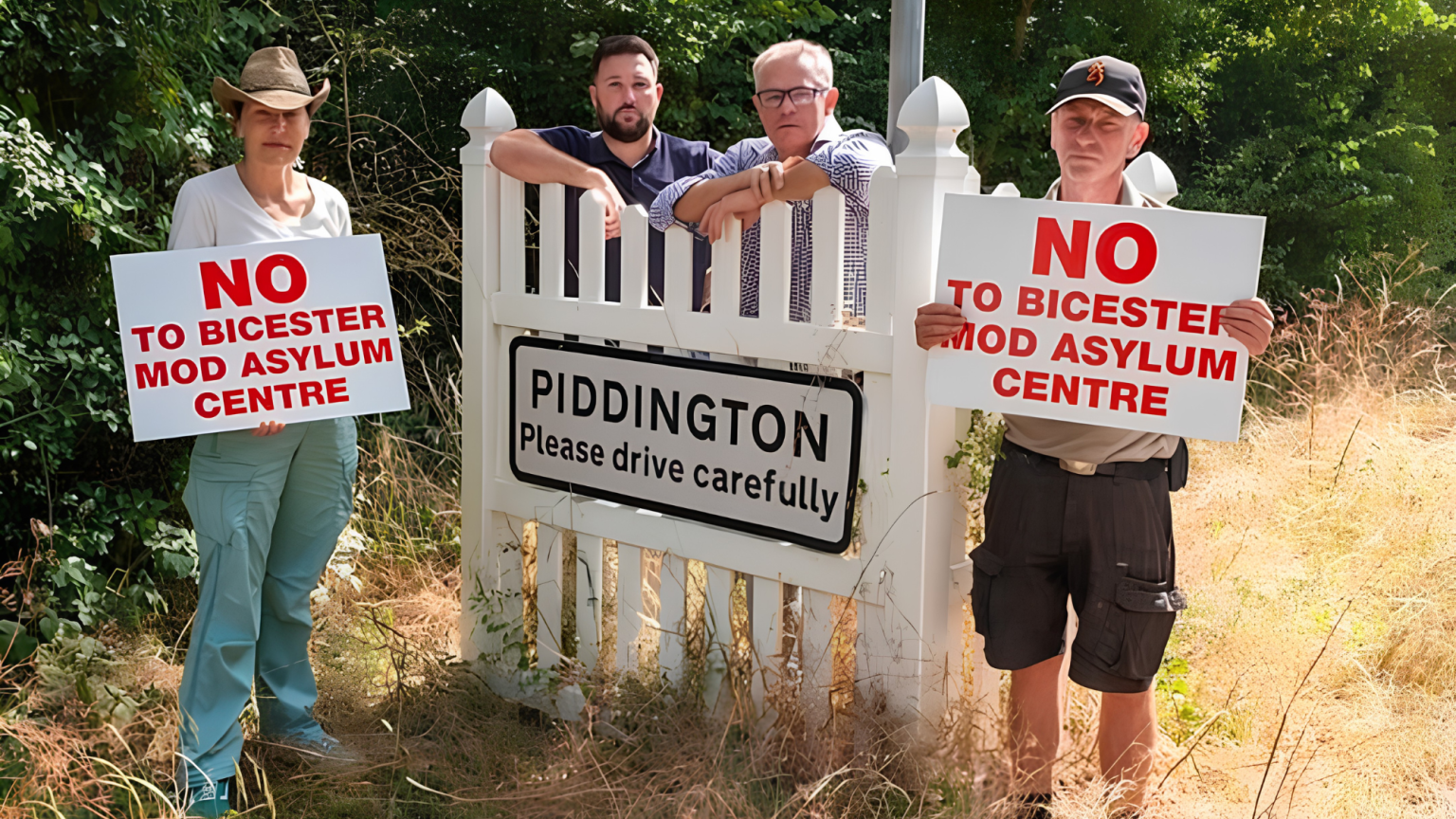
Piddington, a small village in Oxfordshire, might seem like an unlikely centre of revolutionary discontent. But even the residents of sleepy hollows associated with hobby farms, market gardens and village cricket seem to have their limits. In response to the government’s plans to accommodate over a thousand male asylum seekers at a nearby military base, outraged residents have decided to hold a referendum on whether to declare their ‘independence’ from the United Kingdom.
Of course, a Piddington ‘Declaration of Independence’ would be futile – no town, county, city or region can secede from the UK because of a vote in the village hall. But even the act of holding a referendum speaks to a desperation felt by most of their compatriots. If the British state refuses to control its borders, then maybe the Piddington parish council can try to control its own.
Piddington’s 400 residents are perfectly right to feel angry. Soon, the nearby Bicester Garrison will be home to 1,250 men – many of whom do not speak English, and who have no legal right to be in the UK. Even the local MP, Calum Miller of the Liberal Democrats, has reacted furiously to the government’s plans.
Miller’s comments are telling. The Home Office, he told the BBC recently, had given no consideration to ‘social cohesion’. He said he had ‘no idea how the government thinks [1,250 asylum seekers] can be absorbed into the community’. So opposing illegal immigration isn’t ‘far right’, after all. It turns out that no one, irrespective of class or political loyalty, is prepared to live with its daily consequences.
This is why opposition to migrant hotels, or now migrant military camps, has bubbled up in just about every community that has been told to accept them. Crowborough in Sussex, which has been forced to accept 540 male illegal immigrants, has been the scene of protests for months. The local community around RAF Wethersfield, Essex – which is currently housing 1,245 male illegal migrants – has also been up in arms. Of course, last summer was defined by the Pink Ladies’ protests in Epping, Essex, where asylum seekers were housed at the Bell Hotel.
Community cohesion is one concern. Community safety is another. Residents might have been reluctant to state this openly, although one Piddington local alluded to it when he said, ‘There is no crime at the moment, but what happens if there is crime?’. Recent history would sadly suggest that it isn’t if, but when.
The protests in Epping were sparked when a resident of the Bell Hotel, Ethiopian national Hadush Kebatu, sexually assaulted a 14-year-old girl just days after arriving. A few weeks later, Afghan national Ahmad Mulakhil raped a 12-year-old girl in Nuneaton, Warwickshire, where he was living in a taxpayer-funded HMO. In October, three migrant-hotel residents in Brighton gang-raped a woman who was returning home from a night out. In October 2024, in Walsall, Sudanese national Deng Majek violently murdered Rhiannon Whyte, an employee of the migrant hotel he was living in. Last year, dogwalker Wayne Broadhurst was stabbed to death in broad daylight in Uxbridge by an Afghan refugee who arrived in a lorry in 2020. These are just a handful of the seemingly endless examples. Locals are not ‘racist’ or ‘bigoted’ to fear that a large influx of unvetted male asylum seekers, many of whom are escaping criminal convictions abroad, will have an impact on public safety.
Few issues shine a light on the British state’s incompetence like illegal immigration. Having failed to respect the clear wishes of the British people by stopping illegal immigrants from entering the UK, successive governments have proceeded to spend billions of pounds a year housing them. The Labour government seemed to think it could avoid public outrage by transferring illegal immigrants from hotels to military sites – as though the exact form of accommodation they are provided, rather than illegal immigration itself, was the issue. The Home Office still plans to repurpose two more military sites to accommodate illegal immigrants – one in Suffolk and one in North Yorkshire.
As we well know, once illegal immigrants arrive here, there is basically no prospect of them leaving. Their asylum claims progress at a glacial pace through a labyrinthine network of tribunals and courts, at the end of which a judge generally allows them to stay on spurious human-rights grounds. Even those who commit the most serious crimes are highly unlikely to be deported. And although asylum seekers have no legal right to work, that is usually no barrier. The UK’s grey economy is now so large that it is perfectly easy to live, work, drive a car and rent a home without going through the hassle of trying to acquire the right paperwork.
So of course locals feel pushed to the brink. It might be one migrant hotel, or one migrant ‘garrison’, pencilled for your local community that lights the fuse. Yet it’s the sheer weight of the British government’s failure to control the border, with no end in sight, that is making each community response more drastic than the last.
Given all this, is it any wonder that the residents of Piddington have had enough? A vote for ‘independence’ would only be symbolic – but the anger that’s got us here could hardly be more genuine.
Hugo Timms is a staff writer at spiked.
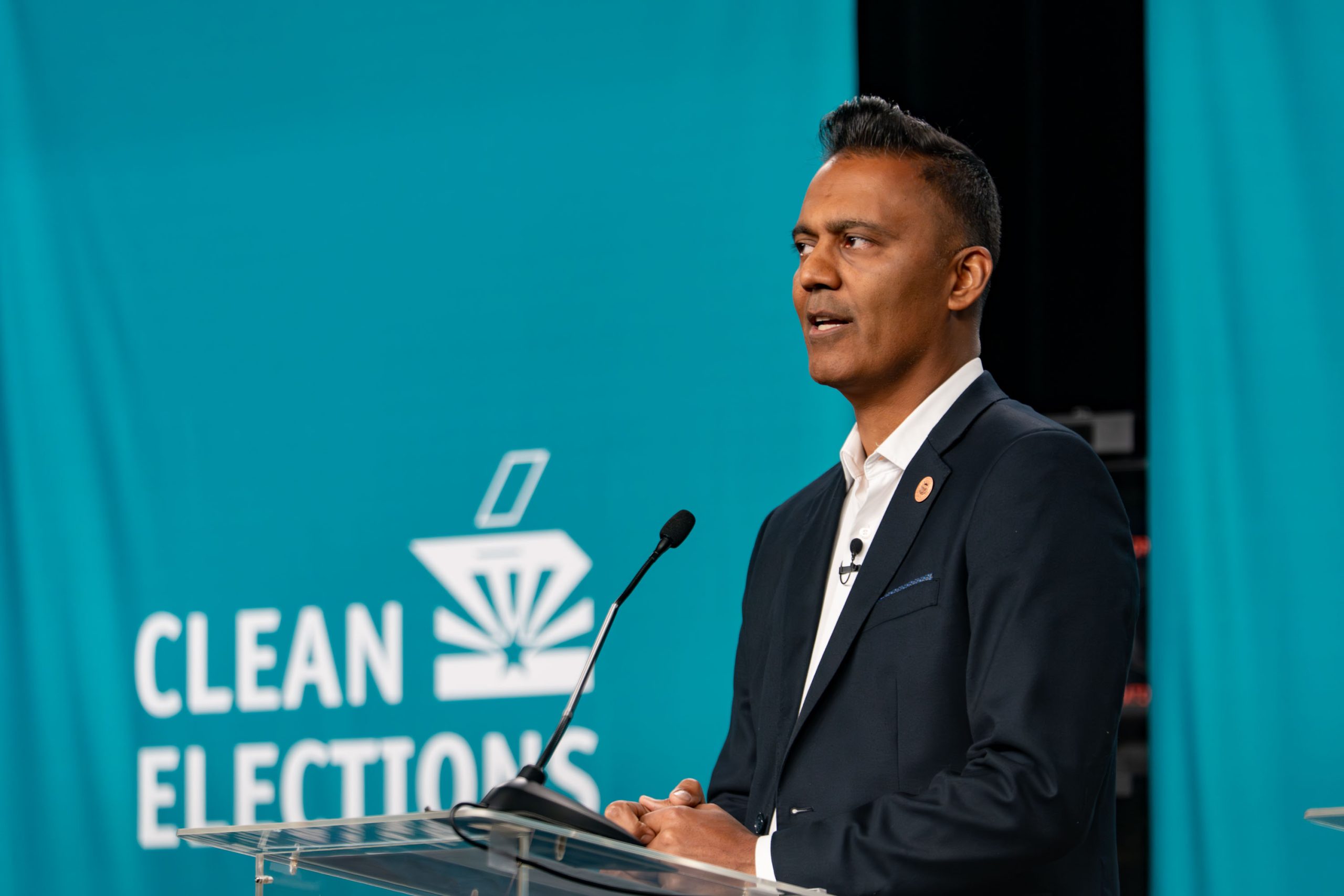

Former state Rep. Amish Shah won the crowded Democratic primary for Arizona’s 1st District on Wednesday, defeating an establishment pick and other well-funded candidates for the battleground seat.
The district, which President Donald Trump carried by just three points in 2024, is one of Democrats’ top pickup opportunities this cycle — and the tight primary evolved into a test of party leaders, after the Democratic Congressional Campaign Committee backed former broadcast journalist Marlene Galán-Woods.
In the end, voters rejected Galán-Woods, the latest example of an establishment-backed candidate losing as Democrats continue to show frustration with leaders in Washington.
This year marks the second consecutive time Shah won the district’s Democratic primary: He won it in 2024, before losing to Rep. David Schweikert (R-Ariz.) by four points in the general election.
The seat became open when Schweikert, an eight-term Republican lawmaker, decided to take on another member of the Arizona House delegation, Rep. Andy Biggs (R-Ariz.), in the GOP primary for governor.
Shah will take on Jay Feely in the general election. The Trump-endorsed former NFL kicker who spent four seasons with the Arizona Cardinals bested former state Rep. Joseph Chaplik in the Republican primary on Tuesday.
The 1st District surrounds Phoenix in central Arizona, and encompasses wealthy Scottsdale and Paradise Valley as well as large swaths of land to the northeast of the city.
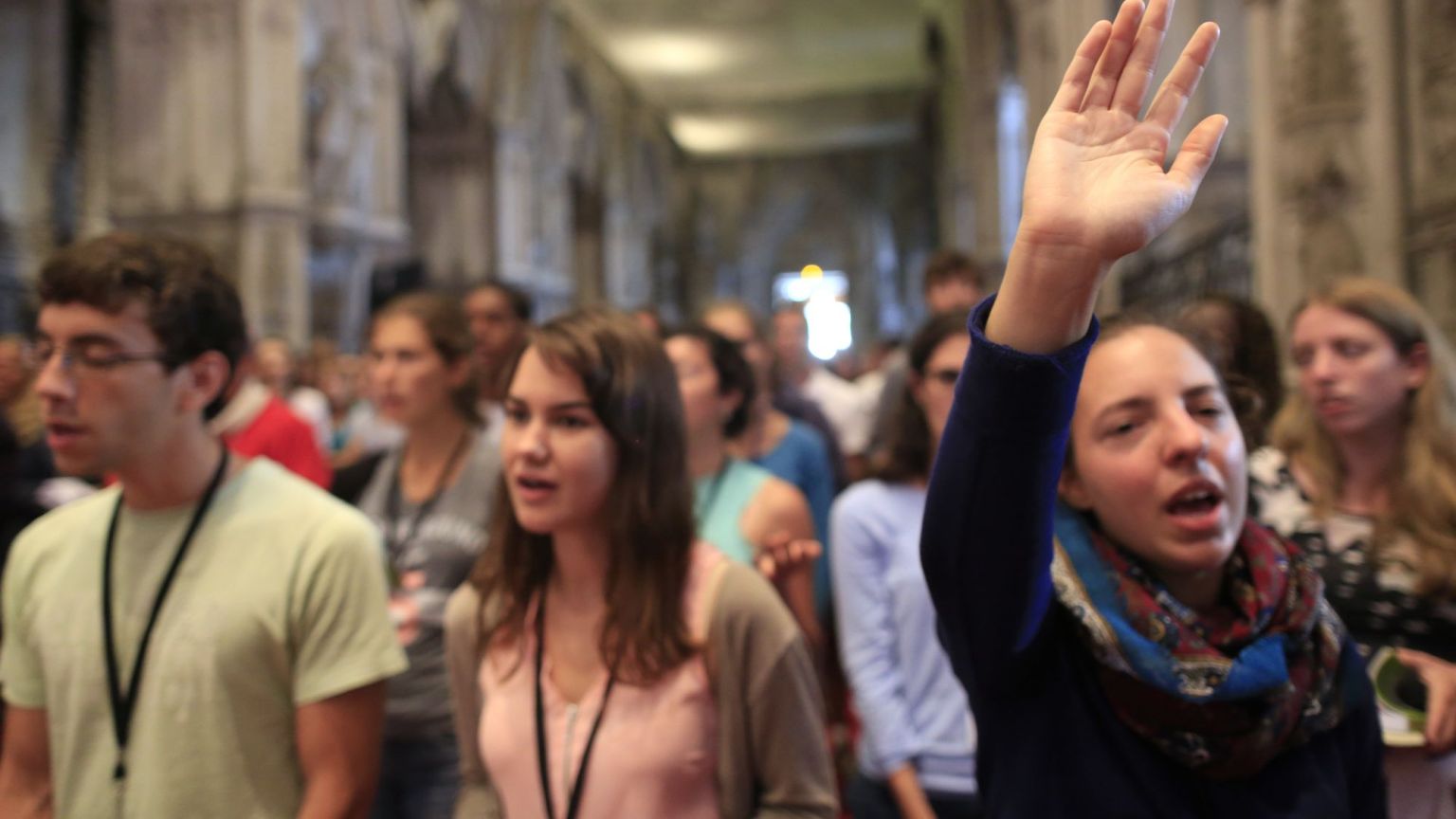
There’s a bit of a media narrative at the moment claiming that churches are seeing more young worshippers flocking to their congregations. It’s perhaps a bit overblown – the numbers aren’t all that high in the UK – but there is certainly something to it.
There is also a concurrent narrative: Gen Z (those born between 1997 and 2013) is becoming socially conservative, or at least more questioning of progressive orthodoxies. Naturally, plenty are drawing a link between the two – people are becoming more socially conservative and so are going to church, or people are going to church and therefore becoming more socially conservative. It’s as though church pews are simply another step on the road to voting Conservative, Reform or (heaven forbid!) Restore.
I submit that causation in this instance is a bit overdone. I would rather simply look at the correlation, at each element separately. Young people perhaps aren’t turning to Christianity because they are becoming increasingly politically conservative, nor vice versa. Rather, they are turning to both in many instances because each offers something that modern Western culture and progressive politics struggle to provide. And I think it’s well worth looking at exactly what those things are.
For all its advantages, modernity has left many young people spiritually homeless. Today’s young adults have inherited a pretty cold world without any ready remedies to nihilism. Traditional institutions – like the church – have been collapsing for years. We are increasingly atomised, with lifelong friendships growing fewer and farther between. Fewer people are marrying, or able to afford to marry, and fewer are able to afford to have children.
Social media seems to be replacing real communities, and doing a bad job of it. Work is increasingly precarious and hard to get into, and when you do get it, it’s not like you can afford to buy a house, or even rent a flat to yourself. Young people don’t go out drinking much, meaning fewer trips to the pub for quiet pints with friends. Our towns don’t look or feel like they used to, high streets are dying, communities are fractured, and we have had our senses of self – both our personal and national identity – undermined on various fronts.
Is it any wonder people are despairing, or simply giving up? And is it any wonder that some people might look to yesterday for the answers?
In many ways, modern individualism is good at giving people freedom, but it struggles to tell them what that freedom is for, or to give them the grounds to make something of it. Well, what are we giving people to believe in? How are we showing them how to orient themselves?
We can’t. Not really. But religion has always excelled here. Christianity has given us a sense of national and individual purpose for centuries, so is it any wonder it’s being called on again to do so?
Christianity offers far more than a set of abstract beliefs, metaphysics and ontology. Its rituals and liturgy give shape to the working week. Its music, the beauty of its architecture (in a modern world in thrall to concrete), and the divine feeling in worship uplift what we might once have called the soul. Its festivals mark the passing of the year. The moral framework and centuries-old prayers bind individuals into something much older and greater than themselves – Christianity is in many ways an ongoing story that invites you to be a part of it. There is a sense to it all of permanence and continuity – a sense increasingly difficult to find in the modern world.
Contrast this with much of modern culture. The endless scrolling and algorithmic feeds, the dating apps that streamline the mating process while divorcing it from so much that is actually romantic. It prioritises the convenience of remote working for ease over being part of a team, and replaces dignity and loyalty with disposable relationships and identity politics.
The church offers and asks something that feels radically different, though it was the norm just a few short years ago. It asks you to belong – to actually, truly belong, rather than simply be a number on a spreadsheet. It asks you to serve rather than to consume, which speaks to something primal and vital within us all. It asks for sacrifice above indulgence, for forgiveness rather than cancellation. It asks you to remain faithful rather than endlessly chasing novelty and hedonistic satisfaction. At its core, it requires you to be selfless as opposed to self-centered. This is quite a profound counter-offer in an age defined by flux, individualism and the soulless ontology of the new atheist.
Conservatism answers many of the same needs. To be clear, conservatism is not Christianity. Far from it. One is a political philosophy, the other a religion with transcendent claims. And plenty of Christian denominations very plausibly use Christ’s teachings to argue for left-wing ideals. However, both appeal to similar instincts because they recognise many of the same truths about human nature. Both value tradition, inherited wisdom, family, local community, duty, restraint, gratitude and continuity. Both are sceptical of the idea that society can simply reinvent itself from scratch.
Modern progressivism typically looks askance at inherited tradition. It’s guilty until proven otherwise, or often simply guilty, with no hope of reprieve. It employs an oppressor-oppressed narrative that fails to ask the fundamental conservative question: why have these traditions survived? Why are these the ways that have organically evolved over millennia? What needs have these traditions and their attendant institutions been meeting? And what, to borrow from GK Chesterton, have the fences of tradition been built to contain?
For young people exhausted by relentless social, technological and cultural upheaval, a more conservative outlook can be reassuring. It helps explain why some are rediscovering both conservatism and the church at the same time. They are searching for roots – for something that modernity does not offer.
Ultimately, though, it’s not about left versus right. As above, there are plenty of left-wing Christians in the world. I grew up in a congregation full of them, and they were glorious people. Why would they not be? Rather, it’s about something much deeper: a growing sense that material prosperity and individual freedom, valuable as they undoubtedly are, are far from enough to sustain a life of meaning and belonging.
Gen Z – and to a fair degree millennials like myself – have grown up sandwiched between unprecedented choice and unprecedented limitations. They can buy whatever they want on Temu and have it delivered the next day, while never being able to afford more than a hovel in which to live, and only in rare instances know what it’s like to wander down a thriving high street that’s unbeholden to curiously empty vape shops and barbers. At the same time, they have been confronted with unprecedented levels of loneliness, anxiety, depression and social atomisation. These are not simply economic problems. They are social, cultural and, in many cases, spiritual ones.
This is the background against which the church is seeing rising numbers, and in which young people are exploring political ideas outside of the current liberal orthodoxies. These are the reasons underpinning it all. For goodness sake, is there any wonder people want change?
James Dixon is a Glasgow-based novelist, poet and playwright.

Jill Rutter takes stock of Andy Burnham’s first few days in government.
After a couple of weeks when Andy Burnham went underground with few sightings in public, this week he has shown what he meant by hitting the ground running.
He appointed a Cabinet – with a heavy Manchester representation (5 members represent seats in Greater Manchester, and there are seven from the North West when two Liverpudlians are added in). London’s representation in the full Cabinet is down to two.
He rewarded those who backed him early and helped usher Keir Starmer out of the door. He dispensed with the services of those who had been some of the most frequent spokespeople for the Starmer regime –Darren Jones and Peter Kyle. Expect to hear far more Northern accents as close allies like Louise Haigh, Jonny Reynolds (back at his old business department) and Lucy Powell become the preferred voices of the government.
There is a huge amount of churn at Cabinet level. But one good decision Burnham has made is to eschew much change at junior ministerial level with a lot of people continuing in post, and others, like Dan Jarvis, who was briefly Defence Secretary after John Healey quit, returning to his old Security Minister beat.
He has moved quickly to reorganise government. The most eye-catching move is the creation of so-called No.10 North, a Manchester base that the new PM will work from (an interesting question is whether his successors with seats well away from Greater Manchester will find that so appealing) but the most important moves are the rebadging and beefing up of the policy secretariats in the Cabinet Office as a new Office of the Prime Minister and Cabinet, with the other, less central tasks hived off into a ‘Onegov’ agency. That starts to address a longstanding weakness in the UK government – that we expect the Prime Minister to drive a programme for government, then refuse to give him or her adequate resources to do it and then wonder why the well resourced permanent Treasury expands to fill the vacuum.
The Prime Minister is also transferring lead responsibility for the central planks of his reform programme to his new Manchester operation. They will lead on devolution strategy (taken over from the Ministry of Housing, Communities and Local Government) – though it is not clear how far that stretches into local government reorganisation – and take over local economic growth from the Treasury. It will be interesting to see how that works with the Treasury’s interest in economic growth, Reynolds reassuming control of the modern industrial strategy he developed in his first outing as Business Secretary and Angela Rayner back to press on with the completion of the devolution map.
Burnham has followed the example of previous Prime Ministers and employed a loyal enforcer at the centre. But Louise Haigh is quite inexperienced compared to some of the earlier occupants of the role – she spent very little time as a minister before being forced to step down by Keir Starmer and the success of a lot of the changes will depend on her, and her ability to work well with the Cabinet Secretary.
The more surprising machinery of government changes are the dismemberment of Rishi Sunak’s Department of Science, Innovation and Technology. Science and innovation go to the ever changing business department, which gets renamed again; digital goes back to DCMS whence it came; and AI goes to the centre. This may, or may not, be a more sensible division of responsibilities than bundling these issues together. What is indubitable is that this sort of change creates distraction and disturbance, as the carve-up and reintegration take up the time and effort of senior leaders and usually end up with a price tag attached. The hope is that this change was much debated beforehand and the pros and cons were properly assessed before the changes were made.
Before taking office, Burnham promised a policy blitz. What has been notable is the nature of the policy announcements seen to date: Unpopular digital ID cards binned before even taking office on Sunday night; Tuesday morning, the decision to temporarily remove VAT (at 5%) from household electricity bills in England, Scotland and Wales; followed on Wednesday morning by taking the bus fares cap in England back to £2 in 2027.
The VAT cut (pending longer-term measures to create a ‘breathing space’ in cost of living pressures) was to be paid for by cancelling plans for digital ID cards: the problem for the government is that their predecessors had never identified how to pay for ID cards which were announced after the spending review was concluded. It’s not huge money in the scheme of things but it is a black mark against the civil service that they failed to stop the government falling into the trap of saying it would be paid for by the money saved by cancelling digital ID. This is a government – as the Prime Minister emphasised to the Cabinet – that needs to be seen to be reining in its potentially spendthrift inclinations.
The bus fare cap is also being funded out of a switch from international climate finance grants to loans. That against a backdrop where the UK aid budget is a fraction of what it once was, and presumably the money that now becomes repayable goes to poor countries saddled with a big climate adaptation or transition challenge.
Expect to see more of this, as what Burnham termed a “cost of living” government looks to subsidise household bills through “reprioritisation”. The rationale seems to be to reverse the experience of the Starmer government – which managed to squander any goodwill in a mess of badly landed policies, minor ethical transgressions and political tone deafness – by buying ‘breathing space’ to develop longer term plans with more promising paybacks. Reeves and Starmer seemed to think they needed to get the economics right, and the politics would follow (it didn’t help that they got the economics quite badly wrong at the Budget); Burnham will be hoping more attractive short-term politics will give time for the economics to come good.
The problem is that he, like Starmer and Reeves before him, faces a double bind of manifesto red lines at home and Trump-induced chaos abroad. He has already pulled off one amazing transition – from barred by-election candidate to unopposed PM in less than six months: escaping that straitjacket would be a stunning second act.
By Jill Rutter, Senior Fellow, Institute for Government.
Politics
The House | Burnham should take the first steps towards electoral reform in his first 100 days

4 min read
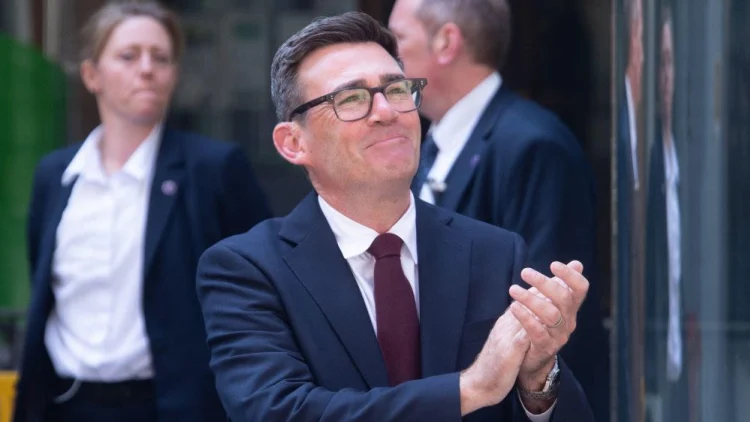
As Andy Burnham becomes Prime Minister, he does so in a Parliament produced by the most unrepresentative general election result on record.
The 2024 general election saw the greatest mismatch between the share of seats parties won compared to their share of the vote. Labour received two-thirds of the seats on just a third of the vote, whereas the Greens and Reform UK received just over one per cent of the seats between them for their combined 20 percent of the vote. Meanwhile, millions of votes didn’t count, with over 70 per cent cast – 21.2m – not directly affecting the outcome.
Part of the reason for this is that Westminster’s first-past-the-post (FPTP) voting system is designed for two parties and cannot cope with the multiparty politics we now have. This trend is not going away: the last general election was the first ever where four parties received over 10 per cent of the vote, and we now have five parties polling consistently over 10 per cent. The result is that Parliament is becoming less representative of the way people voted, and the next could be even more unrepresentative.
The link between what people express at the ballot box and the parliaments they get matters, which is why there are mounting calls for a move to proportional representation (PR). Simply put, PR is about making sure Parliament more accurately represents the way the country voted. We would argue that is the strongest foundation for our democracy.
To his credit, Burnham has himself diagnosed this problem, saying people feel politics isn’t working for them and that he backs moving to PR as part of a necessary “rewiring” of Westminster. In this, the new PM reflects growing support for electoral reform, as the British Social Attitudes Survey has recorded a consistent majority for scrapping FPTP in recent years for the first time since it started polling the question in the 1980s.
So, what happens next? Burnham has said he wants to win a mandate for PR by having it in the next Labour manifesto. Here again, he has considerable support within his own party. A solid majority of Labour members back PR, as do eight of the 11 Labour-affiliated trade unions, and there is a growing caucus of MPs now calling for electoral reform that spans all wings and factions of the party, as well as other parties in Parliament.
Next comes the thorny issue of which electoral system to propose. The UK already has decades of experience of proportional systems that maintain a strong constituency link, such as the Single Transferable Vote in Northern Ireland and the Additional Member System in Scotland and London.
Inaction would leave our democracy on a dangerous trajectory
Burnham has backed a review of the voting system by an independent commission that would then recommend a system of PR for the UK to adopt.
This echoes the Royal Commission that New Zealand had in the 1980s, which laid the foundation for its move to PR from FPTP in 1996. Meanwhile, over 90 Labour MPs have backed the idea of a National Commission on PR.
Whatever the review mechanism, there is an important principle here: that there should be a truly impartial look at how to make our electoral system work better for voters.
Like any new PM, Burnham will be instantly beset by numerous pressing and grave issues as he settles into Downing Street. Launching a commission need not distract from those priorities. It would establish an independent process while ministers get on with governing.
A manifesto commitment on electoral reform requires substantive policy development. A genuinely independent commission should be given time to conduct the work that would later inform that commitment, taking public and expert evidence, assessing the options and making recommendations against clear democratic principles.
Time is of the essence for our democracy. We have a dysfunctional electoral system that is producing parliaments that look less and less like how people voted, at a time when trust in politics is at a record low. Inaction would leave our democracy on a dangerous trajectory.
Burnham has long been one of the most passionate advocates for a politics at Westminster that better represents the whole country. In 2023, he argued: “I don’t believe all people in all places will be equally represented in Westminster until every vote matters.”
Launching an independent commission in the first 100 days of his premiership to look at how to make Parliament properly reflect the way the country votes would be a crucial first step towards realising that vision.
Darren Hughes is Chief Executive of the Electoral Reform Society
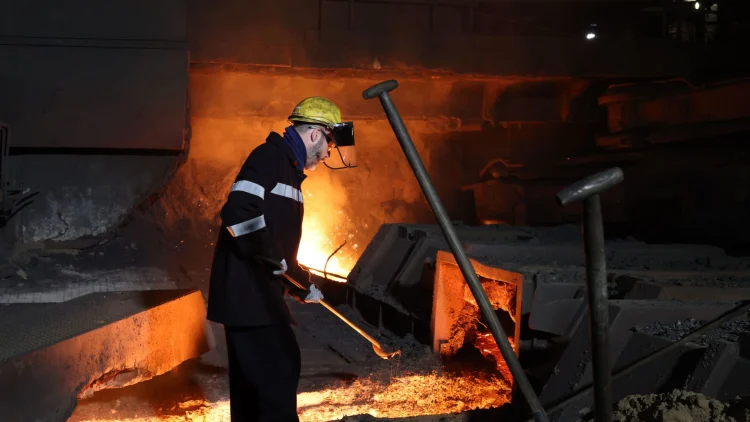

Jonathan Reynolds – then business secretary, and who has returned to the role under Andy Burnham – lifts molten metal during a visit to the British Steel site in Scunthorpe, Lincolnshire, April 2025 (PA Images / Alamy)

5 min read
The defining political question for the next decade is not the size of the state, nor the level of taxation. It is whether Britain can once again become a country where ordinary working people have the freedom to build a good life.
That is why Andy Burnham is right to place reindustrialisation at the heart of his agenda. It is also why I’m part of Labour’s Reindustrialisation Research Group of MPs. Because reindustrialisation is not simply an economic strategy – it is a freedom agenda.
For too long, we have spoken about freedom almost exclusively in negative terms: freedom from regulation, freedom from taxes, freedom from government. Those debates have their place, but they overlook a deeper truth.
Freedom is not simply the absence of restraint. Freedom is the presence of opportunity. It is the freedom to earn a decent wage; to learn a skilled trade; to own a home, raise a family and build a future in the community that shaped you. Above all, it is the freedom to become everything you are capable of becoming.
That freedom has steadily been taken away from too many Red Wall communities. Across the North, the Midlands and Britain’s industrial heartlands, people did not lose ambition. They lost opportunity. They lost industries that had sustained families for generations, and they lost secure, skilled work. And with that went something far more valuable than a payslip: the confidence that if you worked hard, your children would live better lives than you had.
That was never simply an economic loss. It was a loss of freedom. Deindustrialisation did not just close factories – it hollowed out communities, weakened civic institutions and left too many towns dependent upon decisions made hundreds of miles away by people who neither understood their history nor shared their aspirations.
For decades, Britain has attempted to manage that decline. We have redistributed wealth rather than creating it. We have expanded welfare while shrinking productive capacity. We have concentrated investment in already successful places while asking everyone else to be patient. It has not worked.
The answer is not to manage decline more efficiently. It is to reverse it. That is the mission of reindustrialisation. The Reindustrialisation Research Group exists because Britain needs far more than another set of short-term economic interventions. We need a new political economy that makes more things, in more places, with more British workers. One that builds resilience against global shocks, creates good jobs close to where people live and restores agency to communities that have too often felt powerless.
This is not nostalgia but necessity. The world is becoming less globalised and more competitive. Nations are once again thinking seriously about energy security, manufacturing capacity, critical minerals and strategic supply chains. Britain cannot afford to watch from the sidelines while others rebuild their industrial strength, nor can Red Wall communities afford another generation of missed opportunities.
Reindustrialisation means producing more of our own energy, making more of our own steel, building more advanced manufacturing, and investing in defence, nuclear, engineering and new technologies. It means patriotic procurement that backs British workers, affordable energy that allows industry to compete and an active state willing to invest where markets alone will not.
Most importantly, it means spreading that investment fairly across every nation and region of the United Kingdom. Economic growth that benefits only London is not national renewal. It is geographical inequality with a larger GDP. The true measure of success is whether a young person growing up in Hartlepool, Stoke, Wrexham, Grimsby or Bolsover has the same freedom to build a successful life as someone growing up anywhere else in Britain.
That is why education matters. Vocational skills matter. Transport matters. Industrial policy matters. Every apprenticeship, skilled job and factory built expands freedom. Every community connected to opportunity expands freedom.
That is why I joined the Reindustrialisation Research Group. Its mission is not merely to scrutinise policy but to help shape a long-term national strategy capable of transforming Britain’s economy. One that matches the scale of the challenge with the scale of investment required, recognising that Parliament has a responsibility not simply to react to change but to help lead it.
The objective is straightforward: to build an economy that works everywhere, not just somewhere. Working-class communities are not asking for special treatment. They are asking for the chance to contribute again. They do not want dependency. They want dignity. They do not want permanent redistribution. They want productive work. They do not want managed decline. They want national renewal. And they do not simply want freedom from government.
They want the freedom that comes from opportunity: the freedom to work, to earn, to build, to innovate, to stay close to family, to own a home and to believe that hard work will once again be rewarded. That is the promise of reindustrialisation. Not simply stronger economic statistics, but stronger communities. Not simply higher growth, but wider opportunity. Not simply a wealthier Britain, but a freer one.
If we are serious about taking back our freedom, then we must once again become a nation that makes things, builds things and believes in the people who have always been at the heart of Britain’s success. For Red Wall Britain, freedom will not be won through slogans. It will be won through opportunity. And opportunity begins with reindustrialisation.
Jonathan Brash is Labour MP for Hartlepool and a founding member of the Reindustrialisation Research Group


Laurent Warlouzet looks at the evolution of European integration and the role the UK has played from within and outside.
Britain has been at the core of the European integration process since its inception, despite frequent upheavals. In my recently published book, Liberty, Solidarity and Community: Capitalism and European Integration, I argue that there has always been a discrepancy between the official discourse of British leaders, who portrayed themselves as isolated champions of freedom battling continental Europeans, and the day-to-day reality of Britain’s constant engagement with Europe.
An examination of the British archives from Margaret Thatcher’s leadership (1979–1990), in particular, sheds light on how the Iron Lady sought to steer the single market programme in a free-market direction. She also supported greater cooperation in foreign policy and research and development, and she even lobbied Brussels to provide massive amounts of state aid for a limited number of favoured pet projects, from the Harland & Wolff shipyard to the Nissan plant in Sunderland. Obviously, she was later disappointed by what she perceived as excessive dirigisme emanating from Brussels.
Britain was highly influential in Brussels during its membership of the European Economic Community and later the European Union (1973-2020), notably through its powerful Commissioners, from Roy Jenkins to Leon Brittan and Neil Kinnock. Even after Brexit, once the disputes over the Covid-19 vaccines subsided, Britain has remained influential in Europe, largely thanks to its substantial involvement in supporting Ukraine. Even in trade, the attraction of the single market is so great (for the simple reason that, geographically speaking, Britain is still in Europe!) that it has proved difficult to conclude a comprehensive trade agreement with the United States. Such an agreement would probably require significant divergence from EU single market rules, causing major disruption to UK-EU trade in the process. For example, during talks about a putative US-UK trade agreement under the Premiership of Boris Johnson, the issue of the European Union‘s (in)famous ban of chlorinated chicken, which is permitted in the US, was raised.
Even before Thatcher, the UK had played an instrumental role in establishing the first European organisations: the Organisation for European Economic Cooperation (OEEC), which administered the Marshall Plan (1948), and the Council of Europe (1949). Although it initially refused to join the European Communities, it eventually became a member in 1973. Britain failed in its attempts to promote alternatives to the European Communities, such as the 17-country Free Trade Area proposed in 1956 or, failing that, the smaller seven-country European Free Trade Association (EFTA), established in 1960. Yet it remains to be seen whether Britain could revive a new kind of EFTA for the whole of Europe, now that Brussels is embarking on a wave of deregulation. The rise of far-right parties in Europe could hollow out the European Union from within by weakening its regulatory framework and federal judicial system, thereby reviving the model of a free-trade area as the organising principle of the European continent.
Britain is also still an “awkward partner” (an expression coined by a diplomat in 1980) for a European Union that seeks to pursue a more assertive trade and industrial policy. The book shows that Brexit has strengthened the European Union by enabling France to advance long-standing legislative proposals on industrial policy and protectionism that Britain had consistently opposed. Reintegrating Britain into the European Union, or even into some of its initiatives, such as European rearmament or proposals to establish a “European preference” for certain strategic products, would mean greater competition for EU firms. Should Britain be treated as a privileged partner or simply as a friendly neighbour?
Beyond the British case, the book advances two broader arguments. First, capitalism is not simply a contest between free-market advocates and supporters of welfare and environmental policies. There is also a third camp that favours protectionism and a more assertive foreign and defence policy. Accordingly, the governance of capitalism rests on three foundational principles: liberty (the free market), solidarity (social and environmental policies), and community (protectionism and assertive foreign and defence policies).
Second, in seeking to preserve peace while managing growing economic, social, and environmental interdependence, Europeans have chosen a distinctive path: European integration. This project has never been exclusively neoliberal. Rather, it has evolved through a combination of supranational ‘liberty capitalism’ national ‘community capitalism’ (industrial policy), and various forms of ‘solidarity capitalism’ (cohesion policy, the joint procurement and distribution of Covid-19 vaccines, environmental policy, and so forth). Drawing extensively on archival sources, the book also highlights the many alternatives considered by European leaders, including a free-trade area, economic planning, a carbon tax (as early as 1992), fiscal harmonisation, joint industrial projects, a common foreign policy, and a European army.
The book highlights some of the major questions for the EU, such as: is it able to cope with the return of power politics, or is it merely a regulated market? How does industrial policy need to shift in response to Trump’s policies? And how else might the European Union evolve to deal with the new world order?
Today, the central challenge is to develop European forms of ‘community capitalism’ – that is, a European approach to industrial policy and strategic protectionism. A major foreign policy challenge for the United Kingdom in the years ahead is whether the evolving European model is one which it wants to participate more deeply in.
By Laurent Warlouzet, Professor, Paris Sorbonne Université. For a longer summary of the book, see here, or the book is available in open-access here.


(dennizn/Alamy)

4 min read
Politicians making a meal of it. This week: the Golden Arches Theory
The observation was simple, but one that might contain a profound truth: no two countries with a branch of McDonalds had ever gone to war with each other.
The writer Thomas L Friedman, who first noticed this phenomenon back in 1996, had been worried he’d missed an example. Might there have been golden arches in Buenos Aires when Argentina seized the Falkland Islands? No, the chain didn’t open in the country until four years after the conflict.
Friedman’s argument was always tongue-in-cheek, but there was a serious theory underneath it: once a country had reached the point where it could sustain a market in McNuggets, it would have a population wealthy and comfortable enough that they wouldn’t support a government that took them into wars of aggression. With the burger giant spreading to more countries, the implication was that one day we might see world peace delivered simply through the medium of Happy Meals.
Thinking about it now, it’s a slice of 90s nostalgia as vivid as an Oasis concert or a Tony Blair speech about education, a reminder of how optimistic that decade felt: the Berlin Wall was down, Nelson Mandela had gone from jail to government, football might even be coming home (to one part of the UK, anyway). A couple of years before Friedman set out his idea, Pulp Fiction had opened with a long riff about the differences between McDonald’s in France and the US. Thanks to the metric system, Americans learned, in Paris a quarter pounder was called a royale with cheese. Although “a Big Mac’s a Big Mac, but they call it le Big-Mac”.
Sadly, the Golden Arches Theory, as it became known, was doomed. In 1999, Nato bombed Belgrade. In response, locals attacked their branch of McDonald’s, possibly having failed to understand the mechanism by which its presence was supposed to keep them out of a war with the US.
Friedman argued that the short duration of that conflict made it an exception that proved the rule: Serbians didn’t want war, they wanted fries and cheeseburgers (and other things that came with the capitalist post-Soviet order). Unfortunately, more challenges were on the way. Israel’s retaliation against Hamas in 2023, and its subsequent attack on Lebanon, put a strain on the relationships between McDonald’s franchises in the Middle East.
A McDonald’s wasn’t necessarily a sign that a society was getting rich enough to be peaceful
But the final failure of the theory came in the very place where it had arguably first taken root. The 1990s had begun with the grand opening of a McDonald’s in Moscow. Tens of thousands queued to get it. It was a news story around the world, with the BBC interviewing a man who ate half a burger and took the other half home for his wife. This was the West winning. And McDonald’s was a Russian hit: by 2022, there were more than 800 branches in the country, employing 62,000 people.
The company’s presence survived a couple of breaches of the Golden Arches Theory: Georgia had a McDonald’s nearly a decade before the 2008 Russo-Georgian War, as did Ukraine when the Crimea was annexed. But the 2022 full-scale invasion of Ukraine was the final straw. McDonald’s closed and then sold up its stake in Russia.
Even in the 90s, Friedman had acknowledged that getting a McDonald’s wasn’t necessarily a sign that a society was getting rich enough to be peaceful. After all, a big part of the chain’s appeal is that the food is cheap. But he’d still hoped that a world of quick, abundant food would be more appealing to people than war. It turned out that the forces that drive people to attack their neighbours were stronger.


To make it out of a Republican primary in Arizona, there’s one key litmus test: believing the 2020 election was stolen from Donald Trump.
Election deniers who played prominent roles in efforts to overturn the 2020 results triumphed in statewide Republican primaries Tuesday, from Rep. Andy Biggs for governor to state Rep. Alexander Kolodin for secretary of state. State Senate President Warren Petersen was leading his primary for attorney general, though his race was not yet called as of early Wednesday morning.
Biggs, a staunch Trump ally who helped try and overturn the election on Jan. 6, 2021, was later subpoenaed in an Arizona probe. Kolodin represented a slate of fake electors, leading to discipline from the Arizona state bar, and filed lawsuits to try to overturn both the 2020 and 2022 elections. Petersen launched a taxpayer-funded audit into Maricopa County’s election system that eventually led to a subpoena.
Their victories show GOP primary voters continue to prefer candidates who have pushed false narratives about elections or worked to overturn them. But that can prove toxic in November — and Democrats plan to make their rivals pay for those positions in the fall.
“It’s one of those things that just won’t go away,” said former Rep. Matt Salmon (R-Ariz.). “In the Republican Party in Arizona, in the primary, carrying the Trump line on virtually everything — and that includes election denialism — is still something that benefits you.”
But in the general election, “it’s a stone around your neck,” Salmon said. “Among independents and moderate Republicans who vote in the general election, election denialism is not an asset.”
Each of the triumphant election deniers Tuesday centered election integrity in their 2026 campaigns. Biggs has been a prominent supporter of the SAVE America Act, the stalled election bill that Trump has pushed repeatedly. Kolodin has advocated for ending Arizona’s permanent early voting list and for stringent ID requirements. And Petersen has pledged to expand the attorney general office’s election integrity unit in order to investigate election results. Arizona was one of the most competitive — and most contested — states in the 2020 election. Fox News’ decision to declare then-candidate Joe Biden’s victory in the state on election night sent shockwaves through Trump’s orbit. It took then-Republican Gov. Doug Ducey several weeks to acknowledge Biden won.
The Grand Canyon State became ground zero for Trump’s effort to overturn the election. Trump and his allies pressured Arizona leaders, including then-House Speaker Rusty Bowers, to call the legislature back into session and recall the state’s slate of electors. A group of Republicans falsely posing as alternate electors were later charged with forgery, fraud and conspiracy, a case that is ongoing.
Even still, running as an election denier hasn’t been a successful strategy for the Arizona GOP once November rolls around. In 2022, Arizona Republicans nominated hardline election deniers up and down the ballot — Kari Lake for governor, Blake Masters for U.S. Senate, and Mark Finchem for secretary of state — and saw losses in each race, even as Republicans nationally enjoyed an otherwise strong year. And in 2024, Lake again lost, this time for U.S. Senate, even as Trump won the state by more than five percentage points.
“Biggs and Kolodin will be saddled with election denialism for the next three months,” said longtime Arizona GOP strategist Barrett Marson. “While Democrats would be wise to focus on affordability, certainly some of their talking points will focus on how these two are dangerous for democracy.”
Arizona Gov. Katie Hobbs, who ran unopposed in the Democratic primary Tuesday and will face Biggs in November, served as secretary of state during the 2020 election. She has portrayed this year’s gubernatorial election as a contrast between confidence and conspiracy in the state’s election system.
“Arizona is one of seven swing states that will decide the presidential election,” Hobbs said during an MS NOW appearance Tuesday evening. “If Andy Biggs is governor, Arizona is the first swing state with an election denier in charge, and the time to stop that is not 2028. It is right now.”
It’s almost impossible to be a Republican officeholder without agreeing with the president on the 2020 election and the need to dramatically change election law.
“As long as Donald Trump, who has the bully pulpit and is the party leader … is talking about election integrity, it will be a top issue in GOP primaries,” said one Arizona Republican strategist, granted anonymity to discuss the issue candidly.
“Election integrity measures are broadly popular, but the issue being front and center highlights divisions about Jan. 6th and wasn’t a winning general election issue in 2022,” the strategist continued. “Not sure that general election voters will care much about that in 2026 with such a focus on affordability issues. We are about to find out!”
Trump, for his part, has proven unwilling to move past the 2020 election even after winning a return to the White House in 2024. He has never acknowledged he lost that election, and in a primetime speech last Thursday, he announced his administration would declassify documents he alleged show Chinese interference in the 2020 race.
“Our elections were left vulnerable to being rigged and stolen, and the trust of the American people was lost,” Trump said Thursday. “This cannot be allowed to continue.”

IND vs ZIM: Who is Ashok Sharma? Farmer’s son makes India debut after 154.2 kmph IPL breakthrough | Cricket News

New msaRAT malware uses Chrome, Edge browsers to route C2 traffic

JJ Gabriel plan and injury blow during training – Manchester United Academy Notebook


-
 NewsBeat7 days ago
London Mayor Sadiq Khan handed a peerage by Keir Starmer alongside 15 other Labour figures… just days before the PM leaves No10
-

 Fashion6 days ago
Weekend Open Thread – Corporette.com
-

 Politics5 days ago
The House | The City of London can help the new chancellor deliver growth in every postcode
-

 Crypto World5 days ago
Ripple Payments Joins MiCA With 14 Firms, Does It Mean Anything For XRP?
-
 Crypto World6 days ago
Two July Windows Left: The CLARITY Act’s Senate Fight and What Failure Means
-

 Politics4 days ago
Democrats look to World Cup watch parties to register thousands of voters
-

 Crypto World6 days ago
Ripple wins EU-wide access as ESMA adds it to MiCA register
-

 Crypto World2 days ago
Grayscale Files For Worldcoin ETF, WLD Registers Sharp Rise
-

 NewsBeat3 days ago
Unregistered fitter used Gas Safe logo on business flyers
-

 Tech2 days ago
Sail Virtually Aboard The “Itanic” With IA-64 Emulator
-

 Crypto World7 days ago
Injective Submits SEC Transfer-Agent Registration to Onchain Ownership Records
-
 Tech2 days ago
Turtle Beach Command Series KB7 review: a nifty screen-equipped gaming keyboard
-

 NewsBeat6 days ago
Registration is now open for March for Men with Kev 2026
-
 Business1 day ago
New Jersey voter registration controversy explained: How 6,600 noncitizens got on the rolls, and what happens next
-

 Crypto World7 days ago
Claude Fable 5 Slips to Second in AI Coding Leaderboard
-

 News Videos6 days ago
Money | Class 12 Economics | CBSE Board Exam 2026-27
-

 Business6 days ago
Banco Bilbao Vizcaya Argentaria, S.A. (BBVA) Discusses Global Macro Environment and Economic Outlook for Core Markets Transcript
-

 Crypto World5 days ago
Kaspersky exposes OkoBot’s 20-module crypto wallet attack
-

 News Videos4 days ago
Big Money Is Entering XRP
-

 NewsBeat5 days ago
Durham County Council to send out electoral registration emails
You must be logged in to post a comment Login