Politics
Remigration by stealth? The government’s earned settlement proposals
James Bowes analyses the potential impact of the UK government’s proposed changes to its settlement schemes to both new migrants and migrants already in the UK.
The government’s consultation on its “earned settlement” proposals, which would make it much harder for immigrants resident here for long periods to get Indefinite Leave to Remain (ILR), also known as “settlement”, closed today. As written, and unlike previous immigration restrictions, these new rules won’t just affect new immigrants but will also affect over 2 million immigrants already living in the UK. These changes will force many legal immigrants to leave the country entirely.
What is changing?
Some changes will affect all applicants for ILR. The required English language level will increase from B1 to B2. The applicant will need to earn over £12,570 a year for at least three years. This latter change will make many people on a family visa or work dependant visa ineligible for ILR.
While the baseline period to qualify for ILR has been announced as 10 years, many people will face a wait much longer than this. People with a work visa for a job skilled below a graduate level face a 15-year wait for ILR and refugees face a 20-year wait. People who have entered the country illegally, overstayed their visa or entered on a visitor visa face an even longer 30-year wait. People who have claimed benefits may face an even longer wait.
The qualifying period will remain at 5 years for family of British nationals, BNO visa holders and people working in a graduate level job that either pays over £50,270 or is an eligible public sector job (e.g. doctors, nurses, teachers). It will be shortened to 3 years for people earning over £125,140. Qualifying periods remain unchanged for global talent and innovator founder visa holders.
Who will be affected?
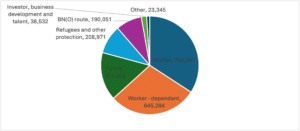

People with a settlement path visa living in the country at the end of 2024 by broad category
Roughly two thirds of people affected by the new rules will be here on a work visa or are the dependant of a work visa holder. Most of the others are on a family visa or are here for humanitarian reasons. Workers, their dependants and refugees will be most affected by the longer qualifying periods. However, everyone will be affected by the tougher language and salary rules.
What will the changes mean for work visa holders?
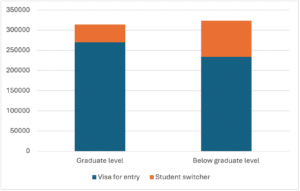

Skilled worker visa grants (including health and care) from 2021 to 2024 split by skill level, visa grants for entry and switchers from a student visa only
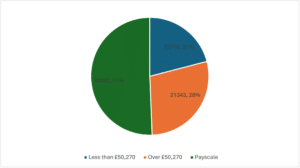

Skilled worker visa grants (including health and care) for graduate-level jobs for entry in 2023. Split by whether the job is on a public sector pay scale or if not, by whether the median salary for the occupation was above £50,270 in Year Ending June 2023.
About half of main applicant work visa holders face a 15-year wait as they are working in a job skilled below graduate level. Most work visa holders working in graduate level jobs will qualify for ILR in 5 years as they are either working in an eligible public sector job or a job paying over £50,270.
However, most dependants of even high-paid workers will face at least a 10-year wait. This is because the dependant themselves will have to earn over £50,270 or work in a public sector job to qualify in 5 years. Most dependants are likely to face a 15-year wait as they are accompanying workers in non-graduate jobs.
Will the changes mean people have to leave the country?
The new rules won’t simply mean a longer wait for ILR. They will mean many people don’t qualify for ILR at all and have to leave the country. Redundancy is much more likely during 15 years on a work visa than it is during 5 years.
Employers may be unwilling to pay the immigration skills charge for 15 years. People on a visa may be unable or unwilling to pay 15 years of visa fees and immigration health surcharge. Many care workers are graduates and so may not want to commit 15 years of their career to working in a care home.
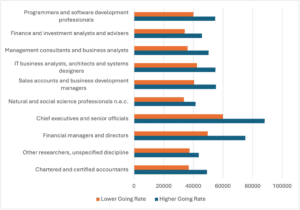

Lower and higher going rates for top 10 non-payscaled high-skilled jobs to illustrate how different the two rates are. NB: Sales accounts and business development managers may be downgraded to medium-skilled.
People who have had a skilled worker visa continuously since before April 2024 currently only have to meet a lower salary threshold and occupational going rate when they renew their visa or apply for ILR. However, these lower rates are currently scheduled to expire in April 2030.
This is a major challenge as both the higher salary threshold (£41,700 compared to £31,300) and the higher occupational going rates are much higher than the lower rates. This means many people, in both graduate and non-graduate jobs, will need a large pay rise to remain in the country, unless the government decide to extend the lower salary threshold and going rates beyond April 2030.
Another challenge for people renewing their visas will be the end of the Immigration Salary List from January 2027 (July 2028 for care workers), that allows a salary discount of 20% for shortage occupations. For visa renewals after this date, the discount to the salary threshold will only apply to visa renewals with the same employer and same occupation.
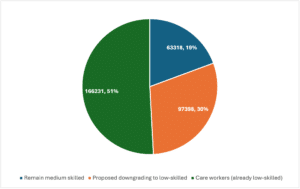

Skilled worker visa (including health and care) grants for entry and to student switchers 2021 to 2024 split by the skill level of the occupation if the proposed changes to skill classification in the Temporary Shortage List review are accepted. Jobs below graduate level only
When a medium-skilled occupation is reclassified as low-skilled, visa renewals are also only possible if they’re with the same employer and the same occupation. Visa renewal for the occupations downgraded to low-skilled in April 2024 will only be possible until April 2030.
Care workers are already considered a low-skilled occupation, only eligible for a visa due to their appearance on the soon to be abolished Immigration Salary List. A further 30 occupations may be reclassified as low-skilled following an updated evaluation of the skill level of jobs; it is unclear what transitional arrangements will exist for visa renewal in these occupations. If the changes are accepted, most people on the 15-year route to settlement would be working in jobs now considered low-skilled.
Unless the proposals are changed to address these challenges, many visa holders will be bound to one specific employer and occupation and only able to renew their visa if that employer is willing to pay a higher salary and visa fees. This will be a particular problem for people employed by exploitative or fraudulent employers. It may not even be possible to renew a visa for some low-skilled occupations.
Conclusion
Over 2 million people will face much tougher requirements to remain in the country than they expected when moving here. The majority are people who came to work. Over half of work visa holders and most dependants face a longer wait to be eligible for Indefinite Leave to Remain. During this time, they will face ongoing visa fees and other charges, and their immigration status will remain insecure. Many will be forced to leave the country entirely. The government claims that this is not the objective – if that is true, then it will need to introduce far-reaching transitional protections.
By James Bowes, Space Management Assistant, Strategic Planning and Analytics, University of Warwick.
You must be logged in to post a comment Login