Politics
“Revealing”: Lord Parkinson reviews ‘Winston Churchill: The Painter’


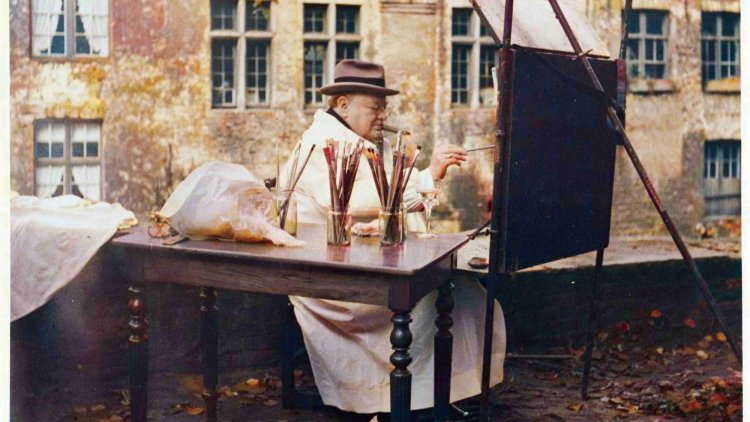
September 1946: Winston Churchill painting in Belgium | Image: © Churchill Archives Centre


5 min read
At a time of turmoil, political leaders could do no worse than seek inspiration from this revealing and enjoyable retrospective of the paintings of Winston Churchill
I was delighted, when arts minister, to learn that the Wallace Collection was planning a Winston Churchill retrospective. It might seem a surprising choice for this museum of decorative arts, but it has a splendidly Churchillian connection: the great-granddaughter of Sir Richard Wallace – the Conservative MP who left the collection to the nation – was Odette Pol-Roger. She befriended Churchill over dinner at the reopened British Embassy in Paris in 1944, reserved an entire vintage for him, and sent him a case each year for his birthday.


Image: © Churchill Heritage Ltd. Image courtesy Churchill Heritage Ltd
The wartime premier’s Nobel Prize in Literature is well-known; less so is his renown as an artist. After two of his paintings were pseudonymously accepted into Royal Academy’s Summer Exhibition, he was elected an honorary academician in 1948. A decade later, a selection of his works toured the United States, Canada, Australia and New Zealand before a hugely popular show at the Royal Academy in London – but there has been no national exhibition in the UK since his death in 1965. High time, then, for this illuminating and enjoyable show, curated by Xavier Bray and Lucy Davis.
These canvases illuminate the visual metaphors in his famous speeches
Churchill turned to painting at one of his lowest ebbs, after his dismissal as first lord of the admiralty in the wake of Gallipoli. Ejected and dejected at the age of 40, “the Muse of Painting came to my rescue”. She would remain an inspiration and comfort the rest of his life. “Painting is complete as a distraction,” he later explained. “I know of nothing which, without exhausting the body, more entirely absorbs the mind.”


Though self-effacing about his “daubs”, the apprentice was typically committed to improvement. His earliest mentor was the society portraitist and war artist Sir John Lavery. One of the most arresting images in this exhibition is the self-portrait Churchill produced at Lavery’s studio in 1915, shrouded in darkness and shadow, an echo of his turmoil that autumn.
High birth and high office allowed him to seek the advice of other artists. Sir William Nicholson – “the person who taught me most about painting” – stayed at Chartwell and tutored him in still-life, though with a Churchillian twist in the choice of subject: bottles of brandy and Johnnie Walker. Walter Sickert encouraged a greater spontaneity and more vibrant palette – seen in his Moroccan landscapes, or in his 1949 Twenty-Minute Sketch of Lake Carezza, painted en route to the inaugural session of the Council of Europe. To stop him overworking it, his wife Clementine is said to have asked a bodyguard to hide it under his bed.


Image: © Churchill Heritage Ltd. Image courtesy Churchill Heritage Ltd
The nearly 60 works selected here (from an oeuvre of over 500) amply demonstrate his development and curiosity, from hasty despatches from the Great War trenches to sophisticated studies of the state rooms at Blenheim Palace.


Especially revelatory is The Beach at Walmer, painted in 1938 and depicting the Churchill family paddling in Kent. The artist himself stands apart, looking out across the Channel. A Napoleonic cannon follows his gaze, echoing the warnings of the man who, within three years, would be lord warden of the Cinque Ports.


This exhibition of the great statesman’s work runs until 29 November, the day before his 152nd birthday. Any other political leaders facing turmoil between now and then might find inspiration in it.
Lord Parkinson of Whitley Bay is a Conservative peer
Winston Churchill: The Painter
Curated by: Dr Lucy Davis & Dr Xavier Bray
Venue: Wallace Collection – until 29 November

You must be logged in to post a comment Login