Politics
Serena Williams makes winning return at Queen’s with confident doubles victory

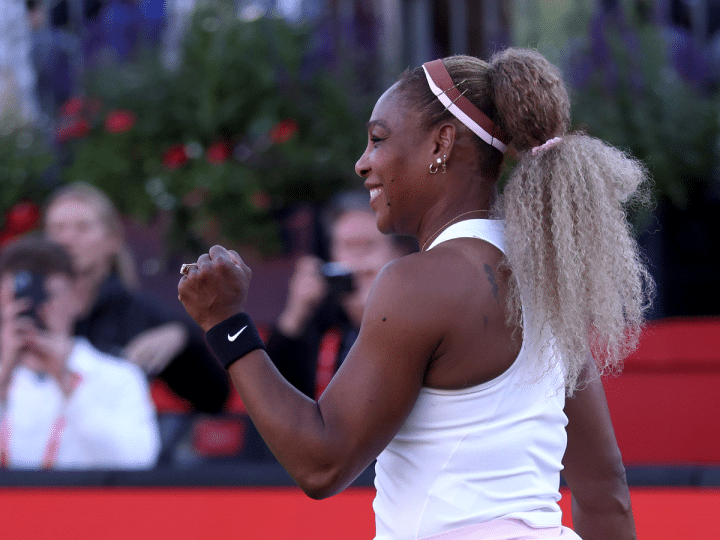

Serena Williams walked back into professional tennis after nearly four years away and immediately reminded the sport what she still carries: presence, power, and a competitive edge that hasn’t dimmed with time.
At 44, the 23‑time Grand Slam singles champion made a winning comeback in the doubles event at Queen’s, partnering 17‑year‑old Canadian Victoria Mboko to defeat third seeds Nicole Melichar‑Martinez and Erin Routliffe 7‑6 (7‑2) 6‑2. It was Williams’ first professional match since the 2022 US Open, and her first ever appearance at the historic Queen’s Club.
The reception matched the moment. A standing ovation greeted her as she stepped onto the Andy Murray Arena, a venue she had never played during her singles career. The response was warm, loud, and unmistakably appreciative of a player whose legacy stretches far beyond the numbers.
Serena Williams sets the tone
Williams and Mboko, an unseeded pairing with a 27‑year age gap, settled quickly into the contest. Williams’ serve was still heavy, still explosive and it clocked speeds up to 120 mph, a reminder that her trademark weapon remains intact.
The early break they secured didn’t hold, with Melichar‑Martinez and Routliffe recovering to force a tie‑break. The tie‑break belonged entirely to Williams and Mboko. They were confidently hitting, with smart court coverage, and a composed finish saw them take it 7‑2.
It was the kind of opening set that signalled Williams wasn’t here for nostalgia. She was here to compete.
Control and a calm finish
The second set was more straightforward, with Williams and Mboko secured a double break, tightening their grip on the match as the crowd leaned into every point. Williams fired two aces in the final game, closing out the win with the kind of authority that defined her peak years.
For a player who has spoken openly about “evolving” away from tennis rather than retiring, this was a return that looked natural, not forced. The movement was sharp, the timing improved as the match went on, and the partnership with Mboko, despite being brand new, clicked immediately.
A win achieved with ease, not expectation
Williams credited Mboko for her composure and impact, noting how naturally their games meshed despite having never played together before. The teenager held her own in the big moments, matching Williams’ intensity and contributing key points in both sets.
The dynamic was clear: Williams’ experience and power paired with Mboko’s energy and athleticism created a balanced, effective team. Their quarter-final opponents Leylah Fernandez and Laura Siegemund, will offer a different test, but the early signs suggest Williams and Mboko are more than just a feel‑good story.
Why Queen’s?
Williams’ decision to return at Queen’s raised eyebrows, but her explanation was characteristically straightforward. With her children out of school for the summer and a desire to play at a venue she had only ever watched from afar, the timing made sense.
Queen’s has long been a staple of the men’s grass‑court season, but its expansion to include women’s events created an opportunity Williams had never previously been able to take. For a player who has spent her career breaking norms, her debut at 44 felt fitting.
Just Tennis
Ahead of the tournament, Williams made it clear she had nothing to prove. Her competitive comeback wasn’t framed as a chase for records or a final push toward another major. Instead, it was about enjoyment, a fresh challenge, and reconnecting with a sport she shaped for more than two decades.
Her schedule reflects that mindset. She is set to play doubles at the Berlin Open next week, but has not confirmed whether she will enter Wimbledon. The door is open, but there is no rush, no pressure, no narrative being forced.
A return that resonates without hype
Williams’ comeback doesn’t need over‑dramatization.
It is a story rooted in longevity, not sentiment. Williams’ presence alone elevates any court she steps on, but her level of play, sharp, purposeful, competitive, is what makes this return meaningful.
The quarter‑final at Queen’s will offer a clearer picture of where Williams’ game sits in a competitive context. Fernandez and Siegemund are experienced, tactically smart, and comfortable on grass. It will be a different kind of test, one that requires rhythm and cohesion.
Williams has already achieved something significant: she has returned to professional tennis with a win, with authority, and with the same unmistakable aura that defined her prime.
Whether this comeback becomes a short chapter or a longer run, Serena Williams is clearly still a dazzling powerhouse.
Featured image via Getty/Paul Harding
By Faz Ali
You must be logged in to post a comment Login