
Politics
Signs Your Child’s Posture Changes Might Be A ‘Red Flag’


If you’ve noticed your child has started sitting in a different way, and it’s not the norm for them, it might be a ‘red flag’ that something’s going on in their body that’s making them uncomfortable.
That’s according to Kelsey Pabst, a registered nurse and medical reviewer at Cerebral Palsy Center, who said: “As a nurse, I treat posture changes as a red flag: when a child suddenly sits or lies differently, it’s often the body adjusting to discomfort or stress before they can express it, and the concern is a repeated pattern rather than a one-off day.
“If that pattern is missed, those small shifts can disrupt sleep, affect mood, reduce focus and make movement harder, even when there’s no obvious illness or injury.”
Specific posture changes to be mindful of
“The things I tend to notice first are shifts away from their natural comfort set-point. That might look like always leaning to one side, sitting cross-legged when they used to stretch their legs out, or constantly changing position as though nothing feels quite right,” said Pabst.
She also recommended paying attention to how they get in and out of a seated or lying position.
“If it takes them longer, they brace themselves on furniture or they avoid bending or twisting, there may be discomfort they can’t describe yet,” she added.
The nurse noted that children, especially younger ones, don’t always connect a sensation in their body with the need to speak up about it.
“Instead, they shift their weight, slump, perch on the edge of seats, or curl up tightly to protect the area that feels sore,” she explained.
Kids with tummy issues, for example, might prefer lying face-down or folding themselves over their knees as though they’re giving their stomach support.
Tight muscles or growing pains might make them pull their legs close or avoid stretching them out fully.
“Their posture can be the body’s workaround for avoiding a sensation they don’t quite understand,” Pabst added.
Similarly, a child’s posture might convey if they are stressed or struggling mentally.
“Stress tends to make children smaller rather than larger,” explained the nurse. “They might curl into themselves, tuck their knees up to their chest or wrap their arms tight around their body, especially when resting.
“Other children become restless and pace, fidget constantly, or sit in positions that look tense and ready to spring up again. Their posture can be a physical ‘tell’ that they don’t feel settled on the inside even if they can’t explain why.”
What to do about it
If you’ve spotted a shift in your child’s posture, the best thing you can do is keep a note of their posture patterns.
“If something feels different, note when it started, whether it’s happening every day and what else is changing at the same time,” said Pabst.
“Ask gentle, open questions such as ‘Does anything feel a bit funny when you sit like that?’ or ‘Where would your body like to be more comfy?’ rather than ‘Do you hurt?’”
She added that encouraging movement, stretching and varied play might help as it “helps reset the body”.
And if you’re seeing changes that don’t settle within a couple of weeks, check in with a GP, physiotherapist or occupational therapist.
“Early reassurance makes a big difference,” she ended, “for you and for them.”

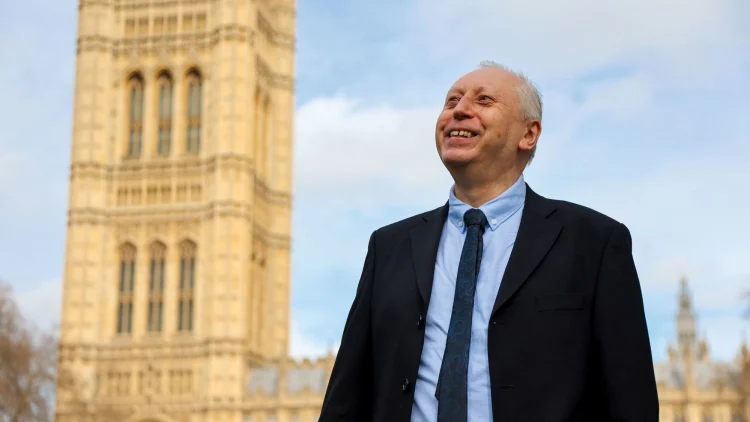
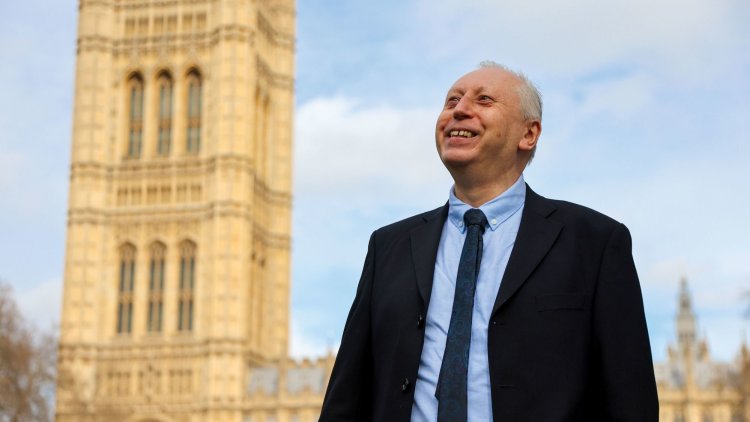
Shaun Connor (Photography by Dinendra Haria)

7 min read
The Printed Paper Office’s Shaun Connor is retiring after an extraordinary 48 years of service to Parliament. He tells Noah Vickers about his varied career and the ‘privilege’ of working in Westminster
Shaun Connor was just 18 when he landed his first job in the Palace of Westminster in January 1978, but his first day started with disappointment.
Born and raised on the Churchill Gardens estate in nearby Pimlico, Connor had never visited Parliament before. He had been hired only a few days previously, having spotted an advert in the labour exchange on Chadwick Street.
“They used to have cards with the vacancies on them,” he says. “I saw this card and all it said on it was ‘Clerical officer required in local SW1 area’.”
What he hadn’t been told was what exactly this work would involve. On his first day, his line manager explained he’d be working in the Records Office, spread across 12 floors in the Victoria Tower.
“I said to him, naively: ‘Records! I love records. I spend all my money buying records.’ He looked at me and said: ‘Not those kinds of records.’”
Far from bursting with all his favourite albums by T.Rex, David Bowie and Roxy Music, the Records Office in fact comprises a vast archive of manuscripts and parliamentary acts stretching back over the last 500 years. But that didn’t stop Connor finding ways to amuse himself.
“I used to run up from the ground floor to the very top to see how long it would take me, every day, and see if I could do a personal best. I couldn’t do one flight of stairs now, never mind all of them.”
That job would mark the start of almost half a century of service to Parliament. Connor, now aged 66, will retire at Easter after 48 years in five different roles.
Parliament, he says, had a different air about it in the 1970s: “In some ways, it was kind of a stuffier atmosphere, but at the same time, strangely enough, it was quite close-knit.
“Back then, the workforce was much smaller than it is now, and virtually everyone knew each other. Remember, there was no Portcullis House, there was no Millbank, it was just the main building.”
Within a couple of years, Connor had moved into a new role in Parliament’s sound archive – a post that seemed more attuned to the career he’d imagined as a boy.
“When I was at school, the thing I wanted to do was get into the music business,” he says. “I wanted to work in a recording studio, to be a sound engineer.”
It was only in 1978 that sound recording began in the Commons and Lords. Cameras in both Chambers were still another 11 years away but, for the first time, MPs’ and peers’ debates reached voters’ ears across the land.
Connor’s job involved retrieving audio excerpts from Parliament for the BBC and other news organisations, but also – for a charge of 50p – creating tapes for parliamentarians who wanted personal copies of their speeches. Among the most regular customers he remembers from that time were Tony Benn, never without his trademark pipe, and Lord Trefgarne, a minister in Margaret Thatcher’s government who is now the longest-serving peer.
This role was followed by jobs in the House of Lords Library and then in the Committee Office, before finally arriving in 2005 at the Printed Paper Office (PPO), where he has worked ever since.
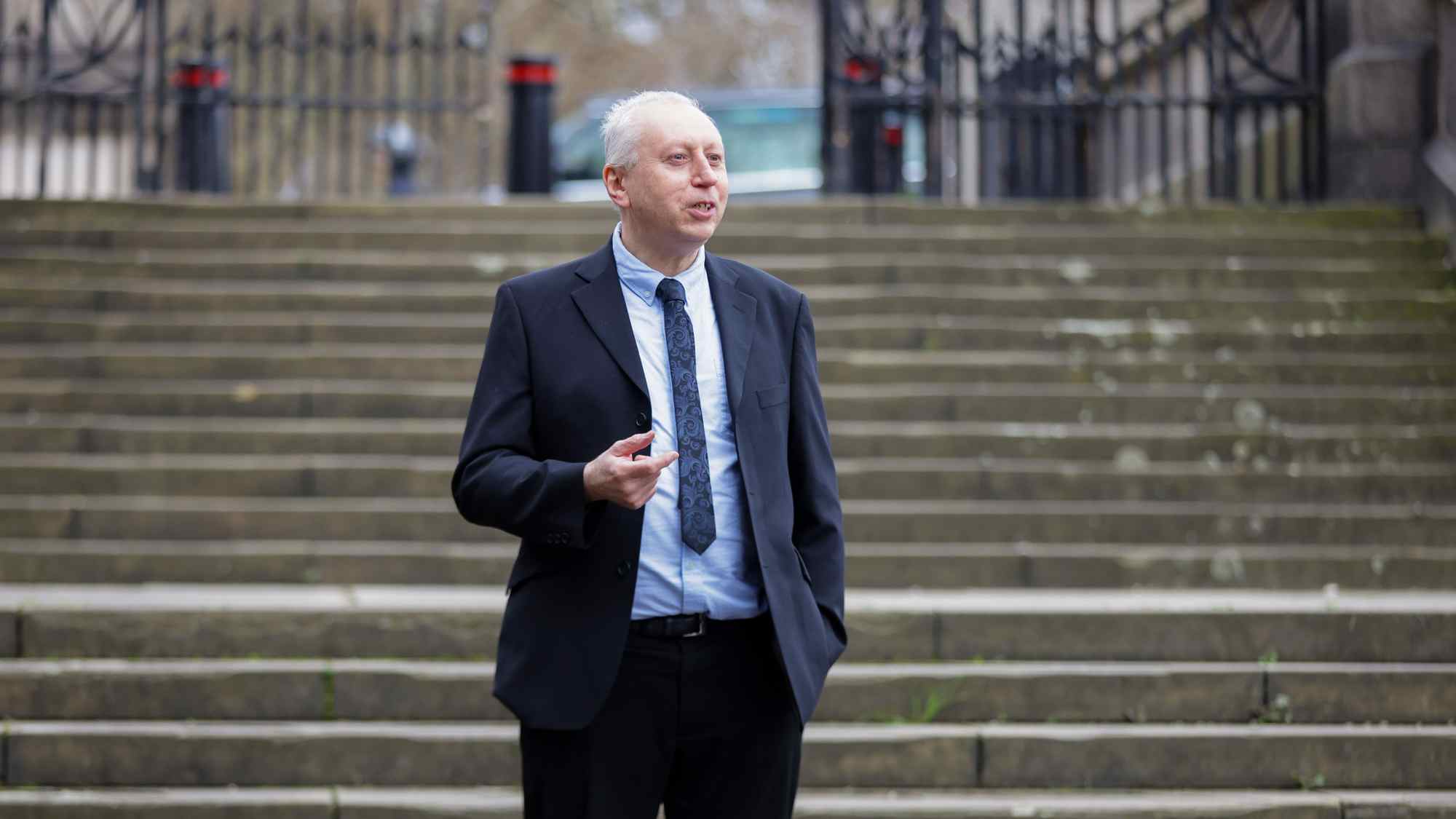
The PPO is responsible for providing peers with documents, reports and copies of legislation, with its front desk serving as an information point about the day’s proceedings.
“I’d never had a front-facing job before, I’d always been behind the scenes,” says Connor. “It was a bit daunting because when you’re at the front desk, people come and ask you things and you’re expected to know the answers to them all.
“Even if you don’t, you’re expected to know things, because you’re representing not just the office, but the House of Lords.”
His nerves were soon settled, however, and he enjoyed getting to know peers – including Lord Sugar. The businessman and former Spurs chairman mentions Connor fondly in one of his books as someone he liked bantering with about football.
“He would never pick up anything, no material,” says Connor, a Chelsea fan. “He would just put his head round the door and say, ‘I see your lot were lucky again on Saturday.’”
If Sugar did come in, it would usually be to ask for a pen – and in return he later gifted Connor a pen of his own. Pressing a button on it played a recording of The Apprentice star saying: “You may be hired, or you may be fired – and you’re probably fired.”
Over his 48 years in Westminster, Connor has seen major changes to how Parliament works, including the arrival of the estate’s first computers in the 1980s. He recalls his older colleagues advising him at the time: “Don’t touch it. It’s a white elephant. It’s one of these here today, gone tomorrow, new toys.”
Connor has also borne witness to political history, from the 1979 vote of no confidence in James Callaghan’s government – which was decided by a single vote – through to the 2017 terror attack, where he was briefly held at gunpoint by a police officer.
“We were in lockdown – you weren’t allowed out of your office, and all of a sudden, there were swarms of armed police around,” he remembers.
Connor’s colleagues called him to say they’d been taken by police to a safe location, and that officers would probably come and take him there too. He decided to attempt a quick trip to the loo first.
“I went downstairs where our toilets are, and as I got out of the lift, I was walking down the corridor, and I heard a voice saying: ‘Identify yourself! Put your hands in the air.’ There was this guy and he was pointing his gun at me.
“I said to him: ‘I work here, I’m going to use the toilet.’ He said: ‘I’d rather you didn’t.’ I replied: ‘I’d rather I did!’” The officer relented and waited outside before escorting him to safety.
I feel proud and privileged to have been a part of this place
As Connor has aged, so has the Palace, with fires, leaks and falling stonemasonry becoming more regular occurrences. Having spent so much time in it, he feels strongly about the need to preserve the building and its heritage: “You’ve got to keep this building, because it’s so iconic. To me, it doesn’t matter how much it’s going to cost – you’ve just got to keep it.”
He is clearly devoted to Parliament and tells The House he expects his last day to be an emotional one.
“Every time I see it on the telly, and they’re talking about the Houses of Parliament… I feel proud and privileged to have been a part of this place,” he says.
“Especially where I am in the PPO, I feel as if I make a difference when I come into work. I’m not just coming into work for work’s sake. I actually feel as if I contribute and as if I’ve played a part in the day-to-day process of how Parliament works.
“That’s the kind of thing I’ll miss – being in day-to-day contact with people and actually feeling part of something.”
In retirement, Connor plans to pursue his interest in photography with his partner Julie, whom he met in Parliament. He also hopes to work the odd shift in his local independent record store, an “Aladdin’s cave” of a place with “loads of old records that need sorting out”.
While the Victoria Tower may not have entirely lived up to his imagination as a music-obsessed 18-year-old, Connor appears now to have found somewhere that will.
Politics
Our Survey: Big support for Badenoch’s position at the start of the Iran war and for increased defence spending
The Prime Minister has consistently characterised Kemi Badenoch’s position that the UK should have allowed the US use of our military bases when requested for their strikes on Iran – especially Akrotiri, in Cyprus, Diego Garcia in the Chagos Islands (still British, just) and Fareford, in the UK – as “wanting a war”.
Phrases such as gung-ho, and warmongering have been levelled at the Conservatives, and indeed Reform. It seems patently obvious that Keir Starmer has decided to tack towards holding on to any Muslim voters he’s not yet shed to the Greens and capitalise on the general unpopularity of President Trump in the UK.
However our most recent survey, taken exactly a month before US and Israeli strikes on Iran shows huge support for Badenoch’s statement that she would have granted use of UK bases to the American when requested from the start of operations.
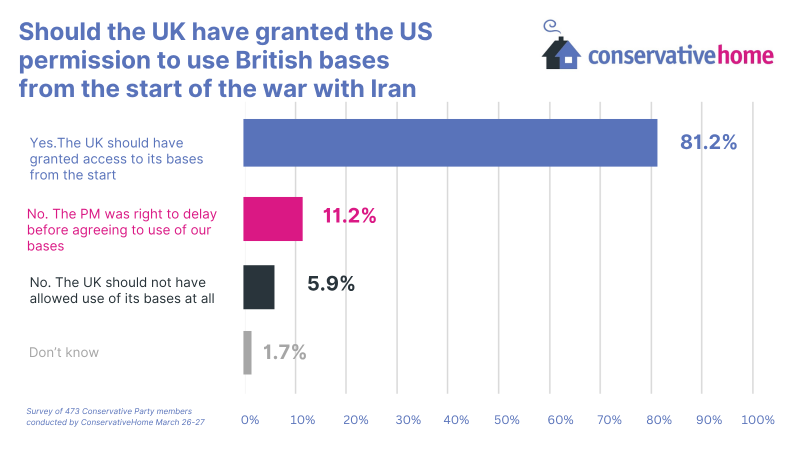 81.2 per cent of responders were clear, the UK should have granted American allies use of the bases. Argument will rage as to whether that counts as ‘participation’ or ‘not involved’ as suits whoever is making it, but the PM’s granting of such bases a day later for ‘defensive operations only’ and his insistence that this is not the UK’s war did not stop the Iranian regime firing on Akrotiri, a base in Iraq or attempted two drone strikes on Diego Garcia. It seems we are considered ‘belligerents’ by the regime whether we like it or not. We should not ignore the 11.2 per cent who agreed with the PM’s position but in context of the support for Badenoch’s it’s small.
Perhaps more tricky for the Conservatives defending the line that all Badenoch was saying was she’d have have granted use of our bases from the ‘get go’ is the significant backing members give to the strikes themselves.
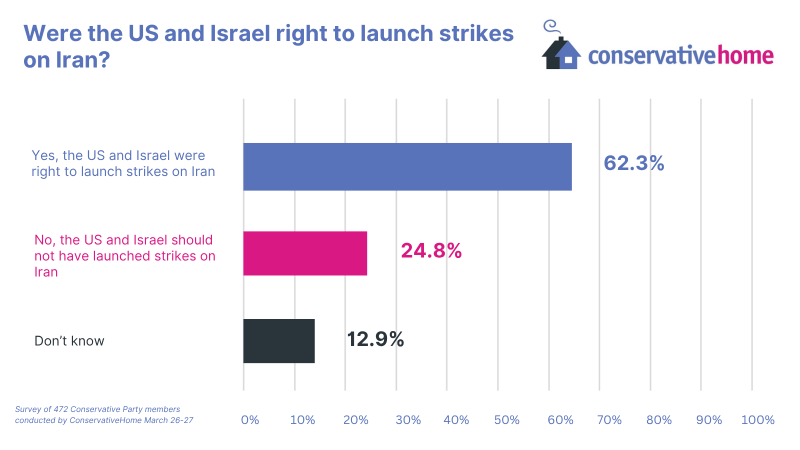
62.3 percent say they back the airstrikes on Iran conducted by the US and Israel even a month after the war started and the ripples financially were already being discussed and felt in fuel prices and the costs of living. There’s still almost a quarter of responders who think the strikes were the wrong choice and that number may grow over time depending on outcomes. We will check this again in the future.
The question only tackles the motivation for the strikes being right, not whether the plan will work or if the war will achieve any stated aim, or continue for far longer than the White House had hoped.
However in terms of the UK’s domestic reaction to the war it has prompted an overwhelming response to the question of whether Britain is spending enough on defence and fast enough, given the questions both the Shadow Defence Secretary, James Cartlidge and ConservativeHome’s Tali Fraser have been asking, on this site, about where the Labour Government are with plans for defence spending.
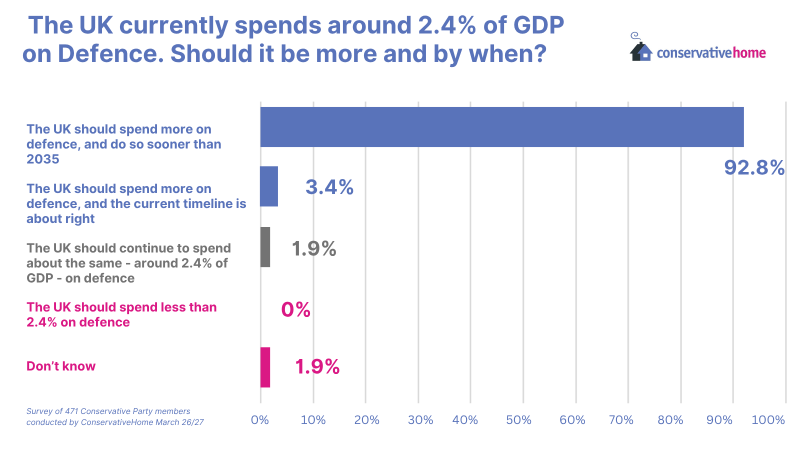
92.8 percent of Conservative members who responded think not only should the Uk spend more on defence but it should do so sooner than the Government’s timeline. Nobody at all thought we should spend less than 2.4 percent of GDP and all other options amounted to just 7.2 per cent of responses.
The news is still focussed on what President Trump does next in Iran, but increasingly also on the effects globally of this conflict. One suspects that those number supporting the initial intent to strike Iran might be porous over time, but the defence spending response will only solidify as the geo-political situation around the world remains febrile, and great powers exercise their might with greater freedom.

Last summer, protests erupted in towns across Britain against the asylum hotels that had recently sprung up in these communities. This was seized on as proof that an incipient ‘far right’ was on the march, and that the public had been whipped into a frenzy against innocent, vulnerable refugees. But the grim case of Ahmad Mulakhil is merely the latest to have vindicated the protesters.
Last week, Mulakhil, a 23-year-old Afghan national, was sentenced to 15 years in prison for raping a 12-year-old girl in Nuneaton. He committed the offence in July, not long after arriving in Britain on a small boat, and while living in taxpayer-funded accommodation in the small Warwickshire town.
Everything that’s wrong with Britain’s immigration system seems to be encapsulated in this case. There is no evidence that Mulakhil had a legitimate case for claiming asylum. Nor was there any good reason why this young man should have been living courtesy of the taxpayer. Perhaps most egregious were the British state’s efforts to cover up the crime and gaslight the public.
Local residents were understandably furious when news of the rape emerged last summer. It sparked protests that mirrored those in Epping, Essex, a few weeks earlier, over reports that a newly arrived illegal migrant had sexually assaulted a teenager. Alarmed by the public’s anger, Warwickshire Police and the local council contrived to bury Mulakhil’s nationality and immigration status. As the Daily Mail reported at the time, police told councillors not to reveal anything about the offender’s background lest this knowledge ‘inflame community tensions’. In other words, it was felt that the public could not be trusted with the facts.
The facts, as we now know, were nothing short of shocking. Mulakhil identified his victim while she was playing on a swing at a local playground. Later that evening, he lured her to the cul-de-sac where he raped her. He also filmed the attack. Police tracked him down with the help of CCTV footage from a nearby corner shop where, immediately after the attack, he bought some drinks using a debit card provided to him by the Home Office. The victim was found alone, mumbling to herself, a short distance from where she was assaulted.
Cases like this are becoming disturbingly common. Hadush Kebatu, an illegal immigrant from Ethiopia, had been in the UK for less than a week before he sexually assaulted a 14-year-old girl and an adult woman in early July last year. Kebatu too had been living in a migrant hotel – Epping’s Bell Hotel – while he carried out the assault. After he was convicted of sexual assault in October, he was paid £500 by the British state to return to Africa, a deportation that was made more difficult after prison officers mistakenly released him. He was eventually found in Finsbury Park in north London. The incompetence of the British state would almost be comical were its consequences not so catastrophic.
Similarly, two Afghan teenagers were recently convicted of raping a 15-year-old girl in a park in Leamington Spa, also in Warwickshire. In January, a Turkish asylum seeker was jailed for raping an 18-year-old teenager in Tamworth, Staffordshire. In all of these cases, children and young women are the main victims of Britain’s failure to protect its borders.
It is common sense that men from countries that disregard women’s rights – or, in the case of Afghanistan, view them as little better than property – will pose an increased threat to the communities where they are sent to live. It is also a perfectly normal human instinct to feel uncomfortable with the fact that a local hotel, or a house on your street, has been repurposed as accommodation for illegal migrants.
This is why protests erupted last summer – not just in Epping and Nuneaton, but across the UK, too. It wasn’t just that people felt threatened – as the evidence shows, they were overwhelmingly right to. It was also that all of this had been done over their heads. There was never any manifesto pledge or vote in parliament giving consent to spending £5.5million per day to house illegal immigrants, possibly in a pub or hotel on your street. Instead, communities have been told to put up and shut up. And when they have refused to stay quiet, they have been smeared with accusations of racism.
Ahmad Mulakhil will rightly spend a long time in prison for his crimes, but he should never have been in a position to commit them in the first place. Instead of being prevented from entering the UK illegally or punished for doing so, he was rewarded with free accommodation and Home Office pocket money. His welfare as a supposedly vulnerable refugee was continually prioritised over the safety and concerns of ordinary British citizens.
It is high time that the public got the immigration system they voted for, before more innocent people are hurt.
Hugo Timms is a staff writer at spiked.

The post ‘Out of touch, smug and overpaid’ appeared first on spiked.

!function(n){if(!window.cnx){window.cnx={},window.cnx.cmd=[];var t=n.createElement(‘iframe’);t.display=’none’,t.onload=function(){var n=t.contentWindow.document,c=n.createElement(‘script’);c.src=”//cd.connatix.com/connatix.player.js”,c.setAttribute(‘async’,’1′),c.setAttribute(‘type’,’text/javascript’),n.body.appendChild(c)},n.head.appendChild(t)}}(document);(new Image()).src=”https://capi.connatix.com/tr/si?token=19654b65-409c-4b38-90db-80cbdea02cf4″;cnx.cmd.push(function(){cnx({“playerId”:”19654b65-409c-4b38-90db-80cbdea02cf4″,”mediaId”:”4dd0a824-abc7-49fa-9369-f6768ffa680b”}).render(“69cabdbee4b010178ee62a15”);});


When the U.S.-Israel war with Iran began a month ago, the tragic potential reverberations of past conflicts echoed quickly for Virginia state Del. Dan Helmer, who deployed to Iraq and Afghanistan and is now running for Congress as a Democrat.
“In 2002, a president lied to the American people and sent my friends to die in a war of choice,” he told POLITICO in an interview, noting that next month marks the 22nd anniversary of his first friend’s death in combat. “And once again, President [Donald] Trump has circumvented the democratic process to launch a war of choice without strategic insight in Iran. … The consequences of reckless military intervention are pretty clear. And the challenges in enacting regime change to get a predictable outcome have defined my experience in the military.”
Michael Bouchard sees things differently. The Michigan Republican House candidate and Bronze Star recipient served in the Army and National Guard, including a counter-ISIS deployment in Iraq for most of 2025 — which encompassed the last Israel-Iran war. Bouchard thinks the current conflict is a necessary, limited mission against a regional menace that has endangered and targeted U.S. service members for decades.
“I’ve seen peace through strength save my friends’ lives, and that’s what this is,” he said. “No one wants to go to war less than somebody who’s been to it. But we can’t just put our heads in the sand and hope things don’t happen.”
Dozens of military veterans running for Congress across the country, both Democrats and Republicans, have now adapted their campaign messaging to befit a nation at war. In a rapidly changing landscape — with ceasefire talks, military escalation and global energy crisis all on the table on any given day — candidates from each party have starkly opposed perspectives on the conflict. But for many of them, the costs and the imperatives of war feel deeply personal.
New York Assemblymember Robert Smullen, who spent 24 years in the Marine Corps and is campaigning in an Upstate GOP House primary, has done multiple Strait of Hormuz transits and studied the enrichment process as a White House fellow at the Energy Department. Montana Democrat Matt Rains, who flew Black Hawks in South Korea and Iraq, is also a rancher watching crucial diesel costs rise. Zach Dembo, a former Navy JAG officer running as a Democrat in Kentucky, has been on two of the aircraft carriers now deployed to the Middle East.
All of that intimate knowledge leads them to some pretty different conclusions.
What they agree on: More than half a dozen Democratic and Republican veteran candidates who spoke with POLITICO said they oppose the autocratic Iranian government and wouldn’t be sorry to see it go.
Beyond that — and respect for the troops — there’s little consensus across the partisan divide.
Democrats are fuming that Trump didn’t make the case for war and get buy-in from the American public, Congress and foreign allies. They argue that the U.S. approach has lacked clear plans and strategic goals. And they deeply fear that what they see as Trump’s recklessness will lead to another forever war, needlessly sacrificing soldiers’ lives without achieving any big-picture goals.
“I don’t see an endgame here, and it makes me really worried,” Dembo said.
“This idea that you can just briefly drop bombs on a nation … and they’ll just like raise the white flag and beg for us to come put a new government in there, I mean, is asinine,” Rains said.
Many Democrats also see the war as a costly distraction from Americans’ economic struggles. “The amount of money we are spending on this war and on this conflict right now, when we have so many issues here at home that are not being addressed … that’s where the real disconnect is,” said Jessica Killin, an Army veteran running in Colorado.
GOP veterans say they oppose endless wars, too. But that’s not how they see this one. Hewing closely to Trump’s messaging, Republicans told POLITICO that Iran has been the real belligerent for 47 years. They agree with their Democratic counterparts that the U.S. needs to have a clear plan and not let the conflict drag out for too long — but they have much greater trust in Trump to achieve those goals, principally stopping Iran from getting a nuclear weapon.
“I understand veterans’ issues. I understand the cost of what they’ve given, their families have given,” said Oregon Republican Monique DeSpain, an Air Force veteran and JAG who’s worked with veterans for 30 years. “That’s why I feel strongly [about] swift removal of any threats to our country … Congress needs to understand national security: The cost of delay and inaction is irreversible.”
It remains to be seen how voters during wartime will receive these and other veterans running for Congress, many of them in crowded primaries or swing districts. Those who spoke with POLITICO said they think they’re uniquely positioned to speak with authority: Democrats pitching their national security expertise to lay bare the war’s flaws, and Republicans reassuring skittish voters about why the U.S. strikes can succeed and bolster American security.
“I’ve been in their shoes, and I actually know what they’re doing and what they’re facing, because I dealt with the same thing after September 11th,” Smullen said of the troops currently being deployed. “It’s a mission that needs to be done. It’s about time that we did it.”
Like this content? Consider signing up for POLITICO’s Playbook PM newsletter.

!function(n){if(!window.cnx){window.cnx={},window.cnx.cmd=[];var t=n.createElement(‘iframe’);t.display=’none’,t.onload=function(){var n=t.contentWindow.document,c=n.createElement(‘script’);c.src=”//cd.connatix.com/connatix.player.js”,c.setAttribute(‘async’,’1′),c.setAttribute(‘type’,’text/javascript’),n.body.appendChild(c)},n.head.appendChild(t)}}(document);(new Image()).src=”https://capi.connatix.com/tr/si?token=19654b65-409c-4b38-90db-80cbdea02cf4″;cnx.cmd.push(function(){cnx({“playerId”:”19654b65-409c-4b38-90db-80cbdea02cf4″,”mediaId”:”ae5e3498-9f4e-49ef-aa65-45d558f88a88″}).render(“69cabdbde4b09eec10e10fbc”);});
It’s obvious why London has the highest level of child poverty in the UK. Newly published data has revealed that it is one of the most economically unequal places in the country.
London poverty
Poverty levels are high in the capital, with a reported 38% of children living in relative poverty compared to 27% in the rest of the UK.
Across the North West and the Midlands, 32% of children live in poverty. In the North East the figure is closer to 30%, while in the South East it is the lowest at 21%.
Following immense pressure, only now is Labour doing something about this. Still, they appear to be reversing a Conservative policy—that’s the two child benefit cap which exacerbated child poverty levels.
Low-income families starting from 6 April will be entitled to equal universal credit payments for each of their children living in the household.
After suspending seven Labour MPs who voted against the cap, prime minister Keir Starmer is making another U-turn—in part spurred by the rise of the Greens. It seems that, for Labour, punishing children for being born is more of an electoral issue than an ethical one. The policy change makes further sense, given that the childbearing rate is just 1.4 rather than the 2.1 needed to replace the population.
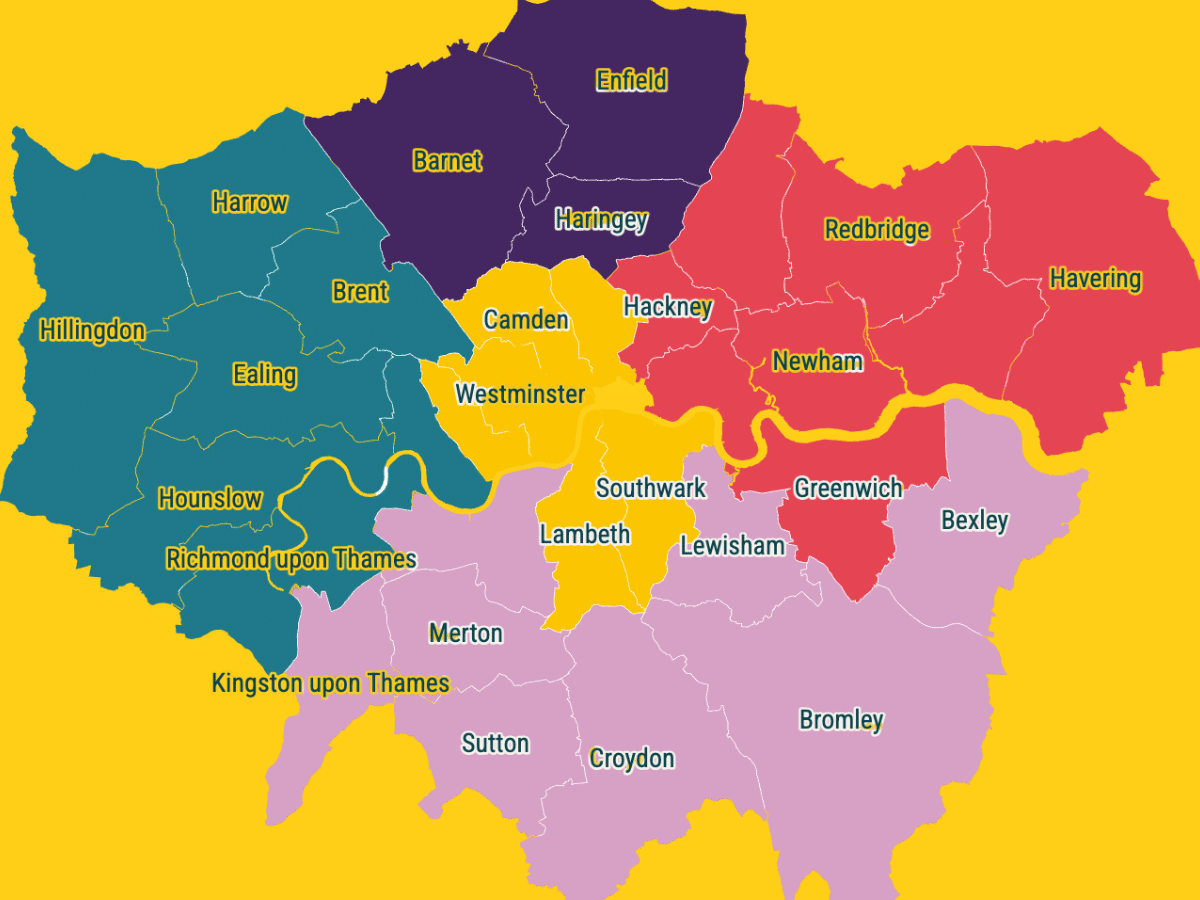
In two London boroughs—Tower Hamlets and Hackney—more than half of the children live in poverty.
London inequality
The capital also has the highest level of economic inequality in the country. Money equates to resources and expertise, which are finite in some instances. It’s worth noting that the current system also upholds artificial scarcity in the instances where the service or product is not finite. These elites restrict access to resources and expertise in a similar manner to JSTOR’s academic gatekeeping.
In London, the richest 10% receive 11 times more income than the less well-off 90%. And that’s before considering higher wealth inequality.
Speaking to South West Londoner, Kelly Hobbs, 50, a single mother in Sutton said:
I’ve had to look into my finances and do huge cutbacks just to be able to afford to live.
When it comes to finite resources and expertise, people can only be rich if others are not well off. That’s why it’s obvious that London, while harbouring more of the less well off, is also the most economically unequal place. It doesn’t mean everything needs to be completely economically equal, just that working for a living if possible should guarantee you a moderately high standard of living.
With the possibilities of artificial intelligence (AI), the UK can increasingly remove the need for labour, through automated services where enjoyable work, creativity, and leisure time take its place. Until then, we need to address the rising levels of economic inequality in the country.
Featured image via Trust for London

A football fan has died inside Mexico City’s Estadio Banorte — a World Cup venue — after falling from a VIP seating area shortly before the start of the friendly match between Mexico and Portugal.
The tragic incident happened on Saturday evening at the extensively renovated Estadio Banorte, also known as the Azteca Stadium, on the same day as the deadline to declare its readiness for the World Cup.
The tragedy has casts a shadow over the stadium’s reopening and raises questions about safety as the countdown begins to highly anticipated global sports event.
Authorities in Mexico said the man was intoxicated and attempted to jump from the second tier of the stands to the first tier by climbing the stadium’s external structure, before losing his balance and falling to the ground, Reuters reported. Sadly, he died at the scene.
In a statement on X, the Mexico City Attorney General’s Office, said:
According to initial reports, the incident took place in the suite area of the venue, from where the person fell to the parking area, resulting in their death.
The Mexico City Prosecutor’s Office will continue the investigations thoroughly and will keep the public informed as relevant developments are obtained.
The incident comes as the stadium prepares to host the World Cup opening ceremony on 11 June when it will make history as the first stadium to host matches in three different editions of the World Cup.
Featured image via Estadio Banorte
The most striking thing in those leaked WhatsApp messages from the Greens for Palestine group was the activists’ searing irritation at having to say ‘Zionists’ rather than ‘Jews’. I’m sick of it, said one. The monsters who laid waste to Gaza ‘were Jews’, the activist said. ‘They were Jewish supremacists’, that lowest, most vile category of human being, which loves to ‘murder, bomb and starve children’. We have been ‘scared into using the word Zionists because of the fear of being labelled anti-Semites’, said these digital lowlifes.
It gets worse. Not only were these Green Party activists hell-bent on truthfully naming the object of their bilious hatred – Jews – they also wanted to preach to the world what a demonic people these Jews are. These supremacists, these slayers of innocents, are ‘an abomination to this planet’, said one.
The 1930s card is played way too often these days. But I honestly cannot recall the last time such Nazi-level bile was uncovered in a mainstream political party in the UK. Greens for Palestine is a faction in the Green Party of England and Wales, which is led by Zack Polanski. The party is in the ascendancy, building an electoral base from that unholiest alliance of bourgeois genderfluids and Gaza-obsessed Muslim conservatives. And now we know it has within its ranks activists who look upon the Jews as a uniquely wicked people and a pox on the planet.
They lie too, these ‘abominable’ creatures. The Green activists flirted with the idea, rife in the digital sewers of Israelophobia, that the burning of the four Hatzola ambulances in Golders Green in London last week might have been a ‘false flag’. That is, the Jews did it to themselves for moral advantage. A Green candidate in the upcoming local elections in England said there is no doubt the attack was an ‘inside job’.
Tellingly, the WhatsApping activists warned each other to watch their words. Our enemies will try to ‘bait us into making statements emotionally’ so that they can ‘say that we are a bunch of unpleasant, vengeful anti-Semites’, one said. ‘Don’t take the bait!’ Can we speak plainly? If you need to remind yourself not to have an ‘emotional’ outburst that might come across as anti-Semitic, then you might well be anti-Semitic. I’m old enough to remember when being anti-racist meant challenging racism, not keeping a lid on your own racism so that no one will find out what a piece of shit you are.
Of course, that’s not how these activists see it. Remember, said one, ‘our cause is a righteous one – we are the good guys’. You know what? Every hater of Jews in history thought this. From the medieval mobs that hunted Jews for ‘killing Christian children’ to the fascists who exterminated Jews for being a typhus-like threat to the Aryan race to the frothing Israelophobes who devote themselves to the destruction of the abominable homeland of this abominable people – all thought they were serving a great, high cause. A burning, untameable, wholly misplaced sense of righteousness lies at the rotten heart of every anti-Semitic crusade.
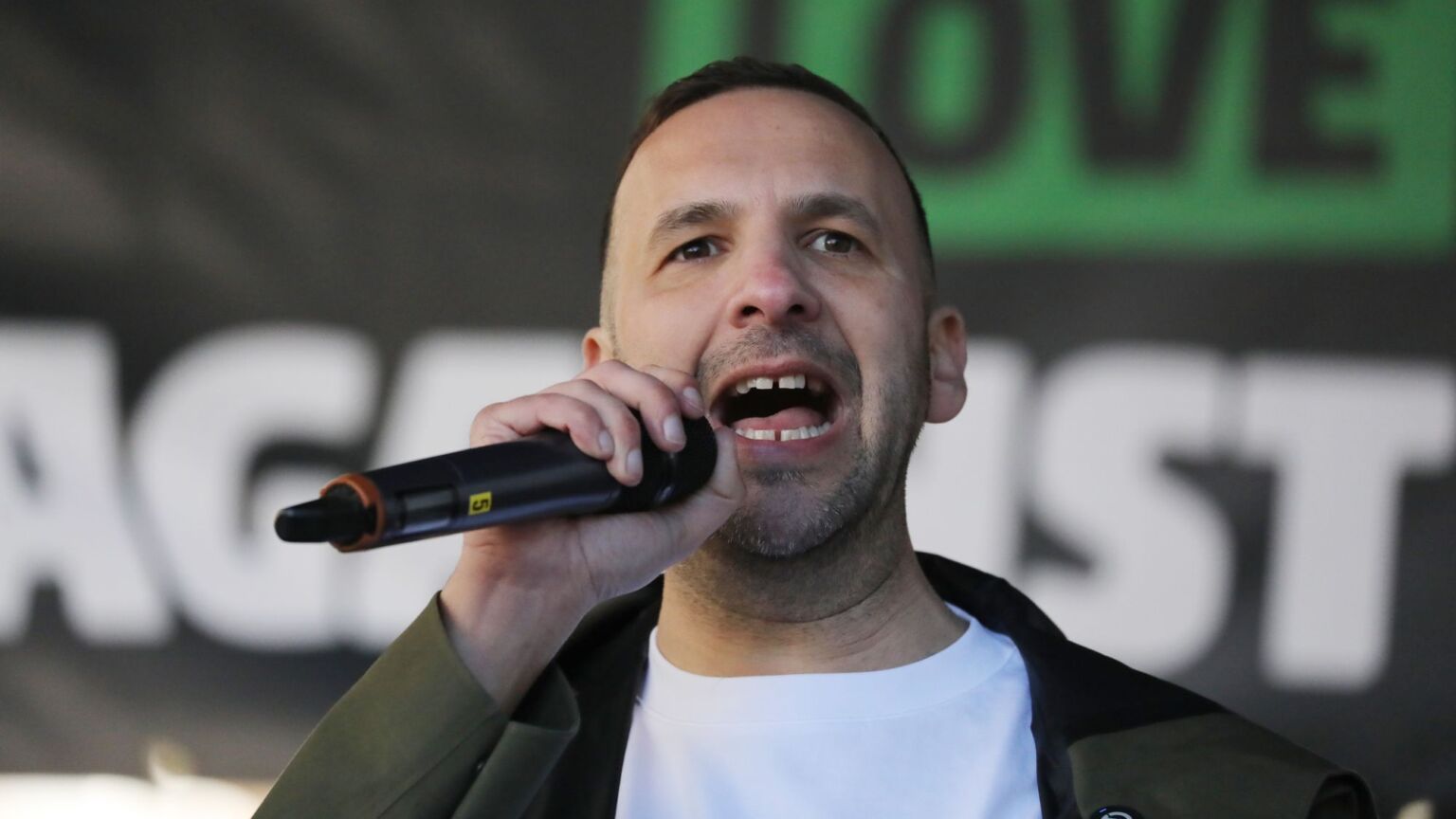
As rancid as that digital chat was, the Green Party’s response to it was worse. Where was Zack Polanski in the hours after this story broke in the Telegraph? Dad-dancing on the stage in Trafalgar Square at that orgy of bourgeois smugness, the Together Alliance’s ‘march against the far right’. The future satirists of our political moment will be so spoilt for content. They will scarcely believe that a party leader gyrated with BDSM fellas to prove his hatred of ‘the fash’ and yet had not a word to say about the fascist-style banter in his own ranks.
Actually, it was even worse than that. Over the weekend, Polanski aimed his ire not at those Green activists spouting Jew hate on WhatsApp but at a Jewish journalist who had the temerity to interview members of his family about the Green Party’s possible adoption of a ‘Zionism is racism’ policy. Polanski himself is Jewish and the fine journalist Nicole Lampert found that some of his relatives think he is taking the Greens in a very dark direction. They said it would be devastating for Britain’s Jews if the Greens decreed that ‘Zionism is racism’ – a policy they didn’t get around to discussing in the end at their party conference this weekend. Polanski accused Lampert of ‘parasitic behaviour’ – oof – and she swiftly found herself on the receiving end of a shitshow of hate from all those ‘good guys’.
So, a recap. Green activists referred to Jews as an ‘abomination to this planet’. The Green Party is considering adopting a policy singling out Jewish nationalism as racist. Polanski called a Jewish journalist ‘parasitic’. And, going back further, the Greens’ deputy leader, Mothin Ali, made excuses for the anti-Semitic barbarism of 7 October 2023, as did other Greens. Can we say it now – that the Green Party has a very serious problem with that most ancient of bigotries?
The Israelophobic left loves to say: ‘But Polanski is a Jew! How can you say the Greens have a problem with Jews?’ Here I will merely cite the words of Ms Lampert, who has been fighting the Jews’ corner in British journalism for many years. Polanski uses his Jewish heritage, she wrote in the Telegraph, to ‘kosherise the rampant Jew hatred in the Greens’. It’s a devastating line, and one it is increasingly hard to disagree with: that Polanski’s historic role is to provide the middle-class adherents to the new Socialism of Fools with a get-out-of-jail card. They point to his Jewishness as proof of their righteousness even as they engage in truly hateful behaviour against that ‘abominable’ people.
‘We’re not anti-Semitic, we’re anti-Zionist’, they’ll say. The irritation of Greens for Palestine at having to say Zionist rather than Jew surely explodes that crap once and for all. But more to the point, what do people mean when they say they’re anti-Zionist, not anti-Semitic? All I hear is: ‘I don’t hate Jews, I just want to deprive them of a right enjoyed by every other people and bring about the destruction of their homeland so that they will once again be scattered across the Earth.’
I’m sick of pussyfooting around this: if you dream of the Jewish nation’s destruction, and chant for the death of Jewish soldiers, and demonise Jewish nationalism as uniquely barbarous, then you have a problem with Jews. It might take 10 years, maybe 30, perhaps longer, but I am confident we will one day look back at the people who said, ‘I’m an anti-Zionist’, in the same way we look at those who said, ‘Round up the Jews’.
Brendan O’Neill is spiked’s chief political writer and host of the spiked podcast, The Brendan O’Neill Show. Subscribe to the podcast here. His latest book – After the Pogrom: 7 October, Israel and the Crisis of Civilisation – is available to order on Amazon UK and Amazon US now. And find Brendan on Instagram: @burntoakboy.

Matrix Composites shares up 50pc on new takeover bid

DeFi in a Post-Quantum World: Are We Ready?

Damien And Biannca Prince Reveal Baby Girl’s Name & First Pics


![Tom Lee & Raoul Pal: "A CRASH Is Coming, Then Bitcoin Explodes To $250K" [2026 Prediction]](https://wordupnews.com/wp-content/uploads/2026/03/1774925538_hqdefault-80x80.jpg)
-
 NewsBeat6 days ago
Manchester United reach agreement with Casemiro over contract clause amid transfer speculation
-

 News Videos5 days ago
Parliament publishes latest register of MPs’ financial interests
-

 NewsBeat4 days ago
The Story hosts event on Durham’s historic registers
-
 Tech5 days ago
Intercom’s new post-trained Fin Apex 1.0 beats GPT-5.4 and Claude Sonnet 4.6 at customer service resolutions
-

 Business5 days ago
Instagram, YouTube Found Responsible for Teen’s Mental Health Struggle in Historic Ruling
-
 NewsBeat6 days ago
Tesco is selling new Cadbury Dairy Milk bar and people can’t wait to try it
-

 Fashion7 days ago
Does It Matter What You Wear When You’re Laid Off and Looking?
-
 Entertainment2 days ago
Lana Del Rey Celebrates Her Husband’s 51st Birthday In New Post
-

 NewsBeat7 days ago
Entrepreneurs Forum survey reveals optimism in North East
-

 Business7 days ago
More women enter wealth management, but few in advisory roles: study
-

 Crypto World7 days ago
BTC gives up $70,000 level as markets mull higher interest rates
-

 Sports6 days ago
Fantasy Baseball Week 1 Preview: Top sleeper hitters for both five- and 12-day period led by Munetaka Murakami
-

 Tech6 days ago
Embedding compliance in AI adoption
-

 Tech6 days ago
US FCC Prohibits Approval Of New Foreign-Made Consumer Routers
-

 Fashion7 days ago
Coffee Break: Korean Skincare Set
-
Sports6 days ago
One Team in Particular Is Monitoring Kirk Cousins
-

 Sports3 days ago
Sweet Sixteen Game Thread: Tide vs Michigan
-

 Fashion7 days ago
Althea Mink: Patrice Taylor’s Atlanta Couture Brand Built on Legacy, Resilience, and Architectural Glamour
-
 Fashion6 days ago
How to Style Spring Like WeWoreWhat: Easy Outfit Ideas for 2026
-
Entertainment18 hours ago
Fans slam 'heartbreaking' Barbie Dream Fest convention debacle with 'cardboard cutout' experience
You must be logged in to post a comment Login