Politics
The House Article | How Thousands Of Ukrainian Children In The UK Are Growing Up In Limbo


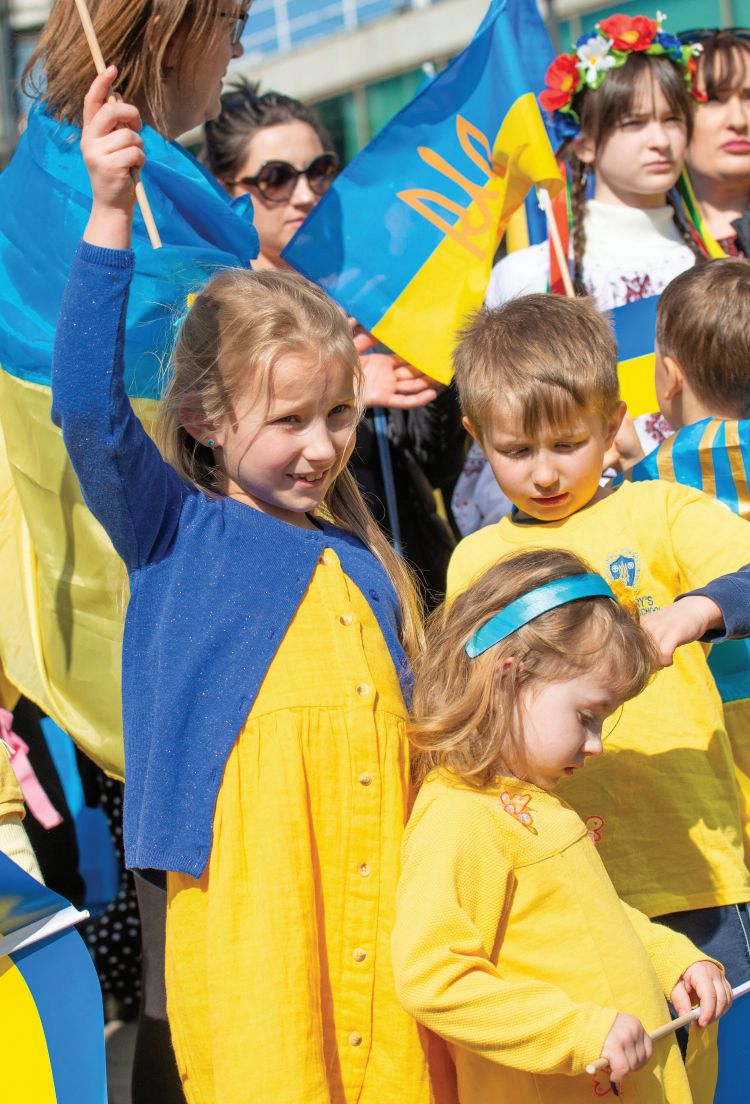
More than 60,000 Ukrainian children have now spent at least past of their education in the UK since 2022 (Alamy)


8 min read
More than 60,000 Ukrainian children have grown up in the UK since fleeing Russia’s full-scale invasion. Zoe Crowther explores how the absence of a long-term settlement plan is leaving these children and their families in limbo
When Alisa Cooper fled Kharkiv in eastern Ukraine to the UK in 2022, her son Kupriian was five years old. Kupriian is now nine and only speaks English fluently. In the four years since leaving Ukraine, Britain has become the place where he learnt to read, make friends and feel safe.
“He hated me a lot at the very beginning of reception [class], and it was really hard for him – the whole process of adaptation, of learning how to speak, how to read, to do spelling,” Cooper says.
“We struggled a lot, but four years passed, and now English is his primary language. His mindset is different from my Ukrainian peers. British values, how people communicate, politeness… All the DNA of British people comes from school, so he is more deeply into the UK culture.”
Kupriian, who has ADHD, has now finally caught up on the English school curriculum with the support of his mother and teachers. “He’s happy here. He’s settled, perfectly settled here.”
Many Ukrainian children can differentiate between an incoming missile and an outgoing missile
Yet Cooper lives with a persistent anxiety about what comes next. “At first, I planned that it would be a short stay here. But now, I’d like to stay here, and I don’t want to return back, if it’s on my own will,” she says. “How can I take him from his environment, his friends, the curriculum?”
Around 218,600 people have travelled to the UK under Ukraine visa schemes since Russia’s full-scale invasion. Around 28 per cent of arrivals were under 18, meaning that more than 60,000 Ukrainian children have now spent a significant part, and in some cases all, of their education in the UK.
Maria Romanenko, a Ukrainian activist who volunteers with displaced families in Greater Manchester, says every Ukrainian child in the UK lives with some form of trauma.
“Unless they left in the first hours of the full-scale invasion, they would have seen a Russian missile out of the window, or heard a siren or heard an explosion,” she says. “Many Ukrainian children can differentiate between an incoming missile and an outgoing missile.”
Romanenko describes how many of these children also faced bullying after talking about the war at school and trying to share experiences that their peers struggled to understand. Most families who fled to the UK also had to leave the fathers and other close male relatives behind, abruptly transforming family dynamics for thousands of children.
“The family goes from two parents to one parent overnight,” Romanenko says. “And obviously that creates various difficulties and challenges, because the mothers still have to earn some money.”
Inna Hryhorovych is headteacher of St Mary’s Ukrainian school, which is part of a trust that coordinates 15 supplementary schools across the UK and supports more than 2,000 displaced Ukrainian children. It also carries out projects in hundreds of mainstream schools, with the aim of ensuring Ukrainian children retain their Ukrainian language skills, achieve Ukrainian qualifications, and can reintegrate into Ukrainian society once the war is over.
The work of St Mary’s is particularly important for the many Ukrainian children with special educational needs and disabilities, who face barriers to accessing the support they need.
Yet St Mary’s reaches only a fraction – around 12 to 15 per cent – of those affected. “What happens to the rest and how are they going to reintegrate?” Hryhorovych asks. “The danger is that they forget their Ukrainian identity.”
After arriving in the UK, many families tried to ensure their children kept ties to Ukraine by studying in British schools by day while catching up on Ukrainian schooling online in the evening.
“That means that the kids are incredibly overloaded with information, and just study twice as much as English kids normally do,” explains Romanenko.
Many of these children have therefore since given up the Ukrainian elements of their education.

The Ukrainian government has urged the UK to introduce a new GCSE in Ukrainian in order to help solve this problem. The UK children’s commissioner and multiple MPs have joined these calls, and the UK government and exam boards said last May that it was being considered – but it has not yet materialised.
Introducing a Ukrainian GCSE, however, would be far from straightforward. Developing a new qualification typically takes several years, and questions remain over whether the subject would be viable given potentially low national take-up. Ministers would also face pressure to extend GCSE provision to other community languages not currently offered, while examiners would have to grapple with how to assess pupils when many candidates would already be fluent speakers.
The House understands the government is therefore highly unlikely to proceed with a standalone Ukrainian GCSE. However, some exam boards are understood to be exploring alternative ways to incorporate Ukrainian language and cultural learning into the existing British curriculum, aimed at supporting displaced Ukrainian children without creating a new qualification from scratch.
Visa uncertainty is also limiting life chances for Ukrainian teenagers. A University of Birmingham survey in March 2025 found that 25 per cent of respondents who applied for a student loan said it was refused because of their visa status.
Hryhorovych adds that uncertainty around the future makes it very difficult for Ukrainian children to overcome their trauma.
“The healing of trauma and integration starts with hope, and hope is born from some new aspirations and goals,” she says.
“But how can you develop that hope if your aspirations have a time tag? There is a deadline to how far you can dream, how far you can aspire to, because you might be told it’s time now to go back.”
In September 2025, the UK government announced a significant extension to the Ukraine Permission Extension, adding 24 months to the original 18-month period. For some who arrived in early 2022, that adds up to a total stay of up to six and a half years.
The healing of trauma and integration starts with hope, and hope is born from some new aspirations and goals
There is growing evidence to suggest that most Ukrainians no longer see their future in the UK as short-term. According to a survey carried out by University of Birmingham researchers in October 2025, 76 per cent of Ukrainian families with school-aged children believe it will be very difficult for their children to integrate into the Ukrainian education system if they are required to return, with a further 18 per cent believing they will have at least some difficulties.
Only five per cent of all respondents to the survey said they would want to return to Ukraine even if it became safe, citing fears of renewed Russian aggression, destroyed infrastructure and economic instability.
This highlights a potentially huge issue for both Ukraine and the UK further down the line: Kyiv’s official position is that Ukrainians who fled the war will not be forced to return home, but that the government hopes people will come back voluntarily once it is safe. The UK government has meanwhile framed its Ukraine visa schemes as a temporary humanitarian sanctuary, rather than a route to settlement, in part to reflect Ukraine’s desire for the eventual return of its citizens.
Time spent on Ukraine schemes, even for children, does not count towards the 10-year period to gain indefinite leave to remain in the UK, despite the scheme protections having been extended.
Yuliia Ismail, an immigration adviser at the charity Settled, which offers free, accredited, multilingual immigration advice for Ukrainians in the UK, says the system was never designed for this scale or duration of displacement.
“It was built as a temporary solution,” she says. “But we should remember, we do have people who don’t have anywhere to return.”
Many major Ukrainian cities, including Mariupol, Bakhmut, and parts of Kherson, Chernihiv, and Kharkiv, have been mostly destroyed.
While few believe Ukrainians would be forced out of the UK immediately after the war ends, Ismail says “there is no clear plan”.
We should remember, we do have people who don’t have anywhere to return
Dr Irina Kuznetsova, a sociologist at the University of Birmingham, argues that the UK is facing an opportunity to establish a “better practice” around planning for the futures of displaced children who have fled warzones.
“These numbers [of displaced Ukrainian children] are unprecedented,” she says. “After decades, people will be looking and thinking about how we could learn from the situation.”
A report co-authored by Kuznetsova in October 2025 recommends counting time spent on Ukraine visas towards settlement, creating a five-year route to residency, ensuring access to Ukrainian language education, and expanding mental health support for Ukrainian children and adults.
Meanwhile, Cooper continues trying to shield her son from the uncertainty. “I’m trying to prevent him from having any anxiety or uncertainty about the future. That’s my job as a parent,” she says.
Sometimes, they attend a Ukrainian social club in Notting Hill for food, conversation and connection to a country that feels ever more distant from their life in London.
“No one can actually force us to do things we’re not willing to do,” she says. “It’s a really individual decision. We are not property, we can make decisions on our own.”
For policymakers, Ukrainian children in the UK are fast becoming more than a humanitarian issue. They are a test of whether Britain’s immigration, education and integration systems can adapt to support and accommodate a generation who have been shaped by war but now see Britain as their home.

You must be logged in to post a comment Login