
Politics
The House Article | “Memorable and disturbing”: Gordon McKee reviews ‘Marty Supreme’



Timothée Chalamet as Marty Mauser | Image by: LANDMARK MEDIA / Alamy

4 min read
If you want to be entertained this winter, you could do worse than going to see the unsettling ‘Marty Supreme’
Oscar-nominated Marty Supreme is not the film I thought it was going to be.
I went in expecting a film with the gratifying arc of an athlete honing his craft, overcoming adversity and reaching the summit of his ambitions.
This assumption was reinforced by the presence of Timothée Chalamet himself. An actor who treats his profession much as you imagine Cristiano Ronaldo treats football: as a vocation demanding total commitment in pursuit of lasting greatness.
That spirit certainly animates Marty Supreme, but it feels less like a portrait of a sporting champion, and more the excoriating tale of an addict.
Marty Mauser, Chalamet’s character and the film’s namesake, is willing to do anything in pursuit of the stage. And it is a stage.

Image by: A24 / Elara Pictures / IPR.VC / Album / Alamy
What ultimately makes the film work is Chalamet’s charm
Mauser is a supremely talented table tennis player, but his drive is not the technicalities of a fast-paced sport. The film follows his escapades as he tries to fund his way to the World Championships in Tokyo. There is no training montage. He is not pursuing the title. He is pursuing the platform.

What drives the character is the performance of a championship match. The showboating; the cheers; the electricity of being watched.
As is so often the case with life’s entertainers, it is off stage that Mauser’s real character is revealed.
He is willing to lie, con and steal to get his fix.
Josh Safdie, the film’s director, forces the audience to sit with this behaviour, offering no warning and little relief. The result is frequently painful to watch.
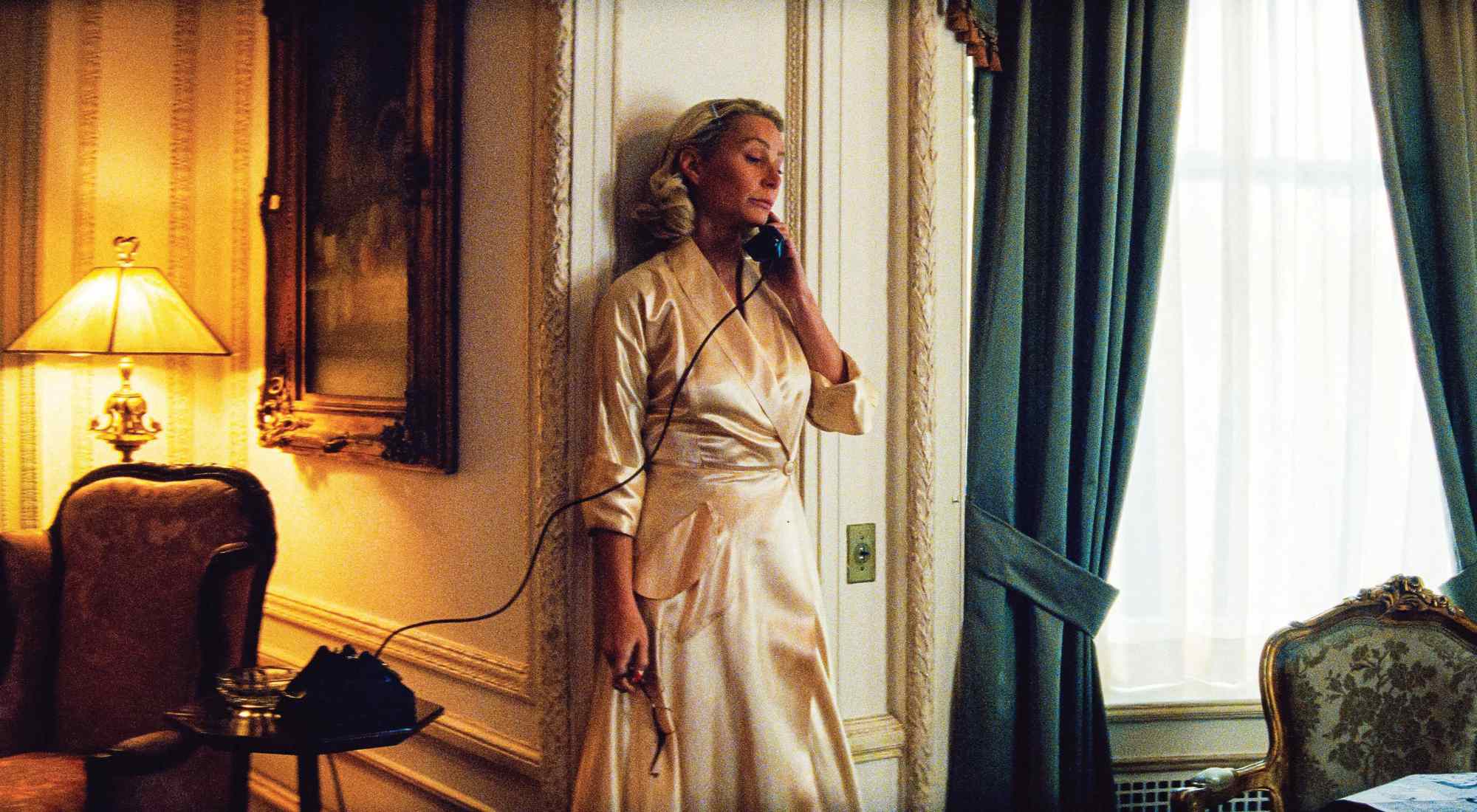
Early in the film Mauser enthusiastically encourages a fellow player to recount his experience in a Nazi concentration camp, setting up one of the film’s most memorable and disturbing scenes.
That same principle governs the dialogue. Grossly offensive jokes are fired off at the speed of a table-tennis serve and never allowed to land, the conversation moving on as relentlessly as a rally.

Image by: LANDMARK MEDIA / Alamy
Odessa A’zion delivers a brilliant performance as the pregnant mother of Mauser’s child. A victim of her circumstance, she mirrors Mauser’s talent for manipulation and self-preservation. Their relationship is less a refuge than a collision.
All of this reinforces the grittiness of its setting – you feel like you are living in the dirty, criminal and enterprising city of 1950s New York.
 In post-war America, as in Britain today, the distribution of opportunity is not equal. The film shows that inequality often isn’t loud or obvious. It’s not about cartoon villains, although there are a few here. It’s about how some people always get the benefit of the doubt, while others are expected to work twice as hard just to be taken seriously.
What ultimately makes the film work is Chalamet’s charm. Marty Mauser should not be a likeable character, and in many ways he simply isn’t. Yet he possesses the rare quality of charisma. You find yourself wanting him to succeed. He is, above all else, a born entertainer.
If you want to be entertained this winter, you could do worse than going to see the unsettling Marty Supreme.
Gordon McKee is Labour MP for Glasgow South
Marty Supreme
Directed by: Josh Safdie
Venue: General cinema release


As the US-Israel war on Iran enters its fourth week and President Donald Trump orders the deployment of thousands of additional sailors and Marines to the Middle East, the troops he is counting on appear increasingly wary of the conflict.
Interviews with active duty soldiers, reservists, and advocacy groups focused on service members found some US troops who are caught up in the war are reporting vulnerability, overwhelming stress, frustration and disillusionment to the degree they may leave the military.
The reservists and active duty soldiers spoke on condition of anonymity for fear of retaliation or because they were not authorised to speak to the press.
A military official who is treating service members evacuated from the Middle East to Landstuhl Regional Medical Centre in Germany amid Iran’s retaliation said troops are suffering from “inadequate force protection and planning” and already reporting a severe, destabilising toll from Iranian ballistic missiles and drones that have been repeatedly striking American military facilities.
Thirteen troops have been killed amid the war so far, seven due to strikes, and at least 232 have been wounded.
A ground operation would be “an absolute disaster… we don’t have a plan for that,” the official said earlier this week. “We can’t even fully defend a single land base in the theatre”
A veteran and reservist who mentors younger officers told HuffPost her contacts are expressing a loss of faith to a new degree.
“I’m hearing out of service members’ mouths the words, ’We do not want to die for Israel — we don’t want to be political pawns,” she said. Another reservist in touch with current troops separately reported hearing similar comments.
“I’ve shared conscientious objector information six times in the past two weeks and I’ve been in the military almost 20 years — I’ve never had people reach out this way,” the first reservist continued.

Illustration: Kelly Caminero/HuffPost; Photo: Getty Images
Mike Prysner, the executive director of the Centre on Conscience and War, said his group would in past years hear from between 50 and 80 troops annually. The month of March has seen a 1,000% increase, he added, saying at least one new service member now contacts the organisation daily.
On Friday, he wrote on X that his group is handling “expedited” objector applications by Army, Navy and Marines personnel who were told they will be deploying this weekend.
And Matt Howard, the co-director of the group About Face: Veterans Against The War, said his organisation has been helping more active duty troops understand their options for dissent.
“Folks have more options than they think they do. The military makes it seem like there is only one route, its through their contract and that the consequences otherwise are devastating,” Howard said. “Folks have the right to options, including conscientious objector status. My understanding is more and more folks are going that particular route. We’re definitely finding ourselves having more of those conversations than we have in a long time.”
There is no indication of a mass exodus from the United States’ 1.3 million-person military over Trump’s campaign. Sources described anger, but also a sense of resignation among many troops.
Many service members have long anticipated and prepared for a US war against Iran, with some more senior personnel seeing that as justified given the country’s role in deadly attacks on American troops, particularly after the 2003 invasion of Iraq.
But dissatisfaction and morale problems could make Trump’s campaign less likely to succeed — and hint at a lasting shift among troops that could have implications for America’s national security establishment.
The lack of a clear, consistent narrative justifying the Iran war is a key source of discontent among troops, the reservists said, demoralising those who believe a poorly planned conflict is placing them in unnecessary danger for no identifiable strategic benefit.
Iran’s retaliation has pummelled wealthy countries in the Persian Gulf that host US forces and have for decades been largely spared large-scale conflicts unlike their regional neighbours, which include Kuwait, the United Arab Emirates, Qatar, Bahrain and Saudi Arabia. Deployments to the Gulf States were, until last month, considered low-risk and, according to former Army Major Harrison Mann, almost laughable.
“It does not enter your mind that that becomes a warzone,” Mann, now at Win Without War, told HuffPost.
Since those facilities started facing fire, military commanders have struggled to address troops’ heightened sense of exposure, the service member said, noting worrying patterns among some personnel, like refusing to answer calls to go to a bunker amid attacks.
Troops now seeking to leave the area are reporting different concerns from those who sought to do so in the recent past, even as tensions were heightened in the region, the service member added: “Getting random indirect fire is not the same as watching the entire gym and coffee shop and some dorms get blown up from a door less than 50 meters away.”
Broader concerns about the U.S. strategy also appear to be affecting troops.
Most service members now exploring registration as conscientious objectors point to the February 28 strike on a school in the Iranian town of Minab as a breaking point, Prysner said.
The strike killed at least 175 people, including dozens of schoolgirls. Sources familiar with the Pentagon’s investigation of the horrifying incident have told HuffPost the US likely bears responsibility.
Additionally, concerns about military service and the Iran campaign appear to reflect shifting attitudes on the US role in the Middle East, particularly relating to Israel. Troops are mentioning reservations about participating in a US-Israeli operation based on their observation of the devastation wrought by the American-backed Israeli offensive in Gaza since 2023, and younger Americans — core to the military — have become far more skeptical of Tel Aviv. An NBC News poll this month found 63% percent of voters under 34 now view Israel negatively, compared to 37% in 2023.
Meanwhile, many veterans are publicly and privately warning that Washington appears to be on the cusp of a costly quagmire akin to the Iraq and Afghanistan wars. One reservist noted that such a portrayal can reach younger troops more easily now than when service members were deployed for those campaigns 20 years ago, given the more honest discussions of failures in those wars and the spread of social media.
Even prior to the recent tumult, the Trump administration’s broader handling of troops and the Defence Department has also fuelled alarm among military personnel.
“It’s not just Iran. Prior to this, it’s been National Guard deployments [in American cities], the possibility of being used against their own neighbours and collaborating with ICE,” Howard said. “This moment is so destabilising in the way the military is being used as essentially a plaything for the administration to further an authoritarian agenda.”
Experts on civil-military relations and the law of war have condemned those deployments as well as apparent violations of international law in ongoing US military strikes on alleged drug boats in the Caribbean and Pacific.
A reservist in regular contact with service members noted Defence Secretary Pete Hegseth’s crackdown on efforts to promote diversity in the armed forces and moves to cancel military partnerships with think tanks and universities: “I’m getting this impression he doesn’t want us to learn or get smart — he just wants us to fight.”
“We’re seeing the direction of this,” the second reservist said, noting that Trump had, despite his campaign trail of avoiding wars, now shown a willingness to act forcefully against Iran, Venezuela and potentially Cuba. “If this doesn’t align with your intent or your career goals, I would get out.”
Politics
Alexander Bowen: Why does Starmer think the ‘faithist’ place for Bishops is staying in the House of Lords?

Alexander Bowen is a trainee economist based in Belgium, specialising in public policy assessment, and a policy fellow at a British think tank.
The Hereditataries are no more – or at least in a month and a half, when this sitting closes, they will be no more. Gone with these hereditary peers then is the last of our living link with 1341 – the first Parliament to meet with the Church and the Peerage separated from the rest.
These peers had survived five religious settlements, four civil wars, one in which the other chamber disbanded it for being “useless and dangerous” and executed its de facto leader, the transition from farm to factory, however many ‘people’s budgets’, and even, unlike for example Saddam-Hussein, Tony Blair, but they could not survive Keir Starmer. After one thousand years it would be Keir Starmer who would stand up for the working man’s right to be quasi-useful in a quasi-useful body – so long as said working man had furnished him with quasi-tailored suits or quasi-effective comms advice.
I, for what it’s worth largely agree with these governing crusaders, in outcome if not in spirit, the presence of hereditary peers was indeed largely bizarre. Appeals to the ‘living embodiments of one-thousand years of history’ and tales of the Norman Conquest are pleasant enough, when the Bayeux Tapestry arrives in London I shall be one of the first in the egregiously long queue, but the legitimacy and purpose of a governing system is defined by the outcomes it delivers for the era in which it operates not by the symbols it once devised. Those outcomes are, as I think we can clearly see, in the category of ‘not good’ at best.
Where I object however to Keir’s culling is in its inconsistency. If our great modernisers are to commit to their own long march through the House of Lords, removing the 92 hereditary peers, then ought they not on their own principles – that these Lords were unrepresentive, unelected, appointed elites with little merit – turn their weapons to the Lords Spiritual? Do they really serve any greater purpose? Why then do they remain?
On any historic basis they ought to be a perfect target for a Labour government committed to symbolic scalps – fox hunters, hereditaries, private schools, farmers with excessively large landholdings. Do Bishops in their Palaces not warrant the same treatment? Was the Church of England not once said to be the Conservative Party at prayer? If for Sieyès Starmer the third estate is everything then why only dismantle the second?
It is, I think, largely because the Church of England has for its part adopted a kind of ecclesiastical Starmerism – doing much to win over those with little interest in it, and little to keep those who have been its demographic. As a shadow for Starmer’s 12 per cent approval, the Church enjoys its 2 per cent attendance.
It is an idea mostly clearly embodied in the concept of ‘Faithism’, that is the belief that faith underpins communities, and their religious practices are, if not identical, largely interchangeable with history condensed into peculiarities.
It is a vision of religion I find slightly bizarre, not least because it seems to be underpinned by assuming your own view of religion is the view of religion, but it is a position that is at least rational. That we have special privileges that we would like to keep and that we can only reasonably defend them amongst our sort if we also extend them to sufficiently docile ‘co-religionists’. It is a kind of spiritual rent seeking – collaboration, potentially sincere, but nonetheless defined by a common attempt to ward off secularism. Like all cartels however, it is not one designed to serve the public interest.
Now I would not presume to know what is in the public’s interest as far as religion is concerned, faith cannot be measured nor evidenced, that is after all the point of faith, but it is at least worth looking at what the alternative to ecclesiastical Starmerism looks like. France and Québec offer that alternative – an alternative where instead of all faiths being privileged, none are.
France for its part defines itself as a secular country and actually means it. The Jules Ferry Laws remove religion from state schools – applied to Britain it means no more lying to nuns to try and get into a better school through the religious quota and no more Trojan Horses. The 1905 Law on Separation of Church and State – apply it to Britain and it means no more religious symbols in the public place, no more religious organisations for civil servants, no more voting in Churches or campaigning in mosques, and it means religious figures being as accountable as anyone else for inciting hatred.
Keep going further to 2004’s law banning conspicuous religious symbols in schools or 2021’s separatism law letting the government supervise and shutter religious groups that attack the basic values of France. Québec for its part has Bill 21 – preventing public religious affiliation by state employees, Bill 94 – preventing public religious affiliation by anyone who interacts with schoolchildren, and now Bill 9 banning public prayer.
That latter bill may be one well worth taking note of given the most discussed subject of the last week – Nick Timothy’s call to ban the public iftar in Trafalgar Square, a position that was naturally criticised by the Church of England’s faithist leaders. Nick Timothy, whatever one thinks of his specific conclusion and whatever wants to propose as a speculative motivation, though I don’t frankly think it particularly matters, is at least asking the right question. If the public square is our collective good, can it be privatised for one faith even temporarily?
The Church of England in preserving its privileges may say yes, but the rest of us needn’t.

James Cartlidge is Shadow Defence Secretary and MP for South Suffolk.
When I shared my policy plans for Defence with Conhome’s Tali Fraser last week, I stressed that we would learn the lessons from Labour’s big mistake – that is, do our Strategic Defence Review (SDR) in opposition, instead of paralysing the MOD as it waits for yet another policy document that will supposedly have all the answers.
I cannot emphasise this point enough: on coming to power Labour made a very specific choice on Defence. In essence, they put urgent rearmament on hold in order to boil the ocean, with all decisions subject to the SDR, which then came forward last June with no actual hard procurement choices – those were punted into yet another review, the Defence Investment Plan (DIP), promised for autumn 2025 but now months overdue.
Rearmament on hold, as war grips multiple fronts – that intolerable scenario has consequences, and causes.
On consequences, at a time when there is alarm at our apparent lack of warfighting readiness, Labour are burning through the months in which they could have seized a great opportunity to truly transform our military – learning the lessons from Ukraine to deliver a potent step change in lethality, which in the summer of 2024 we were uniquely placed to orchestrate.
By April 2024 the drone capability we were supplying to Ukraine was starting to show seriously impressive results on a real battlefield, against Europe’s peer military threat. Most importantly, this was not via the ‘business as usual’ of big primes taking years to produce over-budget, overdue capability; this was happening because of British SMEs delivering cheap, rapid, constantly adjusted drone and counter-drone tech.
And in February 2024 I’d published two strategies to take advantage of this – the MOD’s first Defence Drone Strategy, committing to adopt in parallel for our own armed forces the drone tech we were supplying into Ukraine; and a new procurement model, making the pursuit of ‘Minimum Deployable Capability’ the default for acquisition – not waiting an age to achieve perfection, but getting capability into use as soon as possible, and with most development occurring after adoption by the warfighter.
If this sounds theoretical, in April 2024 HMS Diamond was attacked in the Red Sea by Iranian-supplied Houthi drones and ballistic missiles. We were seeing then the same problem so visible in the Middle East today – relying on a limited stock of expensive missiles to intercept cheap drones. Our ground-breaking anti-drone naval laser weapon DragonFire will enable our warships to intercept drones for 10p a shot, protecting precious missiles stocks, so I ordered it to be procured via this fast-track Minimum Deployable Capability route – and the in-service date was slashed from 2032 to next year.
So this really matters to the here and now. The Defence Drone Strategy promised to learn the lessons from Ukraine’s extraordinary success against the Russian fleet in the Black Sea, by delivering “maritime strike uncrewed systems” for the Royal Navy. Just imagine if Labour had stuck at it, instead of putting procurement on hold, and we now had drone arsenal barges ready for deployment.
That said, such uncrewed warships would still need missiles.
As we reflect that reportedly we have relied on a US destroyer to intercept one of the Iranian ballistic missiles headed for Diego Garcia, I recall how Labour also parked the Munitions Strategy that I had developed with MOD officials – and which was the top priority for the fully funded plans contained in our July 2024 manifesto.
Replenishment of munitions shouldn’t be controversial – we have a strong consensus with the Government on supporting Ukraine, but we can all see that the entirely justified scale of our support has left major gaps in our own arsenal. Again, this matters now – our Munitions Strategy would have supported major procurement of air defence capability.
Take Sea Viper, the system our own Type 45 destroyers rely on to intercept incoming missiles. I’ve repeatedly called for the Government to accelerate its upgrade, known as ‘Sea Viper Evolution’, to enable interception of the most advanced ballistic missile threats.
In January I received the inevitable response via written answer. Yes, the Government sees how important Sea Viper Evolution is, especially in the context of “the Royal Navy’s pivot to a Hybrid Fleet”, with “new and novel approaches to ballistic missile defence”, i.e. arsenal barge drones as envisioned above. But then the killer sign-off – continued progress “remains subject to the Defence Investment Plan”.
So what of the cause for all this paralysis?
In their heart of the hearts, the Labour Government has never truly prioritised defence spending where it matters – in HMT, Cabinet Office and Number ten. The Budget red book detailed exactly how much Labour would spend u-turning to scrap the two child benefit limit, right out to 2031 – but there was no such information for Defence spending; no such certainty for an MOD desperate to know where it stands.
That’s where Kemi’s bold leadership comes in; a leader willing to take tough decisions to make our country stronger. Thus, as our spring conference was opening earlier this month, I joined Kemi at a factory making the British Army’s Boxer armoured vehicles in Stockport, to confirm just how serious we are about reversing the trend of defence spending trailing behind welfare.
Kemi confirmed that a future Conservative Government would restore the two child benefit cap and spend the savings on our armed forces – specifically, delivering 20,000 more troops over the next Parliament. That is, 6,000 extra regular soldiers and14,000 reservists, totalling 80k and 40k respectively – and what would amount to the biggest net increase in the size of the Army under any Prime Minister since 1945.
Importantly, the plan would include the cash needed for training, basic equipment and upgrades to Single Living Accommodation, i.e. barracks – but those new soldiers would also have the drones and counter-drone tech critical to modern combat. This follows the announcement of our Sovereign Defence Fund in December, ringfencing £17bn of public funding for Defence – including by repurposing billions from Ed Miliband’s costly net zero projects – to procure drone tech at massive scale, ultimately ensuring every part of the British armed forces could be trained as war is actually fought today.
I don’t pretend these extra soldiers would deliver infantry ‘mass’. As I wrote in the Defence Drone Strategy, mass in future will be found “in the uncrewed space”. Rather, it would be about delivering an Army that was credible and deployable, with regiments up to strength, filling key positions that deliver deployability – e.g. engineers and logistics.
Nor do I pretend that recruiting such numbers would be easy. As part of our ongoing policy work, recruitment will be a key focus – and that starts with recognising the challenge of holding on to those personnel we already have. That’s why in Government I took the decision to buy back the Defence estate, and in Opposition have committed to an Armed Forces Housing Association to ensure that restoring the MOD’s power to rebuild service accommodation actually delivers ‘homes for heroes’.
Above all, it’s why we’ve fought tooth and nail to stop Labour putting our veterans back in the dock and trashing Army morale; and why at last year’s Party Conference I confirmed that a future Conservative Government would restore full legal protections for our veterans.
Cutting welfare; investing in Defence; focusing on actions that can boost our military readiness right now – this is how we start to deliver a stronger country, with a stronger armed forces.
Politics
Adam Kent: Worcestershire’s nine per cent Council Tax rise was Reform UK’s choice. It could have been avoided.

Cllr Adam Kent is the Leader of the Conservative Group on Worcestershire County Council.
Worcestershire residents are now facing a confirmed 8.98 per cent council tax increase.
At the same time, the County Council has committed £500,000 to consultants from PwC to deliver “transformational change.”
That combination alone should raise eyebrows. Together, it demands scrutiny.
Because this is not speculation. The Council’s own budget papers confirm that the Strategic Leadership Team has been working with PwC to produce a transformation plan, grounded in activity and spend analysis, to deliver savings at scale.
Half a million pounds. On advice.
In an organisation where senior management is already paid millions collectively, the obvious question is:
What exactly are we paying them for?
The justification offered in the same report is stark:
“Limited capacity to deliver change alongside growing day-to-day pressures.”
This is not just an explanation. It is an admission.
An admission that:
- The organisation lacks internal capacity.
- Senior leadership cannot deliver change at pace.
- Consultants are required to fill the gap.
That is not transformation.
That is dependency.
And it goes to the heart of a serious issue: if those paid to lead cannot deliver, outsourcing their responsibilities is not a solution—it is a symptom.
Against this backdrop, the Conservative Group put forward a £14.4 million recurring savings programme, focused on:
- Reducing organisational overhead
- Management rationalisation
- Recruitment control
- Procurement efficiency
- Cutting reliance on consultancy itself
Crucially, it protected statutory frontline services, targeting inefficiency rather than delivery.
It offered a route to:
- Limit the tax rise to 4.98 per cent instead of 8.98 per cent
- Restore financial discipline
- Refocus the organisation on delivery
It was dismissed.
The official reason was that the proposal was “not detailed enough.”
But what does that actually mean?
It means elected members are now expected to:
- Identify specific roles for deletion
- Design staffing structures
- Produce operational delivery plans
That is not scrutiny.
That is management by councillors.
And if councillors are expected to do the job of senior officers, then a very obvious question follows:
Why aren’t they being paid like them?
Because the current reality is this:
- Senior officers are paid six-figure salaries to manage and deliver
- Consultants are paid £500,000 to design transformation
- Councillors are told to produce operational detail—or be ignored
That is not accountability.
It is institutional confusion.
Responsibility for this sits squarely with Reform UK.
They came to power promising:
- To cut waste
- To reduce bureaucracy
- To deliver better value
Instead, they have overseen:
- A £500,000 consultancy contract.
- A confirmed 8.98 per cent council tax increase
- A political arrangement that raises serious questions
Because the budget was secured at a £21.2 million price of abstention paid to the Liberal Democrats.
If £14.4 million of savings could have limited the tax rise to under five per cent, why was £21.2 million committed instead?
Why was more spent than necessary?
Why was this about political arithmetic rather than financial discipline?
And why, having secured that outcome, did the Liberal Democrats abstain, walk out of the chamber, and then proceed to call for the heads of those who had just paid that price?
Residents are entitled to draw their own conclusions.
What has unfolded in Worcestershire is not a single mistake.
It is a three-part failure:
- Senior officers, unable—or unwilling—to deliver transformation without external consultants
- Reform leadership, abandoning its own principles on waste and tax
- Liberal Democrats, accepting the price of abstention and then distancing themselves from the consequences
Each has played a role.
Each shares responsibility.
Strip everything back, and the position is clear.
The Council’s own documents confirm:
- Transformation is essential
- Capacity is lacking
- Consultants have been brought in
At the same time:
- A credible savings plan was rejected
- Council Tax has risen sharply
- Millions have been committed to secure political support
This is not reform.
It is a failure of leadership—managerial and political—funded by residents.
Six-figure salaries are not symbolic.
They are paid in exchange for delivery.
And after £500,000 on consultants, a £21.2 million price of abstention, and an 8.98 per cent tax rise, Worcestershire residents are entitled to ask:
If those in charge cannot deliver—why are they still in charge?

Donald Trump has signalled that he deserves another prize: a so-called “reward” in the form of a third presidential term.
In a post on his Truth Social platform, he shared a user’s image of him with the caption, “3RD TERM FOR TRUMP AS A REWARD FROM STOLEN ELECTION.” The image appears to be a nod to the president’s false claims surrounding the 2020 election.
Those same claims served as a beat his supporters marched to as they stormed the US Capitol during the violent January 6, 2021, insurrection.
Trump’s recent post marks the latest instance that he’s openly toyed with running for a third term, which is barred under the Constitution’s 22nd Amendment. But the law hasn’t stopped the president from selling “Trump 2028” merchandise, nor has it barred him from talking about seeking a third, or even a fourth, term.
Trump has floated the idea of a “president for life” since at least 2018, and last year he told NBC News that he was “not joking” about serving a third term.
“A lot of people want me to do it,” Trump told NBC News in March 2025. “But, I mean, I basically tell them we have a long way to go, you know, it’s very early in the administration.”
That same month, Trump ally Steve Bannon said he and others were “working” to get Trump a third term.
“I’m a firm believer that President Trump will run and win again in 2028,” Bannon told NewsNation in March 2025. “We’ve had greater long shots than Trump 2028.”
Just last month, Trump claimed that he was “entitled” to a third term. However, according to The New York Times on Sunday, Trump’s approval rating averaged about 41%.

The post Hannah Spencer and the curse of millennial politicians appeared first on spiked.

Expert comment provided by the European Institute for Gender Equality.
A Cambridge study found that in the UK, boys typically perform worse than girls in exams, from early years through to university.
Some researchers, including those commissioned by parliament’s Education Committee, have sought to find out why that is, while headlines posit that schools might be “biased” against boys.
We aren’t seeking to explain that difference here. Instead, we wanted to know whether the higher grades girls tend to get in school actually translate to better wages once they enter the workplace.
Here, we asked a spokesperson for the European Institute for Gender Equality (EIGE) about the topic.
“These stronger school outcomes do not automatically translate into equal outcomes later in life”
An EIGE spokesperson said that girls’ academic achievements are a “long-standing achievement in the EU”.
Women increasingly outnumber men in completing third-level education, they added.
But “these stronger school outcomes do not automatically translate into equal outcomes later in life.
“Evidence consistently shows that structural inequalities in households, the labour market and public life continue to shape women’s opportunities, earnings, and career progression.”
Indeed, the author of the Cambridge study we mentioned earlier said that “apparent advantages” suggested by girls’ academic successes “are not necessarily carried through to employment”.
At its current rate, the Trade Union Congress says, the UK’s gender pay gap is not expected to close for another 30 years.
Why don’t girls’ higher grades appear to lead to better pay?
The EIGE spokesperson said that one-third of young men aged 15-24 believe men are better leaders than women, compared to 15% of young women.
“These attitudes shape unequal outcomes over the life course, [and] contribute to a persistent divide in the labour market, where women are overrepresented in public sectors such as education, health, and care – roles that are essential but often undervalued and lower paid,” they added.
Men, meanwhile, are likelier to work in higher-paying sectors.
Additionally, when women choose lucrative jobs, these tend to become lower-paid if others join them and the career is deemed “feminine”. The inverse appears to have happened in e.g. programming, when a formerly feminised role became male-dominated.
And “even when women enter the workforce with strong qualifications, they face barriers to career progression. Women remain underrepresented in senior and decision-making positions, which has a direct impact on earnings,” the spokesperson said.
For instance, in education, which is 76% female, men make an average of 17% more than women in the UK. As a percentage, men are significantly more likely than women to be headteachers (5.8% vs 3.9%).
“In addition, unequal sharing of care responsibilities means women are more likely to work part-time, take career breaks, or adjust their working patterns, all of which can slow career advancement and reduce lifetime earnings,” the EIGE spokesperson said.
“Women are also twice as likely as men to provide over 35 hours of childcare per week and, on average, receive only 75% of men’s pensions.”
Ultimately, “the assumption that better school results lead to better professional outcomes does not hold in reality. Addressing these gaps requires tackling structural inequalities that continue to limit women’s economic equality.”

Donald Trump has shared a Saturday Night Live UK sketch mocking Keir Starmer.
The US president posted the skit from the new Sky UK comedy show on his Truth Social account on Sunday.
In it, Starmer is portrayed as a weak and ineffectual prime minister who is scared of the US president.
At the start of the two-and-a-half minute clip, the PM is shown at his desk in 10 Downing Street waiting on a phone call from Trump.
At one point, he says to deputy PM David Lammy: “Oh golly, but what if Donald shouts at me? What day I say Lammy?”
To laughter from the audience, Lammy replies: “Just be yourself, prime minister. Yourself is who everyone likes.”
When Trump phones and says hello, Starmer screams and slams the phone down.
He then says: “Sod that scary, scary wonderful president. Why is he so difficult to talk to?”
Later in the sketch, Starmer says: “I’m out of my depth here, Lammy. How did Liz Truss make this job look so easy?”
When told by a “Gen Z adviser” what he should do to connect with Trump, the PM says: “I’ll try anything, I’ll do anything – except make a stand.”
Trump’s decision to post the sketch to his 12 million followers is another shot across Starmer’s bows as the war in Iran continues.
The US president has been angry with the PM ever since he initially refused his request for American jets to use RAF bases to attack the country.
Starmer has since said America can use the bases, but only to launch “defensive” missions against Iranian launch sites.
Trump has repeatedly attacked the PM, saying he is “not Winston Churchill” and accusing him of acting too slowly over the conflict.
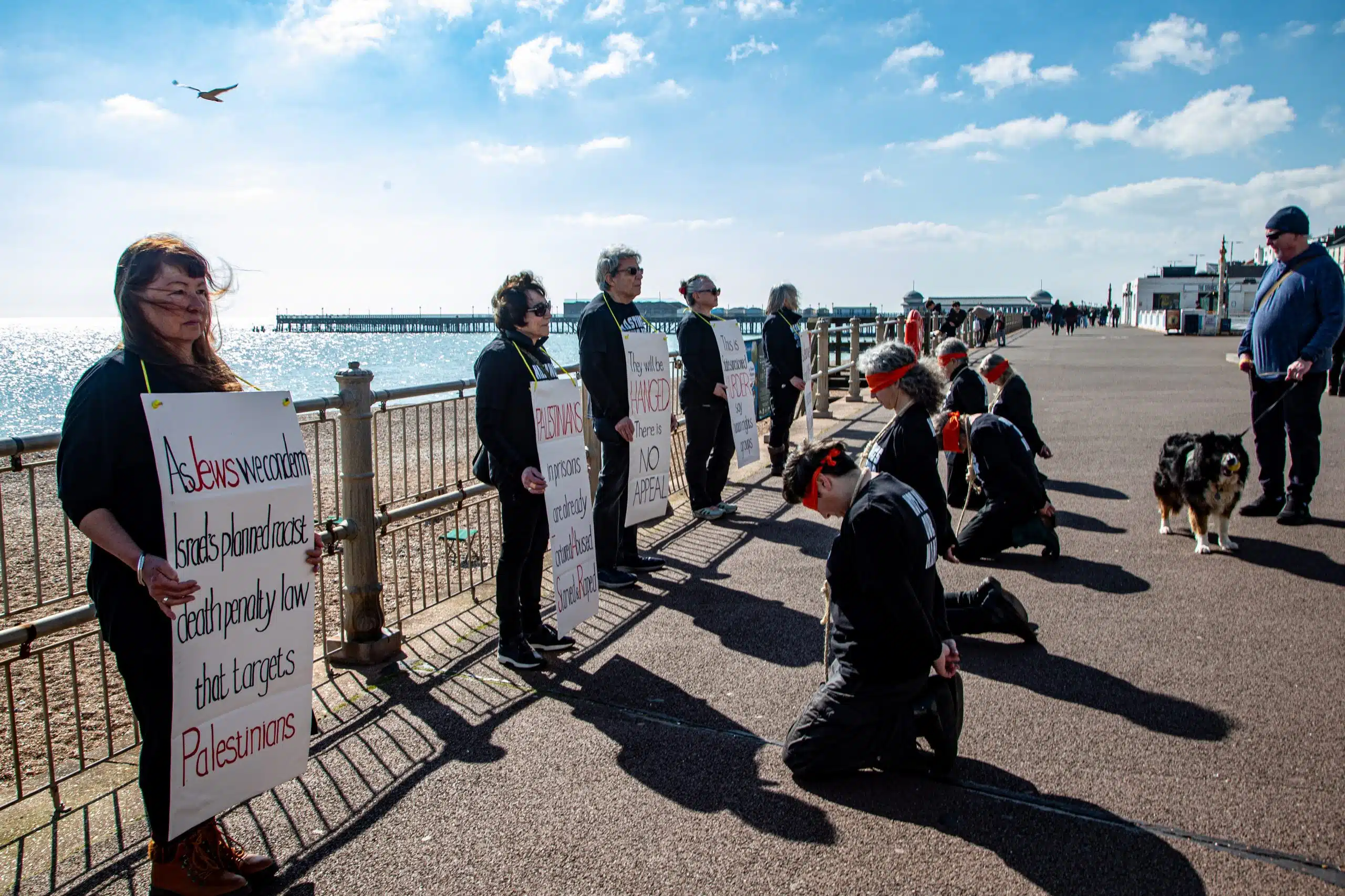
Jews in Hastings, Sussex, took to the streets on Saturday, 21 March, to protest the planned execution law currently going through the Israeli parliament, which targets Palestinians only.
Hastings sees a powerful protest
A video showing the silent, powerful action has now gone viral, viewed tens of thousands of times on social media:
Veteran British artist Annie Lennox, who shared the video, praised the action as a ‘moving example of how local activism can be incredibly powerful’.
She wrote:
Speaking up about what the Israeli government is doing is not antisemitic! It never was and it never will be. When your government is carrying out war crimes and crimes against humanity it is a moral right and obligation to speak up and challenge it.

Dressed all in black with T-shirts that read ‘Not in our Name’, five members of the group Hastings Jews for Justice wore a noose each around their necks and blindfolds to denote the ‘condemned’ while others held placards that read:
As Jews, we condemn Israel’s planned racist ‘death penalty’ law that targets Palestinians.
Palestinians in Israeli prisons are already tortured, abused, starved and raped.
They will be hanged. There is no appeal.
This is state-sanctioned murder say human rights groups.
As Jews we call on all MPs to condemn this vile law.

They handed out leaflets explaining that the bill had passed its first reading in November with Amnesty International stating that this amounted to the Israeli government ‘brazenly granting itself carte blanche to impose death sentences on Palestinians.
‘Any death sentences imposed under these amendments would constitute a violation of the right to life and, when imposed by a military court, may also amount to war crimes.’
‘Shamefully silent’
A spokesperson for Hastings Jews for Justice said:
Our representatives have so far remained shamefully silent about this law.
But this new death penalty law fits right into the existing brutalization of Palestinians – it is a racist, apartheid law as it applies only to Palestinians.
Israel is an apartheid state, according to most human rights groups and the International Court of Justice in its advisory opinion of 2024. Israel is also committing genocide in Gaza and has now launched an illegal and unprovoked war on Iran.
With policies such as these, we cannot continue to pretend that Israel operates as a democracy. We cannot continue to sell arms to Israel that are being used to kill Palestinians in the West Bank, East Jerusalem and Gaza.
It is worth remembering that in 1969 our government finally abolished capital punishment in the UK, arguing such punishment was a ‘barbarous penalty’. How much more barbarous then to enact this policy in a discriminatory system that targets just one group of people?
We call on the British government condemn this appalling apartheid law, to end all arms sales and other military cooperation and to impose sanctions now.
Featured image and additional images supplied

Green Party leader Zack Polanski just got serious on the economy. Not just on substance. His 32-minute speech at the New Economics Foundation on Wednesday 18 March saw a change in tone.
“Our fiscal framework is hypersensitive to market movements, and this creates policy uncertainty that then fuels the very market jitters it was there to supposedly prevent” is one phrase that stood out for me. There was lots of talk of productivity and fiscal multipliers.
This was Zack answering his critics. He can do the heavyweight economics.
Zack Polanski: a shift
Is this a shift away from insurgency? Kind of. It had to happen. To hold power in this country, especially with a media that is equally hostile and banal, you have to talk money. The vast majority of the British people agree that the Iran war is terrible and the Gaza genocide is criminal. But they feel the cost-of-living crisis every day.
I’ve been advocating that we need to appeal to the “Green Curious”. The people who would like to see a government serious about climate action, on poverty. On restoring crumbling infrastructure and creaking public services. There are millions of Green Curious people who see the benefits of compassion and long-term investment. But they want reassurance that their taxes will be spent wisely and their mortgages won’t shoot up. If you want their cross on the ballot paper, you have to look like a safe pair of hands.
Polanski still communicates clearly in everyday language. Rents have gone up by £3300 per household since 2022, he said. That’s £18 billion countrywide. That could have been an extra £18 billion people spent with local businesses. The bakery on the way to work. The local pub at the end of the week. That’s why we’ve got hollowed out high streets. He’s right, and that’s a clear way to explain it.
It’s a welcome change from the long shopping lists the left often recite. We want more money on schools, colleges and universities. Hospitals and care homes. Trains, buses, metros and trams. Of course we do. But unless you answer the question “how?” the public are justified in being sceptical. They’ve been let down by too many politicians too many times.
This speech gets us into the territory of how you actually fix things. Something I’ve been banging on about for years.
Fixing
A wealth tax is a day one priority. Not because it can fund everything, said Polanski. Although £15 billion a year will buy you quite a bit. But because it’s far better for society to spend that on productive infrastructure and long term investment in energy, housing, health and education than it is sitting in private equity funds. The billionaires will still be mega-rich.
There was detail on equalising Capital Gains Tax with Income Tax. That’s another £12 billion. This is bleeding obvious and it’s a scandal that Labour haven’t done it. We should not tax people more for working for a living than we do for owning things. Unlike Income Tax, it’s only taxed on the profits made, anyway.
There was detail on replacing the Office of Budget Responsibility. Established in 2010 to bring down the debt and the deficit, it has obviously failed. I’ve written about it before. It makes unfounded assumptions and always, and I mean always, gets its forecasts wrong. So let’s have an Office for Fiscal Transparency whose job it is to publish the hidden assumptions in Treasury and Bank of England forecasts.
Instead of assuming that all investment has no benefit after five years, let’s get the real evidence. And let’s stop obsessing over GDP as the only measure of economic success.
Polanski is working for everyone
Let’s have a wellbeing measure than includes health, education, and economic security.
I was the first Mayor to introduce one. We used it to guide policy decisions. We still smashed the job creation target, beating our 15 year target in just four years. Every £1 we invested in job creation returned over £3 to Treasury in payroll taxes alone, above and beyond the economic benefits of people having money in their pockets. This stuff works.
And yes, we’d look at borrowing for investment, and when there are adverse economic events, we’d look at quantitative easing. “I’m not an ideologue,” said Polanski, “I’m a pragmatist.”
I liked it. You could deliver it all in the first term of a government. Realistic. Effective. It would make life better for everyone. Even the billionaires would live in a safer country.
Featured image via the Canary

Trump Escalates Iran War As US Troops Express Fears

Match of the Day analysis: Elliot Anderson stars for Nottingham Forest

Why Wall Street wasn’t won over by Nvidia’s big conference

Smart energy pays enters the US market, targeting scalable financial infrastructure

Why Israel is blocking foreign journalists from entering

Bitcoin: We’re Entering The Most Dangerous Phase

CEO SALARY Compared To Regular Worker SALARY! #shorts #money #salary #career #mcdonalds

Crypto Trading LIVE: BTC Live Trading Bitcoin Analysis | 22 MAR #crypto #bitcoin #btc

Anointing For Financial Rest | Sunday Service | Sunday, 22nd March 2026
-

 Fashion3 days ago
Weekend Open Thread: Adidas – Corporette.com
-

 Politics2 days ago
Jenni Murray, Long-Serving Woman’s Hour Presenter, Dies Aged 75
-
 Tech6 days ago
Are Split Spacebars the Next Big Gaming Keyboard Trend?
-
 Crypto World2 days ago
NIO (NIO) Stock Plunges 6.5% as Shelf Registration Sparks Dilution Worries
-

 Crypto World1 day ago
Best Crypto to Buy Now: Strategy Just Spent $1.57 Billion on Bitcoin During Fear While Early Investors Quietly Enter Pepeto for 150x Potential
-

 News Videos5 days ago
RBA board divided on rate cut, unusually buoyant share market | Finance Report | ABC NEWS
-

 Crypto World1 day ago
Bitcoin Price News: Bhutan Sells $72 Million in BTC Under Fiscal Pressure, but the Smart Money Entering Pepeto Sees What the Market Does Not
-

 Business7 days ago
Australian shares drop as Iran war enters third week
-

 Crypto World7 days ago
Crypto Lender BlockFills Enters Chapter 11 with Up to $500M in Liabilities
-

 Politics5 days ago
The House | The new register to protect children from their abusers shows Parliament at its best
-

 Fashion7 days ago
25 Celebrities with Curly Hair That Are Naturally Beautiful
-

 Tech3 days ago
inKONBINI Lets You Spend Summer Days Behind the Register
-
 Politics6 days ago
Real-time pollution monitoring calls after boy nearly dies
-

 Crypto World5 days ago
Canada’s FINTRAC revokes registrations of 23 crypto MSBs in AML crackdown
-
 NewsBeat4 days ago
Residents in North Lanarkshire reminded to register to vote in Scottish Parliament Election
-

 Business7 days ago
Meta planning major layoffs as AI spending and automation reshape workforce
-

 News Videos5 days ago
PARLIAMENT OF MALAWI – PAC MEETING WITH REGISTRAR OF FINANCIAL ON AMARYLLIS HOTEL – INQUIRY LIVE
-

 Business15 hours ago
No Winner in March 21 Drawing as Prize Rolls to $133 Million for Next
-

 Politics3 days ago
Gender equality discussions at UN face pushbacks and US resistance
-
Entertainment7 days ago
Oscars reunite Rob Reiner supergroup of 17 stars for emotional tribute: Here's who appeared on stage
You must be logged in to post a comment Login