Politics
The House Article | Michael Grade: I Am Very, Very Worried About The Future Of British TV


10 min read
Former TV executive Lord Grade has just stepped down as chair of Ofcom. He tells Noah Vickers about his eventful career, enforcing the Online Safety Act and why critics of GB News are secretly ‘embarrassed’
Lord Grade is a titan of British television. Over four decades as an executive at ITV, the BBC and Channel 4, he greenlit and oversaw some of our most cherished programmes, including the launch of EastEnders and Casualty, the importing of Friends and Neighbours onto UK screens, and the broadcasting of Bob Geldof’s Live Aid concert in 1985.
The 83-year-old peer has re-taken the Tory whip after sitting as a non-affiliated member for the last four years while serving as chair of Ofcom. Appointed to the role under Boris Johnson’s government in 2022, his term concluded in April this year.
But despite his extraordinary career in television, he says that what drew him to the job was not in fact its role regulating the world of broadcasting.
“What interested me about the Ofcom job was I started to worry about online safety,” he says, “and there were the beginnings of talk about a bill coming.”
The Online Safety Act, passed by Rishi Sunak’s administration in 2023, is enforced by Ofcom. Companies in breach of the legislation can be fined up to £18m or 10 per cent of their qualifying worldwide revenue, whichever is greater.
Ofcom is up against “very powerful companies who have unlimited access to the best legal brains, and will challenge everything we do”, says Grade, who acknowledges concerns that the regulator moves too slowly.
“When you’re regulating, and [despite] the strong powers that Ofcom has, we’re not a star chamber. Its processes have to be fair and defensible in court.”
The legislation, he argues, is just one part of a wider global regulatory effort to which the big tech companies have been forced to respond.
“I’ve got kids and grandkids and they’re on their screens all day long. The tech companies are beginning to wake up to the fact they’ve got to change. The mere fact of the legislation, and Ofcom’s engagement with the big tech companies, has created quite a bit of change – some of it voluntary.”
Grade’s term at Ofcom also began less than a year after the launch of GB News. The regulator is still regularly accused of failing to hold the channel to the same standards of impartiality as other broadcasters. “The same rules apply to GB News as apply to the BBC, Sky, ITN, whoever,” he insists.
“All news programmes are the result of editorial choices made all along the line. What story are we going to cover? How are we going to cover it? Who do we interview? What are we going to ask them? What are we going to use? Where does it go in the running order?
“Everything’s a choice, all the way up. Because GB News make different editorial choices necessarily on each news day from the BBC, ITN or Sky, doesn’t make it wrong.”
GB News “haven’t always played by the rules”, he admits, but it has been penalised accordingly. He adds: “They’ve actually got better and better. It’s not difficult to comply – sometimes it’s only a sentence in a script.”
Does that mean GB News’ critics should really be angry with how the rules are written, rather than the way Ofcom is enforcing them?
“No, I just think,” he says, before pausing for a moment. “I can now speak [freely], as I’m not at Ofcom. I honestly think they’re embarrassed by the fact that there is a news organisation that has a different news agenda to them, that speaks to the agenda of the majority – if you look at the polls, a large swathe of the voting population, who have no voice on the BBC.
“Immigration, Brexit, these are all issues that don’t get the weight on the BBC, or haven’t been able to, that GB News will give, so what’s the problem?”
To unite that “large swathe” of voters, speaking as a Conservative peer, does he think the Tories and Reform UK should do a deal to win the next election?
“No, I think they’ve got to slug it out to the election,” he says. “If there’s a hung parliament at the end of that, then that’s the time, maybe, for Reform and the Conservatives [to work together]. You can do a confidence and supply agreement, you don’t have to have a coalition – see who’s got most seats.”
Grade is proud of his tenure as a TV executive, his face lighting up as he recalls there being “nothing better than backing a hunch, and the show goes on and it’s beautifully executed, the audience find it and love it, and critics love it”.
His time at London Weekend Television (LWT), a regional franchise of ITV, saw the broadcast of The Fosters in 1976, which featured Lenny Henry in his first regular TV role. It was the first British sitcom to have an all-Black cast, adapted from the American sitcom Good Times.
“What we’re at risk of losing is big drama designed specifically for the British audience”
“Encouraging a lot of Black actors in a lot of shows that we did was a big step forward,” says Grade.
“The critics rounded on it and said, ‘We don’t understand this show – this could have been played by a white family,’ and I said, ‘That’s exactly the point.’ That drove me crazy, but that was great fun.”
Finding TV hits could be the “hardest thing in the world”, he recalls.
“My first boss at LWT, who brought me into television, was the late Cyril Bennett. I said, ‘How do you get a hit, Cyril?’ He said ‘90 per cent luck and 10 per cent accident’,” Grade chuckles.
“You’ve got to know what’s not going to work. You have to know exactly what has got no chance at all – after that, it’s up to the audience. The audience decide what’s a hit and what isn’t.”
As controller of BBC One in the 1980s, Grade almost axed Blackadder after its first series – which had been shot, expensively, on location.
Grade also found it unfunny, so he made the programme’s renewal conditional on its producers moving it into a cheaper studio format, with an audience to react to the jokes.
“Very grumpily, they put it in a studio and the rest is history. You watch the first series – it’s a mess. They [the audience] knew what was funny and what wasn’t funny.”
He made a more committed attempt to kill off Doctor Who, forcing the series to go on an 18-month hiatus and to swap its lead actor from Colin Baker to Sylvester McCoy. Does he expect fans will ever forgive him?
“No, no, no. That show was well past its sell-by date in my time.”
Grade complained that the visual effects were terrible compared to Star Wars and Close Encounters of The Third Kind. He credits Russell T Davies, who resurrected it in 2005, for performing “a miracle with a great brand”.
But he adds: “I have to secretly admit, which I don’t normally admit – I’m not a big fan of sci-fi in any event. I know that’s a blind spot of mine, so I’ve always had to be very careful not to let my own taste intervene.”
Case in point, perhaps, came when he flew out to California to decide which American shows to buy for Channel 4. In a Hollywood screening room, he and his colleagues watched the pilot for a new sci-fi series.
“We all looked at each other and said: ‘This is garbage, it’s hard to stay awake.’ You know, jetlag and everything else… so we turned down The X-Files, which was a big miss.”
Later at Channel 4, the station’s head of comedy presented another pilot episode to him. Grade found it “mindless” and “really stupid in places”, but said to carry on if there was enough belief in it. That series was Father Ted.
These days, Grade warns that British TV is in a perilous place. He shares the concerns raised last year by Wolf Hall director, Peter Kosminsky, that it is becoming increasingly unaffordable for public-service broadcasters to produce high-end British dramas.
“I’ve had many discussions with Peter, who I admire enormously,” he says. “Something’s got to happen, because what we’re at risk of losing is big drama designed specifically for the British audience.
“If it has a life after that, internationally, fine. I think ITV were very surprised that Mr Bates vs The Post Office sold in as many territories as it did, because it was a very domestic story.
“But Happy Valley, Wolf Hall, those sorts of shows are very much at risk. The answer is, the BBC has a secure income, [and] it needs to continue to have a secure income so it can play its part.”
Kosminsky called for a levy to be put on US streaming services, with the proceeds collected into a British cultural fund. A similar proposal was put forward by Parliament’s Culture, Media and Sport Committee, but was turned down by the government.
“That’s been rejected, and it’s a hard sell,” says Grade, who argues it might be possible for the private sector to instead create a one-off fund, which the BBC and others could come to for support in making their more expensive series.
The intellectual property of programmes produced from it would stay in the UK, but the fund’s private backers would be the first to benefit from international sales.
He doesn’t see any feasible alternative to the licence fee as a way of funding the BBC – and he cautions that a subscription model would discourage producers from taking risks on shows which might not sell.
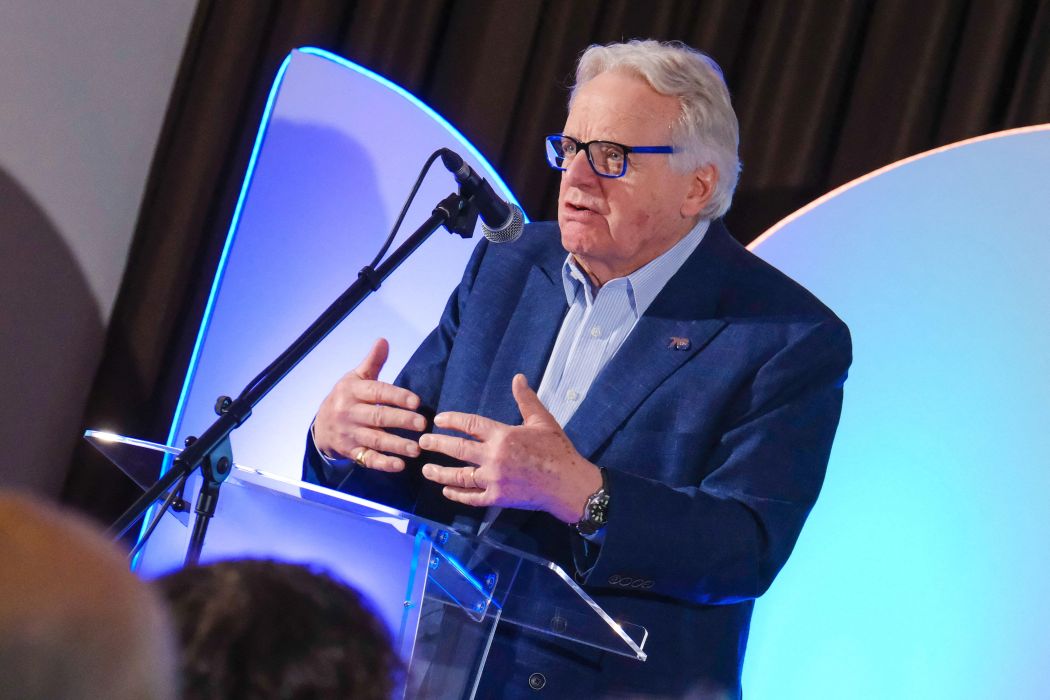

Grade also warns, however, that the corporation is still too big and says cuts should be made so that the licence fee can be re-based at a lower amount.
The rise of working from home, he suggests, means the BBC could free up some funding by selling off some of its physical estate: “When you go to some of the BBC headquarters outside London, you just can’t believe the scale of them.”
He argues, too, that the licence fee should be made progressive by tying it to income in some way.
“It’s wrong that I pay the same as a single mum with three kids in a rented room somewhere – it’s just wrong.”
The peer is optimistic about the corporation’s new director-general, Matt Brittin: “I’m excited and encouraged that they’ve brought in someone from the outside, which I think is what the BBC needs. He seems to be making all the right noises…
“I’m very hopeful that we’ll see some radical change at the BBC, definitely. He’s got to appoint a deputy who’s going to control the journalistic minefield, so they don’t have another editorial crisis – of which there have been too many.”
The last government’s decision not to privatise Channel 4, he argues, was a missed opportunity – despite having fought previous attempts at privatisation when he was the station’s chief executive under Margaret Thatcher and John Major.
“It’s wrong that I pay the same [licence fee] as a single mum with three kids in a rented room”
“There were only five channels in those days. It was a very different world,” he explains. “The question is, can Channel 4 make a virtue out of being small? That’s the challenge. There’s a new team in there, a great new chairman, a very exciting chief executive – let’s see if they can make a fist of it.”
Asked to rate, out of 10, how hopeful he feels about the future of British TV, he gives a score of two. Perhaps two and a half.
“I am very, very worried. Part of it is being kind of misty-eyed about the golden age of which I was privileged to be a part.
“But also the creative industries are one of the most important growth sectors of the economy, and have been for the last decade. The bedrock of that is public service media, and if we lose public service media, eventually that will ripple through into our position as a major provider of international exports, soft power. It’s gobsmacking what we achieve.”

You must be logged in to post a comment Login