Politics
The House Article | NEU’s Daniel Kebede: “Schools Have Become A Battleground For Reform”


Daniel Kebede thinks Reform UK is “increasingly likely” to take power (Alamy)
10 min read
Head of the UK’s biggest teaching union Daniel Kebede tells Matilda Martin that schools are the frontline in the fight against Reform – and teachers should get time off for Glastonbury
Zia Yusuf told the Reform Party conference in September that the country’s schools and universities are “indoctrination camps”.
It’s a claim that Daniel Kebede, general secretary of the National Education Union (NEU), uses to rally opposition to the party he thinks is “increasingly likely” to take power. It’s also how he justifies a drive to recruit support staff despite a TUC agreement forbidding the NEU from doing so.
“Schools have become a bit of a battleground for Reform in terms of the narrative that they’re pushing,” Kebede tells The House.
“I have real concerns around a Reform government, artificial intelligence, Farage’s links to Elon Musk – the Trumpians, essentially. And I would like to see all education workers, really, in a trade union, to ensure that we can mount an appropriate defence if needs be.”
Kebede, 38, studied law at the University of Wales, then trained as a primary school teacher. He was a member of the National Union of Teachers before it merged with the Association of Teachers and Lecturers to form the NEU in 2017.
He left the Labour Party in 2020 when he became an NEU national officer and is yet to tie his flag to the mast of another party, though he did speak at the Socialist Workers Party 2022 conference about racism in education.
Kebede’s election as union leader in 2023 was widely seen as the membership opting for a leader who would take a more militant stance, although turnout was a typically low nine per cent.
The union boss is not without controversy. In 2021, he attended a pro-Palestine rally, where he said it was “about time we globalise the intifada”. These words were raised earlier this month after it emerged that a Bristol school visit by Labour MP and vice-chair of Labour Friends of Israel Damien Egan was called off in September last year. According to reports, a local pro-Palestine group claimed the cancellation had occurred “after concerns were raised by the NEU staff group, parents and local constituents”.
Speaking to BBC Radio 4, Kebede seemed to apologise for his use of the word “intifada”, saying: “I certainly recognise now, as general secretary of this union, I cannot and I certainly will not use phrases like that.”
Until government accept there’s a crisis in education, things are not going to get better for them
The NEU boss is likely to be increasingly under the spotlight this year as his union’s efforts to force the government’s hand on pay ramp up. At the end of February, the union will open an indicative ballot to ask members whether they would be prepared to strike over pay, funding and workload.
“When I’m teaching, when I’m speaking to teachers at the moment, they are saying it’s the worst it’s ever been,” Kebede says.
He says the NEU and government are “on a collision course”, and sees himself as the first in a wave of general secretaries elected on a strategy of “assertive trade unionism rooted in the workplace”. The most recent example of this trend is Andrea Egan’s election as head of Unison, beating key Keir Starmer ally Christina McAnea.
“People, largely workers, are recognising – and particularly post-Corbyn – that if we want to change things, we’ve really got to do it ourselves, and that means you have to be a campaigning, organising trade union,” Kebede tells The House.
“Cosy chats at DfE [the Department for Education] or any other [department] aren’t necessarily the way to get the change that you want to see, and you have to mobilise people on the ground.”
Shortly after winning the 2024 general election, Labour pledged that it would revoke minimum strike regulations. The first changes, including scrapping the requirement of 40 per cent of staff in an important public service to support proposed action, come into force in February. Nevertheless, the general secretary is wary.
“I’m not sure anybody entirely trusts government to not change its mind,” he tells The House, but he adds he is “hopeful”.
Trust in the Labour government is something that has eroded in the past 18 months, with Kebede citing “plenty of instances where the government has U-turned on its decisions”.
He warns that the NEU is “still on a direction of travel this year for industrial action, unless we see an improvement in funding”.
Another area of government policy that has left Kebede deflated is Labour’s increasingly hard line on immigration.
“I was hoping for a more progressive direction of travel from government on this, more painting the positive vision for future Britain, telling the positive stories of migration.

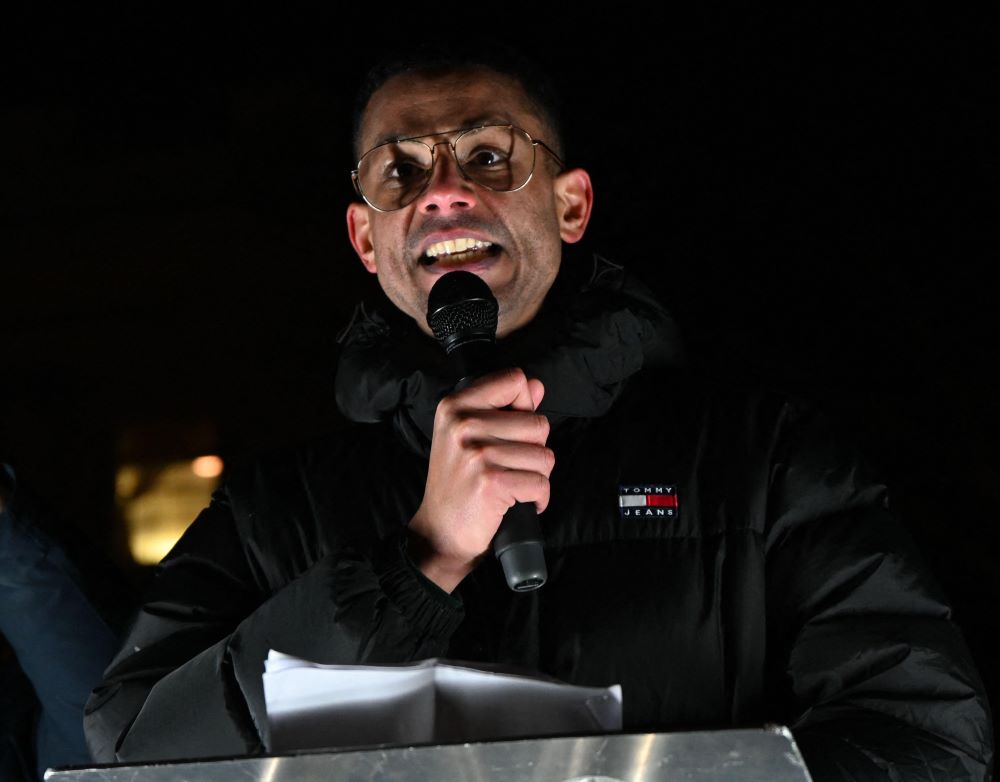
“That seems to be largely absent at the moment, and I think that emboldens Reform, rather than really defeats them and their ideas.”
Kebede says he hears stories about the “toxic” climate surrounding migration and racism in schools every day: “I don’t think we can expect anything else, because the outside world, outside of our schools, is pretty toxic as well.”
“Year on year, we’re seeing an increase in racism, racist incidents on the ground. Now, of course, that is creating a hostile environment for Black, minority and migrant children who are accessing education, but also for those who are teachers and support staff.”
Kebede is positive, though, about what he calls an “upswell” of staff wanting to tackle this.
Where the NEU leader would like to see the government go further and faster is on the regulation of AI. He is concerned that the risks around AI may be “greater than possible benefits”.
“I think they’re being very gung-ho on it,” Kebede says of the government. He envisages a “perfect storm” around the government’s attitude towards AI.
Recently, the NEU carried out strike action over the use of a “virtual teacher” in a school in Devon. Kebede worries that the use of this tech could become more common as finances are squeezed and schools struggle with recruitment.
“You can certainly envisage a direction of travel in which public finances are tight, in which you have a different government, and you have the likes of Elon Musk… – he thinks it should be gamified and so on – in which teachers, as we know them, no longer exist.
“You essentially have managers of programmes in which education, as we know it, is fundamentally different. In fact, we would argue, not an education at all.”
He adds there could be “a class dynamic to it all”, with the poorest children suffering the most.
Kebede also believes that the government needs to have a stronger focus on workload and flexibility to improve teacher retention.
“Graduates entering the world of work have so much more flexibility than teachers, and we’re just going to have to be very innovative about it.”
Should teachers be able to take time off to go to Glastonbury festival? Menopause leave, fertility leave, sabbaticals, career breaks, secondments. Are these all things that he would like to see?
“They need to recognise teaching as a gendered profession. It’s 75 per cent female,” he says. “A catalogue of policies that every school is forced to follow on menopause leave, maternity and endometriosis would be very important.”
He continues: “We do need to find ways to inject greater flexibility into teaching. Not being able to go to Glastonbury, actually, was something I always complained about as a teacher…
“You do have some schools that will come to some accommodation around some of these things. We want to see that become the norm much more.”
Schools have become a bit of a battleground for Reform in terms of the narrative that they’re pushing
Flexibility and workload aside, how to solve the deepening crisis in the special educational needs and disabilities (SEND) system is a question that has plagued successive governments.
With every MP invested in the outcome, the reforms could be the most difficult task facing Education Secretary Bridget Phillipson in 2026.
The changes, set to be unveiled in the coming weeks, are widely expected to amend Education, Health and Care Plans (EHCPs) – the legal documents that identify the specific needs of pupils who receive them and set out tailored support.
Kebede is supportive of Phillipson’s aspirations to have more children taught in mainstream schools. “But, and there is a very big but,” he warns, “schools need to be resourced to be able to deal with that.”
He is far from alone in thinking this will be key to making the reforms workable. One Labour MP warned before Christmas that failing to deliver on this aspect could lead to “another junior doctors situation”.
“I think if there are to be changes around EHCPs… the first thing you have to do is take parents and the profession with you, and you have to make schools more inclusive first. But that all requires money.
“I’m really concerned that government will try and do things on the cheap, and if they do that, I think we are going to end up in a winter fuel allowance-style crisis for this government, because they’ll take no one with them, and they will hit the sand very quickly.”
Another tricky area for Phillipson to navigate will be the publication of guidance for schools on same-sex spaces.
Shadow education secretary Laura Trott warned in late 2025 that delays to the guidance were putting children and teachers at risk.
Kebede tells The House that it should be Phillipson’s priority to “get it right”.
“What I will say on the issue, generally, though, is it’s become very hyperbolic; a very toxic area of policy discussion. Most schools… deal with these situations with real care, consideration, thoughtfulness, and I just wish that was the attitude that government ministers took, really, because it’s very difficult.”
It’s a line Phillipson has had to tread carefully at times.
In an interview last year, she said teachers have the right to request pupils refer to them with the gender-neutral Mx, though they cannot insist on it.
Does Kebede think pupils should be asked to respect their teachers’ pronouns in the classroom?
“Yeah, I think respect is important, isn’t it? Respecting others is very important. I thought that was a very difficult interview that Bridget had to do. In most schools that I’ve come across, people’s pronouns are generally respected.”
While Kebede is critical of the overarching direction of travel under Labour, it is clear that he still has a fair amount of respect for the Education Secretary.
He said in 2024 that he and Phillipson had “a very good relationship”. Would he still agree with that today?
“I think the positive thing about Bridget is that she will always engage in dialogue, and we can disagree agreeably,” Kebede replies carefully.
Feelings towards the Labour government in the education profession appear to have hardened. An NEU poll shared with The House revealed that Labour’s support has collapsed among school and college staff by 70 per cent since the general election: 60 per cent said they had voted for Starmer’s party then, but just 18 per cent would do so again now. The Greens came top in the poll of NEU members conducted in December.
It presents a pretty devastating report card for Phillipson. Why has support fallen so dramatically?
“I sometimes feel for Bridget in the sense that she’s essentially constrained by the Chancellor, by public finance, as all education secretaries are.
“The real issue that this government is confronted with is that the material conditions for teachers and support staff under this government have not improved. In fact, they’ve gotten worse. Every teacher I’m talking to at the moment is [saying], ‘We’re running on empty. We can’t take any more.’
“Until government accept there’s a crisis in education, things are not going to get better for them.”

You must be logged in to post a comment Login