
Politics
The House Article | University funding is unfinished business for Labour



(Alamy)

4 min read
Andy Burnham has entered Downing Street with a long list of promises – delivering regional growth, shifting power beyond Westminster, creating a joined-up skills system and equipping public services for the future.
It is an ambitious agenda.
Yet, one policy challenge continues to go unaddressed by Westminster: higher education and how it is funded.
Successive governments have relied on universities to deliver their defining ambitions, while also avoiding the question of how to sustain them.
Boris Johnson wanted universities to help “level up” the country. Rishi Sunak wanted Britain to become a science superpower. Sir Keir Starmer promised to break down barriers to opportunity. Burnham now wants to strengthen technical education, which many universities – including my own – are already delivering at scale.
But while the slogans have changed, the underlying dependence on universities has not, and nor has the underlying funding problem.
Before Labour entered government in 2024, university finances were reportedly included on Sue Gray’s risk register of problems a new administration could inherit. Over two years later, we are still waiting for the government to work with us to find a long-term solution.
Without one, the consequences will be hard to ignore.
More than a third of universities in England reported a deficit in 2024-25, according to the Office for Students. Universities UK also found that 44 per cent of institutions had closed courses over the previous three years, and almost a third had cut their academic research.
This doesn’t mean that every university is struggling financially – we’re not, and we all have a responsibility to manage our finances carefully and demonstrate continued value. But when pressure is widespread enough to alter what we can deliver, it becomes a national policy problem.
Higher education is fundamental to the UK’s economic infrastructure. It supplies the workforce on which our public services and industries depend, provides the research and innovation on which our international competitiveness depends, and supports growth for regions across the UK. London Economics reported the total economic impact of UK higher education is £265bn, which shouldn’t be taken for granted.
Without urgent action, the danger is systemic collapse by attrition. This doesn’t mean universities suddenly disappearing, but instead dispersing the research teams who are close to ground-breaking discoveries; closing courses in sectors with immediate staffing gaps, such as medicine and nursing; and losing our competitive advantage on the global stage.
What can the government do to avoid losing the sector on which it relies so heavily?
The Treasury Committee’s recent report offers a strong and credible starting point. It concluded that students graduating today could ultimately pay as much as 95 per cent of the cost of their higher education in England, and recommended moving, over time, towards a 50:50 balance between the individual and the state.
I support that principle.
Graduates benefit from higher education, and it is right they should contribute towards its cost, but the country benefits equally, too. If governments continue to depend on universities to realise their policy ambitions, the state should contribute directly.
The committee is also right that the student finance system needs to regain trust. The government should reverse the repayment threshold freeze, replace RPI with CPI when calculating interest and give future borrowers protection against retrospective changes to the terms on which they took out their loans. Young people shouldn’t enter a significant, long-term financial commitment only to find the terms becoming less favourable after the event.
Reassuringly, Education Secretary Lucy Powell has recognised the need for action and said that student loans are at the top of her in-tray. But what matters now is whether this recognition turns into tangible action. There is an opportunity to do what successive governments have failed to do, and fund higher education in line with the role we expect it to play.
If he wants to realise his ambitions for the UK, Burnham can no longer afford to leave higher education funding unresolved.
Professor Koen Lamberts is Vice Chancellor at the University of Sheffield


Sellafield’s SIXEP Continuity Plant has reached an important milestone, with key equipment installed as the project reaches 75% completion.
The SIXEP Continuity Plant (SCP) has reached an important milestone. Teams have completed a series of major crane lifts on the Sellafield site.
The new plant, being built through the Programme and Project Partners (PPP), is now three-quarters complete. It’s on track to begin operations in 2029.
The main buildings are finished and protected from the weather. Work is now focused on fitting out the inside of the plant and installing specialist equipment.
Once complete, SCP will take over the work carried out by the current Site Ion Exchange Effluent Plant (SIXEP). It has been operating since 1985.
The plant plays an important role at Sellafield. It removes radioactive material from water used in site operations before the water is safely discharged to sea. Often described as the site’s “kidneys”, it helps keep this process running safely.
Recent lifts have seen 14 pump and valve modules moved into position. Each module weighs 16 tonnes. Teams have also installed a 55-tonne gantry crane. This spans 21 metres across the plant.
Steve Harnwell, PPP’s managing director, said:
“After years of design, engineering and manufacturing, I’m delighted to see the plant’s operational equipment arriving on site. Installing this equipment on a nuclear site is no mean feat. Our teams have had to thoroughly plan every detail.
Every major project we are delivering at Sellafield is a step towards safely managing and reducing the UK’s most hazardous nuclear materials.
We’re delivering stores for different types of nuclear material, processing plants, and analytical facilities. It’s infrastructure with purpose.
Our work is being delivered by so many organisations all working together. It stands as a powerful symbol of what UK infrastructure can achieve. Delivering with purpose, leading with expertise, and creating lasting value.”
As equipment continues to arrive and be installed, the plant is moving closer to operation.
The new plant will continue this work until at least 2060. It will support Sellafield’s mission to reduce risk and deliver the site’s long-term clean-up programme.
The progress also comes as PPP marks 7 years of delivery at Sellafield. Established in 2019, PPP brings together Sellafield Ltd, KBR, Amentum, Morgan Sindall Infrastructure, Altrad Babcock and a wide supply chain to deliver major infrastructure projects.

For my constituents in Edinburgh, the defence debate in Westminster can sometimes feel distant, dominated by discussion of GDP percentages and Treasury settlements.
Yet some of the most important work in keeping this country safe is happening a few miles from my constituency office and, following the publication of the government’s Defence Investment Plan, this is the moment to build on it.
In June 1943, a factory in the Crewe Toll area of Edinburgh began producing gyro gunsights for the Spitfire, as Britain battled for control of the skies over Europe. That site went on to become the birthplace of Ferranti’s radar business and is the direct ancestor of what is now Leonardo UK’s Edinburgh operations.
Over eighty years on, the site designs and builds cutting edge electronics equipment, including radar for the Typhoon and Gripen fighter jets and Norway’s all-weather search and rescue helicopters. It is, quite literally, part of the eyes and ears of the UK’s air defences and increasingly of our civil infrastructure too, with technology that helps stop drones over airports and critical sites. The technology has even found its way into elite sports, providing essential elements of the Hawkeye system used at Wimbledon.

MDU warns Chancellor clinical negligence system ‘not fit for purpose’

Northern Ireland RE curriculum is ‘indoctrination’ – Supreme Court
Companies like Leonardo are a key part of our regional economy and the broader national economy. Across the UK they employ thousands of people, invest hundreds of millions of pounds a year in R&D and keep that intellectual property onshore.
Beyond these economic considerations, they are rooted in the history of many of our cities, continuing a proud tradition of British industry through careers and apprenticeships that stretch back generations.
This illustrates a broader point about the UK economy that Westminster needs to grasp. What turns a spending commitment into tangible regional growth is the pipeline feeding it: skilled people, local supply chains and the confidence for firms to expand beyond simply fulfilling existing orders.
That point goes well beyond Edinburgh and well beyond defence. For years, Westminster has struggled to translate spending commitments into the kind of durable growth that changes places.
Andy Burnham understands this problem and his record in Greater Manchester shows what is possible when that changes: devolved powers over transport, skills and investment turned into a genuine regional growth strategy, with decisions taken by people who understand the local economy rather than made at a distance in Whitehall. Scotland already has significant devolved powers of its own, but there is more that government could do to give Edinburgh and the wider central belt the same confidence to make investment decisions in sectors like defence and advanced manufacturing.
None of that happens, though, without the people to deliver it. A regional powerhouse is only as strong as the regional talent pool, and that talent pool is one of our city’s underappreciated assets. Heriot-Watt, where I worked before entering Parliament, produces exactly the kind of engineering graduates that advanced manufacturing firms need, yet too many of them still end up in London or overseas because the opportunities to build a career here aren’t visible enough.
Schemes like the Edinburgh Guarantee, which has already matched thousands of young people with local jobs and apprenticeships, show what is possible when the connection between education and industry is made. The task now is to widen that pipeline and make sure advanced manufacturing employers are fully part of it.
Edinburgh has eighty years of proof that it can design and deliver world-class equipment to keep our country safe. Let’s make sure the next eighty years of production are here too.



Britain is building fewer homes than it needs. NHBC Chief Executive Paul Turner argues that funding certainty from government must be matched with a focus on training skilled workers to deliver quality homes
The housebuilding and construction industry knows the market is under real pressure. Around 300,000 new homes a year are required to deliver what Britain needs. But we are only building around two-thirds of that, and the pipeline behind that number is shrinking rather than growing. NHBC registered 29,162 new homes in the second quarter of 2026, 4 per cent down on last year, after a 6 per cent fall in the first quarter. Fewer homes registered today means fewer homes completed next year and the year after.
A big part of the issue for developers has been uncertainty. It is harder for prospective buyers to afford their mortgages with rates much higher over the last few years compared to pre-pandemic. Added to this, significant supply cost increases mean the cost of building a house is much higher. With material uncertainty in the system about the viability of new housing, developers are building fewer homes.
Against that backdrop, MHCLG took a significant step under Angela Rayner’s leadership. The 10-year £39bn Social and Affordable Homes Programme will provide funding to support the delivery of around 300,000 new social and affordable homes. Alongside this, Andy Burnham’s ambitious council housebuilding programme, the biggest since the post-war period, will provide much-needed demand certainty for years to come. For the first time in decades, the sector will be able to look at a substantial part of the development pipeline and see funded demand stretching out over ten years. This certainty will support the wider market – from housing associations and councils to builders and training providers and most importantly help more families benefit from the security and stability of a safe, warm home.
Funding creates the pipeline, but skilled workers turn it into homes. The Fabian Society recently highlighted the stark skills challenges facing construction. Tackling the Built Environment Skills Crisis explores issues such as an ageing workforce, the high costs of training and the impact of labour shortages on project delivery and quality. 36 per cent of UK construction workers are over 50, with up to 700,000 expected to retire by the early 2040s – in an industry that has a higher density of skills shortage vacancies than any other.
To make matters worse, only 50 per cent of construction employers reported investing in workforce training during the previous year, with investment per employee also falling by 19 per cent in real terms since 2017.
The National Audit Office, the UK’s independent public spending watchdog, has similar concerns. Increasing Construction Skills shows we need nearly 900,000 extra construction workers to build 1.5m homes, deliver the Warm Homes Plan, and contribute to at least £725bn of infrastructure funding commitments.
More recruits alone will not be enough. High-quality homes require a high-skilled workforce to build them. This has never mattered more, because the homes that will be delivered over the coming decades have to meet stringent quality standards. We are asking for more competence at a time the workforce needs to grow faster than it has in a generation.
NHBC has a distinctive perspective on this. Through our inspections focused on construction quality, and our 90 years of expertise, we see how homes are built and how they perform long after handover. That gives us a practical, long-term view of what drives quality in new homes. Repeatedly, that experience reinforces a simple point: the quality of a home depends on the skill of the people who build it.
With social housing the stakes are higher still. These homes are for people least able to cope when a home performs poorly: a poorly detailed wall or window can become a heating bill a tenant struggles to afford. The aim of the Social and Affordable Homes Programme needs to not just be to build more homes, but to build quality homes that give families everywhere safety, warmth and long-term security.
I have spent my career in insurance and one thing this industry teaches you is to think in years and decades. Viewed over the long term, the idea that speed and quality are competing priorities quickly falls away. Defects identified during construction cause delay; defects discovered years later cost far more. The most efficient way to build is to build right first time, to a high standard – and that starts with skilled people on site.
None of this sits on one set of shoulders. Government has set the ambition and announced policies that will help to give the industry the certainty it needs, through the £625m construction skills package and beyond. Every builder who takes on an apprentice is investing in the whole industry’s future.
Training providers have a responsibility to produce people who are ready for a live site, not just an exam. That matters because a country that values the hard hat as much as the graduation cap must create training routes that lead quickly and credibly into skilled work. That is where NHBC has put its money, firmly backing the government’s ambitions.
We are investing £100m in twelve multi-skill training hubs, developed with partners across the industry, where apprentices train in bricklaying, groundworks, site carpentry and timber frame installation in realistic site conditions, to the same NHBC Standards their work will be inspected against. Through concentrated blocks of learning they qualify in 14 to 18 months, roughly half the time of traditional routes, with achievement, retention and pass rates significantly higher than the national average.
The government has made a serious long-term commitment to social and affordable housebuilding, and should now create a pipeline for the industry to invest in. Only then can the sector have the confidence to begin the necessary hiring, training, and upskilling to produce the homes we need in every postcode.
In June, in Manchester, Andy Burnham set out his economic vision and asked a simple but powerful question: if you do not give people a good home, what chance do they have of a good life? We agree. At NHBC we believe that everyone deserves a quality home.
The Prime Minister is right: everything starts with a good home. Good growth in every postcode will depend on homes that are safe, warm and built to last – and on continued investment in the skills and training needed to build them well.
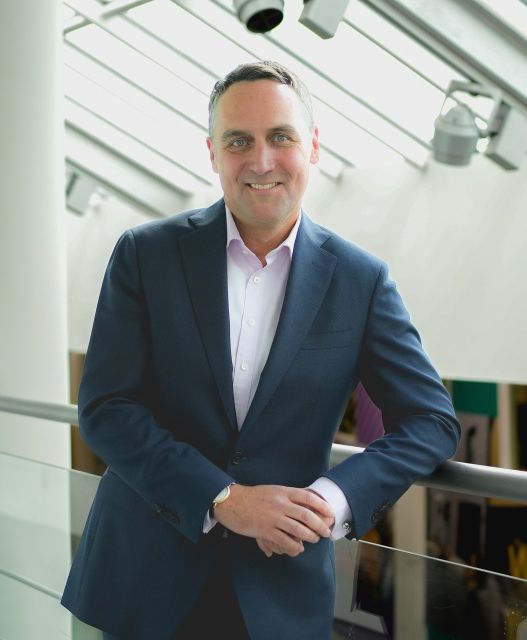 Paul Turner is the Chief Executive of NHBC, the UK’s leading independent provider of warranty and insurance for new-build homes. NHBC’s purpose is to raise standards in house building by championing high-quality homes and protecting homeowners.


Credit: Unsplash

Marcus Samphire, Market Director – Security and Critical Infrastructure
| AtkinsRéalis
A cyber attack doesn’t have to succeed to cause disruption. As infrastructure becomes more connected, resilience is increasingly defined by how organisations respond, recover and continue operating under pressure
The conversation around cyber security in critical infrastructure often focuses on preventing attacks, and for infrastructure operators responsible for energy, water, transport and other essential services, that remains an important priority.
However, the challenge has broadened significantly, as the growing convergence of information technology (IT) and operational technology (OT) reshapes what cyber risk means in practice. Operators are connecting smarter digital systems with ageing infrastructure that was never designed for today’s threat landscape, with the result that as well as greater efficiency, better visibility and improved performance, new vulnerabilities and new forms of risk exposure are entering the picture.
In this changing environment, cyber resilience is increasingly becoming the practical application of cyber security: for operators of critical national infrastructure, the question is no longer only whether an attack can be prevented, but whether essential services can continue to operate safely if systems are compromised, suppliers are disrupted or key operational technologies must be isolated. The ability to maintain services, recover quickly and make effective decisions under pressure has become central.
The growing importance of resilience reflects the reality of the threat landscape. The UK’s National Cyber Security Centre (NCSC) handled 204 nationally significant cyber incidents in the year to August 2025, compared with 89 the previous year. Of those, 18 were categorised as highly significant incidents, representing a 50% increase and the third consecutive annual rise.
Resilience as a system challenge
Historically, organisations could focus primarily on protecting their own assets and systems; today, risks increasingly emerge at the points where systems, organisations and supply chains connect.
Critical infrastructure can also no longer be viewed as a collection of discrete assets protected behind a perimeter. It increasingly operates as a connected system made up of operational technology, field devices, cloud platforms, remote access capabilities, data flows and complex supplier ecosystems. Across sectors including energy, water, transport, aviation and telecoms, resilience depends not just on securing individual assets but on understanding how assets, systems and organisations interact.
This is particularly important in the context of critical national infrastructure. Traditional measures of resilience – regulation, standards and guidance – provide a critical baseline and help organisations to establish priorities, improve consistency and strengthen security. The direction of travel is also becoming clearer from a policy perspective. The UK’s Cyber Security and Resilience Bill is expected to strengthen requirements on operators of essential services and certain critical suppliers, extending expectations around incident reporting, risk management and resilience assurance.
However, compliance alone cannot keep pace with a threat landscape that is evolving so rapidly. In an environment shaped by geopolitical tension, supply chain dependency, rapidly evolving digital tools and increasingly capable hostile actors, resilience can no longer be judged solely by whether an organisation has satisfied a compliance requirement. Instead, infrastructure operators must truly understand and continually monitor the threat landscape.
An example is the Volt Typhoon threat actor that compromised multiple US critical infrastructure organisations across sectors including communications, energy, transportation and water. Investigators found evidence that the group had maintained access within some victim environments for as long as five years. The lesson for infrastructure operators is that cyber threats are not always singular events. Adversaries may establish persistent footholds long before disruption occurs, reinforcing the need for continuous monitoring, threat hunting, detection and a clear understanding of how services will continue operating, how decisions will be made under pressure and how recovery will be managed.
Organisations that may see themselves primarily as utilities providers or infrastructure operators are increasingly part of a broader system that supports economic activity, public services and national capability, while governments and organisations are only as strong as the cyber resilience of their suppliers.
Leaders in such organisations can build operational resilience before a cyber incident occurs, by understanding how critical services depend on technology, suppliers, people, physical assets and data, and where failures could create operational or safety consequences. They should be asking challenging questions, both to themselves and their supply chains. What happens if a threat actor gains access to our network? What if a key supplier is compromised? What if we can no longer trust the integrity of our operational data? How would we continue operating in a degraded state for days or weeks while recovery takes place?
Asking the right questions
As organisations increasingly depend on technology partners and software providers to deliver their services, they need to place a greater emphasis on cyber requirements during supplier procurement, assurance and contract management, rather than treating cyber security as a technical issue to be addressed after delivery. This focus on third-party assurance is likely to become even more important as the Cyber Security and Resilience Bill broadens scrutiny of critical suppliers and recognises that national resilience depends not only on operators themselves, but also on the organisations and technologies they rely upon.
Transparency and visibility are key here – many organisations have a strong understanding of their own estate’s strengths and weaknesses but less visibility of the dependencies that sit several tiers down their supply chain. The question they should be asking themselves is no longer “are my systems secure?” but “do I understand all of the systems and suppliers my operations depend on?”.
Investment in technology and compliance remains essential, but clearly, resilience is equally dependent on governance, decision-making, operational preparedness and organisational culture. The strongest organisations are building resilience into every aspect of their operations and their supply chains, with a focus on understanding their dependencies, continually testing their preparedness, strengthening detection and response capabilities, and developing confidence in their ability to recover from disruption.
As our critical infrastructure and the technologies it depends on continues to evolve, behavioural and supply chain resilience will provide the foundation for organisations to adapt and modernise with confidence, while maintaining the trust, reliability and continuity that society expects.

I lament Jason Arday’s apparent suicide. I shake my head at the dreadful pity of it. Yes, he had been serially dishonest. And yes, the immediate responsibility lay with him: the hand that killed him was his own. Yet his death was still a tragedy. He’d become so trapped in a fantasy about himself, it seems, that when reality finally broke in, Nemesis came with it. A terrible reckoning caused the self he’d invented to disintegrate. It must have seemed to him that black nothing remained.
But Jason’s responsibility is widely shared. It also belongs to all the adults who indulged him. Who failed to make him reckon with the truth. Who lowered the threshold so he could clamber over it. Who encouraged him to dismiss criticism as expressions of racist bad faith. Who, year after year, aided and abetted the elaboration of his fantastic claims. Who patronised him.
Why did they do it? For many, no doubt, because uncaring kindness was so much easier than telling the truth. For some, evidently, because their own academic standards were hardly higher than his. For others, because he was a useful poster boy for their ‘decolonising’ crusade.
But is it credible that not one of the seasoned teachers or academics who vetted him in the course of his career failed to see what is now so glaringly obvious – that the emperor was stark naked? I think not. I’d wager a modest fortune that some did see it, but knowing what it would cost them to say so, suppressed the thought and bit their tongues. Why? Lest they be accused of racism, their friends step away, and their careers suffer.
There’s a warning in this sorry tale for the leadership of the Church of England. The Church commissioners, including both archbishops, persist in their support for ‘Project Spire’, the policy of devoting £100million to paying reparations for the church’s alleged profiting from transatlantic slavery. Reliable sources tell me that the project has been vigorously championed among the commissioners who are responsible for managing the church’s assets, including the First Church Estates commissioner, Alan Smith. They also observe that the decision to proceed with the project was made in the wake of the killing of George Floyd in Minneapolis in May 2020 and the consequent anti-racist, knee-bending panic. Apparently, only one of the commissioners’ 27 board members voiced an objection to it. Was that because all the others were convinced supporters? I know for a fact they weren’t. So why didn’t more doubters speak up? Could it have been – as an eye-witness reports – that dissent was suppressed, because senior church figures are concerned about being branded racist?
My own ‘lived experience’ tells me that’s entirely plausible. Sometime during the Covid epidemic – late 2021 or early 2022, I think – I was invited to join in a Zoom call to discuss the Church of England’s responsibility for making slavery reparations. Of the four people present, three (including me) were white. The fourth was a black clergyman. Most of the meeting was taken up with him and me arguing. I remember pulling my punches, partly because my view of the historical and ethical nonsense of reparations was not as clear and firm as it is now. But mainly because I was aware of how bad I would look if I said what I honestly thought. In the current, emotionally manipulative climate, when claims of racial harassment are so easily made and readily believed, it’s very risky for a white person to speak up candidly to a black person about race and slavery. So, I tied my tongue.
Since its public launch in January 2023, the wheels have come off the rationale for Project Spire. Richard Dale, an historian of international banking, has shown that the commissioners misunderstood the data: the 18th-century church fund, the Queen Anne’s Bounty, neither directly invested in nor profited from slave-trading. I, until recently holder of the Anglican world’s premier university chair in Christian ethics, have pointed out the astonishing failure of the commissioners to publish any considered ethical justification. And Charles Wide KC has exposed their failure of due diligence in launching the project before discovering that it’s beyond their lawful powers to divert money from resourcing the Church of England’s ministry to supporting black-led businesses in the Caribbean and Africa.
How have the commissioners and the project’s officers responded? Mainly by retreating into a bunker and saying as little as possible, hoping no one will notice the fuss and the critics will tire and go away. But also by complaining that forensic questioning is a form of harassment and refusing to answer it. By indirectly threatening critics with litigation. By refusing to name them. And on one (aurally recorded) occasion, by publicly defaming them as deliberately spreading disinformation – that is, lying. Recently, Bishop Arun Arora, deputy chair of the church’s Racial Justice Board and public champion of Project Spire, has gone to the desperate length of invoking in its defence the authority of none other than Alan Lester. ‘Desperate’, because Professor Lester is no expert on transatlantic slavery and, in my long experience of him, his rational mouth is more gum than teeth.
I am a Christian convert. I’m an active member of the Church of England. I’m even an Anglican priest. I wish the leadership of my church no ill. But they’re stubbornly leading us into our very own Arday affair, where the nakedness of Project Spire will be exposed for all to see and those responsible for stewarding the church’s assets will be called to public account. I know that the reputational costs of rowing back will be high, but the costs of rowing onward will be much, much higher. Commissioners – and bishops, clergy and laity – who’ve been harbouring doubts and biting their tongues need to muster the courage, take the risk and speak up now. Before it’s too late.
Nigel Biggar is a Conservative peer, Regius Professor emeritus of moral theology at the University of Oxford and author of Reparations: Slavery and the Tyranny of Imaginary Guilt (Swift, 2025).

TALLAHASSEE, Florida — Million-dollar fundraising advantages and even endorsements from President Donald Trump did little to sway Florida voters Tuesday as they rattled the state’s parties by opposing candidates backed by the establishment.
Newly minted Democratic socialist Angie Nixon scored a massive upset — and notched a win for progressives — by beating retired Lt. Col. Alex Vindman, who had a huge fundraising edge. And, in another major development, two candidates endorsed by Trump, scandal-plagued Rep. Cory Mills and former administration official Catalina Lauf, lost their bids for Congress.
Taken together, the results show Democratic and Republican voters in solidly red Florida are hungry for change amid dissatisfaction with the economy, an ongoing war in Iran and restlessness over the status quo.
“People are frustrated, frankly, with both parties,” said Florida’s Chief Financial Officer Blaise Ingoglia, who is a former legislator and chair of the Republican Party of Florida. “They’re frustrated with people not delivering. … They want people to deliver for Floridians. They want people to deliver for Americans.”
National Democrats scrutinized states throughout the country during the primary season, looking for every opportunity they could find to pick up seats and flip the upper chamber come November. The one thing they may not have been betting on: A progressive who sorely lagged in fundraising scoring an upset in Florida. But that’s just what they got with Nixon’s win.
A state lawmaker and Jacksonville community organizer who recently joined the Democratic Socialists of America — but notably did not have DSA’s endorsement — Nixon ended up handily winning with more than 55 percent of the vote, surprising the state as she’s now positioned to campaign against GOP Sen. Ashley Moody, the former state attorney general appointed to the Senate by Gov. Ron DeSantis to replace Secretary of State Marco Rubio.
On Tuesday night, Nixon told supporters who gathered to hear her victory speech in Jacksonville that her win sent “shockwaves” to the Washington establishment.
“And they better get ready,” Nixon said. “When we realize that we are each other, we are not each other’s enemies, and that we are all struggling.”
In the state Legislature, Nixon was an adversary of DeSantis and his fellow Republicans, as she notably opposed Florida’s rare mid-decade redistricting push by railing on the newly drawn maps on the House floor in a pink jumpsuit and shouting through a pink megaphone. Nixon campaigned on progressive policies like free childcare and freezing rent nationally, helping her score support from national progressives like Democratic Reps. Maxwell Frost of Florida, Ilhan Omar of Minnesota, Rashida Tlaib of Michigan and Ayanna Pressley of Massachusetts.

Vindman had a prominent profile as a National Security Council whistleblower who testified in Trump’s first impeachment trial and secured a massive fundraising advantage surpassing $20 million largely from small-dollar donors. Nixon, meanwhile, didn’t scratch $1 million. But being outgunned proved not to be a factor for Nixon.
State Rep. Anna Eskamani, a progressive Democrat from Orlando, said Nixon’s campaign centered around the needs of the working class, from affordability to health care. Those concerns generated enough momentum for Nixon’s campaign to overcome the millions of dollars spent by Vindman.
“It really just speaks to saying that money doesn’t determine everything,” Eskamani said. “They’re tired of health care not being affordable and one job not being enough.”
Some Florida Republicans celebrated Nixon’s victory, believing a progressive will be easier for the GOP to overcome in November.
“It was a wild night in Florida politics,” GOP Rep. Randy Fine said at the victory party for Rep. Byron Donalds after he won his own crowded primary. “I mean, the Nixon win is the greatest gift ever. She’s crazy and should be in jail for the stuff she pulled on the House floor.”
But Fernand Amandi, a Democratic strategist for both David Jolly, who won the Democratic primary for governor, said that Nixon’s win shows frustration with longtime GOP control in Florida.
“It tells me that Democrats are uniting behind a message that holds a Republican Party that has total control over Florida government for 30 years responsible for the cost-of-living crisis that Floridians from all walks of life are suffering through,” Amandi said. “It doesn’t matter which wing of the party — they are uniting behind the message.”
On the Republican side, Trump’s endorsement didn’t prove to be the deciding factor in two races. In Florida’s 19th District, Trump’s endorsed candidate, Lauf, a former adviser at the U.S. Department of Commerce during the president’s first term, lost to Jim Schwartzel, a media executive and owner of a conservative talk radio station, by about 7 points.
It was a crowded field, with several former congressmen, including former North Carolina Rep. Madison Cawthorn and New York Rep. Chris Collins also running.

In Florida’s 7th District, Mills fell short of his bid to hold on to his seat, even with the president’s early backing. Instead, former television anchor Ryan Elijah defeated him by about 12 percentage points.
Under investigation by the House and shunned by some of his GOP colleagues in Congress, pressure has been building on Mills for weeks and only intensified recently as Republicans like DeSantis and Rep. Anna Paulina Luna came out against him. Mills has remained adamant that he has done nothing wrong amid a long line of incidents — including a restraining order placed on him at the request of a former girlfriend — and had defied calls from other Republicans to step down from his central Florida congressional seat.
Mills hoped Trump’s endorsement would put him over the line with voters, but it wasn’t enough. Elijah, who outraised Mills and other GOP contenders, tried to make the case during the campaign that a Mills win would make the seat an easier target for Democrats.
During his victory speech Tuesday night, Elijah highlighted the support he got from rank-and-file House Republicans, particularly Rep. Mike Haridopolos, with whom he said he has had a long relationship. And he noted the risk those GOP members took in balking against a Trump-endorsed candidate.
“To have those leaders jump on board with us a couple weeks ago, against an incumbent and against a presidential endorsement, and they did that anyway.” Elijah said. “That is courage right there, and I applaud them for that.”


President Donald Trump just suffered another endorsement loss, this time in deep-red Wyoming.
Republican state Sen. Eric Barlow defeated Trump-backed Superintendent of Public Instruction Megan Degenfelder in the gubernatorial primary on Tuesday.
It’s another blow to Trump’s once-stellar primary endorsement record, which has shown vulnerabilities in recent weeks. Former MyPillow CEO Mike Lindell lost his primary for governor in Minnesota last week, as did a Trump-endorsed Michigan congressional candidate who fell to an opponent who had already dropped out. Two other Trump-backed candidates fell in Florida Tuesday: Rep. Cory Mills and House candidate Catalina Lauf.
Trump’s endorsement power has seemed to particularly wane in governor’s races. Georgia Lt. Gov. Burt Jones, Iowa Rep. Randy Feenstra and South Carolina Lt. Gov. Pamela Evette all fell in their primaries this year despite the president’s support.
Barlow, a fourth generation Wyomingite rancher, centered his campaign on protecting public lands, funding public schools and expanding rural health care access. Degenfelder leaned heavily on her Trump endorsement, and her campaign as well as outside groups supporting her ran repeated attack ads casting Barlow as too liberal to lead the state.
But Barlow was able to overcome those attacks and Trump’s endorsement on Tuesday.
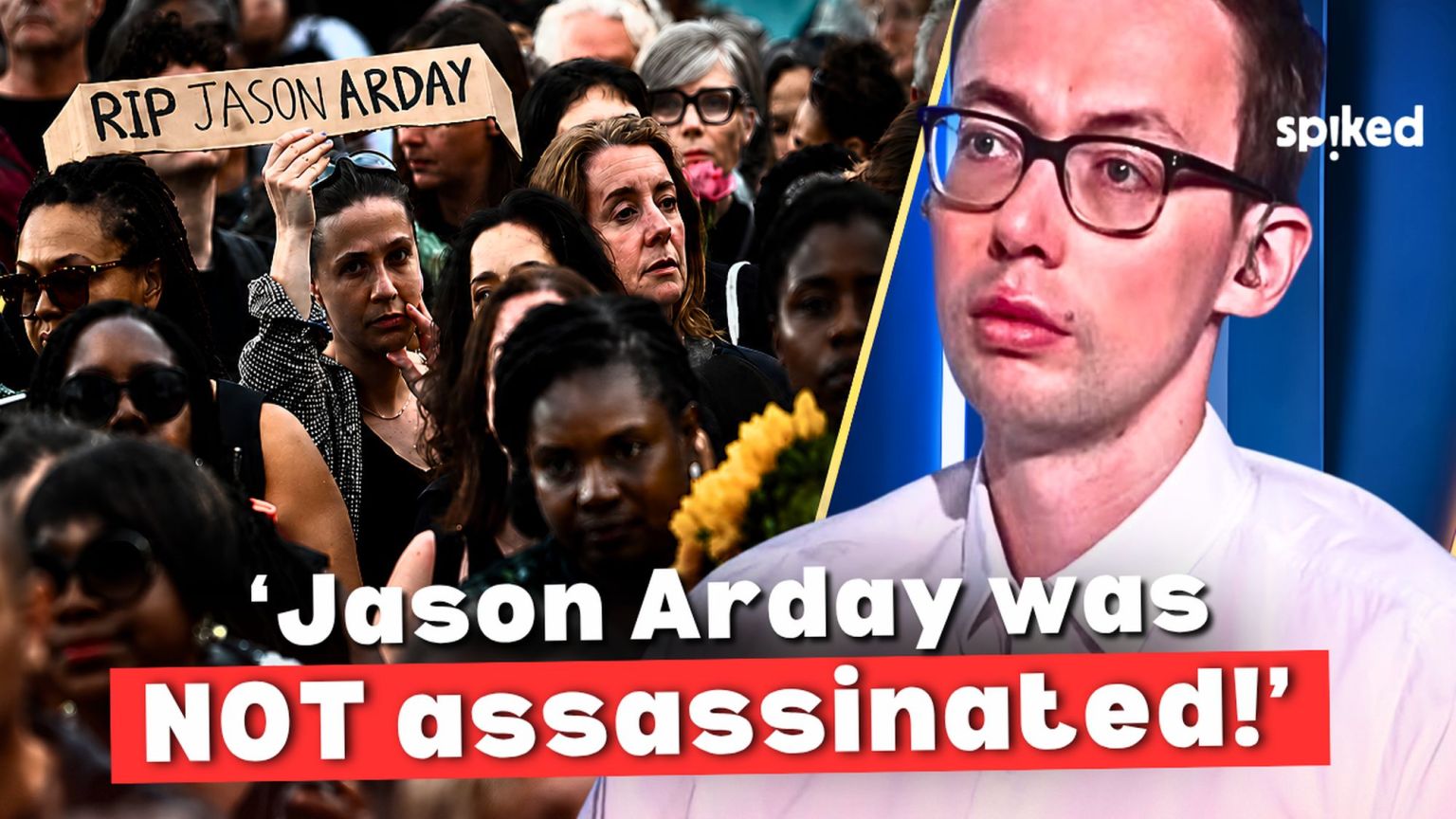
The post ‘He was not assassinated. This is a sinister lie’ appeared first on spiked.
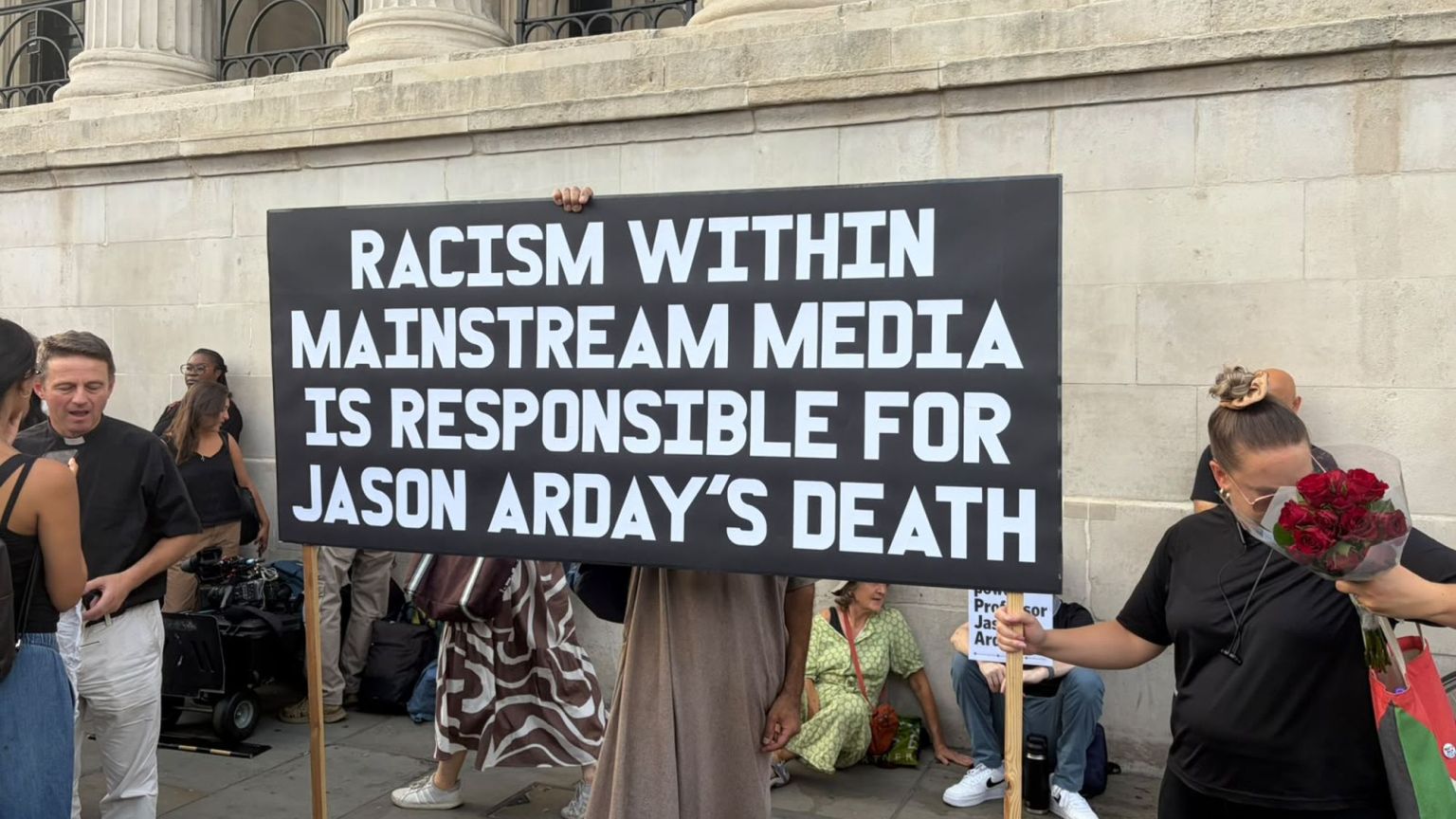
It was promoted as a ‘vigil’ for Jason Arday, but it wasn’t grief that united the large crowd that gathered in Trafalgar Square last night.
‘Racism within the mainstream media is responsible for Professor Arday’s death’ read a large sign held below the entrance of the National Gallery. Other signs read ‘249 articles in 22 days’ – a reference to what many people claim was the media’s racially motivated obsession with Arday – and ‘unalived by a witch-hunt’. Stand Up to Racism – the group that organised the vigil – had produced placards stating ‘Rest in Power Professor Jason Arday’. From the outset, the atmosphere was combative and indignant.
It became more so as the speeches began. Bell Ribeiro-Addy, the Labour MP for Clapham and Brixton Hill (the Arday family’s local MP), told the crowd that the late Cambridge professor hadn’t so much killed himself as he had been killed by the media. Arday, she said, was the victim of a ‘media onslaught’ that was ‘relentless, merciless, wicked’, carried out by ‘vicious, evil people’. Photographer Misan Harriman accused the media of ‘gleefully enjoying racialised harassment’ in its reporting of Arday. ‘Justice must be served’, Harriman added. ‘The impunity of the fourth estate must stop.’
The supposed bigotry of the media – the Spectator and the Telegraph were singled out to loud boos and cries of ‘shame’ – was the main target. Labour MP Diane Abbott said a ‘vicious media’ had ‘driven [Arday] to his death’. Simon Woolley, principal at Cambridge’s Homerton College, went even further. He said Arday’s suicide was a ‘lynching’ and a ‘public assassination’. Veteran activist Patrick Vernon said Arday, in his death, had joined the pantheon of modern black martyrs that included Stephen Lawrence and George Floyd.
The vigil had the shape and feel of a Black Lives Matter protest. And in essence, that is what it was. Stand Up to Racism’s Weyman Bennett told the crowd to ‘never surrender what our ancestors fought for’. Before performing an odd rendition of ‘Fix You’ by Coldplay, the musician Jermain Jackman urged his fellow ‘black kings and brothers’ to chant ‘I am great, I am loved, I am smart’.
On the question of Arday’s plagiarism, the answer appeared to be simple: it wasn’t true, or was greatly exaggerated. Vernon praised Arday’s ‘scholarship’ and ‘achievements’. Another speaker celebrated Arday as an ‘extraordinary academic’ and an example of what was possible when ‘talent, determination and opportunity come together’. Dawn Butler, another Labour MP, told the crowd that ‘when we say his name, do not miss out the “professor”’. The message was clear: under no circumstances could Arday – who was routinely hailed as a ‘once in a generation’ genius – have his academic bona fides questioned.
Looming over the event was the almost wholly fictitious account Arday had presented as his ‘life’ to his various employers and in his recently published memoir. This was an aspect of the Arday affair that no member of the audience, and certainly no speaker, wanted to touch. The avoidance of Arday’s repeated and extreme lies was perhaps unsurprising. It would, after all, have been an admission that this tragedy was not as simple – ‘a campaign against all of us’ in Abbott’s words – as the organisers were so eager to make out.
Was it racist to question whether Arday had run 600 miles in six days, as he had claimed? Was it relevant that Arday’s apparent health battles – his non-verbal autism, his brain tumour, his testicular cancer – were likely all fabrications? Did it matter that this celebrity academic at Cambridge had never single-handedly raised £5million for charity, as he originally claimed? Or that he had never been a visiting professor at the University of Glasgow, Ohio State University in the US or Nelson Mandela University in South Africa, despite what his CV said? And why did he claim he played football for Crystal Palace and won great sums of money as a snooker champion? Was none of this relevant to the media interest in his life?
Other inconvenient facts were also glossed over in what felt like an effort to instill a collective amnesia. There was predictably no mention of the fact that Arday had hired one of the UK’s most expensive law firms, Carter-Ruck, to silence his critics. Or that he’d prompted the Metropolitan Police to investigate a journalist from Times Higher Education who raised questions about Arday’s plagiarism last year.
The death of Jason Arday is undoubtedly tragic – but those at the vigil made no attempt to understand why his life unravelled. In blaming the media for his demise, they ended up deifying a fantasist, who saw no way out when he realised the game was up. The only things served by this spectacle were the forces of genuine reaction – of racial grievance-mongering and the authoritarian quest to silence the free press.
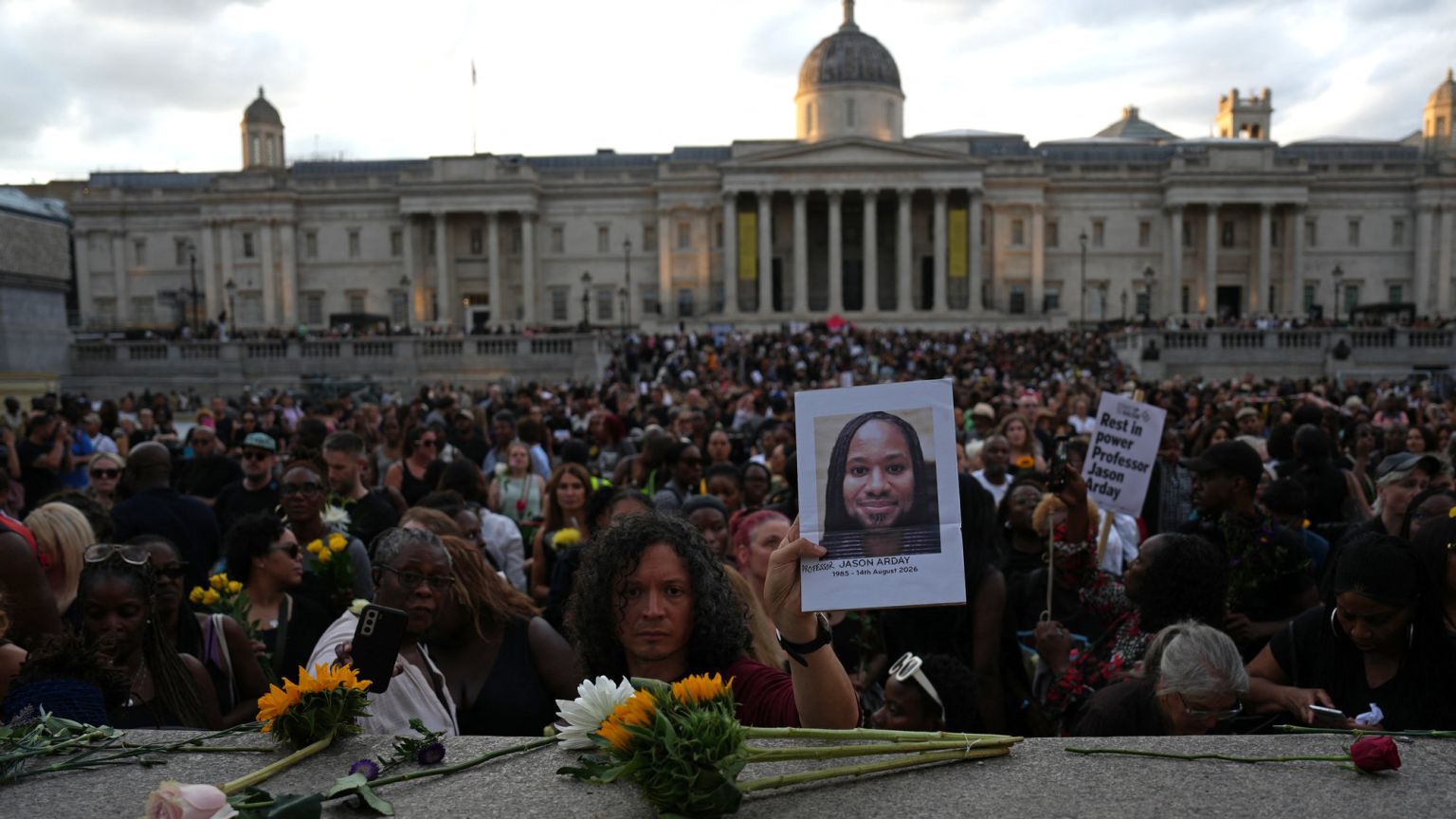
Jason Arday is dead and the ‘racist’ mainstream media killed him. That was the message of a vigil in Trafalgar Square last night, as thousands gathered to pay their respects to the disgraced Cambridge professor who tragically took his own life on Friday. It is also untrue.
We must make no bones about saying it. Because in the ‘anti-racist’ canonisation of Arday – whose awful death came after his own untruths, his plagiarism and fabulism were laid bare by the press – we see a kind of derangement that some vainly hoped had been and gone with Peak BLM.
The vigil on the steps of the National Gallery was the IRL expression of a sentiment that has been swirling on social media since the devastating news of Arday’s suicide broke: that he was hounded out of Cambridge by blood-thirsty journalists desperate to ‘lynch’ a young black man.
The tone was religious, in the fire-and-brimstone sense. ‘We are going to stand against the wicked, evil people who dragged his name through the mud’, said Labour MP Bell Ribeiro-Addy, from the stage. Lord Woolley – founder of Operation Black Vote and veteran ‘anti-racist’ leader – called the journalists who exposed Arday ‘the dogs of hell’.
Arday’s death, said Woolley, was a ‘public assassination’. A member of the crowd corrected him: ‘A lynching!’ ‘A lynching!’, repeated Woolley. I was standing about 10 feet away as he said all of this – blood-curdling, inflammatory lies not from a students’ union activist, but a deputy vice-chancellor of Cambridge and peer of the realm.
Woolley was a good friend of Arday. They sat together in his final days. Arday’s nearest and dearest are certainly entitled to their grief – their anger, even. What they can’t do is smear journalists for telling the truth, while expecting us to swallow their falsehoods. Indeed, in the tragic story of Jason Arday, there has been far too much of that already.
The narrative now being forged, both online and off, goes something like this. Arday was a young professor, minding his own business, when the media suddenly decided to take him down. He was accused of plagiarism, then ‘exonerated’. But still they kept on coming, so furious were they that a black man was given a perch at Cambridge.
He has been turned into a spotless figure, martyred by a vicious media. The problem is, this isn’t true. More than 100 passages were found in his PhD, apparently lifted from another’s thesis. He was also credibly accused of falsifying data, of lifting quotes from academic papers and passing them off as original quotes from people he had interviewed.
Then there is his personal story – from claims about running ultra-marathons to claims he was the subject of racist intimidation – which also collided with reality. Police directly contradicted his version of events. Experts pointed out that his alleged sporting achievements would, if true, make him a record-breaking athletic specimen. School friends even challenged his claim he was mute as a child.
I take no pleasure in repeating all this. But the truth matters. Indeed, had Cambridge refused to participate in the fantasy land Arday was constructing for himself, had it listened to academics and higher-education journalists who began raising the alarm years ago, and who were met with legal threats and police probes for their efforts, Arday might never have become the story of this long, hot summer.
The attempt to turn Arday into a saintly victim of a racist press is obnoxious on so many levels. A man’s suicide is being used as a platform on which to pursue pre-existing political agendas, from shackling the press to shoring up the rotten, racist ideology of DEI – which insists academic standards must be lowered for ethnic minorities to thrive.
If anything, the fall of Jason Arday was set in motion by DEI. So captured was Cambridge by this warped, phoney form of ‘anti-racism’ that it elevated a man who might have sounded all the right notes about ‘white supremacy’, but whose lies, or perhaps delusions, were always going to be exposed eventually, bringing his world tumbling down.
Everyone in possession of a pulse wishes Jason Arday, the man, were still with us. To say he erred is not to say he wasn’t a cherished friend, colleague, family member – a human being. Suicide touches far too many lives as it is. The thought of anyone making that worst and most final of decisions grates against our humanity. But the myth of Saint Jason is an affront to reason we simply cannot indulge.
Politics Home Article | Latest crane lifts mark major progress on SIXEP Continuity Plant

Manchester United star makes exciting prediction about the new season

Physicists Entangle Quantum Memories Across a Record-Breaking 420 Kilometers





-

 Fashion5 days ago
Weekend Open Thread: Ann Taylor
-
 Sports5 days ago
This U.S. Amateur is a glimpse into golf’s future in more ways than you think
-

 Tech5 days ago
11 Ways to Rank Your Videos
-
 NewsBeat4 days ago
Myanmar says over 300,000 Rohingya refugees verified for repatriation as exodus enters ninth year
-

 Sports4 days ago
Birmingham 2026: Day 6 Timetable for Irish Athletes
-

 Politics4 days ago
SEQ Code: The Three Letter Boarding Pass Code That Could Give You The Worst Seat
-
 Entertainment7 days ago
Keke Palmer Subtly Hints At Sean Evans Drama With Cryptic Post
-

 Sports7 days ago
DeQuan Jones in ‘high spirits’ after successful leg surgery
-

 Tech6 days ago
DeepSeek Harness launches as open source rival to Claude Code, alongside V4-Pro on API with higher prices
-
 Crypto World7 days ago
Perplexity AI Predicts an XRP Scenario Few Analysts Are Discussing
-
 Entertainment7 days ago
2026’s Most Ambitious Fantasy Movie Officially Scores Sequel Update
-

 Crypto World1 day ago
OCC Greenlights Trump Family Crypto Firm for Trust Charter
-

 Politics7 days ago
How Average Are You In The UK?
-
 Entertainment7 days ago
All 10 Hayao Miyazaki Fantasy Movies, Ranked
-

 Fashion7 days ago
Why Botanical Fashion Never Goes Out of Style
-
 Entertainment7 days ago
Travis Kelce Breaks Silence On ‘Crazy’ Taylor Swift Wedding
-
 Entertainment5 days ago
10 Netflix Shows That Quietly Became Modern Classics
-

 Fashion7 days ago
Wednesday’s Workwear Report: Stretch-Cotton Pleated-Waist Top
-

 Fashion6 days ago
The Details Do the Dressing
-

 Fashion5 days ago
Weekly News Update, 8.14.26 – Corporette.com
You must be logged in to post a comment Login