Politics
The House | Bosnia is going home


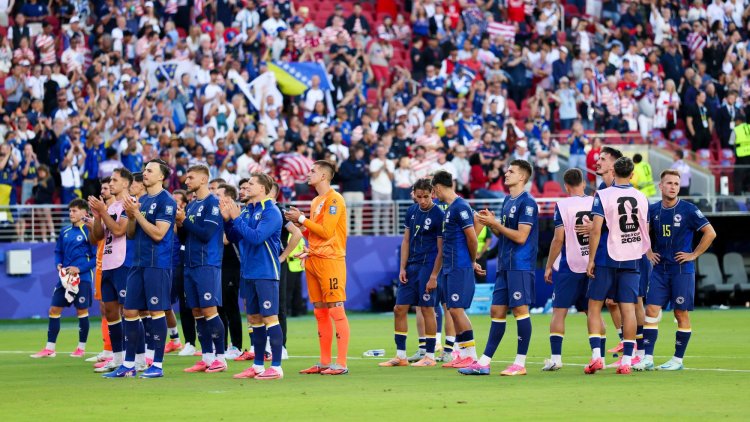
Bosnia salutes their fans after World Cup exit/Alamy


4 min read
Early this morning, Bosnia and Herzegovina’s World Cup journey ended with defeat to the United States. Today, its players begin the journey home.
Yet the most important story was never the result.
Some of these young footballers are the children of survivors of the genocide at Srebrenica. Others come from families that endured the siege of Sarajevo, survived concentration camps or were driven into exile by war.
They represent a generation that exists because their parents and grandparents survived an attempt to destroy both a people and a state.
For the four weeks of the tournament, they achieved something Bosnia’s political leaders—and much of the international community—have failed to accomplish in almost three decades: they gave Bosnians a reason to believe in their country, in one another and in a shared future.
Since the Dayton Peace Agreement ended the war, Bosnia’s nationalist elites have built an entire political economy around division. They do not solve problems; they manufacture crises. They do not govern; they manipulate. Rather than competing over economic growth, education or the rule of law, they compete over fear. Every election is turned into a referendum on ethnic survival. Every reform is portrayed as an existential threat. Every compromise is denounced as surrender.
For secessionists, the argument goes further. They portray Bosnia and Herzegovina as an artificial state—unworkable, unsustainable and destined eventually to disappear. The country’s political dysfunction is treated not as a problem to solve, but as proof that the state itself cannot succeed.
The tragedy is that too much Western policy has accommodated this narrative rather than challenged it. Obstruction has been rewarded in the name of stability. Secessionist threats have been managed rather than defeated. This national team exposed the bankruptcy of that approach.
Its players came from different cities, different communities and families shaped by war in profoundly different ways. Some were born in Bosnia and Herzegovina. Others were raised in the diaspora because conflict forced their families to flee. Their histories were different. Their shirt was the same.
Nobody asked whether the goalkeeper was Bosniak, Serb or Croat before celebrating a save. Nobody cared which entity a defender came from after a last-ditch tackle. The only qualification that mattered was whether a player could help the team win. Merit replaced ethnic arithmetic, and patronage. Shared purpose replaced manufactured division.
That is how successful teams are built. It is also how successful states are rebuilt.
Football cannot rewrite Bosnia’s constitution. It cannot reform public administration, strengthen the judiciary or stop young people leaving. It cannot dismantle the patronage networks that have hollowed out public life.
But it can expose a lie. The lie is that Bosnia’s citizens are incapable of acting together. The lie is that ethnic division is immutable. The lie is that Bosnia and Herzegovina exists only because outsiders insist upon it. For four weeks, millions of Bosnians disproved all three.
That is why reports that public screenings and celebrations were discouraged in some predominantly Serb municipalities should not be dismissed as isolated incidents. They reveal something more profound. A successful Bosnian national team threatens political movements whose legitimacy depends on denying the existence of a shared Bosnian civic identity. A population united by achievement is harder to manipulate through fear.
The players did not defeat nationalism. They demonstrated that nationalism is a political strategy, not a historical inevitability.
No one should romanticise what happened. Bosnia’s constitutional paralysis remains. Corruption remains. Secessionist rhetoric remains. So does the unresolved legacy of genocide, including its denial and the glorification of convicted war criminals by some political leaders.
But one assumption has become much harder to sustain. If a team made up of young people from families shaped by genocide, siege, displacement and exile can unite around a common purpose and earn success through merit alone, what excuse remains for politicians who have spent thirty years insisting that the country itself cannot function?
The players are going home. Bosnia’s nationalist leaders remain exactly where they have always been. They deserve a political red card. Increasingly, so do those in democratic capitals who continue to indulge them.
For too long, the Internal community has, in the name of “stability”, all but legitimised those who undermine Bosnia and Herzegovina’s constitutional order, normalised secessionist threats and treated political spoilers as indispensable interlocutors rather than as the principal obstacle to a secure, democratic European state.
The lesson of this World Cup is that Bosnia and Herzegovina’s citizens have once again demonstrated that they are ready for a country built on merit, competence and shared citizenship. Bosnia is not held together by international supervision or constitutional engineering. It endures because its people continue to choose it.
ends

You must be logged in to post a comment Login