Politics
The House | Brexit Scars And UK Political Instability Temper Brussels Enthusiasm For EU Reset


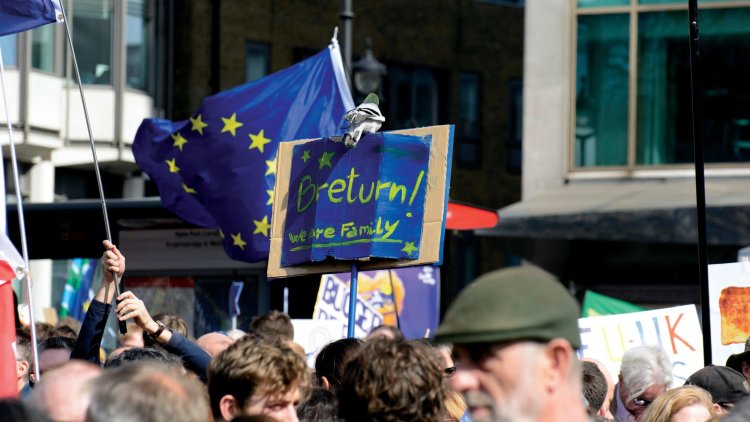
(ZEN – Zaneta Razaite/Alamy)
6 min read
The European Commission and national leaders can see the benefits of a rapprochement but Brexit scars, unresolved disputes and uncertainty over who will be in No 10 are tempering Brussels’ enthusiasm, finds Christian Spillmann
The reset between the European Union and the United Kingdom was much ado about nothing.
Brexit was a tragedy. The ‘reset’ is a farce. ‘Breturn’ is a fantasy. The language of international relations is rarely so blunt, so unvarnished. Instead, pleasantries and embraces conceal a more awkward truth. The divorce negotiations left a bitter aftertaste on the Continent. Yet the return of Donald Trump to the White House has fractured the global order. His disdain for Europeans, and the consequences of his erratic decisions, have made closing ranks imperative. A rapprochement between the UK and its former EU partners is now vital to Europe’s security. Keir Starmer wishes to go further. The British Prime Minister is seeking a reset of relations, though he has drawn three red lines. The reception has been polite; enthusiasm conspicuously absent. In Brussels, the issue is not a priority, and mistrust among European leaders is real. How much faith can be placed in the contrition of a country that offers its former partners a fresh start while preparing to cast its votes for one of the architects of the rupture?
Brexit shattered the relationship between the UK and its EU partners. Negotiations were arduous, at times bruising, and strained relations among member states. Nowhere is the ambivalence more pronounced than in France. Emmanuel Macron has taken Keir Starmer under his wing. The two leaders have forged a privileged bilateral relationship. The French President is strongly in favour of resetting ties with the UK, and the British Prime Minister has become his interlocutor of choice on European defence. Paris regards London as a strategic partner and is acting accordingly. Macron and Starmer co-chair the ‘coalition of the willing’ for Ukraine and are co-ordinating the mobilisation of a naval mission to secure maritime routes through the Strait of Hormuz and the Red Sea.
Yet the Franco-British relationship is not without strain. Beneath the cordiality lies suspicion. Paris refuses to allow London to enjoy the benefits of the single market without accepting its obligations. The UK has been unable to join Safe, the EU’s flagship rearmament programme, stymied by a European preference championed by France – at least 65 per cent of components must be produced within the bloc – as well as by Starmer’s reluctance to pay the entry price, a financial contribution estimated at between €4bn and €6.5bn. London’s defeat in this stand-off has underscored the difficulty of translating a political ‘reset’ into tangible integration.
All is not lost. Starmer has signalled his intention to negotiate participation in a second round of the Safe programme, should the financial terms become more ‘equitable’. A second EU-UK summit is scheduled for late June in Brussels, with the date yet to be fixed. Progress is expected on migration, with the Commission set to present a ‘Channel Plan’, as the issue has become a European one. But the Continent will press the UK to cease being “so attractive to irregular migrants”, citing its labour market, the absence of identity cards and the pull of community networks, as one European negotiator warned. Advances are also anticipated in aligning carbon markets (ETS), sanitary and phytosanitary measures (SPS), UK participation in the Erasmus programme, and the YES scheme for youth mobility.
These remain incremental steps, albeit useful ones. “We are identifying areas for co-operation. We are operating in the narrow margins between the Trade and Co-operation Agreement and Starmer’s three noes: no return to the single market, no customs union, no freedom of movement,” one negotiator explains.
British officials have revived the idea of rejoining the single market for goods. Representatives of the 27 EU member states have unanimously rejected this notion of a ‘pragmatic Breturn’. It does not hold. The four freedoms are indivisible. British negotiators, their counterparts complain in Brussels, appear at times short of subtlety. “They no longer understand us,” comes the lament.
The reset resembles a diplomatic farce – replete with misdirection, half-truths, misunderstandings, slammed doors and sudden reversals. London seeks to escape its isolation. Continental capitals, confronted with a cooling of relations with Trump’s America, are in search of a reliable partner. Scenes of reconciliation multiply: summits, state dinners, grand declarations, smiles for the cameras.
Yet the misunderstanding endures. London appears to believe that a reset entails regaining the commercial and security advantages of EU membership without paying the full price. On the Continent, there is an expectation that the UK will finally accept EU rules and contribute financially to common projects. The result is predictable: when the moment comes to strike agreements and sign cheques, each side discovers it has been talking past the other. Doors slam, recriminations follow and disappointment prevails. The reset is a diplomatic vaudeville: frequent quarrels, regular reconciliations.
The reset is a diplomatic vaudeville: frequent quarrels, regular reconciliations
For now, the reset has disappointed, constrained by the caution of Starmer and his Labour government. The Continent struggles to discern what, precisely, the British want. Their démarche is driven in part by the UK’s economic difficulties – Brexit has proved deeply damaging – yet the ambition of a reset is curtailed by Starmer’s red lines. The mantra ‘Brexit means Brexit’ has become a straitjacket. The EU has other priorities; in Brussels, the matter is viewed as secondary.
European commission president Ursula von der Leyen has entrusted it to the commissioner Maroš Šefčovič, tasked with managing and deepening the EU’s global trade partnerships.
The stance that the UK has not abandoned its status as the opt-out state irritates European partners.
“The British must decide: either we proceed with incremental improvements, or they opt for a broader political debate on rejoining the single market and the customs union,” officials in Brussels argue.
At root lies the question of trust. What are Starmer’s chances of remaining Prime Minister until 2029, given Labour’s heavy losses in the wake of the 7 May electoral bloodbath? The British say they wish to reconnect with the EU, yet Nigel Farage, a leading architect of Brexit and an avowed Eurosceptic, tops voting intentions with his Reform UK party. A paradox – and a nightmare – for the EU.
“The British have paid to discover what Brexit entails,” says an official involved in negotiations with London. “It has plunged the country into a hole. Many now recognise the error and want to end their isolation. Yet a majority appears ready to vote for the man who put them in this predicament.”
In that contradiction lies the essence of Europe’s bewilderment.
Christian Spillmann is a former AFP correspondent in Brussels and co-founder of La Matinale Européenne/Il Mattinale Europeo

You must be logged in to post a comment Login