Politics
The House | China And Clean Energy: Is Britain Swapping One Dependency For Another?


Illustration by Tracy Worrall


10 min read
As the conflict in Iran highlights Britain’s exposure to fossil fuel markets, Zoe Crowther examines fears UK’s shift towards clean energy might mean replacing one dependency with another
For years, the political logic of the energy transition has rested partly on the promise of greater sovereignty and less economic exposure to volatile oil markets, unstable regimes and geopolitical shocks. But as countries race to electrify transport systems, build offshore wind farms and expand solar generation, another dependency is becoming harder to ignore: China’s dominance in the clean energy supply chain.
In a surprisingly hawkish speech in Brussels earlier this month, EU commissioner for climate, net zero and clean growth Wopke Hoekstra said that the EU had been “too naïve for too long” over the role of China in Europe’s energy sector.
He warned of the danger of creating a new reliance on Chinese cleantech after the negative impact of dependencies on Russian gas, and imported liquefied natural gas from the Middle East and the US has become increasingly obvious.
More than 20 years ago, the first “China shock” came when China’s accession to the World Trade Organization unleashed a wave of low-cost manufactured exports that transformed global trade and hollowed out industries across Europe and the United States, contributing to political backlash, increasing populism and economic insecurity in the Western world.
Analysts are now increasingly speaking of “China Shock 2.0”: The Financial Times has reported on the extent to which it is now not just cheap consumer goods flooding global markets, but Chinese dominance in electric vehicles, batteries, solar panels, wind turbines and the critical minerals supply chain underpinning the energy transition.
Loom, a UK-based strategy and research group focused on the intersection of climate policy, energy security, industrial strategy and geopolitics, has published a new report arguing that the transition away from fossil fuels risks creating new strategic vulnerabilities if governments fail to develop domestic industrial capacity and more resilient supply chains. It describes China as Europe’s “next energy blind spot”, with strategic dependence being relocated rather than removed.
The Iran conflict has highlighted the structural risks embedded in fossil fuel dependence, hastening calls from the pro-climate movement to further expand the UK’s renewable sector.
However, while Britain has made significant progress in decarbonising electricity generation, much less progress has been made in electrifying heating and transport, leaving large parts of the economy heavily dependent on oil and gas.
Dan Marks, research fellow in energy security at the Royal United Services Institute (Rusi) tells The House that instability in fossil fuel markets is not temporary but structural.
“While Vladimir Putin is in charge of Russia, while the ayatollahs are in charge of Iran… Russia could be sanctioned at any point, and Iran can close the Strait of Hormuz at any point. So that’s structural risk built into the oil and gas market for an indefinite period of time.”
Unlike fossil fuels, which require continuous imports vulnerable to price shocks and disruption, renewable infrastructure generates energy domestically once installed. However, there are still widespread concerns around both the economic dependency and national security implications.
Chris Aylett, research fellow in the Environment and Society Centre at Chatham House, describes the most significant effect as being that the UK could forego huge economic opportunities in an energy system where China is the leader.
“China’s been working on this and developing this massive green industrial behemoth for decades,” he says.
“It’s absolutely at the top of its game, it’s producing to the highest quality and lowest cost, and it’s just really difficult to challenge that. Other countries, including in Europe, are making a bit of headway, but it’s not going to match China, and certainly not in the UK.”
This is likely to continue for the foreseeable future, as China is still building out its capacity.
The US may have been the only western economy with the scale to seriously challenge that dominance through former president Joe Biden’s Inflation Reduction Act, which aimed to boost domestic green manufacturing, but that effort was weakened after President Donald Trump reversed major parts of the policy.
There is also concern that the US could pressure allies to remove Chinese technologies from energy supply chains, echoing the Huawei dispute. But Aylett believes this is increasingly unlikely as Washington’s leverage has weakened after the “strategic blunder” of the Iran War.
“It’s diminished him [Trump] in a way… his power on the world stage of being able to say and do whatever he wants,” Aylett says.
Alongside the economic risks are the direct risks to the UK’s national security from Chinese interference, which extend to both clean energy infrastructure itself and some of the communications technologies used.
Graeme Downie, Labour MP and chair of the Coalition for Secure Technology, points to Chinese-made cellular IoT modules – essentially low-tech semiconductors – which are prevalent in many products from traffic lights and IT routers to parts of the energy system.
“Anything that can communicate usually has a module in it,” he tells The House. “Energy security means security of supply, but it also means security of technology.”
Aylett warns that these connected technologies can create vulnerabilities regardless of where they are made.
“Connected technologies are vulnerable to cyber attacks, whether that be remotely operated via a back door, or whether they are just vulnerable to attack generally due to poor security standards and practices,” he says. “Russia, for example, doesn’t make clean energy tech but engages in cyber attacks on energy infrastructure. So that is a risk.”
Downie believes the current crisis should force a broader rethink of the UK’s energy security system. “We should have learned this lesson after the Russian invasion of Ukraine,” he says. “We’ve got to take this opportunity to do it properly.”
After multiple national security incidents involving China in recent years – including the arrest and investigation of individuals accused of spying for China, and warnings from MI5 that China represents a significant long-term espionage and interference threat – the UK government is alive to the risks.
China’s been working on this and developing this massive green industrial behemoth for decades
In March, the UK blocked Chinese wind company Ming Yang from building a £1.5bn turbine factory in Scotland on national security grounds. The government has refused to elaborate on the reasons for that decision when asked by The House. Some speculate, however, it reflects a more aggressive stance on the technologies and desire to widen the supply base.
Mike Reader, Labour MP and member of the Energy Security and Net Zero Select Committee, argues Britain’s vulnerability is partly the result of decades of deindustrialisation. “The Conservatives left us completely reliant on a global supply chain without UK capability,” he says. “The de-industrialisation of the UK was done without considering our sovereignty and our security.”
The government is therefore now trying to strengthen domestic resilience. Pranesh Narayanan, senior research fellow in IPPR’s Centre for Economic Justice, says the UK’s updated Critical Minerals Strategy is more sophisticated than previous efforts because it identifies parts of the supply chain Britain could realistically develop, particularly refining capacity.
But he warns the funding attached – around £50m – is insufficient and “not necessarily commensurate with the scale of the problem”. He argues the government should allocate some money every year over a longer term towards this to build resilience.
The government’s industrial strategy, too, is described by Narayanan as taking “positive steps” to identify the manufacturing base that the UK could develop. “But it’s going to be slow to deliver, and you’re going to need to commit to delivering it over many, many years.”

There are signs of growing co-ordination across Europe. The UK recently joined the Hamburg Declaration alongside countries including Germany, Denmark and the Netherlands to develop a vast interconnected North Sea offshore wind grid.
Chatham House’s Aylett describes there as being a “decent amount of political will and momentum” in the UK to support the European wind sector, and develop offshore wind as one area where Britain could still carve out a competitive advantage.
However, any meaningful diversification away from China will take years and require sustained state intervention.
Narayanan points to India, Vietnam and Malaysia as countries developing alternative solar manufacturing capacity, but says markets alone will not solve the problem. “Some public effort is going to be needed as the market isn’t going to do it by itself,” he says.
Loom is set to produce further reports looking at where those alternative opportunities could emerge.
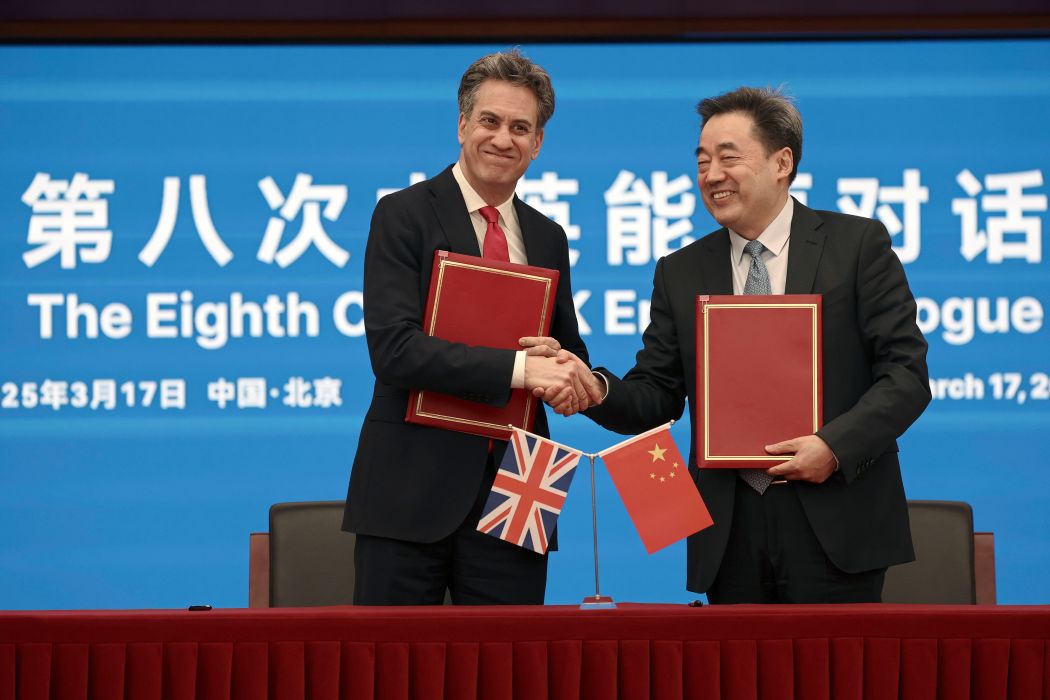
The Labour government has appeared to pursue a strategy closer to “de-risking” than “decoupling”: accepting that deep economic ties with China in sectors such as clean energy and critical minerals are unavoidable, but acknowledging that action is needed to reduce dependency.
European governments don’t want to communicate trade-offs
Reader says: “It’s an almost hawkish, anti-China argument to say, are we reliant on China? The whole world is reliant on China’s critical minerals and rare earths, whether you’re talking about wind, EVs, phone batteries, the toaster that you’ve just bought…
“I wouldn’t say we are more reliant on China because we have clean energy. We’re reliant on the critical minerals and rare earth minerals supply chain. What’s important is that the government is setting out strategies to deal with that upstream challenge… When we build the next batch of small modular reactors, the factory that builds the reactor has to be in the UK, so not in France, not in Taiwan, not in Korea, it has to be in the UK supply chain.”
The ‘de-risking’ approach has exposed tensions inside Whitehall between security hawks and departments such as the Treasury and the Department for Business and Trade, which are focused more on trade and investment. Business Secretary Peter Kyle, in particular, has been consistently keen on Chinese investment in the energy industry.
IPPR’s Narayanan argues policymakers need to be more precise about what dependency means. “What are the specific risks of buying things from China?” he asks. “Are we buying things that ultimately give the Chinese government some kind of access to our digital infrastructure or data?”
Rusi’s Marks argues that political leaders have avoided confronting difficult trade-offs. “What governments are meant to do is decide and to govern,” he says. “A lot of European governments – this isn’t just a UK problem – have just become technocratic, and all they really want to do is find win-wins: tweak this regulation, make this process slightly more efficient.
“They don’t want to communicate trade-offs. Nobody is preparing populations for what might happen if the Strait of Hormuz doesn’t open in the next two to three months. At no point have they come out and said we’re in a national emergency here.”
The energy transition may still reduce Britain’s exposure to the volatility of global fossil fuel markets, but the emerging debate suggests sovereignty in the age of net zero is becoming more complicated than simply replacing oil with wind turbines.
The challenge for ministers is no longer whether dependency exists, but which dependencies Britain is willing to accept and how much resilience it is prepared to pay for. It is a difficult balance for any government to strike, particularly one already grappling with multiple competing crises and mounting pressure to bring down energy bills for households still struggling through the cost-of-living crisis.

You must be logged in to post a comment Login