Politics
The House | It must be the Iranian people who decide their fate when the Islamic Republic collapses


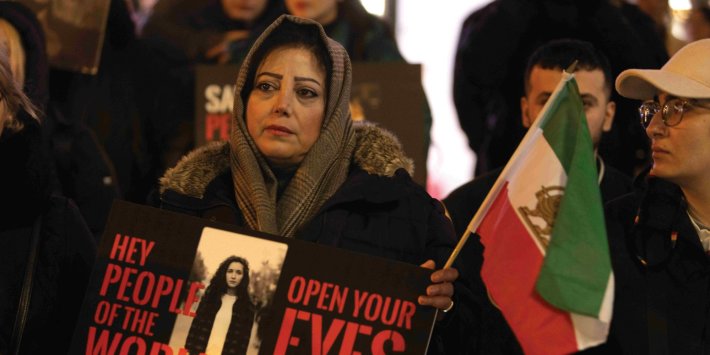
Glasgow, January 2026: A candlelit vigil for Iranian protestors | Image by: Jeremy Sutton-Hibbert / Alamy


4 min read
That the current regime has lost any sense of moral authority over the vast majority of Iranians is clear
It’s no secret that the situation in Iran is dire. What’s more difficult to determine is an accurate picture of precisely what is going on. We know that the protests that began towards the end of December spread fast and wide, on a scale not seen before in the catalogue of protests that have erupted intermittently, and been quashed violently, since the start of the millennium. This time, it was not only dissatisfaction with social issues but the virtual collapse of the economy which drove even the bazaaries – or shopkeepers – onto the streets in droves.
That the current regime has lost any sense of moral authority over the vast majority of Iranians is clear. Yet the Islamic Republic persists in power through a combination of breathtaking brutality and lack of a suitable alternative. This regime is undoubtedly in its final death throes – the violence demonstrates a desperate struggle to survive another day at any cost – but it’s impossible to say how long it will be before the final breath; will it be quick or long and drawn out? Either way it’s likely to be painful.
And what then? The real question is what will follow once the Islamic Republic collapses. There is no credible opposition around which others will coalesce, only factions and groups, each with their own agendas (some, incidentally, just as dangerous as the status quo). Whatever happens, it must be the Iranian people who decide their fate and build for themselves a better future. Certainly, the support of the international community is essential, but a new government imposed by, say, America, with a puppet leader will not do. That way lies the ongoing cycle of dissatisfaction and corruption, with a people beholden to the whim of external powers, ultimately involved, not because of altruism but for their own self-interest.
A new government imposed by, say, America, with a puppet leader will not do
Right now, foreign media are banned from entering the country and the internet shutdown has virtually cut Iran off from the rest of the world. At best there are sporadic reports; brief spells during which news leaks out and families here, desperate with worry, get snatches of information. I’m trying to stay in touch with a few people, but my WhatsApp messages remain, sometimes for days, showing one tick only – unseen and unread at the other end.
Reportedly, there are anything between a few thousand and 30,000 dead; no one disputes that many of them are young people. Whatever the precise number, it’s too many. And there are countless more injured or in prison. The people I’m in contact with tell me terrorist groups were rampaging the streets, killing and beheading government officials, while the regime didn’t distinguish between them and innocent protesters, clamping down with unprecedented violence.
There are rumours that medical staff treating the injured have been executed. One message I received a few days ago said, “As far as I know, everyone who helped the wounded has either been arrested or killed.” Another, that though “some medical staff were killed in the clashes”, reports of their “execution” is exaggerated. Unsurprisingly, the protests are getting weaker – I’m told they’re now restricted to rooftop chants at night-time – and so, while the country is gripped by “a great sorrow”, inevitably the media are losing interest. I suspect it will only be a matter of time before the cycles of protest and violence repeat themselves.
Meanwhile, the US is amassing troops, threatening to attack Iran, at the same time, holding conversations, hoping to reach some kind of resolution. The future is uncertain and people continue living under violent oppression, unimaginable fear and the catastrophic effects of a failed economy. And these are a proud people – the product of a once great and ancient civilisation; ordinary people longing for freedom, justice, the opportunity to live their lives to the full. They are my countryfolk and I weep for them; they deserve better, much better.
Lord Bishop of Chelmsford is a Lords Spiritual peer

You must be logged in to post a comment Login