Politics
The House Opinion Article | In defence of Sir Olly Robbins


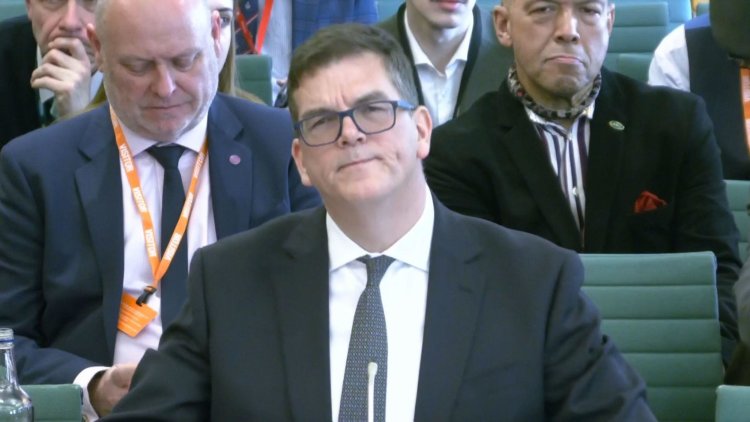
Sir Olly Robbins appearing before the Foreign Affairs Committee, April 2026 (PA Images / House of Commons/UK Parliament / Alamy)
5 min read
It was, without risk of hyperbole, humbling to sit behind Olly Robbins as he gave his evidence to the Foreign Affairs Committee on Tuesday.
Full disclosure: I’ve known Olly for over a decade. I’ve seen him operate in a variety of roles and it is telling that he has respect across the political divide. In his role as Theresa May’s Brexit negotiator, he was the devil incarnate to a tribe within the Conservative Party, but I watched David Davis brush past and tap him on the shoulder just before the committee session started.
As he said in his evidence, he has served numerous ministers and prime ministers of different political persuasions. Few would doubt, particularly after Olly’s evidence session, of his passion and commitment to public service, serving impartially the government of the day and critically ensuring that our country remains safe.
He’s spent almost half of his career in security roles, which is why his defence of the vetting process was not just some theoretical arcane civil service tradition – he passionately believes that maintaining its integrity is vital for our national security and he has a responsibility to protect it.
What we learnt from his evidence was that Olly stood firmly behind the decision he took to grant developed vetting (DV) – a level of security clearance required to work in the most sensitive areas of government – to Lord Mandelson.
He explained, repeatedly and with a patience that would have been lost on me, that in the Foreign, Commonwealth and Development Office (FCDO) the vetting work done by the UK Vetting Service (UKVS) is advice to the department – it is not a decision. In other departments, they accept the UKVS recommendations. FCDO is a DV-by-default department – the thousands of civil servants who work there all require this security clearance – so they make their own decisions. They will also consider other issues and may take a different view from UKVS, including at times not to grant clearance when UKVS are recommending they do. This is normal for FCDO and a number of other employers including the Ministry of Defence. They have a whole team of experienced professionals who do this.
We also learned from Olly’s evidence that it is not unusual for vetting to throw up issues of concern. Many of us have complicated lives and I don’t think anyone would describe Lord Mandelson’s history as straightforward. As Olly said, Mandelson may have had a complicated backstory, but the process for assessing – and mitigating – risks associated is one that FCDO have a wealth of experience of.
The characterisation that the government have been keen to promote – of a failed vetting overturned by FCDO º is not only factually incorrect but also a deliberate attempt to cast doubt over that decision. Suddenly, the Mandelson appointment becomes a question of Olly’s judgement rather than that of the Prime Minister.
We also found out that as part of the mitigation process, Mandelson had been required to pass an even more stringent security check; one carried out independently of the FCDO. Again, reinforcing the rigour around the decision to award DV. All of this points at a decision, albeit made under the intense pressure of pre-announced appointment, that Olly repeatedly defended.
Ultimately, the decision to sack Mandelson was nothing to do with any issue raised as part of the vetting process. It was the revelation around the extent of his contact with Epstein – the very issue that for many should have precluded his appointment in the first place.
The Prime Minister said that he would not have appointed Mandelson if he’d known questions were raised, and that he should have been told. To many, this may seem logical. Olly was at his most passionate on this because not only does he firmly believe that protecting the sanctity of the vetting process is vital for our national security but so did this government. In September, Stephen Doughty, a Foreign Office minister addressed parliament in the wake of the sacking of Lord Mandelson and said, “Ministers… are not informed of any findings other than the final outcome”. That statement, as Olly testified, was not only cleared by No 10 and the Cabinet office – No 10 explicitly wanted to emphasise it. Ministers are distant from the vetting process when it suits them.
Now the Prime Minister insists he should be told and that details can be revealed without compromising the confidentiality of the process. If you need evidence as to the risks of politicians having sight of these details, you only have to look at events of last week. Less than 48 hours after No 10 were given details on Mandelson’s vetting, it was splashed across the front page of the Guardian.
Accountable for his decisions and fiercely defending the values that help keep our country and citizens safe at home and abroad, Olly’s evidence to the committee showed a committed, passionate public servant. The contrast with the spectacle of the previous day in the House of Commons could not be more stark.
Dave Penman is general secretary of the FDA trade union for civil servants

You must be logged in to post a comment Login