Politics
The House Opinion Article | Who’s Behind The Wheel Of Self-Driving Taxis?


7 min read
A security check on a fleet of new electric buses in Oslo late last year uncovered features that caused international alarm.
The 300 Yutong buses were sending data back to its manufacturers in China. The company insisted this flow was necessary to “optimise” their performance.
But Norway’s transport authorities moved to prevent access to data being sent to China. They also said they had mitigated any possibility of a ‘kill switch’ that could be activated by the manufacturer crippling the fleet from afar.
The incident brought into sharp relief the challenges the Chinese-dominated market in electric vehicles are posing western policymakers – made all the more acute with the advent of self-driving cars.
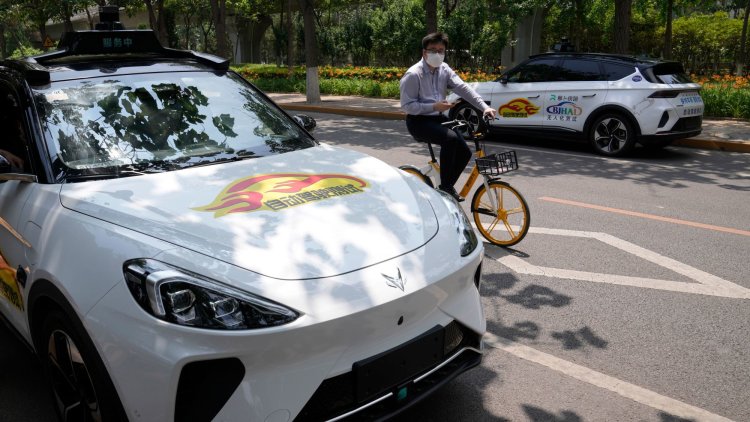
China dominates the global EV market, with its home-grown company BYD overtaking Tesla as the world’s largest electric carmaker last year. Amid reports that Chinese self-driving taxis could be trialled in the UK as soon as this year, MPs and peers from across the political spectrum are urging caution.
The BBC reported in December that Uber and Lyft had unveiled partnerships with Chinese tech giant Baidu to pilot these taxis in London, which Transport Secretary Heidi Alexander called a “vote of confidence in our plans for self-driving vehicles”.
But Alex Sobel, Labour MP for Leeds Central and Headingley, tells The House he is worried these partnerships – and others with Chinese firms – could open the door to major data vulnerabilities. Under Chinese law, companies operating within its national borders are required to hand over any data requested by the authorities in Beijing.
“I am concerned that people’s personal information potentially can be shared with the Chinese state and used for a variety of purposes, if you are particularly concerned for certain communities – for instance, from Hong Kong, from Tibet, Uyghurs, or Chinese who have a dissenting view from the Chinese government,” Sobel says.
Chinese activists defying their government don’t only face persecution at home. Beijing conducts an extensive campaign of transnational repression against dissidents and critics – such as posting bounties against high-profile Hong Kong democracy campaigners who fled to safety in the West.
“Transnational repression is becoming increasingly sophisticated,” Sobel says. “And I’m not just saying that about China or other countries as well, but other countries don’t have as much reach and penetration to the UK as China.”
Sobel adds that while he believes there should be a kill switch in any AI-powered devices as a failsafe mechanism, such switches should be in control of the country’s government in which the technology is operating.
“If the Chinese state decided, for whatever reason, they want to act in a hostile way towards the UK and kill all of these off at a point in time when there’s a deep penetration in the UK, obviously that would have a massive effect.”
North Durham Labour MP Luke Akehurst is another with concerns. He posed a written question to the Transport Secretary in January, asking her to assess the risk “that electric buses operating in the UK could be remotely rendered inoperable via their internet-connected systems by hostile state actors”.
Dr Alessandro Arduino, an affiliate lecturer at King’s College London, tells The House that robo-taxis and other self-driving vehicles offer a “revealing case study” in how new technology can sit on a fine line between fresh innovation and national security dangers.
He notes that these cars generate reams of data as they drive – from location information to citizen movement and urban layout. “Such data is invaluable not only for training artificial intelligence systems but also for forecasting and strategic analysis,” he says. “China’s own policy framework is explicit in treating data and AI as matters of state sovereignty and national security, and I do believe that context matters.”
Such a dramatic threat as a kill switch would not be the first order concern, he adds, saying that the most urgent consideration is whether operating companies can keep their data secure from malicious actors.
A Transport for London (TfL) spokesperson says: “Safety is our top priority, and we are interested in learning more about technologies that could potentially help deliver safety benefits for all road users.
“TfL recognises the challenge of legislating in response to changes in automated vehicle technology in a timely manner to ensure benefits are delivered and risks are mitigated.”
It is not the first time the use of Chinese tech in Britain’s infrastructure has faced fierce opposition over national security fears. In 2020, the government halted the use of Huawei equipment in Britain’s 5G network and ordered that existing tech be removed by the end of 2027.
But it comes at a time when Downing Street is seeking a reset in relations with China after a frosty few years. In January, the controversial Chinese new ‘mega-embassy’ in London was granted planning permission – despite repeated concerns over its proximity to crucial fibre-optic cables and potential for heightened espionage.
Keir Starmer has also now become the first British prime minister to visit Beijing in eight years, travelling along with a cohort of business leaders in a drive to reap the vaunted benefits of dealing with the world’s second-largest economy.
The Prime Minister’s visit saw the announcement of plans to allow British citizens visa-free travel to China and the lifting of sanctions on MPs who had blasted Beijing’s repression of Uyghur Muslims.
Former Conservative leader Iain Duncan Smith MP, a persistent China ‘hawk’, says he would like to see a pilot of self-driving taxis in the UK blocked if it uses Chinese technology. “They all basically data-harvest those who use them. It goes all the way down the line.”
Chinese companies such as Baidu have also long been criticised for their role in online censorship in the country, where the government maintains fiercely tight control over the information space.
Sam Goodman of China Strategic Risks Institute tells The House: “Given the integral role Baidu plays in internet censorship in China, and its legal requirement to share users’ data with China’s Ministry of State Security, it is hard to see how it can be trusted with the data security and personal safety of the British public.”
As AI technology, including that used in self-driving vehicles, continues to advance at breakneck pace, governments across the world have been left scrambling to find a policy answer on how best to regulate the sector and mitigate its risks without suffocating innovation.
Professor James Davenport of the University of Bath tells The House that lawmakers face grappling with both the novelty and broad range of AI technologies as they figure out effective regulation. “For example,” he explains, “the EU AI Act will impose the same requirements on self-driving taxis as on chatbots offering psychiatric advice. The alternative would be an enormous mass of detailed legislation and incredible turf wars.”
Liberal Democrat MP Wera Hobhouse, who was refused entry to Hong Kong last year, says the proposed pilot “fits a worrying pattern of the government growing far too cosy with Beijing”. Hobhouse is among the voices who believe the pilot should not go ahead until the government can categorically prove there would be no risk posed to national security or public safety.
She tells The House: “From approving a Chinese super-embassy in London to pushing ahead with closer economic ties despite repeated security warnings, the government are sending the wrong signal: that trade is being prioritised over security, human rights and the safety of those who have fled repression to build new lives in the UK.”
A government spokesperson tells The House: “Safety is central to our plans for automated-vehicle pilots. All proposed deployments will be subjected to rigorous safety and cyber-security assessments.”
Baidu did not respond to a request for comment. It has previously denied allegations of links to the Chinese state and military. An Uber spokesperson said: “No matter which country an AV partner is from, we only work with them if they can both meet Uber’s own high standards and fully comply with all applicable laws on safety, security, and privacy.” Lyft did not reply to requests for comment.

You must be logged in to post a comment Login