Politics
The House | Rishi Sunak On AI: I Wish I’d Spoken To The Country More About The Change Coming


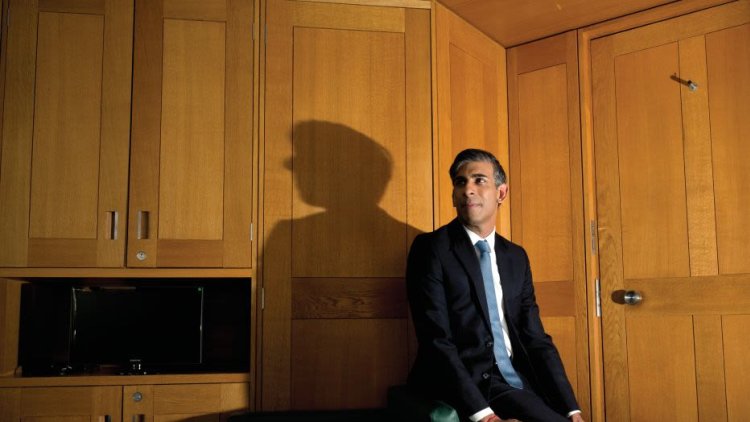
Photography by David Sandison


10 min read
Britain is well-positioned to benefit from the AI revolution, but its workforce may be more exposed than many others. Rishi Sunak tells Francis Elliott how he wishes he had done more to help voters prepare for what is about to come
Rishi Sunak has more time on his hands these days. Not just because he is out of No 10 but also because he is recuperating from a skiing accident caused by ‘showing off’ to his daughters.
In between the pain relief (“a lot of tramadol”) and the physiotherapy, the former prime minister has been building his own AI tool. In will go 20 episodes of his favourite podcasts and post-broadcast social media commentary on them, out will come a short precis that keeps the Richmond MP bang up to date on the issue about which he most cares.
He’s understandably quite chuffed with his new tool, having learned how to build it from a series of free online courses designed to improve AI skills.
“I’m about to turn [this] into something where, instead of having hundreds of pages of transcript, I would just get the three-, four-page, weapons-grade stuff that I need done, completely automatically, every single week.”
This may be peak geek chic, but it is also Sunak practising what he preaches: if you don’t want AI to consume you, you better start consuming AI. The 46-year-old may not have had a mandate or much of a majority as prime minister but, in starting to prepare the UK for the AI revolution, he has emerged with something of a legacy.
Advisory jobs at Anthropic and Microsoft keep him on the frontline of the policy implications of what tech leaders and politicians delicately call “the challenges of the transition” but the rest of us fear is massive, potentially destructive disruption.
Until relatively recently, the consensus had held that AI, like every other so-called general-purpose technology, would in short order create more jobs than it automated. Just as in the 17th century, nobody could conceive of the job as an electrician, so we today cannot comprehend the jobs AI will create.
But Sunak is one of those, like Anthropic boss Dario Amodei, who is – in terms of labour market disruption – starting to shift to a rather less rosy position: that this time it might be different.
“It’s both the breadth and the pace. If you compare in the past, and a nice way to measure it is, how long did it take a technology to get to, say, 100 million users? For electricity, it took about 70 years. Telephone, 50 years. PC, 15. Internet, seven years.
“It took ChatGPT two months. That gives you a sense of how quickly this is [taking place]. Why does that matter? Because history would tell you, these things over time have always worked out, and that new jobs have been created.
“Now, where that might break down is if the disruption is happening so quickly before you get all the new jobs being created. If it just happens so fast, you will get more concentration of job losses first before the new jobs come along.
“The second [factor] is because it is so broad. In the past… general-purpose technologies… would displace employment from a particular area, but there were multiple other opportunities that that person would be able to find work in, that were not disrupted by the same technology.”
He says “this time it’s different” are among the most dangerous words in the English language, but it’s not an implausible outcome. “And certainly not so implausible that a leader should just assume the best.”
Which takes us to Keir Starmer. Sunak gives the Starmer government credit for taking forward the agenda. He recently appeared with David Lammy selling Britain to an audience of AI leaders gathered in Delhi and has met with both Peter Kyle and his successor as tech secretary, Liz Kendall. He says they are broadly doing the right things.
But he clearly thinks Starmer hasn’t the bandwidth or the capacity to make preparing the country for what is to come an absolute priority, and admits he wished he had done more while he was in No 10.
“I wish I had done more on it, and that I’d spoken to the country more about the change that is coming and what it means for us, and how we can make sure it works for the country, how it works for families, how it works for our public services, how it’s going to be good. But also to give people the reassurance that they need, because there’s a lot of anxiety out there about what it means to them.
“You can only have, as prime minister, a handful of personal priorities that you are going to drive through the system that emanate from your office in Downing Street, that the entire system and the entire country knows are your priorities. That is the only real way to change something of this magnitude. This [issue of AI] is, and should be, for the country’s sake, one of those three things.”
Starmer is possessed of a rather different priority at the moment, as Sunak acknowledges.
“The problem with all the drama that we’ve seen in the last week, when these things happen, governments stop governing, essentially, and they start focusing on survival.”
Domestic squalls will pass; the question of how the UK copes with geopolitical and technological dislocations will sustain.
“If you look at the two things that have just changed, we as a country need to make sure that we are prepared for them. It’s a geopolitical environment that has changed, and the fact that we’re on the cusp of this enormous, significant technological revolution, are the two most dominant structural forces out there.”
Does Sunak agree with Nick Clegg, another who found a berth on the US west coast after government, that talk of UK AI sovereignty is “dishonest”? In as far as sovereignty means the UK being entirely independent, Sunak agrees that this is a fiction.
The US and China will continue to exert huge leverage over other nations because of their dominance over the emerging technology. But Sunak says the UK has cards to play and that it needs only to make itself “indispensable” in part of the supply chain to protect itself.
As a Conservative, Sunak is suspicious of the ‘picking winners’ element of the government’s new AI Sovereign fund, but sees the value in putting resources – not just cash but computing power – behind potential capabilities that might, in time, serve as vital national assets.
New hardware innovations – chip-making – are among the start-ups that have been given taxpayers’ cash. Other assets include the AI Safety Institute which seems well-positioned to serve as the world’s premier kitemarking service for Big Tech to show consumers their products won’t do serious damage. (Anthropic recently submitted its new Mythos tool to the ASI for evaluation.)
I wish I had done more on it, and that I’d spoken to the country more about the change that is coming
UK biotech and access to NHS data also mean the country is well-placed to make the most of a coming explosion of new drugs and treatments powered by AI.
These are, Sunak agrees, “reasons to be cheerful”. Even better, he says, is another lesson from the other times the world has been transformed by new technology.
“History tells you that you don’t need to be the place that invents the technology to be the place that benefits the most from it,” starts an enthusiastic Sunak. “I geek out about this all the time.
“The printing press is my favourite example. That’s invented in Germany, in Mainz, the Dutch were the ones that run away with it. But you look at why it’s fascinating, it’s because of a couple of reasons.


“One is they didn’t have censorship laws. So, obviously, if you’re a printing business, you’ve got to have these very stifling laws in Germany, what you could and couldn’t say in print. They didn’t have that in the Netherlands – free for all.
“The second thing is, they didn’t have guilds like the Germans. These old-school trade union closed shop decided [who could and could not operate a press]. And then the third thing is, because there were more advanced financial markets in Amsterdam, the companies could hedge paper costs, right? Which really matter, because they were volatile.
“So, that’s why the Dutch became [the world’s] publisher, right? So, you don’t need to be Beijing, you don’t need to be Silicon Valley. This technology exists. It’s out there. We should be trying to win the race for what I call everyday AI.”
It’s a full-fat free market interpretation from a man who is, after all, paid to keep the regulators at bay. But he is not as aggressive as some Tories on the threat to AI from any EU reset, noting that the Commission itself is trying to unwind some of its early attempts to bring US tech giants to heel and that Starmer has largely followed his own hands-off approach.
Nor is he particularly exercised about the relatively high energy costs making Britain a less attractive place to build data centres – a huge number of which will be needed to power the AI revolution. He does, however, say the government ought not to be “ideological” about letting data centres source their energy from fossil fuel sources.
He sees both sides of the debate about whether to ban under-16s from social media, noting the design challenges of that policy but also its utility in making it easier for parents to set rules.
When these things happen, governments stop governing essentially and they start focusing on survival
Despite the noise around social media, so far the so-called ‘techlash’ in the UK has been muted compared to that which is starting to shape US politics. There is no high-profile equivalent of Bernie Sanders, the Democrat senator leading the campaign against data centres, or Steve Bannon attacking AI from the populist right.
But the fact is that the UK’s economy is dominated by just those sectors that appear to be most vulnerable to labour market disruption.
That AI models can already reliably replicate many, if not most, of the tasks carried out by many so-called knowledge workers has huge potential implications for this country. The upside is an economy that receives an outsize productivity boost – the downside is a white-collar bloodbath so bad it potentially shatters the social contract.
Some AI insiders apparently have started to become profoundly worried about the societal implications of a technology that could turbocharge existing inequalities, concentrating ever more wealth in the hands of a tiny number, while also creating a “permanent underclass”.
Sunak wants political leaders in the West to move fast to reassure voters that they will be helped through the transition. The UK particularly cannot afford to miss out on a change that could at last lift it out of its decline.
There is still plenty of time to ensure that AI augments and does not just automate. Governments can rebalance the tax system to favour labour, he says. Workers, meanwhile, have time to learn the AI skills that will make them more attractive to employers.
“The biggest risk in all of this is if you just put your head in the sand and try to ignore it. The bigger risk is we will get left behind and become less competitive and efficient than other countries,” Sunak warns.
“We happen to have more knowledge workers [than] other countries. I think the bigger risk is we don’t embrace this wholeheartedly and as quickly as others…
“There is currently, in the West, a trust deficit when it comes to AI, for sure. In contrast to places like India, China, the Gulf, Singapore, where positivity and trust around AI is very high, in Western countries here – the US in particular – it’s very low.
“And we do need to change that because if that persists, all these wonderful benefits I think this technology can provide will never get realised because it will either be regulated or banned or just not adopted.
“We have to create an environment where people feel more positive about the technology in order for us as a society to actually get the benefits.”

You must be logged in to post a comment Login