Politics
The House | The UK is cutting aid as progress on child mortality stalls. This is not the moment to retreat


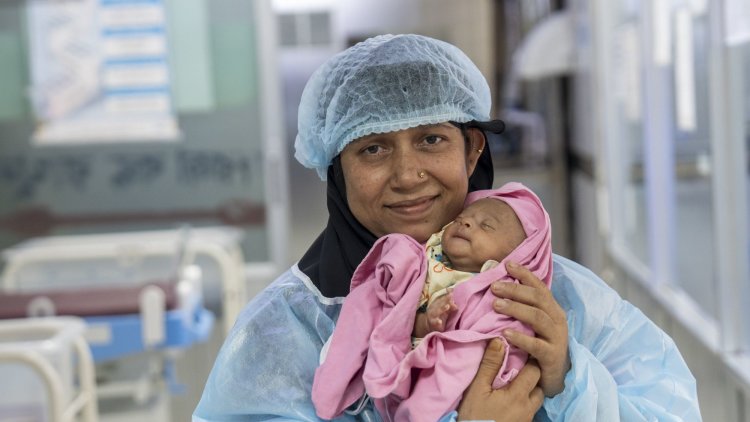
Misnahar and newborn son, Sarid. (Credit: UNICEF/2025/Saikat Mojumder)


Dr Philip Goodwin, Chief Executive Officer
4 min read
On a November morning in Cox’s Bazar, Bangladesh, an auto-rickshaw sped towards the district hospital. Inside, 37-year-old Misnahar had just given birth.
Her son, Sarid, had arrived far too early – weighing just 900 grams, and immediately showing signs of respiratory distress. Health workers rushed him to the Special Care Newborn Unit, placing him on oxygen and surrounding his tiny body with tubes and wires. For the first 24 hours, Misnahar could only wait and watch through the glass.
Today, Sarid weights 1.5 kilograms and is growing stronger. He survived because skilled care was there when he needed it, enabled by sustained investment – from governments, partners and organisations like UNICEF. It is proof that we know how to save children’s lives. The question is whether the UK will continue to help fund it.
Last week, the UN released its most comprehensive picture of annual child mortality globally. The findings are sobering. In 2024, 4.9 million children died before their fifth birthday – nearly half in their very first month of life.
Child mortality has more than halved since 2000, but that momentum has flatlined. In 2020, 5 million children died before their fifth birthday; in 2024, that figure had barely shifted. These are not inevitable deaths. The leading killers of children under five – preterm birth complications, malaria, pneumonia, diarrhoea, malnutrition – are largely preventable with proven, low-cost interventions. Immunisation. Skilled care at birth. Quality antenatal services. The tools exist. Yet the past few years have seen the gradual erosion of the political commitment and investment required to reach every child.
We know that investing in children delivers some of the highest returns on investment. Children who are vaccinated, well-nourished, educated are more likely to grow into adults who support their communities, strengthen their economies and contribute to a more stable world. That is why UNICEF UK has repeatedly warned that last year’s decision to slash the Official Development Assistance (ODA) budget by 40 per cent would have devastating consequences for the world’s most vulnerable children. Last Thursday’s aid allocation offered the first glimpse of what this will mean in practice.
The consequences for children are stark. Multilateral commitments to global health will be reduced by 23 per cent, while regional bilateral aid to African countries – where the majority of child deaths occur – will collapse by 56 per cent. Funding to safeguarding programmes is disproportionately reducing, putting children’s safety further at risk. Support for the Global Polio Eradication Initiative has been cut entirely, just as the world was on the verge of eliminating a deadly yet preventable disease for good.
The UK government’s decision to use the aid budget to cover refugee costs at home is a significant part of the problem. In 2026/27, £2.2 billion – significantly more than all multilateral spending combined – will be spent in the UK rather than reaching the children who need it most. When that forces a choice between funding polio eradication and other life-saving programmes for children, it is hard to argue that UK aid is still serving its original purpose – protecting the world’s most vulnerable people.
The progress of the past 25 years – child mortality more than halved, diseases driven back, millions of live saved – was built on global partnership and sustained investment. The UK has been a major part of that. To step back now, when that progress is most fragile, would be a betrayal of the children who still need it most.
UNICEF UK is calling on the UK government to commit at least 25 per cent of the UK aid budget to children – the investment needed to protect immunisation and nutrition programmes and to train the frontline health workers who make these life-saving services possible. Next month’s Global Partnerships Conference offers the government a key opportunity to show that children are central to its new vision for development.
Misnahar’s dream for Sarid is simple: that he grows up to become a doctor or nurse. “The people here saved my baby’s life,” she said. “Maybe one day he can save others.” That future is possible – for Sarid and other newborns like him – if the support systems that saved him are still standing.
Dr Philip Goodwin is chief executive of UNICEF UK

You must be logged in to post a comment Login