Politics
The House | Without a real political horizon for Gaza, peace, self-determination, and two states remain impossible


5 min read
As the international community turns its attention to Phase 2 of the Gaza process, there is once again a temptation to believe that stabilisation, reconstruction, and new administrative arrangements can substitute for politics.
In short – they cannot. Gaza cannot be rebuilt – physically or psychologically – without a credible political horizon that speaks to dignity, security, and self-determination.
I have spent many years engaged directly in the Middle East Peace Process, working with Israeli and Palestinian leaders across successive crises, ceasefires, and diplomatic initiatives.
One lesson stands above all others: when politics is deferred, violence returns. When the end goal is unclear, even the most well-intentioned interim arrangements eventually collapse under the weight of mistrust. Three decades on from the Oslo Accords, one state exists, Israel – the other, Palestine, does not.
It is in that context that the Olmert–Al-Kidwa initiative deserves renewed attention and support – not as an artefact of a more optimistic past, but as one of the clearest demonstrations in recent decades of what serious political courage looks like. It is the only living document signed by a prominent Israeli and a Palestinian.
I had the privilege of working directly with both Ehud Olmert and Nasser Al-Kidwa on their plan. They approached the task not as a public relations exercise, nor as a symbolic gesture to the international community, but as a genuine attempt to resolve the conflict at its core. Their dialogue was rooted in realism, honesty, and an unflinching recognition of each other’s national narratives and security concerns.
The Olmert–Al-Kidwa plan does something rare: it spells out, in practical and detailed terms, how a negotiated two-state solution could actually be delivered. It addresses borders based on the 1967 lines with agreed land swaps; it deals seriously with security arrangements to ensure Israel and Palestine’s long-term safety; it proposes an internationally supported framework for Jerusalem that respects the religious and national attachments of both peoples; and it confronts the refugee issue with realism rather than slogans.
Crucially, it makes clear that Palestinian statehood is not an abstract aspiration or a diplomatic reward to be deferred indefinitely. It is the organising principle of the entire process.
The objective is not merely recognition on paper, but the establishment of a viable, sovereign Palestine – living in peace and security alongside Israel, with borders, institutions, and legitimacy rooted in international law and mutual recognition.
This initiative has been sustained through years of quiet engagement, and notwithstanding the tragic terror attack on Israel of October 7th 2023 and the ensuing war on Gaza – facilitated discreetly by the International Communities Organisation (ICO), who provided a space for political thinking to continue when optimism was in short supply.
The plan demonstrates that even when official negotiations stall, conflicts ignite. Political thinking must not. They are practitioners and experienced political leaders who understand that peace requires both technical solutions and moral courage.
At the time, the plan received considerable attention, most notably across Europe. In France, in particular, the proposal helped re-energise high-level thinking around Palestinian self-determination and recognition.
The subsequent return to violence was not a refutation of that political work; rather, it underscored what happens when such efforts are abandoned and progress is not consolidated during brief windows of opportunity.
The US led Phase 2 announcements – focused on governance structures, demilitarisation, and reconstruction – contain echoes of that earlier thinking. But echoes are not enough. Administration without legitimacy, reconstruction without reconciliation, and security without political destination will not hold.
Having worked through previous ceasefires and collapses, I am deeply wary of approaches that promise order while avoiding the harder questions of statehood, sovereignty, and rights.
Palestinians must be able to see that reconstruction leads not to permanent limbo, but to genuine self-determination. Israelis must be able to trust that political progress will deliver enduring security, not temporary quiet.
If Phase 2 is to be more than a holding pattern, it must reconnect explicitly to a political end-state. The Olmert–Al-Kidwa plan shows that such an end-state is not imaginary. It is negotiable, achievable, and grounded in the lived realities of both peoples.
The recent establishment of President Trump’s ‘Board of Peace’ and its endorsement by many Arab countries and some key nations across the wider Islamic World also provides an opportunity, if seized, to a genuine pathway to sustainable peace and with a united political will to finally deliver upon a sovereign state of Palestine.
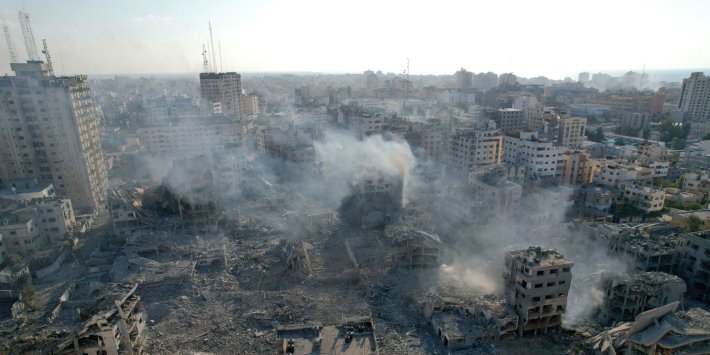
Gaza’s ruins will not be cleared by technocrats alone. Its future will be secured only when the international community has the courage to insist that today’s plans lead somewhere real –towards a Palestine living in peace and security with Israel, and towards a settlement that finally brings an end to a conflict that has exacted too heavy a price from both nations and people. Let us grasp this moment and make peace a living reality.
Lord Tariq Ahmad of Wimbledon, Chair of ICO’s Advisory Board, is a British diplomat and parliamentarian who served as a Minister of State at the UK Foreign Office, with responsibility for the Middle East, South Asia, the Commonwealth, and human rights, and as the Prime Minister’s Special Representative on Preventing Sexual Violence in Conflict.

You must be logged in to post a comment Login