Politics
The paradox of selectivity – UK in a changing Europe
Jonathan Portes analyses how increasingly strict immigration policies may have impacted the overall economc contribution of migrants in the UK. He argues that if the objective is to maximise economic contribution, the UK system may now be ‘too selective’.
All advanced economies have “selective” immigration policies. Unless a country closes itself off to immigration entirely, or has fully open borders, this is inevitable. And politicians and economists generally agree that one important criterion on which policies should be based is that of economic contribution – that is, giving some preference to those who are likely to contribute positively to the host country’s economy. This is rarely the only criterion – others, such as legal and moral obligation to refugees, the ability of families to reunite across borders, and so on – also matter. And it can be measured in different ways – earnings, current or prospective, likelihood of making a positive fiscal contribution, skills or qualifications that are seen as particularly likely to be beneficial, and so on. But all systems use one or more such measures.
This perspective has informed the UK policy debate before and after Brexit: the coalition government’s desire to reduce migration while attracting the “brightest and the best”, Vote Leave’s promise of a “skill-based points system”, the post-Brexit migration system that equalised conditions for EU and non-EU origin migrants while setting earnings and skills thresholds, and the decisions by both the Sunak government and the current one to substantially tighten these thresholds while barring entry entirely in some occupations, particularly care work, where most workers are relatively low-paid.
In particular, the story of the post-Brexit period would seem very clear. In the face of post-pandemic labour shortages, and in an attempt to mitigate the negative impacts of Brexit, the system for non-EU migrants was radically liberalised – that is, it became significantly less selective – in 2021. As a consequence, numbers soared, with particularly strong growth among less well-paid migrants, especially in care. More recently, partly as a result of political backlash, policy was tightened substantially in 2024 and 2025 and numbers arriving, especially to work, fell sharply.
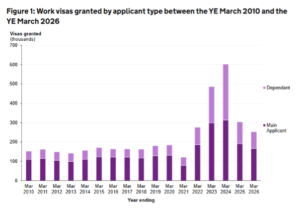

Given these changes in selectivity operated primarily through salary thresholds, the obvious implication is that new non-EU migrants arriving after 2021, but before 2024, should have had substantially lower earnings than those arriving either before 2021 (under the pre-Brexit system) or after 2024 (after the substantial rise in salary thresholds that was introduced then). There is just one problem. The data says otherwise.
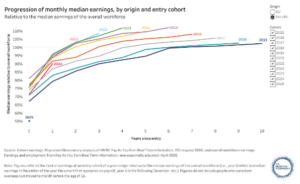

Using HMRC data, we can track the earnings of migrants by the year in which they entered the UK employee workforce. As the above narrative suggests, there was indeed a sharp rise in new entrants from 2021, and a more gradual fall from 2023 to 2025. However, we see no evidence at all that earnings were lower during this period of lower selectivity. Indeed, quite the opposite. The median earnings of non-EU migrants who entered the employee workforce in 2018 attained parity with the whole workforce in three years; for those who entered in 2022 and 2023, it took only two years, a slight but visible improvement.
And what about those who entered in 2024, after the tightening? So far they seem to be tracking the 2018 cohort rather than the later ones. And those who entered in 2025 have extremely low earnings compared to any of their predecessors, although we cannot attach too much weight to the first year figure, which may be dominated by students working part-time. Broader labour market conditions, which seem to have disadvantaged new entrants to the labour market across the board, may also have played a part here.
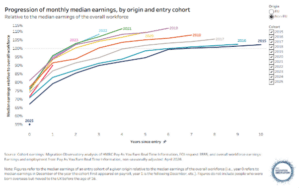

In other words, the 2021 move to lower selectivity and much higher numbers does not appear to have reduced either initial earnings or early years earnings progression among new non-EU migrants, if anything the opposite; outcomes did not worsen, but may have improved. And the very sharp reversal, designed to increase selectivity, appears, although any conclusions must be very tentative at this stage, to have coincided with a substantial worsening of labour market outcomes – precisely the opposite of what might have been expected and what policy was intended to achieve.
What is the explanation? First, it is important to note that increasing the selectivity of ’economic’ routes may well, paradoxically, reduce the selectivity of the migration system overall. By definition, those coming on work visas are likely to be in full-time work, and, even under a relatively liberal system, most will be on average or higher earnings; by contrast, those coming through other routes – family, refugee routes or asylum – often will not be in work, especially at first, and may often be on low earnings. So reducing work flows may increase the average earnings of work migrants, but may reduce the average earnings of new migrants overall (and indeed the overall workforce).
This seems very likely to be part of the explanation here – while care workers and others in middle-skilled occupations excluded by recent policy changes are not generally highly paid, they and their dependants are not (especially if they work full-time, as most do) at the lower end of the earnings distribution either for new migrants or for the population as a whole.
Second, even within economic migration routes, tightening the rules, supposedly to favour the “brightest and the best” may in fact deter them. As is often observed, we can choose migrants, but they also need to choose us – and those who are most likely to be economically beneficial have the most choice. As thresholds, fees and bureaucratic burdens rise – and policy changes signal a more hostile environment towards immigration and immigrants more generally – these workers may substitute toward alternative destinations, even if they remain formally eligible.
Does this mean that there is no point trying to select migrants on economic grounds? No – as noted above, some selectivity is inevitable, and at some point, lowering requirements will indeed reduce average outcomes. But it suggests that, if the objective is to maximise economic contribution, the UK system may now be ‘too selective’: a liberal and flexible system towards economic migration routes is likely to produce better results overall than one whose primary aim is to limit eligibility to a very narrow set of potential migrants.
[The data in this blog is taken from my work with Ben Brindle and Madeleine Sumption of Migration Observatory, published here. The opinions expressed here are my own.]
By Professor Jonathan Portes, Professor of Economics and Public Policy, Department of Political Economy, King’s College London.
You must be logged in to post a comment Login