Politics
The UK’s favourite butterfly has been revealed

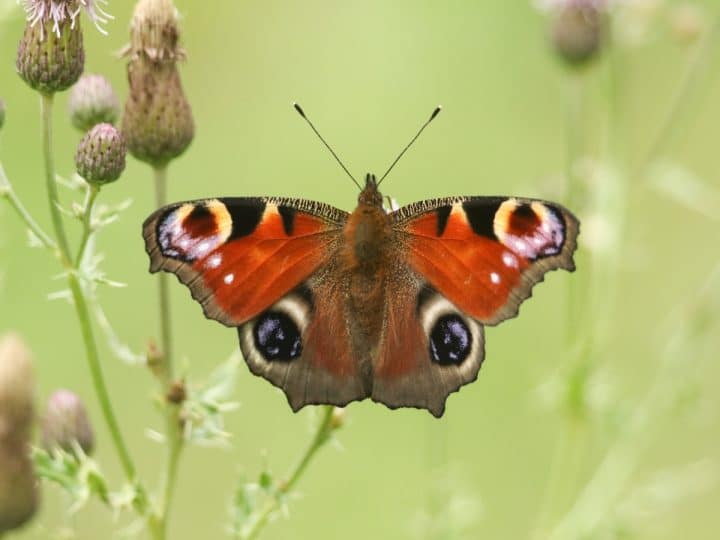

Wildlife charity Butterfly Conservation has today revealed that the colourful peacock has beaten off fierce competition from a colourful cast of species to take the top spot as Britain’s Favourite Butterfly.
Topping the first-ever vote to find the nation’s champion, the garden favourite beat 59 other butterflies to claim the highly coveted title. See the full run-down below. The poll saw over 20,000 votes cast across the UK between 15 May – 7 June.
Engaging the public, with votes like this and with the forthcoming Big Butterfly Count, helps scientists track the fortunes of butterflies. And that can give important insights into the state of nature in the UK.
The top five was a rainbow of colour, with the orange-tip coming a close second, red admiral third, holly blue in fourth, and the bright yellow brimstone coming in fifth. But ultimately, the stunning peacock, with its eye-catching and instantly recognisable beauty, stole the nation’s hearts.
Butterfly Conservation’s head of engagement, Kate Merry, said:
The response to Britain’s Favourite Butterfly has been absolutely wonderful, and we’re not surprised. It’s clear that people up and down the country love butterflies of all shapes, sizes and colours, and voted in their thousands for their favourites.
The peacock is a worthy winner; it’s a true showstopper and a species that I bet a lot of us picture when we think of butterflies.
It’s been really special seeing people get so passionate about their favourites and throw their support behind them! Now we can’t wait to see how many Peacocks are spotted up and down the country in this summer’s Big Butterfly Count.
Butterfly emergency
The result comes at a critical moment for the UK’s butterflies. In 2024 Butterfly Conservation declared a butterfly emergency after numbers recorded during its Big Butterfly Count fell to their lowest ever.
Now the charity is calling on everyone, everywhere to take part in this year’s Big Butterfly Count between Friday 17 July – Sunday 9 August. It’ll help conservationists get an updated picture of how the UK’s most common butterflies are faring.
The top five – a rainbow of joy across the country
The Peacock, Britain’s official favourite, is an iconic butterfly. This showstopper is instantly recognisable with its striking colours and stand-out eye-spots, a remarkable evolutionary defence mechanism designed to ward off predators many times its own size.
It is a regular visitor to gardens and green spaces across the whole of the UK, particularly where patches of nettles can be found as they are its caterpillars’ favourite foodplant.
Completing the top five in the vote to find Britain’s Favourite Butterfly are four species that between them create a kaleidoscope of colours and show why Brits love butterflies so much.
In second place, the Orange-tip is a worthy runner up, with its glowing white wings and vivid tangerine tips in the males, this uplifting species is a sure sign of spring and that warmer summer days aren’t far away.
Taking third is the Red Admiral whose striking jet-black wings, bold red bands and white spotted tips make it one of the most iconic species in the UK. A long-distance migrant, it travels all the way from North Africa to flutter around UK gardens each year, although it is now commonly sticking around through the winter, a sign of our warming climate.
In fourth, the fairy-like Holly Blue, which counts British icons Dame Joanna Lumley and Geri-Halliwell Horner amongst its fans. Its powder-blue wings are a shimmering delight when spotted in gardens, this species has been steadily spreading northwards in recent decades, bringing its appealing beauty to gardens and hedgerows across more of the country than ever before.
And rounding out the top five, the Brimstone, whose sunshine-yellow wings may have given all butterflies their name – the original butter-coloured fly, whose appearance is often heralded as the first sign of spring.
The Big Butterfly Count
The Peacock, Red Admiral, Holly Blue and Brimstone, along with 16 other butterflies and day-flying moths, can be recorded as part of this summer’s Big Butterfly Count in July and August.
Butterfly Conservation’s Big Butterfly Count is the world’s largest butterfly survey, and this year it carries greater urgency than ever. Conservationists are hoping that a surge in public participation in 2026 will both improve the data picture and help galvanise support for butterfly-friendly habitats across the UK.
Merry added:
Taking part in the Big Butterfly Count couldn’t be easier, simply spend 15 minutes in any outdoor space and count the butterflies and day-flying moths you see and submit your sightings to help build our interactive map.
This information will help conservationists to see how some of our more-common species are faring, which in turn helps to build a wider picture of how all butterflies and moths are doing.
It’s easy, fun for all the family, and a great excuse to get outside and experience the simple joy of spotting butterflies.
This year’s Big Butterfly Count takes place from Friday 17 July – Sunday 9 August. Simply download the free app, spend 15 minutes in any sunny spot and record the number and types of butterflies spotted. Find out more here.
Britain’s favourite butterfly – list of 60 butterfly species in ranked order
- 1 Peacock.
- 2 Orange-tip.
- 3 Red Admiral.
- 4 Holly Blue.
- 5 Brimstone.
- 6 Comma.
- 7 Common Blue.
- 8 Small Tortoiseshell.
- 9 Swallowtail.
- 10 Painted Lady.
- 11 Speckled Wood.
- 12 Small Copper.
- 13 Marbled White.
- 14 Adonis Blue.
- 15 Purple Emperor.
- 16 Chalk Hill Blue.
- 17 Gatekeeper.
- 18 Green Hairstreak.
- 19 Purple Hairstreak.
- 20 Large Blue.
- 21 Silver-washed Fritillary.
- 22 Marsh Fritillary.
- 23 Silver-studded Blue.
- 24 Scotch Argus.
- 25 Small Heath.
- 26 Clouded Yellow.
- 27 Small White.
- 28 Small Blue.
- 29 White Admiral.
- 30 Meadow Brown.
- 31 Ringlet.
- 32 Wall.
- 33 Large Tortoiseshell.
- 34 Large White.
- 35 Grizzled Skipper.
- 36 Northern Brown Argus.
- 37 Pearl-bordered Fritillary.
- 38 Brown Argus.
- 39 Duke of Burgundy.
- 40 Mountain Ringlet.
- 41 Brown Hairstreak.
- 42 Glanville Fritillary.
- 43 Small Skipper.
- 44 Dingy Skipper.
- 45 Green-veined White.
- 46 Cryptic Wood White.
- 47 Dark Green Fritillary.
- 48 Wood White.
- 49 High Brown Fritillary.
- 50 Heath Fritillary.
- 51 Grayling.
- 52 Lulworth Skipper.
- 53 White-letter Hairstreak.
- 54 Large Skipper.
- 55 Essex Skipper.
- 56 Large Heath.
- 57 Chequered Skipper.
- 58 Black Hairstreak.
- 59 Silver-spotted Skipper.
- 60 Small Pearl-bordered Fritillary.
Featured image via Getty Images
By The Canary
You must be logged in to post a comment Login