
Politics
Trans activists are still taking the p*ss

‘Please, please, please listen to James O’Brien today.’
The email came from a woman listening to LBC’s coverage of the new Equality and Human Rights Commission (EHRC) code on single-sex spaces, which came into force this week in the UK. She had no journalism training, but she instinctively understood what was missing from O’Brien’s programme. ‘He had not one woman on to discuss the impact on women’s rights’, she wrote to me.
The EHRC code followed last year’s Supreme Court ruling, which clarified that the words ‘woman’ and ‘female’ refer to biological sex in equality law. In practice, this means service providers may lawfully exclude men from women’s toilets, changing rooms and other intimate spaces, regardless of how they identify.
But there were no guests on O’Brien’s show making the case for women’s sex-based spaces. Every caller I heard advanced one of the familiar pro-trans arguments: the code is unworkable, this is devastating for trans people, they’re being excluded from public life.
At one point, a trans-identifying caller talked about wetting himself outside a public toilet. The implication was that the new EHRC code left trans people with nowhere to go – and no option but to piss their pants in the street.
The reality is rather more mundane: they can use the facilities corresponding to their biological sex or, where available, a gender-neutral toilet.
As for O’Brien himself, he said he was a ‘cis man’, stated that women cannot have penises biologically but perhaps might ‘socially’, and even managed to link gender-critical views with Donald Trump. So it was hardly surprising that, instead of asking the question any self-respecting journalist would ask – why would people urinate on themselves when they didn’t need to? – he simply made sympathetic noises and allowed a frankly ridiculous claim to stand.
He wasn’t alone. The coverage of the guidance offered a sobering reminder that journalists can be remarkably cowardly when reporting on sex and gender.
On BBC Radio 4’s Today programme, EHRC chair Mary-Ann Stephenson was given time to explain the law. But the introduction framed the subject as an ‘angry debate’ between women’s rights and ‘trans rights’. Lambeth councillor Natalie Kane claimed the code could deter LGBT people from accessing ‘life-saving’ services – another questionable claim that went unchallenged.
Channel 4 interviewed a man who identifies as a woman who described feeling unsafe in men’s toilets but having ‘lovely chats with women’ in female facilities. Nobody asked whether any women objected to his presence, or why his discomfort in the mens’ should outweigh women’s in having a man in the ladies’.
LBC’s Shelagh Fogarty did better. When Chay Brown of TransActual insisted that ‘trans women are not men’, she replied: ‘I think trans women are biologically male… some facts are just facts.’
But there was no equivalent 12-minute interview presenting the women’s rights perspective. When a caller named Monica said that any man who enters a woman’s space knowing it will make her uncomfortable is not a good man, Fogarty characterised her position as ‘zero tolerance’. ‘What other approach is there?’, Monica asked, exasperated.
Jeremy Vine began the discussion on his Channel 5 show by explaining that single-sex toilets and changing rooms should be used according to biological sex. So far, so good.
When a caller expressed concern that her daughter, who identifies as male, would have to use the girls’ toilets, Vine’s trans-identifying guest, Stephanie Lynnette, appeared to suggest that she wouldn’t have to – citing the protected characteristic of gender reassignment in the Equality Act. But this does not give someone the right to use opposite-sex facilities. Nor was this the only inaccurate statement that was allowed to stand.
Vine did challenge Lynnette at points, while his other guest, Carole Malone, was given space to defend single-sex provision. But none of the phone-in guests put forward a pro-women’s rights position. Instead, they largely focussed on the supposedly devastating impact of the code on trans people.
As the discussion drew to a close, Vine asked whether the solution was simply to ‘muddle through’ – apparently meaning that Stephanie could use ‘whichever loo she wants to’. This directly contradicted the legal position he had set out at the beginning of the segment.
Be careful what you wish for, Jeremy. Afterwards, Lynnette posted photographs from inside Channel 5’s women’s toilets, announcing: ‘Today a trans+ woman pissed in your bathroom and guess what? Absolutely nothing happened.’ This was not someone reluctantly using the only available facility. It was a deliberate act of defiance, photographed and publicised to make a political point.
So why do otherwise fierce interviewers like O’Brien and Vine appear to lose their nerve whenever the subject turns to trans people? Perhaps they fear that asking reasonable questions will make them appear unkind – or leave them open to accusations of transphobia. Perhaps editors and producers set the agenda. Who knows?
Trans-identifying contributors are often treated as possessing special authority, with their testimony accepted as ‘lived experience’ rather than subjected to normal scrutiny. Women, meanwhile, are expected to defend their position – often against what feels like hostile attack. They are asked whether they understand how upsetting excluding men might be, why they object to using female pronouns for males, or whether the real problem is male violence rather than trans people (while ignoring that transwomen are in fact male).
When I was interviewed for TalkTV on Wednesday afternoon, it was therefore something of a surprise when Mark Dolan asked me: ‘Janet, can you explain to me why single-sex spaces are so important to women?’ It was a question I hadn’t heard asked all day.
Dolan broadly agrees with me, but that is beside the point. On the day a new statutory code affecting women’s sex-based rights and spaces came into force, every journalist covering it should have asked that question – and wanted to understand the answer.
Trans people – and those speaking on their behalf – should not be handled with kid gloves or automatically given more airtime. Their claims should be scrutinised like anyone else’s, while others affected by the issues must also be heard.
Compassion must not be confused with credulity. If journalists are too afraid of being called transphobic to ask reasonable questions, they are not helping audiences understand contested issues. They’re behaving like activists, not journalists – privileging one perspective, shielding it from scrutiny and denying audiences the full story.
Janet Murray is a freelance journalist and director of SEEN in Journalism



The nation’s most prominent pro-Welsh independence campaign and pressure group, YesCymru, has set an ambitious target of 2032 for Welsh secession.
This week, YesCymru set a clear and ambitious objective for the country’s growing movement. It wants the Welsh people to have a sovereign referendum on Welsh independence in 2032.
The announcement came at the National Eisteddfod, Wales’s largest cultural festival, celebrating Welsh language, music, literature and arts. YesCymru chair Rob Hughes made the bold announcement at one public meeting in Pabell y Cymdeithasau on the Eisteddfod field on Sunday, August 2.
The 2032 target sets an ambitious but not rushed deadline. It will allow for the groundwork to be set without immediate pressure felt. It gives the nation time to build momentum following the historic election of Plaid Cymru to Wales’ devolved halls of government.
The moves towards independence are not isolated but rather form a united Celtic Alliance front. Respective ruling parties across the Celtic nations are talking seriously about going beyond devolution now.
Aberystwyth to Host Mid Wales’ First YesCymru March for Independence
What are the practical steps?
Before any such vote could take place, the Welsh government would have to win dramatic powers from an unsympathetic Westminster establishment. It currently holds no such right to secede from the Union.
Honeymoon-period Prime Minister Andy Burnham has already flatly refused both Scotland and Wales independence referendums. But by 2032, we could be three PMs away from Burnham. (At least, based on the average pace at which Westminster has shuffled through previous PMs in the past decade!)
We might even be facing major UK constitutional changes in the intervening years. This comes after Burnham suggested that the case for Britain to adopt a written constitution — a single overarching legal document — is growing stronger. Such a written constitution exists in real countries such as Spain, India or the US.
As it stands, the UK’s constitution is uncodified. This means that it exists across a series of disparate sources including statute law, common law, and unwritten conventions. Essentially, the critical set of rules and standards outlining how the country is governed, remains something of a mishmash.
In theory, this could mean that anti-unionist parties could be dealing with an entirely different political landscape. However, that is also true of Burnham’s highly-flaunted plans around maximum devolution across the nations. These might lessen support for independence, if perceived generally successful.
Such parties — Sinn Fein, the SNP and Plaid Cymru — now control the devolved governments across the Celtic nations. By the time of any referendum, a new constitution may work better in their favour, or worse.
In the meantime, Plaid wants greater powers over policing and justice, and rail infrastructures. It is also calling for the Crown Estate to be devolved from Westminster to Cardiff.
Hughes’ case for Welsh independence
Speaking at the Eisteddfod meeting, YesCymru chair Hughes said:
I think we’ve had enough of wandering through life without giving us and our supporters and the people of Wales something to have as a focus.
What we need to do is persuade the people of Wales that an independent Wales will provide a better future for them and for the generations to come.
The 2032 campaign will focus on growing support for independence over the next six years. YesCymru say that their work will turn that support into a clear demand for a referendum. They also plan on setting out the various political and practical steps required to achieve that ultimate, revolutionary objective.
Hughes closed the public meeting at National Eisteddfod, saying:
Let’s build a country that is fair, tolerant and welcoming, and use the skills, belief and ambition of the people of Wales to create a country that works for all of us, for our children and for the generations to come.
It’s a big, ambitious step, to be sure. Hughes has met with Welsh Cabinet Minister for Government Effectiveness and the Constitution Dafydd Trystan Davies and officials this week to discuss the campaign group’s aims. They reportedly discussed the constitutional future of Wales and the organisation’s role in building public support for independence.
Support for Welsh independence has been as high as 41% in previous polls, with support for Plaid rising year-on-year. This has been particularly buoyed by Welsh Labour’s collapse. It is also supported by general perceptions of repeated Westminster governments’ failures on delivering fairly for Wales.
With a possible goal now firmly in mind, the Welsh population could be voting Yes soon enough. It may come before Scotland can even get an answer on how to be allowed to even ask the question again.
North of Ireland’s First Minister on the emerging ‘Celtic alliance’
Featured image via Ifan Morgan Jones


The campaign against ‘Frankenchickens’ is gathering pace. The name refers to types of chicken selectively bred for the cheap meat industry.
If a human baby grew at the same rate as one of these chickens, they’d be as heavy as two gorillas by eight weeks old.
That’s one of the questions in a new comedy sketch featuring high-profile UK comedians. Project Slingshot released the sketch as part of its £3m ‘Don’t Buy It’ campaign, highlighting the horrors of factory farming.
The latest instalment in Project Slingshot’s campaign turns its attention to ‘Frankenchickens’, the fast-growing chicken breeds supplied to major UK retailers and restaurant chains.
The Chicken Quiz, hosted by Last One Laughing stand-out star Sam Campbell, and featuring comedians Jon Richardson, Sara Pascoe, and Kerry Godliman, was directed by Simon Amstell. It focuses on the conditions of chickens in British factory farms. The comedians reveal that 90% of UK chickens grow so fast that they can barely stand.
The sketch also satirises welfare claims made on chicken packaging. When Pascoe insists: “You can’t lie on a label”, Campbell replies: “Yeah, you can. People lie on labels.”
It goes on to highlight the reality of intensive chicken farming, including birds spending much of their lives sitting in their own waste, causing painful skin burns. Around 1.1 billion Frankenchickens are grown in these conditions for slaughter in the UK every year.
Accompanying the video, a series of adverts is appearing across the London Underground network, featuring Campbell, Richardson, Pascoe, Godliman and Chris Packham.
Project Slingshot has allocated at least £3m of funding for its campaign against Big Ag this year. The organisation is stepping up pressure to end factory farming by 2040. It plans to increase investment into its campaign to £15m next year. This will place pressure on the food industry to be honest about the practices and outcomes of factory farming and on the government to tackle this damaging food system.
Frankenchickens everywhere
The Frankenchicken ads follow the viral London Underground campaign which challenged the pig industry’s claims that CO2 pig gassing qualifies as “humane slaughter”. Comedians Diane Morgan, Jen Brister and Shabaz Ali, TV’s Dr Amir Khan, and TV personality and athlete Mathew Pritchard fronted this.
Joanna Lumley also supports the campaign and comments:
90% of chickens, pumped full of antibiotics, are bred to grow so fast that their bodies collapse, their legs buckle and their hearts give out. They live for just 35 days, mostly in pain, and yet the industry calls it efficiency. I wonder if the general public would agree, if only they knew. We must ban Frankenchickens now because we’re better than this.
Campaigners coined the term “Frankenchickens” to describe breeds of birds that have been genetically selected to grow unnaturally fast. Today, the vast majority of farmed chickens in the UK reach slaughter weight within 34 to 36 days. Growth rates have increased by over 400% since the 1950s. Estimates suggest almost 90% of that increase is as a result of genetic selection.
Project Slingshot’s co-founder, Naomi Hallum, comments:
Factory farming has broken the chicken. In the UK, almost 90% of the 1.1 billion chickens bred for meat annually are the overbred, fast-growing ‘Frankenchickens’, who are prone to lameness, broken bones, and heart attacks.
They spend so long sitting in their own waste, they suffer painful skin burns that you can still see on chicken meat in the supermarket. Despite this, the industry still expects us to believe that animal welfare is its top priority. Well, we just don’t buy it.
In July, campaign group Anima hit the headlines when it called out Pret A Manger for supplying Frankenchickens across its chain of over 470 outlets in the UK.
Project Slingshot has added to pressure on Pret while also highlighting companies including KFC and Moy Park. KFC dropped its pledge to end the use of Frankenchickens by 2026. Moy Park supplies Frankenchickens to KFC alongside McDonald’s and supermarkets including Tesco, Aldi and Ocado.
More than 750 ads are appearing in 206 London Underground stations. And there are 6,600 more inside tube carriages, for 12 weeks. The stations include Euston, Charing Cross, Liverpool Street, Embankment, and Kings Cross St Pancras.
Featured image via Project Slingshot
By The Canary

Arriving at university in the autumn of 2021, I joined a sports society. For me, it was cricket. I’m distinctly average but had enjoyed a single decent season in the first XI at my school. At my first university social, a student three years my senior explained the concept of ‘ones’ – a uniform for ‘beveraging’ in, consisting of brown shoes, a blue shirt, your club tie and chinos. So, for the next three years, on almost every Wednesday of term time, I donned my ‘ones’ with dozens of other young men as I embarrassed myself before, in turn, embarrassing the next crop of freshers – until I graduated.
Most commentary on the culture war on campuses understandably focusses on the threats to free speech. But there is another battle being waged that is largely hidden from outsiders, against sports societies and their drinking culture.
Just as is the case with free speech, the freedom to choose who you embarrass yourself with, and how, is under attack from welfare-obsessed universities and students’ unions. Take my beloved, if obnoxious, ‘ones’. Two years ago, Cardiff University Students’ Union banned that specific combination of clothing, citing reports of rugby lads ‘pushing each other’ in a nightclub queue. Apparently, this could easily have escalated into a ‘major incident’. After the ban, the SU claims to have seen ‘a marked improvement in behaviour in the queue’. Which hardly sounds likely.
Perhaps the Cardiff SU’s real motivation can be gleaned from a Guardian article on the ban on ‘preppy staples’, which explained: ‘In recent years the look, including polo shirts, has become identified with some “alt-right” groups in the US, such as the deadly torchlight march in Charlottesville, Virginia, in 2017 and protests involving the far-right Proud Boys.’
I haven’t made that quote up. It’s a textbook example of poor argument – tarring a disliked group by loose association with the far right. It also confirms that the war on sports clubs’ drinking culture really is just another front in the broader culture war.
There are genuine moral dilemmas that students running sporting societies can face. In our cricket team, we had a good number of British Asians representing the university, many of whom were practising Muslims who didn’t drink alcohol. This, of course, makes it tricky to include them in drinking games. Our solution was to encourage them to down copious pints of milk during socials instead.
Did we strike the right balance between accommodating the majority and welcoming the minority? I won’t pretend that this was the right answer, but how to include our Muslim teammates was a question we genuinely tried to grapple with. We didn’t need the university to issue guidance or produce another policy document – we worked it out ourselves, debating where to draw the line and how to include others without hollowing out the traditions that made the club what it was.
Sports societies are one of the few places left where students can still learn to govern themselves. Freshers start at the bottom and, over time, inherit real responsibility – for organising socials, running tours, managing budgets, looking after those younger than themselves. That gradual, semi-formal transfer of responsibility is useful preparation for the world of work. But that is now under threat from SU busybodies.
Perhaps the clearest quirk of university culture is the gulf between students and the people who supposedly represent them. At UCL’s student-union elections last year, just seven per cent of students voted for the winning candidates – despite record turnout. The result is a strikingly unrepresentative leadership. What normal student would voluntarily stay on for an extra year, once all his or her friends have graduated, to run LGBTQ+ inclusion strategies, virtue-signal about Palestine and police rugby socials? And so we end up with people who struggle, fundamentally, with the idea that young adults might want to spend an evening drinking together without institutional supervision.
I’ve since retired my ‘ones’, along with most of the boorish behaviour that came with them, but I’m grateful for the experience all the same. Across the UK, largely unnoticed, quiet battles are being fought between students and their unions over the culture of sports societies. The rules are left deliberately unwritten – freshers are expected to infer them, while senior students are discouraged from spelling them out. All it takes is one excuse to have a society suspended for a year, and then traditions decades in the making can quietly vanish.
Does any of this matter? I think so. I’m grateful for the fun I had with my sports society and sorry that the next generation of students may never get the chance to inherit this. The culture war isn’t just coming for ‘problematic’ speakers or statues of alleged colonialists – it’s also coming for those ordinary students who enjoy a drink or two with their sports teams.
Jake Weston works at the Academy of Ideas.

Westminster loves nothing more than a bit of groupthink.
A settled view on a particular issue can quickly become established fact in SW1, even if there is plenty of evidence that it may be wrong.
The most recent example is the growing belief that two-party politics will return in time for the next general election.
This is not an outlandish idea, given the most recent trend in the opinion polls.
It is undeniable that Labour has enjoyed a Burnham bounce since the former mayor of Greater Manchester replaced Keir Starmer as party leader and prime minister.
A crossover point was reached earlier this week when, for the first time in 18 months, Labour overtook Reform UK in the poll of polls.
This has coincided with a steady decline in support for Reform amid the ongoing controversies over the financial arrangements of both Nigel Farage and his party.
At the same time, Kemi Badenoch’s Tories have been enjoying a modest uptick in support, while the Green Party have also gone into reverse following a series of mis-steps by their leader, Zack Polanski.
A YouGov poll seemed to confirm this trend on Thursday when it revealed that Reform and the Greens have fallen to their lowest favourability ratings to date.

Some political commentators have therefore concluded that the next election will once again be a straight fight between Labour and the Conservatives.
However, leading pollsters have told HuffPost UK that it is far too early to assume that British politics will simply return to the way it has always been for most of the last century.
Indeed, Chris Hopkins, political research director at Savanta, said a return to two-party politics “feels like something of an impossibility”.
He said: “In almost all opinion polls conducted since Andy Burnham became Labour leader, five parties have achieved 10% or higher.
“The top two – more often than not, Labour and Reform UK – tend to combine for around 50% of the overall vote share.
“This is a far cry from recent general elections, especially 2017 where the Conservative and Labour combined for a whopping 82% of the overall vote.
“Of course, if British politics has taught us anything over the last few years, it’s that the fortunes of political parties can change very quickly, so you can never rule a return to two-party politics out.
“For now, only the Greens feel at risk of losing ground, probably to a rejuvenated Labour Party, but Reform UK don’t feel like they’re going anywhere while Nigel Farage is at the helm.”
With Farage certain to return as MP for Clacton next Thursday with a thumping majority – albeit having only defeated Count Binface and a variety of other minor political figures – the chances of him shuffling off the political stage appears remote.
Indeed, the signs are there that the Reform leader is preparing to come out fighting in an attempt to wrest back the political momentum from Burnham.
Keiran Pedley of Ipsos UK said “we should be careful not to overstate the return of two party politics”.
“Reform are still ahead of the Conservatives for now,” he pointed out. “The Greens and Lib Dems have a significant presence in some parts of the country and nationalist parties are in power Scotland and Wales.
“It may well come to pass that the next election ends up as a mainly Labour vs Conservative affair, but we should caution against jumping to that conclusion too soon.
“To announce the return of two party politics having declared it dead a few months prior feels somewhat premature.”

The Tories’ mini-renaissance under Badenoch, who has won praise for her performance as leader in recent months, threatened to come off the rails this week, however.
Her decision to stand by a former neo-Nazi chosen to stand as a Conservative council candidate in Somerset sparked a furious backlash and baffled many senior Tories.
Joshua Bonehill-Paine eventually stood down, but was appointed an adviser on anti-radicalisation by Badenoch, a decision which led to fresh outrage.
This was followed by the announcement that the party would evict 230,000 non-EU foreign nationals from social housing, and ban newcomers from gaining such tenancies.
Coming on the back of Badenoch’s decision to remove the party whip from Gavin Barwell and block the likes of Grant Shapps from standing as candidates, it seems clear that she wants to take votes from Reform.
Moderate Tories believe she is making a huge mistake.
One senior figure told HuffPost UK: “Her strategy appears to be to hope that Reform implodes/Farage walks away and then pick up the pieces.
“The reality is that there’s a solid populist vote of 20% that will be very hard for the Tories to reach and the cost of doing so would be to alienate the majority of the electorate. With Labour moving leftwards on the economy, a big opportunity is being lost.”
Cameron Garrett, deputy director of research at the More in Common think-tank, said: “Our politics is increasingly volatile, and it’s too soon to be heralding a return to the two-party system.
“Kemi Badenoch’s personal approval rating has risen dramatically in recent months, but it has yet to lift her party’s fortunes. And while Burnham has seen a bounce, it’s too early to tell whether it will last.
“Voters will need to see real, tangible change before they’re willing to return to the political mainstream for good.”
Listen to Commons People, the podcast that makes politics easy. Every week, Kevin Schofield and Kate Nicholson unpack the week’s biggest stories to keep you informed. Join us for straightforward analysis of what’s going on at Westminster.

According to research conducted by Dr John Gottman and Dr Julie Schwartz Gottman of the Gottman Institute, there are four “horsemen of divorce”: criticism, contempt, defensiveness, and stonewalling.
And Susie Masterson, a BACP-registered therapist, told HuffPost UK that warning signs of divorce aren’t usually as simple as issues like financial problems or different life goals.
“I have seen couples overcome lots of challenging situations including: infidelity, unemployment, family estrangement and critical illness,” she said.
Here, she shared what she thinks can make the difference between couples who may be likelier to stay together and those that might split.
How can a therapist tell a couple may be headed for divorce?
“Compatibility is not just about liking the same things or shared values; it’s about how we respond to challenges,” Masterson said.
She stated that couples often come to therapy during transitions like moving in together, changing jobs, having kids, or battling illness.
“Our responses to these transitions often highlight differences which might otherwise not have been apparent,” the therapist added.
For instance, many couples have financial disparities that might not be visible until e.g. someone loses their job.
But “Whilst many couples file for divorce citing financial challenges, it’s usually not that simple. When I speak to couples, it’s the differences between the response to these challenges that cause the relationship to break down.
“Successful relationships are predicated on a balance between power, respect and connection,” she explained.
“To be in a relationship with someone requires investment. We need to meet each other wherever we are. We all change. Just not at the same time or at the same pace. Tolerance is key to being able to manage this.
“In my experience, relationships break down when one or both parties are not willing/able to do this. This is often due to competing needs in a situation, where it becomes difficult for any concessions or compromises to be made.”
How can I tell if I’d be happier divorced?
That’s not to say that tolerance and compatibility should be forced in a situation that isn’t serving you.
Masterson pointed out that all relationships go through cycles of rupture and repair. And “Sometimes, when we have been together for a long time, the accumulated impact of this can wear us down”.
It’s also possible that past hurts have gotten swept under the rug, in which case, learning how to heal from them should take priority. “Even if it doesn’t keep us together, it is a brilliant skill to learn as [we need] to be able to model this for our kids. It will also help us in future relationships.”
Ultimately, she ended, “It’s equally important to recognise that not all relationships can go the distance. Before making the decision to separate, it can be really helpful to fast forward to a preferred future and ask questions like: what will be different, how will it feel, who will be in my life, where will I be, what will I be doing?
“Then pause and reflect why any of these preferred outcomes are not possible within the relationship. When you have this clarity, it can help with self-trust and empowerment to commit to a certain course of action.”

Did you know that our eyes make three types of tears – basal tears, which lubricate our peepers, reflex tears, which respond to stressors like onion fumes, and emotional tears?
Well, it turns out our sweat might take different forms depending on whether it comes from stress or a workout.
“When you’re exercising or sitting in a hot environment, your body mainly produces sweat to cool itself down. This comes from eccrine sweat glands, which produce a watery sweat that’s mostly made up of water and salt,” Dr Asiya Maula, a private GP at The Health Suite, told HuffPost UK.
“Stress is different. When you’re anxious, nervous or frightened, your body’s ‘fight or flight’ response kicks in.
“This activates a different type of sweat gland called the apocrine gland, which is found mainly in the armpits and groin.”
How can I tell eccrine vs apocrine sweat apart?
It can be hard to tell them apart, Dr Maula said. But stress, or apocrine, sweat has a different texture: this “contains more proteins and fatty compounds, making it thicker than the sweat produced during exercise”.
Additionally, “stress sweat” might have a more intense odour.
“Stress sweat itself is actually almost odourless when it’s first produced. The stronger smell develops when bacteria naturally living on the skin break down those proteins and fats,” the GP explained.
“That’s why many people notice stress sweat has a much more noticeable odour than the sweat they produce after a run or a gym session”.
Of course, context helps – “If you suddenly notice damp palms before a presentation, sweaty underarms during an important meeting or increased sweating while you’re feeling anxious despite not being physically active, stress is likely to be playing a role.”
But the speed of onset might matter too, Dr Maula said.
“People often describe stress sweat as appearing very suddenly and affecting areas like the palms, soles of the feet and underarms, even when the room isn’t particularly warm.”
What does stress sweat mean?
Well, aside from meaning that you’re – you guessed it – stressed, the doctor said occasional apocrine sweat is nothing to worry about.
But “if you’re finding yourself sweating excessively during everyday situations, or you notice it’s becoming more frequent alongside symptoms such as poor sleep, constant worrying, palpitations or feeling on edge most of the time, it may be a sign that your stress levels are becoming difficult to manage”.
That’s worth speaking to your GP about, she said.
How can I stop stress sweat?
Unfortunately, it’s not possible to stop stress sweat in the moment.
But if you want to try reducing your stress levels overall, Dr Maula said you can try “Regular physical activity, good quality sleep, limiting excessive caffeine, mindfulness techniques and breathing exercises can all help reduce activation of the body’s stress response”.
And, she ended, “For people whose sweating is particularly severe or affecting their quality of life, there are also medical treatments available, so it’s important not to suffer in silence”.

I have a confession: I’m really lazy about cooking. It’s gotten to the point that pretty much all I eat is the same meals on rotation (a crazy medley of beans, corn, and avocado; or cold noodle soup, if you must know). And both of them come together in less than 20 minutes.
The thing is, if I wasn’t lactose intolerant, pescatarian, and extremely fussy, I would eat ready meals probably every night. But thanks to being raised in an ingredient household, my conscience simply can’t convince myself to do it.
But recently, desperate to find another way of eating, I started shopping around.
I was near giving up hope when I found Grubby. I can’t stop raving about its meal kits, and while they come in handy when I want to learn a new recipe or think I’ll have the time (and energy) to actually get my hands dirty, it’s its healthy ready meals I’ve actually fallen in love with.

These freezer-ready boxes come packed with wholefoods, protein, and fibre, and can be popped in the microwave so they’re ready in under 10 minutes.
But even though they’re microwaveable, they’re as good as a home-cooked meal. Seriously – some of the recipes include Spicy Szechuan Noodles, Sticky Teriyaki Udon Noodles, Creamy Nduja Rigatoni, and Peri Peri Tempeh Bowl.
And yes, as you might have guessed, they’re all completely plant-based, so you’ll know for certain that you’re eating plenty of fibre and ticking off your five a day.
Don’t worry, though, they taste just as good as a meatier or fishy option – in fact, my meat-loving girlfriend said she’d buy them for herself.
Depending on how often you feel weak at the knees at the idea of cooking a meal, you can opt to have the boxes delivered fortnightly or weekly, or simply do a one-off order.

I’ve been keeping my freezer stocked ever since I first tried them, because they’re such a convenient meal to fall back on – especially when the idea of turning a hot stove on is the last thing I want to do (or I come back steaming from a ‘picnic’ that involved two picky bits each).
It’s not just the meals that taste good, though, Grubby also does good for mankind and the planet.
For every meal you buy, it donates one to children in need. And it uses completely carbon neutral delivery, plus recyclable and compostable packaging.
Trust me, if you’re as lazy as I am you’ll want to get these in next time you have a busy week.

You might already know that strength training is one of the best activities we can engage in as we age, while aerobic training like jogging, walking, and swimming is also linked to better heart health in our later years.
In fact, it seems the best longevity results come from a combination of exercise types.
Still, when it comes to healthy ageing, the University of Strathclyde has called a type of movement called balance training “neglected”. It can reduce the risk of falls and related fractures, which are most common among those over 65; inconveniently, though, our balance “can deteriorate” over time.
Steven Powell, director of training and education at Power Plate, said: “A lot of people assume [balance loss] is simply what getting older feels like, but that’s not necessarily true.
“In many cases it’s a sign that the systems responsible for keeping you upright, your muscles, joints and nervous system, aren’t being challenged often enough.”
Here, we asked Powell and Iain Murray, managing director at Power Plate, how to tell if your “balance age” is higher than it should be.
Three signs your balance age may be high
1) You’ve started to change your plans and habits
Murray told us that you might not notice a sudden decrease in balance – but that doesn’t necessarily mean your “balance age” hasn’t risen.
“Instead of asking whether your balance is getting worse, ask yourself whether you’ve… started editing your life around your body. Have you stopped booking active holidays?” he asked.
“Do you let someone else lift the heavy suitcase? Are you turning down long walks because you’ll ‘pay for it tomorrow’? Those are often much more meaningful signs that your balance age and movement quality aren’t where they could be.”
2) Reflexes no longer feel automatic
For his part, Powell told us, “Your balance age isn’t something you can measure with a single number, but it is something you can spot through how your body behaves. One of the biggest signs is that you’ve started thinking about movements that used to happen automatically.
“Maybe you hesitate before stepping off a kerb, instinctively reach for a handrail, or feel less stable getting dressed while standing on one leg. Those are all clues that your body’s ability to react quickly and efficiently may not be where it once was.”
We’ve written before at HuffPost UK about how the amount of time you can stand on one leg for could say a lot about your biological age.
3) You’ve lost confidence in your movement
Murray said, “The ability to move confidently underpins almost everything we enjoy, from travelling and socialising to playing with grandchildren or simply feeling independent.
“When that confidence starts to fade, people often accept it as an inevitable part of ageing, when in reality it’s usually a signal that they’ve stopped investing in one of the most important aspects of their long-term health” – balance.
And Powell added that as we age, “we lose lower body power, the ability to generate force quickly, faster than we lose muscle mass, and that can have a bigger impact on how confident and stable we feel in everyday life.”
How can I lower my “balance age”?
If you think your balance age might be too high, Murray and Powell say there’s some good news: it’s not set in stone.
Powell told us, “The body is remarkably adaptable when you give it the right stimulus. Exercises that build lower body strength and power, improve mobility, and challenge your stability all encourage your brain and muscles to communicate more efficiently”.
Some experts think that squats provide a great full-body workout to help slow the signs of ageing, though other exercises that can help include:
- Calf raises,
- Knee raises,
- Standing with your eyes closed,
- Tai chi,
- Yoga,
- Walking backwards or sideways,
- Using a wobble board,
- Dancing,
- Single-leg training,
- Standing from a seated position.
The NHS recommends trying stabilising movements like these at least twice a week.
Powell ended, “You don’t need to train like an athlete. A few minutes of purposeful movement, done consistently, can make a real difference to how confidently you move through everyday life.
“The earlier you start paying attention to your balance, the easier it is to stay ahead of the decline rather than trying to reverse it later.”
Politics
Politics Home | West Yorkshire Mayor visits CCEP’s Wakefield site, following Counter Cultures campaign launch
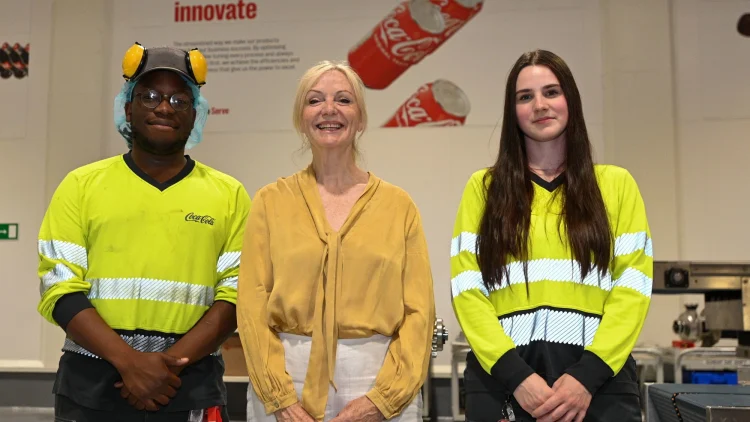

Tracy Brabin tours manufacturing facility featured in Coca-Cola Great Britain’s Counter Cultures campaign, which celebrates local vocational careers
Coca-Cola Europacific Partners (CCEP) welcomed West Yorkshire Combined Authority Mayor, Tracy Brabin, to its Wakefield manufacturing site last week – the facility at the heart of the company’s new Counter Cultures campaign, which celebrates the people and businesses behind Britain’s food and drinks industry, from production lines to local pubs, cafés and independent retailers.
Brabin toured the site – which is Europe’s largest soft drinks facility by volume – to see how the company is contributing to local employment and skills development.
CCEP supports thousands of independent retailers, hospitality businesses and wholesalers across Yorkshire through a dedicated field sales team. The Wakefield site directly employs 600 people – including 27 apprentices – and has invested £103m in operations at the site since 2019.
It’s also where Mark and Lewis Baker, father and son, work as Reliability Engineer and Utilities & Facilities Apprentice respectively, whose story features prominently in the new Counter Cultures campaign.
The visit comes as new research shows 58% of Gen Z in the UK are considering vocational careers, with over half (52%) considering following in their families’ footsteps. A similar number (47%) are choosing to build careers closer to home – a trend particularly strong in Yorkshire where a third of respondents (33%) said they’ve noticed more young people staying local rather than moving away, with the majority citing positive impacts on local businesses, communities and economies.
The findings highlight a growing opportunity for companies to invest in place-based skills, creating career pathways that enable young people to build futures in their own communities, strengthening local economies and supporting regional growth.
During the visit, the Mayor also saw how technology is shaping the future of manufacturing, meeting Spot®, a robotic inspection dog developed by Boston Dynamics that has recently been introduced at CCEP’s Wakefield and East Kilbride sites. Spot supports maintenance teams by monitoring almost 600 inspection points across seven production lines, collecting real-time data without interrupting production.
Katharine Duncan, Wakefield Site Director, CCEP, said: “Showing Tracy around our Wakefield site meant she could see the community spirit of our team first-hand. Many colleagues have worked here for years, building friendships and taking pride in what they do. As one of Yorkshire’s long-standing local employers, we’re proud to offer job opportunities with clear progression.”
Tracy Brabin, Mayor of West Yorkshire, said: “It was great to visit Coca-Cola and see how a global brand is creating new opportunities for young people right here in West Yorkshire by giving them the skills they need to build their careers.
“West Yorkshire is home to one of the largest food and drink sectors in the UK and having international businesses investing in our region is testament to what we have to offer and our commitment to growing the local economy.
“Through our Local Growth Plan, we will continue working with partners to create more jobs, support local businesses and ensure people have the skills they need to succeed, helping to build a stronger, brighter region that works for all.”


Early on Tuesday 4 August, an autonomous group broke into the offices of DB Schenker in Hillington, Glasgow. Bypassing security in the early hours of the morning, the group covered the building’s foyer and offices with paint and messages saying “Drop Elbit” on the walls.
The group claims it is ‘targeting the supply chain’ of Israeli arms and munitions. DB Schenker is owned entirely by DSV. This is a Danish company that allegedly provides ‘logistics transport services’ to Israeli drone and military technology manufacturer Elbit Systems.
Elbit Systems produces 85% of the Israeli military’s drone fleet, in addition to 80% of the state’s weapons and equipment. Israel has used Elbit weapons throughout the ongoing genocide in Gaza, in the Palestinian West Bank, against Syria and Yemen, and currently against Lebanon and Iran.
Elbit Systems’ drones have also taken part in attacks on international aid flotillas in international waters. Elbit Systems routinely lists its equipment as ‘battle-tested against Palestinians’.
DSV has recently come under intense pressure both within the UK and internationally due to its contract with Elbit Systems. Before the Glasgow action, groups in the UK, US, Denmark, Germany, France, the Netherlands, and Ireland had all damaged DSV premises in the past six months alone.
In April 2026, activists targeted a DSV office at Birmingham Airport, breaking windows and covering building in red paint. In May, a group in Bristol sabotaged a fleet of DSV trucks, slashing tyres and damaging vehicle exteriors. And in July, activists targeted a DSV site in Cork for a third time in the span of several months.
A spokesperson for the Glasgow group stated:
As long as DSV and its subsidiaries maintain their contract with Elbit Systems, property damage and disruption will continue. We will interrupt, delay and destroy the supply chain that provides Israel with its weaponry by any means necessary.
While DSV’s website proudly advertises their track record delivering Christmas gifts on time to children, their warehouses stock parts used to slaughter thousands of kids in Palestine, Lebanon and Iran.
DSV supplies hundreds of different industries, and does not depend on Elbit Systems to be able to pay their employees. Sinking to this moral low was their choice. Dropping Elbit could be their wisest logistics decision yet.
Featured image via the Canary
By The Canary
Mum in her 20s tricked into taxi then raped in terrifying attack after Manchester night out

Wizards of Waverly Place’s Jake T. Austin on Revival Absence

Steve Smith Sr says 49ers star Brandon Aiyuk is self-sabotaging career

Renter of Home in Anne Heche Crash Denies Settlement With Son

No Jackpot Winner as $257 Million Prize Rolls Over to $269 Million Monday Draw

Weekend Open Thread: Staud – Corporette.com

MY TEAM MEMBER ASKED ME TO EXPLAIN EVERY TRADE #youtubeshort #Cryptocurrency #trading #daytrading

The Mutual Fund Category Most Indians Ignore & Why It’s YOUR BEST BET | Anthony Heredia | FWS 112

3 Things Not to do with Credit Card #LLAShorts 76
-

 Politics7 days ago
Meta enters AI-training agreement with far-right ‘propaganda rag’ Newsmax
-

 Politics5 days ago
Zack Polanski: an incitement to murder Nigel Farage?
-

 Crypto World6 days ago
MicroStrategy Post-Earnings CLARITY Act Push Could Add New Catalyst for Its Stock
-

 Crypto World7 days ago
XRP Ledger v3.3.0 brings five institutional features
-

 Crypto World7 days ago
New York sues Kalshi over prediction market gambling
-

 Crypto World5 days ago
Crypto PAC spending tops $2M in Michigan House race
-

 Business5 days ago
DTCR: Deleveraging And A Hedge Fund Collapse Point To A Possible AI Bottom
-

 Tech6 days ago
ESET tracks rise in malicious AI skills and adaptable malware
-
 Crypto World7 days ago
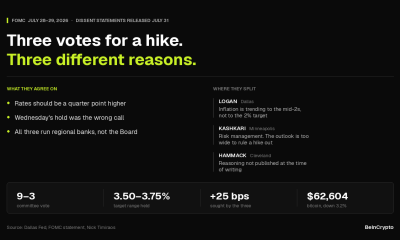
3 Fed Officials Just Explained Their Rate Hike Vote: Is Inflation Winning?
-

 Sports6 days ago
France Cricket implodes: letters hidden in a drawer and a board at war
-
Crypto World5 days ago
XRP Ledger urges node upgrade after manifest flood
-

 Crypto World7 days ago
Moneyflip CEO charged in $40K murder-for-hire plot
-
 Sports7 days ago
Bruno Fernandes decision made as Man United ‘discuss’ striker transfer option
-
Business7 days ago
FIFA has scrapped $20 billion World Cup sell-off plan, New York Post reports
-

 News Videos6 days ago
Financial Crash Expert: The 90-Day Collapse Timeline They Are Desperately Hiding.
-

 Sports2 days ago
Jordan Coyle & Cordiamo take Laya Arena Stakes at RDS
-

 Sports7 days ago
Commonwealth Games 2026 Live Updates | Day 9 CWG 2026: Lovlina Borgohain, Sachin Siwach Enter Final After Indian Judokas Script History
-

 Crypto World4 days ago
US Tech Stocks See Largest 5-Week Inflow in History: Can Nasdaq Break Its Downtrend?
-
 NewsBeat6 days ago
Tourist plane on sightseeing flight in Peru crashes into a field, killing all 13 people on board
-

 NewsBeat6 days ago
Arsenal reach full agreement with Newcastle over Bruno Guimaraes transfer | Football
You must be logged in to post a comment Login