Politics
Ultra-Endurance Athletes Reveal What They Eat During A Race

Let’s say you’ve completed a marathon or two, and you’ve decided that you want to take your running to the next level. You decide to try an ultramarathon, such as a 50-mile race or 100-mile one.
Or perhaps you’ve enjoyed long bicycle rides and are now considering ultra-distance cycling, races of 125 miles or longer that last six hours or more.
Now you’ve got to start training your body to handle those kinds of races. But it’s not just about training your muscles. Training for an ultra-endurance sport, which includes ultramarathons and ultra-cycling, means training your stomach, as well. That means training yourself to eat – and to eat frequently.

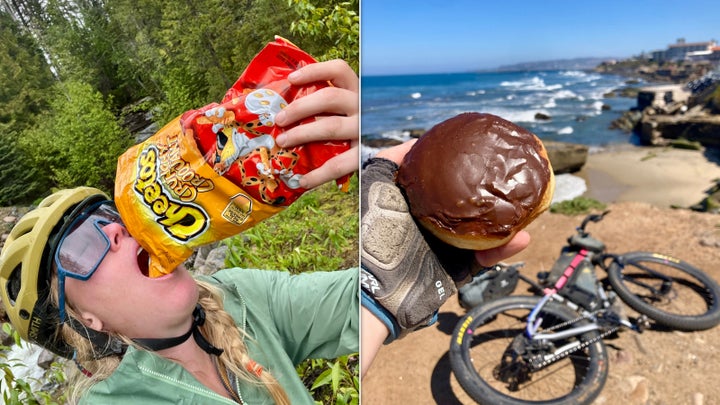
Courtesy of Meaghan Hackinen
And it’s not just a matter of eating some food during the races (while staying hydrated), it’s also about finding the right food for you while training, during the race and afterward.
The science of fuelling your body
There’s a common refrain from ultra-endurance competitors: food is fuel.
“If you want to be able to perform during a training run or race, [food is] your body’s fuel. So think of your body like a car. You’re not going to go on this long-distance journey with your gas tank on E. You’re going to start the road trip off with the fuel tank full,” explained Amy Goblirsch, a registered dietitian at the Running Dietitian and an ultramarathon runner.
While that may be true for regular sporting events, even a marathon, it’s especially true with ultra-endurance sports.
You can probably run a marathon without eating during the race itself; similarly, you can probably do a weight-training session without fuelling up during sets.
But ultra-endurance competitions mean that you have to eat regularly and eat enough calories to get you through it. That may mean eating every 30 minutes to an hour for the length of the event, which can last eight to 36 hours.
Ashley Paulson, an iFit trainer and professional ultrarunner, explained: “You can be in the best shape of your life. You could have dialled in every bit of your training. But if your fuel goes out the window, so does your competition.”
But food is more than fuel, noted Supatra Tovar, a clinical psychologist, registered dietitian and fitness expert. She said: “It directly affects physiology, mental clarity, emotional regulation and overall safety. These events place enormous stress on the body through long hours of sustained effort, elevated stress hormones, fluid and electrolyte loss, gastrointestinal strain and nervous system fatigue. What you eat and drink can determine whether you finish strong, struggle through the final miles, or end up injured or unwell.”
Paulson noted that without the fuel, recovery time can take longer if you are depleted. And more importantly, there’s a risk of hurting yourself.
“Guess what happens when you’re tired? You start running sloppy. What happens when you run sloppy? You get injured,” she noted. She always knows when her fuelling is off during training because she can feel it the next day.
Carbs are king
Carbohydrates are key for ultra-endurance athletes during training and during competitions.
“Carbohydrates are going to be your body’s preferred source of energy, and what it’s going to be most efficient at breaking down for energy,” Goblirsch said. Goblirsch recommended carbohydrates like fruit snacks, Rice Krispies treats, and Uncrustables peanut butter and jelly sandwiches.
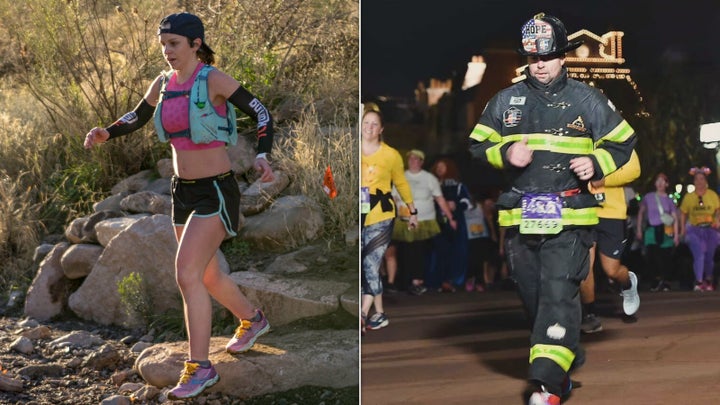
Courtesy of Amy Goblirsch and Rob Verhelst
Paulson goes for simpler food during training, like white rice, pasta, potatoes and pancakes, which are popular foods for many ultrarunners.
While Paulson loves a bag of Cheetos during a race, she prefers wetter food during the competition since she often deals with a dry mouth.
At aid stations set up five to eight hours apart (depending on the ultramarathon), she’ll choose ramen, which is wet, has carbs in the noodles and sodium in the broth, as well as bananas, apple sauce and even oatmeal if it’s liquified enough.
Meaghan Hackinen, a pro ultracyclist, typically eats easy-to-prepare foods at home like scrambled eggs or pasta during training. But as a pro ultracyclist, she’s often competing in 2,700-mile races – like the Tour Divide that goes from Banff, Canada, to Antelope Wells, New Mexico – so she often has to rely on whatever food is available at places along the way.
“You are fuelling mostly at gas stations, and so the quality of nutrition is terrible,” Hackinen noted. At petrol stations, she’ll get chocolate bars, iced coffee drinks, hand pies and frozen burritos.
Hackinen noted that people are often appalled by her diet during races, but she noted that what she eats on the road during these races is not what she regularly has at home. She’s at the mercy of what is available and the need to compete.
Other nutrients are important too, such as fats, sodium and protein.
Firefighter Rob Verhelst, who is a veteran and Ironman record holder, competes wearing full firefighter gear. He chooses peanut butter pretzels, beef sticks, peanut butter and jelly sandwiches and even burgers during races.
His favourite post-race food is chicken broth. It’s warm and is full of sodium, which is important since these races deplete the body’s sodium stores.
But carbs are really crucial for these types of sports. Tovar said: “Carbohydrates remain the most efficient fuel for sustained output, especially during higher intensity segments. Even athletes who train low-carb typically perform better when they include carbohydrates during long or hard efforts.”
You have to train your gut, not just your muscles
While eating is natural, eating a large quantity of food over a short period of time is not.
“That was one of my challenges when I first started doing endurance sports,” Hackinen said. Getting enough food and exercise was tough, “because it just upsets your stomach if you are not used to eating that much,” she noted.
During training, she has to think about how many calories she’s burning and find a way to balance that out. “There’s a saying that ultracycling is as much an eating contest as it is a physical endeavour,” explained Hackinen.
Goblirsch noted that ultra-athletes often aim to consume 60 to 120 grams of carbohydrates per hour. Most people are not used to eating that much in an hour, much less repeatedly over several hours.
So part of the training regime is working to get yourself used to eating. Some people may start with 30 grams per hour, but it depends on the individual. (Many factors play a role in how many calories an athlete consumes, but by Goblirsch’s estimates, an athlete might consume anywhere upwards of 10,000 calories over the course of a 36-hour, 100-mile race.)
For some people, they have to force themselves to eat, even if they don’t want to. Paulson recalled that her crew has to remind her to eat, even if she doesn’t feel like it. “Because you get to the point that everything is tired, even your digestive tract is tired of that,” she said.
Packing enough food on the go is key
Given the long distance of these competitions, ultra-endurance athletes have to think about food they can carry. There are aid stations for ultramarathons, but they can be five to eight miles apart. Paulson carries 500 extra calories in a big vest just in case she needs to rest or gets lost.
Hackinen also tries to pack enough food for 12-24 hours since she may find herself in very remote areas. She often packs gummies and Twizzlers, which can be easily chewed, peanut M&Ms and salted nuts. If it’s not too hot, she’ll bring chocolate bars. She may also add an apple or a peach.
Eating the wrong foods can be disastrous
The foods to avoid often depend on the individual. Some people may be fine with sports nutrition, like energy gels and chews; while others may not tolerate them and need naturally made food.
But there are some general categories to think about if you are fuelling for an ultra-endurance race. Part of training will be figuring out what works and what does not.
Tovar noted: “During long efforts or immediately before competition, many athletes do better limiting very high-fibre foods such as large salads or raw vegetables, extremely greasy or heavy foods if they are not accustomed to them, very spicy foods or anything unfamiliar.” For instance, Verhelst noted he avoids citrus since the acidity will cause issues in his stomach.
Hackinen noted the danger of overeating since food can be hard to find during these longer races. She may find herself drinking a full litre of chocolate milk, in part because she cannot store it and she desires it so much. Hackinen also tries to avoid any food that might be suspicious, like meat in very hot areas, since she wants to avoid food poisoning.
At the end of the day, your diet really depends on what works for you during these ultra-endurance races. Verhelst noted that one of the biggest things he wished he knew about starting his ultra-endurance training and competing was not to follow other people when it came to nutrition. He needed to find his own nutrition path to give his best in these ultra-endurance competitions.
CORRECTION: This story has been updated to accurately reflect the distance between aid stations.
You must be logged in to post a comment Login