
Politics
Wealthy broadcaster Andrew Neil just bragged about getting a waiter sacked

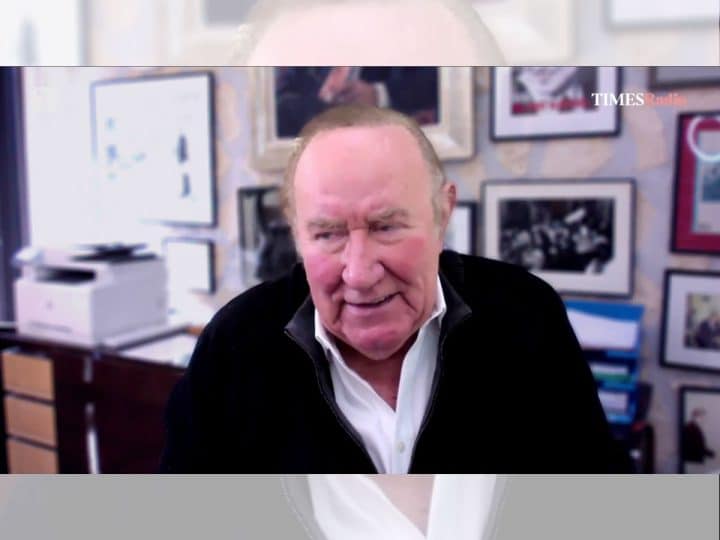

Andrew Neil is an established figure in British media and one of the people responsible for GB News. Neil is notorious for looking and acting like a human whoopee cushion, with the latest example of that being the following:
Lesson learned: never ask @afneil for a higher tip!
“I called the owner later that night, and he was fired in the morning.”@StigAbell | @KateEMcCann pic.twitter.com/oHuuFJvQBD
— Times Radio (@TimesRadio) April 27, 2026
A multi-millionaire bragging about getting a poorly paid waiter fired? Only in the British media!
Andrew Neil’s tip was ‘a bit light’
In the clip that was merrily published by Rupert Murdoch’s Times Radio, Neil said:
I was [reprimanded] for leaving only 15%, in cash, by the way…
The waiter came back in that New York aggressive way. I was taking some people out to dinner. I was the host. I was picking up the bill. And he said quite loudly, ‘Was there something wrong with the meal or the service, Mr Neil?’ And I said, ‘No, no, it’s fine.’
‘Oh, because it’s just, it’s a bit light,’ he said. Yeah. A bit light. And this was in front of everybody, and it was embarrassing. And I [indecipherable] got out more dollars and gave him a bigger tip.
However, he was unlucky, because I happened to know the owner of that restaurant, and I called the owner later that night, and he was fired in the morning.
Employers in the US get away with paying poverty wages by forcing their employees to rely on tips. Although the American tipping system is hard for Britons to wrap our heads around, it is part of their culture.
Lest we forget, Andrew Neil is a right-wing British commentator, and what do the right tell us over and over? They tell us people coming to Britain must respect our culture, and that they must integrate with our customs.
Why couldn’t Neil respect the Yanks’ godawful culture and simply pay up?
Paying the price for Neil’s fragility
As many highlighted, this exchange will have a more significant impact on the waiter than the temporary embarrassment Neil experienced.
Getting some poor kid fired for making you slightly uncomfortable is quite the in character flex, you fucking talking gammon.
— Tehran Tadhg (@TadhgHickey) April 27, 2026
As Mukhtar highlighted, there were other ways Neil could have solved this problem.
This is disgusting, and the fact that he thinks getting a waiter sacked is a flex is very telling.
He should have asked his friend who owns the restaurant to raise the wage. https://t.co/OlKKqbXmyP
— Mukhtar (@I_amMukhtar) April 27, 2026
Novara’s Aaron Bastani, meanwhile, commented:
Zero class.
Turns out you can’t buy it!
Parody account, The Iain Duncan Smiths, said:
Andrew Neil ensuring he will never have a bodily-fluid-free dining experience ever again
Bloated ego
People like Andrew Neil probably do believe this sort of perceived sleight is the worst thing that can happen to a person. Although he’s worked in politics for years, he’s long been outside the impacts of political decisions, and it shows.
When we suffered through the austerity years, Neil did not suffer.
When we suffered through the cost of living crisis, Neil did not suffer.
When Neil got asked to inflate his tip, however, he ensured everyone suffered by throwing his weight around and moaning to the Murdoch press.
Featured image via Times Radio
By Willem Moore



Former Labour shadow chancellor Ed Balls was all over the news on 27 April. This was because he responded to the accusation that he’s a Labour politician by having a meltdown live on air.
Balls argued he can’t be a ‘Labour politician’ because he hasn’t stood as an MP in over a decade. As Greens leader Zack Polanski highlighted, however, Balls was a key Labour figure for years, and he’s married to the current foreign secretary. In other words, he’s a Labour politician by stealth who’s swapped the benches of parliament for the swivel chairs of the newsroom.
Since Balls’s public embarrassment, a clip has reemerged of him talking about Peter Mandelson becoming our ambassador to the US. It’s a clip that demonstrates his thinking is fully aligned with that of the current Labour leadership:
I’m afraid this party needs to die.
Not least for the people it’s meant to look out for. https://t.co/IIslCItQ0e
— Aaron Bastani (@AaronBastani) April 27, 2026
Oh dear, Ed Balls
In the clip above, Ed Balls says:
Peter Mandelson is the kind of person who can use that sort of British allure, his past experience, his way with people.
When Balls said this, Mandelson’s “past experience” included being forced to resign in disgrace from government on two separate occasions. His “way with people” included being friends with Jeffrey Epstein – the 21st century’s most notorious paedophile.
Balls also said:
I would think Peter is – unusually – in these times – the kind of person you’d want to be your ambassador.
When journalists and politicians were saying this, what they meant was: ‘Mandelson and Trump were good pals with the same paedophile, so they should get along like a house on fire‘.
Balls also said:
And, you know, sources close to Peter have obviously been working hard to make sure he gets the job. Let’s hope he does.
The fact that sources close to Peter were “working hard to make sure he gets the job” has now become a national scandal, as we’ve reported. Today, that saw Starmer’s ex-chief of staff Morgan McSweeney doing his best to defend the indefensible:
WATCH: Morgan McSweeney makes the understatement of the century.
I made a "serious mistake" by recommending Peter Mandelson for the US Ambassador job. pic.twitter.com/2NSVprLthS
— PoliticsJOE (@PoliticsJOE_UK) April 28, 2026
And there are still more connections to discuss too.
It’s a big club
In the clip at the top, Ed Balls is talking to podcast co-host George Osborne. Osborne was the actual chancellor when Balls was the shadow; he was also Starmer’s top pick for the ambassador position they eventually gave to Mandelson:
How on earth do you reconcile the PM constantly highlighting the immeasurable damage done to the country by austerity with that very same PM wanting to reward the man single-handedly responsible for it with a plum government job?
— Ben Kentish (@BenKentish) April 28, 2026
So Labour and the Tories are in bed together, and all of them are in bed with the media. Because let’s not forget; George Osborne also had a late-stage career in journalism. After being booted out of office, he became the editor of the London Evening Standard. He held this position despite being a sitting MP.
Unbelievable, right?
And yet this sort of thing is widely accepted in the British establishment.
Featured image via The Canary
By Willem Moore


Christian Turner is the man who replaced the disgraced Peter Mandelson as the UK’s ambassador to the US. He’s proven less controversial than his predecessor, but that may be about to change:
[@FT] pic.twitter.com/X0hTw4GNt8
— Politics UK (@PolitlcsUK) April 28, 2026
 WATCH: In leaked comments, the UK’s ambassador to the US predicted Labour MPs will oust Keir Starmer as Prime Minister after the local elections
Turner is likely going to attract even stronger criticism too, because he also said:
I think there is probably one country that has a special relationship with the United States — and that is probably Israel.
While this is obviously the case, the idea that a UK ambassador to the US would admit this is wild.
Starmergeddon – once again, thanks to a UK ambassador
The recording of Turner was made in February. As reported by the FT, Turner was still settling into his role, and was talking to a group of students.
While we agree with most of what Turner is recorded as saying, it is – shall we say – unconventional that a senior diplomat would be so forthcoming with a group of young adults.
Speaking about Starmer, Turner said:
To get to a threshold where you remove a prime minister from the Labour Party, according to Labour Party rules… is really quite hard.
80 MPs have to sign a letter in public, which is like signing your death warrant. It’s much harder than for Tories. So I think that is still quite difficult.
And Keir personally is – as you know – he’s a stubborn guy. He’s never lost a fight he’s in. And so I think Keir saying “I’m quitting” is quite a high bar.
This last point is a moment of disagreement for us, because we still remember Starmer’s many u-turns.
Turner continued:
So probably the moment I would look to is the May elections. If Labour does very badly in the May elections, I suspect the party will move to get over that threshold and remove him. It seems to be the conventional thinking. If they do okay, he might carry on going.
We’re pretty confident they won’t do okay at this point. We’re pretty confident that they won’t do ‘badly’, either; they’re going to do much worse than that:
Median estimate via @Moreincommon_, April '26 pic.twitter.com/OFxPMxmoUV
— Stats for Lefties
 Projected net changes for local elections:
 Ref +1,437
 Grn +926
 Lib +327
 Con -627
 Lab -1,738

 (@LeftieStats) April 21, 2026
Turner also said:
For me – that’s just me as a citizen, speculating – because I have to serve with whomever is there.
So it’s a glowing recommendation from Keir’s man in Washington then.
And the controversial comments don’t stop there.
Special relationship
During a question-and-answer session, Turner said he disliked the phrase “special relationship” to describe Anglo-American ties, complaining that it was “quite nostalgic, it’s quite backwards-looking, and it has a lot of baggage about it”.
He added: “I think there is probably one country that has a special relationship with the United States — and that is probably Israel.”
The comments were made in the weeks running up to the US-Israeli strikes on Iran that began the current conflict in the Middle East.
We know that the government didn’t properly vet Mandelson; we’re beginning to suspect they didn’t vet Turner either.
He’s absolutely correct in what he’s said, but there’s no way Starmer would have hired this guy if he knew the man would be spitting truths like this in the lair of the Great Satan.
To be completely fair, Turner hasn’t given up on the ‘special’ rhetoric, telling the students:
There is a deep history and affinity between us. Particularly on defence and security, we are intertwined.
And also:
The relationship will carry on, if you want, being ‘special’, but I think it’s going to have to be different.
So not ‘special’ as in ‘good’ then.
Scandalopalypse
Turner dipped his toes in other hot waters too – this time the Epstein scandal. As reported by the FT:
Turner answered questions about the Epstein scandal and the contrast in how it had played out on either side of the Atlantic.
He said it appeared to him “extraordinary” that the scandal over the convicted sex offender had “brought down a senior member of the royal family [Andrew Mountbatten-Windsor], a British ambassador to Washington, potentially the prime minister, and yet here in the US, it really hasn’t touched anybody
Again, Turner is absolutely correct.
Again, it’s wild he’s the one saying it.
These comments are so shocking because the key US politician embroiled in the Epstein scandal is president Donald Trump. If Keir Starmer knew his ambassador to the US would be asking how Teflon Don wriggled out of it again, he would have deployed James Bond to retire the guy.
And as a reminder, this was in a question and answer session with students.
Students!
Just imagine the sort of things Turner is saying at functions when he’s got a couple of piss-weak American beers in him.
Private comments from the UK ambassador
In response to the leaked comments, a spokesperson from the Foreign, Commonwealth and Development Office said:
These were private, informal comments made to a group of UK sixth-form students visiting the US in early February. They are certainly not any reflection of the UK government’s position.
This is a problem then, isn’t it, because Turner’s job is to represent the government’s position in the US.
He had one job!
The FT approached Turner for comment too, but he didn’t get back to them. Given his previous comments, we can’t wait to see what he comes back with.
Featured image via The Canary
By Willem Moore


James Hill is a former Tory councillor from West Northants. According to him, Reform UK councillor John East has been caught maintaining a fake account to do battle in Facebook comment sections:
This needs to be investigated fully.@BBCNorthampton @ChronandEcho @NNjournalism @NadiaLincoln @NLiveRadio pic.twitter.com/ngrN6w3aj8
— James Hill (@cllrjameshill) April 27, 2026
While it’s not confirmed, Hill certainly makes an interesting case.
Mike Oxlong = Reform?
The controversial account uses the handle ‘Mike Oxlong’. For those of you who are reading this aloud, you probably just realised this name sounds a lot like ‘My Cock’s Long’. Regardless of who’s running the account, then, we can say for certain they’re some sort of mature genius.
In the video posted by Hill, Oxlong is responding to a local media post about two Reform councillors leaving the party to become independents. Oxlong’s response reads:
don’t worry, the real truth about these two will come out in time.
For now, though, while the police are investigating one of them, the party is not likely to say too much.
So either Oxlong knows something about the local Reform group’s inner workings or he’s a fantasist.
Next, Hill shows that Oxlong has 64 friends – two of which are Reform UK councillors. Beneath Oxlong’s name is the following message:
Heart of gold, nerves of steel, knob of butter
For reference, an obsession with penises is known as ‘phallophilia‘.
The key piece of evidence presented by Hill is that Oxlong recently updated his cover picture. The uploaded image pictures three men: the first is unidentified, the second is Nigel Farage, and the third is John East. The implication, then, is that East accidentally uploaded this image to his side profile instead of his main account.

In the second video uploaded by Hill, Oxlong’s cover picture has changed to an image of a cat. This video was presumably taken after the first, because Oxlong is now friends with a third councillor.
Certified oddball behaviour
If East is operating a second account to argue with people on Facebook, he’s certainly not the first middle-aged man to do so. There are actually many weirdos behaving like that on Facebook, which is why all the younger users abandoned it years ago.
Operating side accounts would definitely be odd and unsettling behaviour for a politician. As we’ve reported, though, it would hardly be the worst thing that a Reform councillor has done:
- Reform councillor reposts that Labour MP ‘should be shot’.
- Reform councillor dramatically quits over council tax betrayal.
- What a surprise – Reform councillor attends just one meeting and sends two emails in six months.
- Reform councillor fined £40,000 for hiring ‘illegal’ workers.
- Reform councillor would like to see wage cuts to fund his pay rise.
We approached East for comment, but hadn’t heard back at the time of writing.
Featured image via The Canary
By Willem Moore
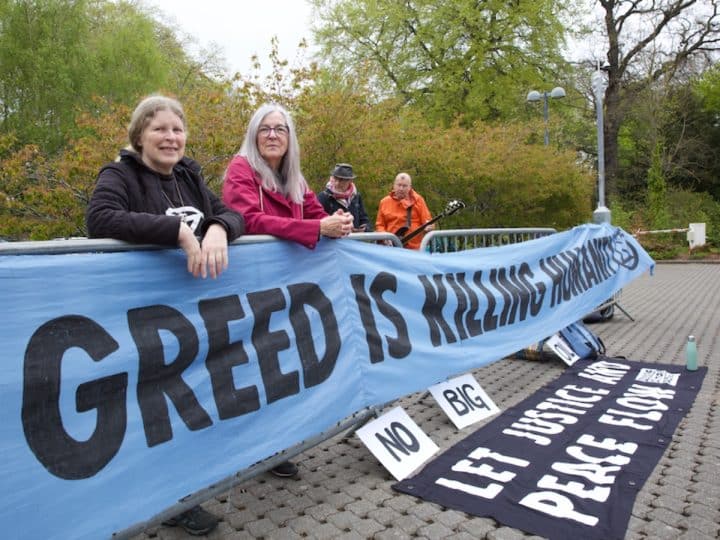

Environment campaigners have thrown a spanner into the NatWest bank’s annual general meeting over its “climate backtracking”. The ShareAction group and others have demanded protest votes against bank chair Rick Haythornthwaite at the meeting in Edinburgh today, 28 April 2026.
Natwest AGM disrupted
Campaigners say that the board must be held accountable for the bank loosening restrictions on lending to fossil fuel companies and its decision to abandon decarbonisation targets. The call has been backed by some of the bank’s major investors, including the Anglican church, which says it will oppose board members’ reappointment.
The financial scale of support for the move is significant. A ShareAction letter to the AGM demanding a meeting with bank bosses has been signed by investors holding over a billion pounds in value. These include the church, the Greater Manchester Pension Fund and investment management companies. A separate letter signed by seventy climate experts demanding a reversal of the damaging decisions is also being presented.
NatWest has changed its rules to permit lending to oil and gas companies that hold most of its assets abroad and has abandoned its commitment to only lend to companies that are ‘credibly’ transitioning to non-fossil fuels and transparently reporting on their climate impact. The bank made this move despite noting in its own 2024 company report that the lack of transparency was a major factor affecting its own ability to make proper decisions. Its 2025 report also boasted of the bank’s “new Environmental & Social (E&S) Energy Supply Sectors Risk Acceptance Criteria”.
NatWest also dropped targets limiting lending involving harmful building materials.
In 2025, NatWest awarded its chief executive a 33% pay increase, to £6.6m a year. It has also removed caps on executive bonuses.
Featured image supplied
By Skwawkbox
Politics
The House | Pride in Place: Can Labour’s Successor to ‘Levelling Up’ Finally Make a Difference?


(Tracy Worrall)
8 min read
Through MHCLG, Labour has begun a programme, like many plans before it, to regenerate hundreds of the most deprived places in Britain. Pride in Place has high and worthy ambitions. Will it succeed where others did not? Benedict Cooper reports
It was meant to be all about the big policy announcement. The next phase of a major programme to lift the poorest communities out of poverty, announced by the PM personally.
It just happened to be the week we learnt about Peter Mandelson’s secret dealings with Jeffrey Epstein during the financial crisis, sparking the gravest political crisis of Keir Starmer’s premiership to date. So, in the end, Pride in Place got very little time or coverage that day, and only one, nominal question at the press conference that followed.
It wasn’t the first time a major policy programme meant to tackle dire, endemic poverty has been eclipsed by a Westminster scandal or the rest of the news agenda.
By the time the successes of the New Deal for Communities programme were being felt, the New Labour government was in a new world of problems. David Cameron’s Big Society vision fizzled out with austerity. Levelling up, announced in March 2021, was soon consumed by partygate. And Rishi Sunak’s Long-Term Plan for Towns only really got going in April 2024, three months before he was out of office.
All, in their own ways, sought transformative change for the poorest communities. All fought the more sensational stories of their days for coverage, to gain the popular traction they needed to pick up true engagement and not fade quietly into the history book of good ideas.
Is the Pride in Place Programme (PiPP) going to be different? Is it any better as a policy? Is it political, a means of staving off Reform in the places it currently thrives?
PiPP dates back to before the election of 2024, a planned major policy of a future Starmer government. It was the administration’s first secretary of state for housing, communities and local government, Angela Rayner, who introduced it – conscious from the start that this wasn’t the first policy of its kind.
Writing in The New Statesman in March 2025, Rayner led with the line that “Labour has learned from the failures of ‘levelling up’”. And she identified one of those failures. “It has to be local communities that decide the future,” Rayner wrote, “and that’s what ‘levelling up’ failed to grasp. Whitehall can’t micromanage our towns and cities.”
Up to £20m of funding per place, spread over 10 years, was set aside for an initial phase-one tranche of 75 towns. To this, a further 169 places were added in phase two, and then on 4 February, at the ill-fated press conference in Hastings, 40 more towns were announced.
A total of 284 places, receiving £5.8bn over 10 years. In the words of current MHCLG Secretary Steve Reed, a “pilot in a new way of governing” that “dwarfs anything that has come before”. Memberships of the first wave of neighbourhood boards have already been confirmed and, from this month, delivery funding will start flowing into local authorities in those areas. The plan is up and running.
Communities are not homogenised, self-organising groups. How do you set up the decision making ability?
But is it a good one? Carola Signori is policy and research officer at the Independent Commission on Neighbourhoods, and also a consultant for 3ni – the national network for neighbourhood improvement. She says that Pride in Place shows promise, if it continues the local-first approach.
“The community objective is very much there. And I think this is one of the most important things in terms of the goal of this, which is to create capacity in these places, create social capital, create trust, create engagement with the communities.
“That means not just having them being consulted on things, but actually to decide what they think is most needed.”
That’s the idea behind one of the key tenets of the revamped policy. Neighbourhood boards are made up of local residents, community leaders, businesspeople, campaigners, councillors and the MP. Their job: to design unique local 10-year regeneration plans to “revitalise their neglected high streets, create new spaces for young people… to breathe new life into neglected communities”.

Business in the Community has spent years developing programmes to enable the public and private sectors to work together to lift their towns. Its director of place, operations and strategy, Amanda Anderson, sees genuine merit in the principle, but raises questions about the delivery.
She says: “I think the intention is right but there’s a question of how they develop the policy to the boards in these areas. How are you going to get £20m into these places? Communities are not homogenised, self-organising groups. How do you set up the decision making ability for these local communities?
“We believe that we can really only solve complex long-term challenges with genuine collaboration between public and private sectors. We need to support the next generation of community leaders, and not just give more to an already overwhelmed community and voluntary sector. I hope that’s in somebody’s line of sight.”
Certainly, the government claims that it is. An MHCLG spokesperson says: “For too long, high streets across the country have been overlooked and neglected, and vital community assets have fallen into disrepair.
“We’re changing this by investing up to £5.8bn in communities across the country, giving them the freedom to invest in local priorities like buying beloved community spaces and revamping high streets.”
One city councillor on the front line of delivering the funding, to an area badly in need of investment, sees evidence that this freedom has been built into PiPP as a priority.
Councillor Linda Smith is cabinet member for housing and communities at Oxford City Council and representative of the Blackbird Leys ward in Greater Leys, one of the most deprived areas both in the city, and nationally.
She says the inclusion of Greater Leys in phase two of the PiPP is a “welcome boost” to the area, evidenced by the level of local engagement the plan has received.
We need to support the next generation of community leaders, and not just give more to an already overwhelmed community and voluntary sector
“There’s massive potential in this”, she says, as “£2m per year for 10 years in a small geographical area has the potential to make a huge difference”.
“We’ve seen really high levels of interest in the public engagement events we’ve held, at drop-in sessions for residents. I’ve never seen so many people at a community event in Greater Leys, including teenagers from the local youth club.
“If you look at the programme prospectus, there’s a list of things that can be spent on that goes on and on, and is so diverse. Nobody can say that Whitehall is mandating how the money can be spent.”
Perhaps not now, but that has certainly been the case historically. If PiPP is to succeed, Labour will need to keep its local champions on side.
There are some reservations, of course. Breaking down the sums, regeneration experts will tell you that £2m per year will go much further in some places than others.
And different places need different types of funding. Some need money to invest in buildings, others need revenue for services. PiPP guidance, that 70 per cent of funding should be used for capital projects, could be storing up frictions for the future.
As Smith says: “The problem in Greater Leys is not derelict buildings. The council’s made the investment in the bricks and mortar. Where we’ll struggle is to get that revenue funding in place to really make the most of it.
“With more revenue funding, so much more could be happening there.”
And then there’s the politics. The government might not want the programme to look it, but you can’t target a policy, however obliquely, at towns where arch-rival Reform is thriving, without being called political.
Back in February before the barrage of questions about Mandelson came in, the Prime Minister had a stern word for those “exploiting the social scars” of Britain, those “telling you that entire cities and towns, the great communities of this country are ‘wastelands’, ‘no go zones’. I reject that – completely.”
Presenting the final policy paper, in September last year, Reed declared that Pride in Place was about allowing communities to “take back control”, an “answer to those who feel silenced, ignored and forgotten”. And in a candid swipe at Reform, this is Labour’s “alternative to the forces trying to pull us apart”, he claimed.
Can one policy reverse the “geography of discontent” that think tank UK in a Changing Europe believes set the UK on the road to Brexit, or “the politics of grievance” Keir Starmer has pledged to rid from the system? Can Labour convince the silenced and forgotten towns that they, not Reform, offer a hopeful, alternative future?
Much of that is out of their hands. Events dictate history. But for now, at least, the fates of the country’s forgotten places and the government in No 10 appear to be aligned. Pride in Place needs to succeed, both for the people and places who badly need change, and the politicians promising to deliver it.


John Higgins beat Ronnie O’Sullivan 13-12 in a final-frame decider to reach the World Championship quarter-finals, overturning a 9-4 deficit and producing a late session that will be talked about long after the table is cleared.
John Higgins won: How the match turned
Higgins’ recovery was methodical rather than miraculous. After falling well behind, he chipped away at O’Sullivan’s lead across the last two sessions, producing three centuries in the closing stages and stringing together a run of frames that flipped momentum.
O’Sullivan twice held a five-frame advantage but could not halt Higgins’ charge, and the match boiled down to a single, decisive frame.
What mattered, Higgins’ cue ball control improved when it counted. His scoring bursts, including multiple centuries, forced O’Sullivan into riskier positional shots.
The Scot’s ability to stay composed under pressure was the difference.
The key detail
This was not a spectacle of theatrics so much as a reminder of the sport’s fine margins. O’Sullivan showed visible frustration at times. Higgins, by contrast, kept grinding. Neither player produced a flawless performance, but Higgins’ late-session scoring and temperament earned him the win.
The handshake at the end was brief and respectful, the kind of closure that follows a match decided by inches and millimetres rather than headlines.
Wider ripple effects at the Crucible Theatre
It wasn’t just Higgins and O’Sullivan making headlines. World number one, Judd Trump, was eliminated in another match that went the distance. He lost in a final-frame decider to Hossein Vafaei, who will make his first quarter-final appearance.
Vafaei recovered from an overnight deficit and produced big breaks when it mattered, underlining that the draw at Sheffield is no place for complacency.
Mark Selby, a multiple-time champion, voiced concerns about the table conditions after his exit. He called the table “heavy and pingy” and suggested they affected play.
Meanwhile, Neil Robertson was able to progress to the last eight with a more straightforward win.
Those reactions and results matter, they shape the narrative of this year’s championship and raise questions about consistency at snooker’s pinnacle.
This particular tournament feels different, a classic in the making. We have seen upsets and tight finishes that have opened the draw, with new names now moving through, and we have seen how established stars have been tested, to the point of elimination.
That mix is healthy for the event and for the sport.
The bottom line?
This was a match that rewarded persistence and punished lapses. Higgins’ comeback was clean, efficient and earned. O’Sullivan’s frustration was understandable but ultimately, irrelevant to the scoreboard.
The Crucible has a way of exposing small weaknesses and turning them into decisive moments. On this occasion, Higgins found the answers when it mattered most and that is the key to winning at the Sheffield venue.
Tight matches like this are why the World Championship remains the benchmark for snooker.
No single frame defines a career, but a win in a match of this calibre will be a highlight in Higgins’ season and a talking point for the rest of the tournament.
Featured image via PA
By Faz Ali


The Masafer Yatta community of Umm al Kheir, has learned that they will be barred from attending their own demolition hearing in the South Hebron Hills of the occupied West Bank. According to the Higher Planning Committee of the Israeli occupation’s Civil Administration, who will be holding the hearing in the illegal settlements of Beit El, this is because of “security considerations“.
‘They do not want to hear the truth’
The Israeli occupation will prevent residents of the village from attending the proceedings, which are due to take place on 28 April.
Only legal representatives are allowed to be present at the hearing, which concerns demolition orders threatening the whole community. The hearing will also consider a master plan proposed by the village as a path to preventing these demolitions.
Khalil Hathaleen, head of the Village Council in Umm al Kheir, tells the Canary:
They have prevented residents from attending court because they do not want to hear the truth. They just want to please the settlers and demolish our historic village. Why don’t they hear us in court? Isn’t that our right? I don’t know how they think, but we feel wronged, criminalised. Why don’t they demolish the new settlement neighbourhood they built four months ago?
96 structures in Umm al Kheir are at risk of demolition, which would make all 300 residents, including women and children, homeless. It is deeply troubling to exclude these Palestinians from a court process, which will determine the fate of their homes and community – and essentially, their lives.
Settlers continue stealing land from Bedouins
Demolition orders and threats of displacement have been ongoing in Umm al Kheir for years. Settlers, who have the full support and protection of the Israeli occupation forces (IOF) have stolen almost all of Umm al Kheir’s land. Since 2007, more than 100 structures have been demolished in the village.
A new outpost, established only a few metres away from the village’s community centre, has not only left these Bedouin families with the constant threat of settler violence, but also nowhere to graze their livestock – their only source of income.
Hathaleen says:
We are going through a very difficult time. We call on everyone to help stop this crime against us.
The community is calling on journalists, human rights organisations, and citizens around the world to take notice of the court’s decision tomorrow. Whatever the outcome, Hathaleen says the residents of Umm al Kheir will not give up, and will keep resisting the constant harassment, intimidation and violence designed to uproot them from their land.
They plan to follow all legal paths to halt the demolitions, and also work with the media to draw as much attention to the injustices the Israeli occupation continues to bring down upon them.
Ongoing displacement since the Nakba
The descendants of the families living in Umm al Kheir originated in the Negev. They were dispossessed of their land during the violent establishment of “Israel” in 1948, known to Palestinians as the Nakba, or catastrophe.
Zionist militias forcibly displaced and expelled an estimated 750,000 Palestinians from their homes during this time, and destroyed and depopulated over 500 villages. Most of the Palestinian population turned into refugees.
These Bedouins migrated to the area of Masafer Yatta. They legally purchased the land where they are now living in Umm al Kheir, but the Israeli occupation considers all structures in the village to be illegal. This is because they were built without permits – something almost impossible to obtain from the Zionist regime.
More than 3,770 Palestinians were forcibly displaced from their homes in the occupied West Bank in 2025. This was due to Israeli occupation, home demolitions, settler violence, and access restrictions. These included Palestinians from 13 rural communities, which were completely wiped off the map.
Featured image via Médecins Sans Frontières
By Charlie Jaay
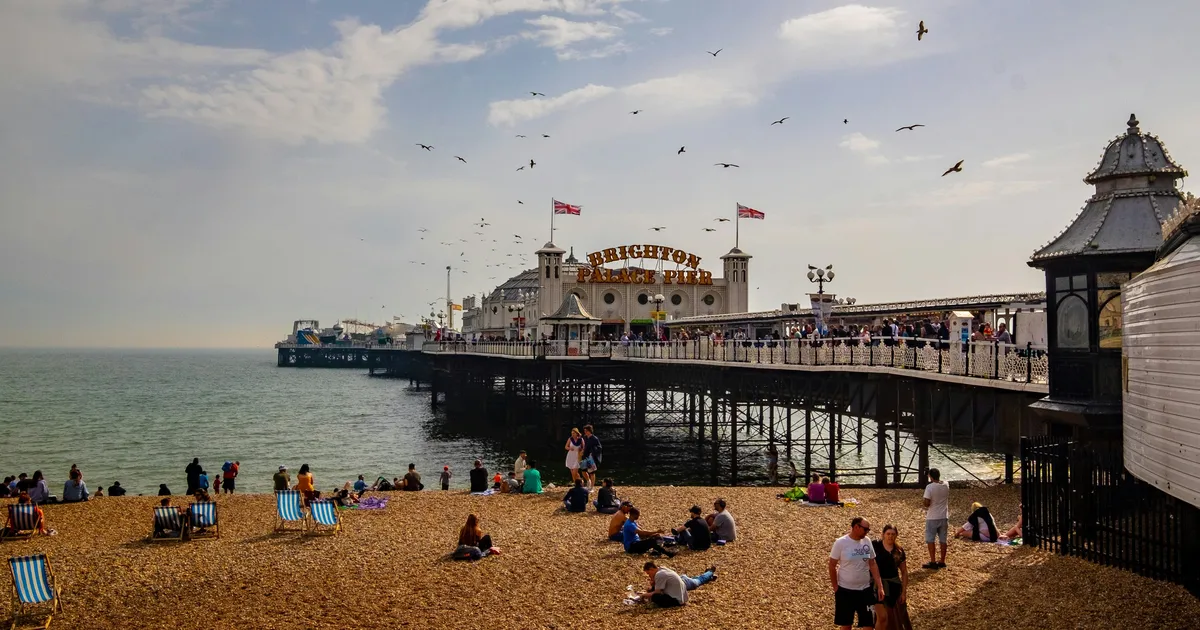
The UK is having a series of balmy spells thanks to the direction of the jet stream and a stubborn area of high pressure.
These conditions have led to what the BBC called a weather “traffic jam”, though we have seen some cooler climes recently.
This week, the Met Office has predicted 24°C temps in parts of the UK during the upcoming May bank holiday weekend, too.
Here’s where those temperatures are expected, when, and how long it’s expected to last.
When will it be hot in the UK this May bank holiday weekend?
Today (Tuesday 28 April), the Met Office said we can expect a slight dip from yesterday’s warmer weather. Highs of 19°C are expected.
But, “From midweek, high pressure brings a return to largely dry and fine weather.” That means that though we can expect some wind in the southeast, on Wednesday, 29 April and Thursday, 30 April, generally, the weather will be dry and fine across the UK.
Later on Thursday and leading into Friday, 1 May, though, the weather will become more “changeable,” with “thundery bursts” predicted, despite hotter temperatures.
According to Met Office Deputy Chief Forecaster, Tom Crabtree, “It will feel warm and humid in parts of England on Friday, with temperatures potentially reaching 24°C… Into the Bank Holiday weekend, the weather looks more changeable, with showers at times – particularly in the north – but also some sunnier intervals.”
Broadly, though, the weekend is expected to be colder and wetter than our finer midweek weather.
Where will it reach 24°C in the UK this weekend?
On Friday, 1 May, these may occur “in central and southern areas”, per the Met Office.
Northern areas are likelier to experience showers, meanwhile.
The weather service stressed that these conditions can change, and we’ll know more closer to the date. Check your local weather service for the most accurate information.
When will the sunshine end?
In their long-range forecast, the Met Office said that there’ll be an “increasing chance of showers or longer spells of rain, along with some strong winds at times” starting from Saturday, 2 May.
However, temperatures are predicted to be slightly higher than normal.

We hope you love the products we recommend! All of them were independently selected by our editors. Just so you know, HuffPost UK may collect a share of sales or other compensation from the links on this page if you decide to shop from them. Oh, and FYI – prices are accurate and items in stock as of time of publication.
With warmer weather and longer days here at last, something about that sudden burst of energy it gives you makes it very tempting to give your whole house an overhaul.
If you’re itching to do a big spring clean but aren’t sure where to start, here’s a list of the best budget-friendly (if not the most exciting) buys to help make the whole thing 10 times easier.
Open the windows, get your favourite playlist on, grab your cleaning essentials and your home will be sparkling in no time.


UNISON has hit back at criticism of upcoming strike action at Ash Field Academy. The union, which represents the vast majority of support staff at the Evington SEND school, announced a week in advance that staff would walk out on 30 April, 13 May, and 14 May over the victimisation of UNISON rep Tom Barker.
The Ash Field Academy dispute
Barker has been suspended since October 2025 on unspecified allegations. Discovery Schools Academy Trust (DSAT), the multi-academy trust which operates Ash Field Academy, imposed the suspension just days after UNISON members had voted to strike over DSAT-imposed staffing cuts.
Barker was a central figure in organising this strike ballot, and in encouraging members to use their vote. This was just the latest chapter in Barker’s long-standing work to organise for UNISON at the school. More details of this history are below.
UNISON believes that Barker’s record of successfully supporting and advocating for members at Ash Field Academy is the reason for his suspension. The union made this clear to DSAT soon after the suspension, and has repeatedly called for his reinstatement. The Trust has repeatedly refused this.
DSAT counter claims
DSAT claims that the suspension is due to allegations unrelated to Barker’s trade union work. After almost six months of suspension, DSAT has still not presented any evidence of wrongdoing – nor even detailed the allegations against him. Yet Barker is still suspended and UNISON members are still being deprived of their workplace rep.
UNISON consulted members at Ash Field Academy about how they wished to respond to the suspension. They voted to try petitioning the employer, and filing a grievance demanding Barker’s reinstatement, and to hold a ballot for strike action if those attempts failed.
DSAT refused to act on the petition, and refused to formally hear the grievance. So members had no option but to consider strike action.
In a March strike ballot of UNISON members at Ash Field Academy, 87% of participants voted to take strike action over Barker’s suspension and the attack this represents on their rights. The only demand UNISON is making is that Barker is reinstated. Doing so would cost DSAT nothing.
The upcoming action is a result of this ballot. DSAT was notified of the result several weeks ago, giving it fair warning that if they did not reinstate Barker, strike action would follow. To date, it still hasn’t reinstated him.
Barker’s history of UNISON organising
Barker has worked at Ash Field Academy as a Teaching Assistant for close to ten years. He’s been a UNISON steward for seven years.
In 2023, Barker was a principal organiser of an 8-month long dispute. It ultimately won pay increases of between 18% and 25% for student facing staff after the revelation that Ash Field Academy leaders, despite claims to the contrary, were underpaying the workforce. This was one of the most successful education disputes in UNISON’s history.
In the same year, alongside parents, students, and UNISON members, Barker helped organise a campaign to defend the residential provision at Ash Field Academy, ‘Resi’, which was under threat by Leicester City Council.
When Ash Field Academy Trust joined DSAT in early 2024, Barker, working alongside other UNISON reps, successfully defended members against cuts to pay and conditions.
In 2025, Barker and his Ash Field Academy fellow members defeated DSAT’s attempts to cut around 10% of the support staff.
In addition to these examples of his collective leadership, Barker has also been a fearless advocate for members on an individual basis. Barker has represented many members during HR processes, where he has fought tirelessly for their interests.
Sam Randfield, UNISON Leicester City branch secretary, said:
UNISON believes that Tom is being victimised because of his record in effectively representing and advocating on behalf of UNISON members at Ash Field Academy. This attack on Tom is therefore an attack on the collective rights of all members at Ash Field.
If DSAT is successful in victimising Tom, all members – not just in UNISON, but other trade unions too – could suffer in the future. We cannot allow DSAT to get away with attacking trade union reps because they don’t like their history of organising.
We have given DSAT ample opportunity to back down from their position. They have refused every request to reinstate Tom. Despite his willingness to cooperate with the investigation into the unspecified allegations against him, they insist on keeping Tom suspended.
That is why our members have been left with no option other than to take strike action. We call upon DSAT to immediately reinstate Tom. That is UNISON’s one and only demand.
An Ash Field Academy UNISON member who wishes to remain anonymous said:
The Trust has said repeatedly in communications with the press that it supports the legal rights of trade unions. That is not our experience.
I believe Tom is being scapegoated for his work on behalf of union members at the school.
The last thing we want to do is negatively impact the lives of our students and their families. But the truth is that striking appears to be the only language the Trust responds to.
Last year, the Trust cut around 10% of support staff at Ash Field. They did this against our protests. We said we are already understaffed and struggling to support our students.
It was not until we won a strike ballot that the Trust agreed to reverse this decision. Why do we always need to make threats for them to listen?
Not only is getting rid of Tom wrong morally, it will do immense harm to our ability to defend services against attacks from the Trust. That’s why I am striking.
Featured image via the Canary
By The Canary

Seattle’s Sniffies lands $100M investment from Match Group in major bet on sex-positive tech

UK tells Afghans promised sanctuary in Britain they must make their own way to safety

Kiniksa Pharmaceuticals International, plc 2026 Q1 – Results – Earnings Call Presentation (NASDAQ:KNSA) 2026-04-28

Manchester United reach agreement with Casemiro over contract clause amid transfer speculation

US brings back mandatory military draft registration

Steven Gerrard disagrees with Gary Neville over ‘shock’ Chelsea and Arsenal claim | Football


-

 Tech22 hours ago
Register Renaming | Hackaday
-

 Fashion4 days ago
Weekend Open Thread – Corporette.com
-
 Crypto World3 days ago
Hyperliquid $HYPE Rally Builds Momentum as AI Sector Enters Prove-It Phase
-

 Politics6 days ago
Making troops accountable for war crimes threatens US alliance, ex-SAS colonel warns
-

 Politics6 days ago
Disabled people challenge government SEND proposals over segregation concerns
-
 Business5 days ago
Patterson-UTI Energy, Inc. (PTEN) Q1 2026 Earnings Call Transcript
-

 Business6 days ago
Rolls-Royce Voted UK’s Most Iconic Trade Mark as IPO Register Hits 150
-
 Sports2 days ago
IPL 2026: Ruturaj Gaikwad registers slowest fifty of the season, enters all-time unwanted list | Cricket News
-

 Crypto World7 days ago
New York sues Coinbase, Gemini over prediction market offerings
-

 Politics18 hours ago
Drax board avoid their own AGM, accused of greenwashing & environmental racism
-

 Politics6 days ago
Starmer handler McSweeney to be dragged from shadows by Foreign Affairs Committee
-

 Politics6 days ago
Zack Polanski responds to home secretary’s taser threat
-
Politics6 days ago
Wings Over Scotland | How To Get Away With Crimes
-
 Business6 days ago
HCL Tech share price tank over 9% after weak Q4. JPMorgan, HSBC & 3 others cut target price
-

 Crypto World7 days ago
Crypto’s great hope in Senate’s Clarity Act still has a path to survive tight calendar
-

 Politics6 days ago
‘Iran is still a nuclear threat’
-
 Sports6 days ago
Tim Bradley names the current best in the world: “Better than Inoue and Usyk”
-

 NewsBeat2 days ago
LK Bennett closes all stores after entering administration
-

 Crypto World4 days ago
Michael Saylor says BTC winter is over. Market analyst disagrees, says bitcoin was in a pullback
-
 Crypto World7 days ago
Ethereum Price News: ETH Flashes a Bullish Setup No Holder Should Miss While Pepeto Nears Its Binance Listing
You must be logged in to post a comment Login