Politics
What’s at stake in the biggest by-election in British history
On Thursday 30 July, voters in Greater Manchester will vote to elect a new Mayor in a by-election triggered by Andy Burnham’s return to Westminster. Here, Rob Ford reflects on the by-election and what’s at stake for the different parties.
One of the knock-on effects of Andy Burnham’s return to Westminster was the triggering of a by-election to replace him as Mayor of Greater Manchester (GM). By law, the vacancy must be filled quickly, which is why voters in Greater Manchester, who may well be weary of casting ballots after two by-elections and a full set of local elections this year, return to the polls on Thursday to elect Burnham’s successor. There has never been a Mayoral by-election before, and with over 2 million eligible voters, this is by far the largest by-election Britain has ever seen. Yet you would be forgiven for not noticing it was even happening.
To be fair, it has been a busy month. One Prime Minister has departed, and GM’s former Mayor has replaced him following a leadership contest which mutated into an extended coronation. And the Mayoral by-election does not look that exciting – the three polls conducted since the candidates were known all suggest Bev Craig will hold the Mayoralty comfortably for Labour, though with a much-reduced vote share.
Opinion polling on the 2026 Greater Manchester Mayoral by-election, first preferences
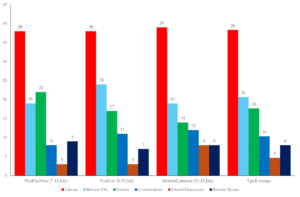

Labour lead Reform by an average of nearly 20 points on first preferences and are further helped by a change in the voting system from first past the post (FPP) to supplemental vote (SV). Under the old system, an even split between Labour and the Greens could have let Reform through the middle. Under SV however, voters can cast a second ballot, and the second preferences of the Greens are likely to go overwhelmingly to Labour. All three polls have Labour at well over 60% in a run-off against Reform.
But while the likely result looks clear, there is still a lot at stake. Labour want a show of strength in a city region where the party has long been politically dominant. A big win in his former stomping ground will provide a significant boost for Andy Burnham. It is also important for Bev Craig, who will have a much easier job negotiating with the ten boroughs in her combined authority if Labour can retain control of most of them in next year’s local elections. A big win this week will be an early sign this can still be achieved, despite a disastrous set of local election results in May.
Reform’s hopes of landing an early blow on Burnham may have faded, but the party is still keen to secure a strong second place. Reform topped the poll in seven of GM’s ten boroughs in May’s local elections, making sweeping seat gains across the region. The by-election is a valuable opportunity for the party to consolidate in boroughs such as Salford and Wigan where it could potentially take control with a strong showing next year.
The Greens have also seen their high early hopes dashed, but they too have much to gain from turning out as many votes as possible. Their advance in May’s locals was concentrated, with a huge surge in support in city centre wards, particularly those in or near Gorton & Denton, the Westminster seat the party gained from Labour in February. So the by-election provides a valuable opportunity to keep the new Green electorate mobilised and engaged, hold off a resurgent Labour, and build towards next year’s local elections where further gains could bring real power and influence in the central boroughs.
There is less at stake for the other two parties in England’s current five party system – the Conservatives and the Liberal Democrats – though both will see the campaign as an opportunity to gather information in their GM stronghold areas (Trafford and Stockport respectively). But this is also a big by-election for the newest player on the political scene, the far right Restore Britain party. Restore Britain was only founded (by former Reform UK MP Rupert Lowe) a few months ago, but it has already notched up strong showings in some national polls, and a third place finish in the Makerfield by-election. The party is polling at an average of 8% in this contest, a remarkable showing for a brand-new party with perhaps the most extreme far right agenda ever seen in British politics. Restore may find a receptive audience in the ethnically divided former mill towns on the fringes of Greater Manchester where the BNP won substantial support in local elections twenty years ago. A strong performance in such boroughs this week may be an early warning sign of exceptionally polarised local election campaigns to come next year.
All by-elections provide useful information on the shifting sands of voter sentiment, and this giant contest, held over a sprawling, politically and socially diverse city-region, will be more informative than most. Even if the outcome proves to be predictable, it will be well worth sifting through the detailed results for early signs of the next twists to come on the great British political rollercoaster.
By Professor Rob Ford, Professor of Politics, University of Manchester.
You must be logged in to post a comment Login