Politics
Why Britain’s elites still cling to the European Union

Ten years ago, the Brexit referendum tried and failed to settle Britain’s relationship with the EU. We are now in limbo, unable to decide what we want or why. That has been our problem not only for 10 years, but for the best part of a century. It is only partly because European unity is a utopian idea, now a very old one. Utopian in the sense that while there is a goal – a United States of Europe – there is no way of getting there and no idea of the costs it might entail. This inevitably causes confusion and division in all European countries. But they, unlike Britain, all have weighty reasons for going along with the fantasy. Unlike Britain, they know what they want – or at least they did once. France wanted to control Germany and buttress its status as a Great Power. Germany wanted to supersede its Nazi past. Italy, Spain, Portugal and Greece had similar historic disasters to escape. Eastern Europe found a refuge from Russian domination, hence Ukraine’s eagerness to join. As Switzerland and Norway had no such motives they stayed out of ‘the European project’. But Britain could not make up its collective mind about what to do, or why to do it.
Early British enthusiasts for a United Europe were disappointed imperialists. They had tried to unite the British Empire in the late 19th century, when secretary of state for the colonies Joseph Chamberlain had declared that we had entered the age of great empires, not little states. So Britain, undeniably little, had to become big. When their dreams of an Imperial Federation were dashed, they turned to the idea of a European Federation in the interwar period. The champions of a European Federation were, admittedly, something of a joke. But they had discovered a theme that most of the British political class would adopt unquestioningly from the 1950s onwards: the urge to join a bigger club. They had to be ‘in the room’. Unlike their French or German counterparts, they did not know what to do once they were there. It was enough simply to be in the warm, and go along with the crowd. This is the only discernible rationale of the present government’s plan to ‘reset’ Britain’s relationship with the EU.

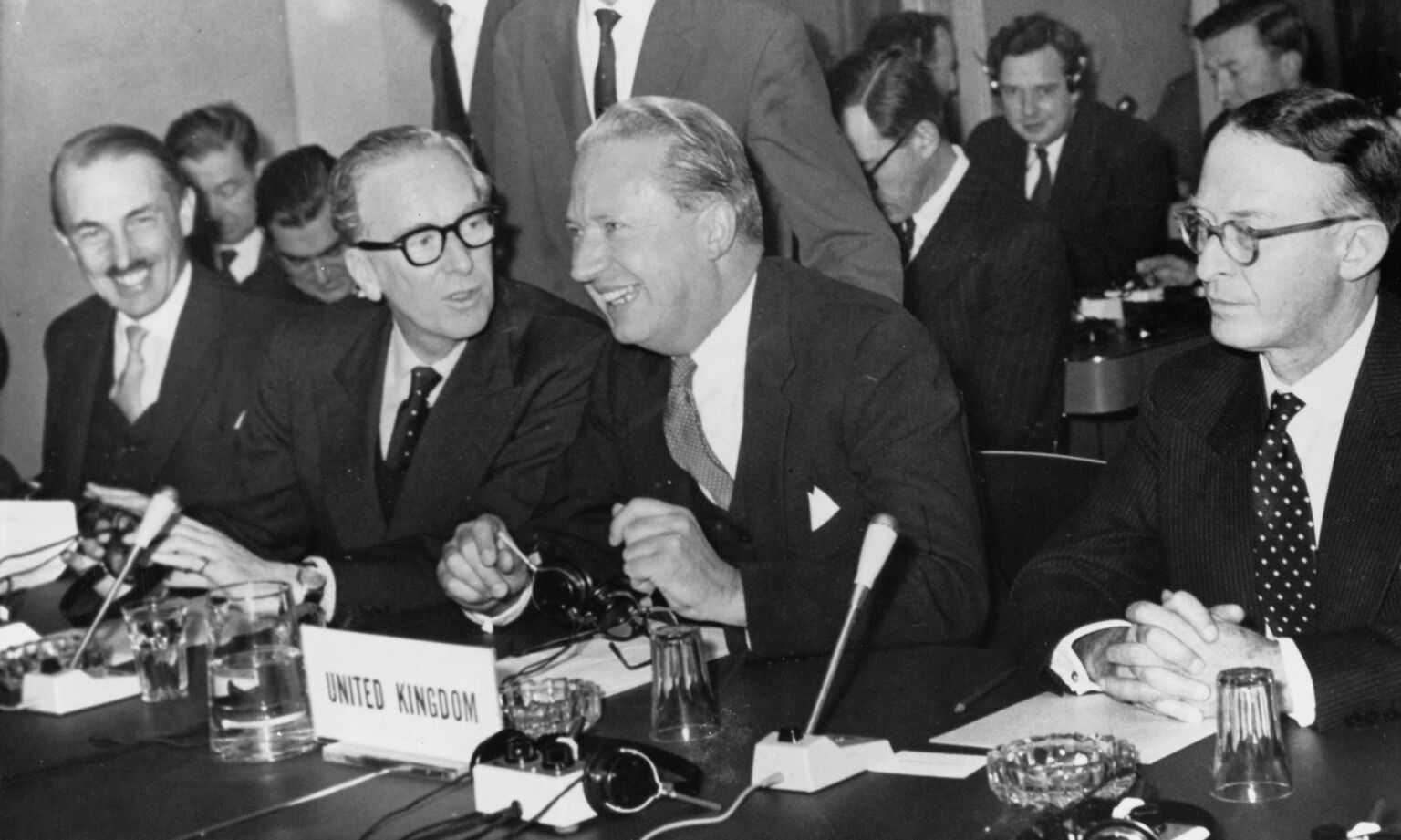
Edward Heath, Lord Privy Seal, at a meeting with British delegates on joining the European Economic Community, Brussels, Belgium, 9 November 1961.
The post-imperial desire to join the European club (first the Coal and Steel Community, then the European Economic Community) emerged powerfully during the 1950s. After Indian independence, the rest of the empire was rapidly unravelling. ‘Europe’ seemed the alternative. ‘If we try to remain aloof’, a Cabinet committee warned in 1960, ‘bearing in mind that this will be happening simultaneously with the contraction of our overseas possessions, we shall run the risk of [losing] any real claim to be a world power’. Horror of horrors, Britain was in danger of becoming merely ‘a greater Sweden’. The French made an identical calculation, but were far more decisive – for example, making some remaining colonies part of ‘Europe’. Britain was less willing to bet its shirt on the European horse, still having important relations with the Dominions and of course the ‘special relationship’ with the US – which, ironically, has always wanted Britain to be in ‘Europe’ to defend American interests. So Britain dithered, wanting the sort of non-exclusive relationship with Europe that was never on offer.
The policy changed under Harold Macmillan’s Conservative government in the late 1950s and early 1960s. The new cause was a fundamental misunderstanding of economics. This too has been a leitmotif of Britain’s European policy, and never more so than today. Britain’s GDP growth in the 1950s was slower than that of the new European Economic Community. Some – though by no means all – economists ascribed Europe’s superior performance to the EEC. Britain’s relative inferiority was blamed on a range of political, economic, social and cultural shortcomings for which EEC membership would provide a miraculous cure: Britain was ‘the sinking Titanic’, wrote one influential advisor, and ‘Europe’ would be ‘the lifeboat’. Britain must cast adrift what were described as outdated Commonwealth trading relationships (in the 1950s, Australia was as economically important to Britain as ‘the Six’ combined, and most Commonwealth trade was duty free) and embrace the European future and its protectionist customs union. Britain would join the EEC whatever the terms of entry: they must, said the chief official negotiator, ‘swallow the lot’.
They swallowed at precisely the wrong moment. Europe’s rapid growth (which the French call ‘the 30 glorious years’) was due essentially to postwar recovery and to a one-off shift of resources from agriculture to industry. France’s rural workforce fell by nearly three-quarters. Italy, because it had been more economically backward, became Europe’s star performer, displaying dazzling signs of modernity – cars, music, films, fashion. But this spectacular growth ended in the 1970s, just as Britain joined. Ironically, since then the Commonwealth markets we abandoned have grown faster than the European market we embraced. For four decades, Britain attached itself to a chronically underperforming economic region.
It paid a high price for the privilege, both in direct budgetary payments and in the higher cost of European imports. Food prices rose by around 25 per cent, the balance of payments worsened, and this fuelled the economic and political turbulence of the 1960s and 70s. The benefits – rather small – of trading with Europe did not cover the costs.
On the contrary, once inside the EEC Britain’s economic performance deteriorated. As the EEC and then the EU consolidated its system by regulation and imposing a single currency, the British economy was negatively affected by the resulting stagnation in what had become its principal trading partner. Britain’s exports outside the EU were therefore much more buoyant, despite the Single Market and obstacles to non-EU trade.
Britain, of course, narrowly dodged the single currency. Tony Blair wanted it but Gordon Brown didn’t. This, Blair’s then Treasury minister Ed Balls later admitted, was ‘the most successful economic decision of the past 30 years’. So it was. Britain’s economic growth was now higher than the Eurozone. But Britain could not escape the slipstream of the Euro. The damage it did to southern and eastern Europe made Britain the employer of last resort for a mass of European migrants, who had been given full rights of employment and settlement. Furthermore, Britain’s position as the EU’s major financial centre while remaining outside the Eurozone was seen as anomalous and dangerous by European politicians. This situation, in the words of the Cambridge economist Helen Thompson, ‘put a time-bomb under the sustainability of Britain’s membership’.
This seems not to have disturbed the placid pro-EU consensus of the British political class. The extent to which they had been able to commit Britain to the European system – we were constantly warned that we were missing the European train as it surged out of the station – was limited only by what the electorate would stand for. So Blair did not dare to risk a referendum on joining the Euro, and he jumped at the chance of cancelling a referendum on the European Constitution in 2005, on the pretext that France and Holland had already voted it down. The EU was able to use its preferred method of adopting the core of the constitution by treaty, ignoring the voters.
When David Cameron legislated for a referendum on membership in 2016 it was not with the intention of having a serious and necessary debate followed by a mature decision on Britain’s relationship with the EU. Rather, it was to bully the electorate into voting Remain by deploying ‘Project Fear’, and silencing the Eurosceptics in the Conservative Party.
The majority of the electorate did not obey the strident instructions of British and foreign politicians. But can there be any serious doubt that the majority for Leave would have been much more decisive if the Cameron government had permitted an honest national debate? Cameron’s unsuccessful attempt to force the result, and then the refusal of much of the political class and the civil service to accept it, led to a decade of confusion, anger and disillusion. There is no point in summarising that saga here.
However, what is worth considering is why 10 years later the Remainer / Rejoiner / Reset faction continues to try to reverse the result. Most of the debate – as it has been since the 1950s – has been ostensibly about trade and the economy. For over 70 years now, political discussion about sovereignty, democracy and law – the ‘taking back control’ issues – have been smothered by promises of greater prosperity on one hand and threats of impoverishment on the other.
It is increasingly hard to take this rhetoric at face value. None of the prophecies of doom made in 2016 have materialised. (Remember the promised collapses in trade, house-prices and employment? The threatened emergency budget and tax hike?) The British economy – despite the growth-destroying policies of Conservative and Labour governments – has somehow managed to perform overall at least as well as the EU. Where our goods exports have fallen, they have fallen round the globe; and this is evidently not because of Brexit, but overwhelmingly because Net Zero, high-energy costs and the deliberate running down of the North Sea oil and gas industry has directly hit and even destroyed our biggest exporting industries (fuel, chemicals, cars, aircraft parts). The EU itself is in the doldrums, and has even admitted it officially: Mario Draghi’s 2024 report, The Future of European Competitiveness, warned despairingly that the EU was facing ‘slow agony’. It is not suddenly going to provide us with a dynamic market for our expensive goods. As for our exports of services, they have been unaffected by Brexit.
Yet some think tanks, media outlets such as the Financial Times and The Economist, universities and politicians keep repeating that Brexit has caused economic devastation and that ‘realignment’ would give an economic boost. More and more ingenious and less and less credible methods have to be deployed to support these assertions. The current favourite is the ‘doppelganger’ analysis, which produces a hypothetical economic growth pattern for Britain by comparing it with a selection of other countries. The outcome depends on the selection you make. This is how the statements – officially adopted by the present government – that the British economy will eventually lose four per cent or even eight per cent of GDP are produced.
Do the people saying these things really believe them? I’m beginning to think not. They defy both common sense (how could being aligned with the EU make Britain more economically dynamic than the actual members?) and economic analysis (they do not align with actual economic performance). At best, this is reckless disregard for the truth. At worst, conscious untruth. The motives are not hard to find: political advantage and economic interest.
When Britain formally applied to join the Treaty of Rome in 1961, the motives – economic misunderstanding and post-imperial declinism – may have been misguided and inglorious, but they were understandable and sincerely put forward. Even in 2016, a rational and honest case to Remain could just about be made. But now? The stubborn rejection of the 2016 referendum, in the face of the evidence, is a symptom of crisis. It is the refusal of the establishment to give up political and cultural power to what they condemn as ‘populism’. Populism has been neatly defined by John Gray as ‘a term liberals use to describe the political blowback against the social disruption that their policies have created’, and they see it as incarnated in Brexit.
Britain can no longer be seen – despite policy failures – as ‘the sinking Titanic’ which only European integration can save. Instead, our beleaguered political establishment now imagines membership of the European club to be ‘the lifeboat’ that can save it from sinking beneath the populist billows. They shut their eyes to the waves of European populism lapping over the EU’s gunwales.
Robert Tombs is co-editor of Brexit: The Facts Strike Back, published by Bite-Sized Books, 2026.
You must be logged in to post a comment Login